
Your Workspace Is Either Working for You or Working Against You
Here’s the deal: I have worked in chaotic job site trailers and purpose-built Lean workstations, and the difference in what comes out of each one is not even close. The chaotic trailer produces reactive leadership. Papers get lost. Screens are too few to hold the whole picture at once. The desk is covered in layers of things that should have been filed, discarded, or acted on three days ago. And the leader sitting in it is spending energy managing the clutter before they can manage the project.
The Lean workstation produces something different. The leader who walks in, sits down, and has immediate access to the BIM model, the schedule, the field documents, the printed plan set, and the whiteboard where the day’s critical thinking is already mapped out that leader starts working in seconds. No context switching. No searching. No excuse not to be ready for every conversation that walks through the door. The workspace does not make the leader. But it either multiplies their capacity or diminishes it from the moment they arrive.
What the Chaotic Trailer Actually Produces
Jason Schroeder teaches something that is uncomfortable to sit with the first time you hear it: you cannot take a superintendent with a dirty desk, a disorganized truck, and a cluttered workspace and expect them to run a clean, safe, organized project with hundreds of workers, multiple trade partners, and a tight schedule. Whatever you have in the mind will be physically manifest on the project. The desk and the project are mirrors of each other.
This is not a character judgment. It is a system diagnosis. A superintendent who has never been given a standard for their workspace has never had the opportunity to build the mental clarity that a 5S’d environment creates. They are not failing the system never set them up to succeed. And when the workspace reflects chaos, the project team that walks into that trailer absorbs the chaos before a single decision is made. The tone is set by the environment before anyone opens their mouth.
I remember walking into a project trailer on a large healthcare project where the lead superintendent’s desk had three layers of unsorted submittals, two monitors showing the same thing, plans spread across the full table surface with no organized system, and a whiteboard so covered with outdated notes it hadn’t been updated in two weeks. The superintendent was sharp and experienced. But every conversation in that trailer started with someone searching for something. Every decision got made in the gaps between finding the information needed to make it. The trailer was costing the team time before the workday even reached the field.
What the Lean Leader’s Desk Is Built Around
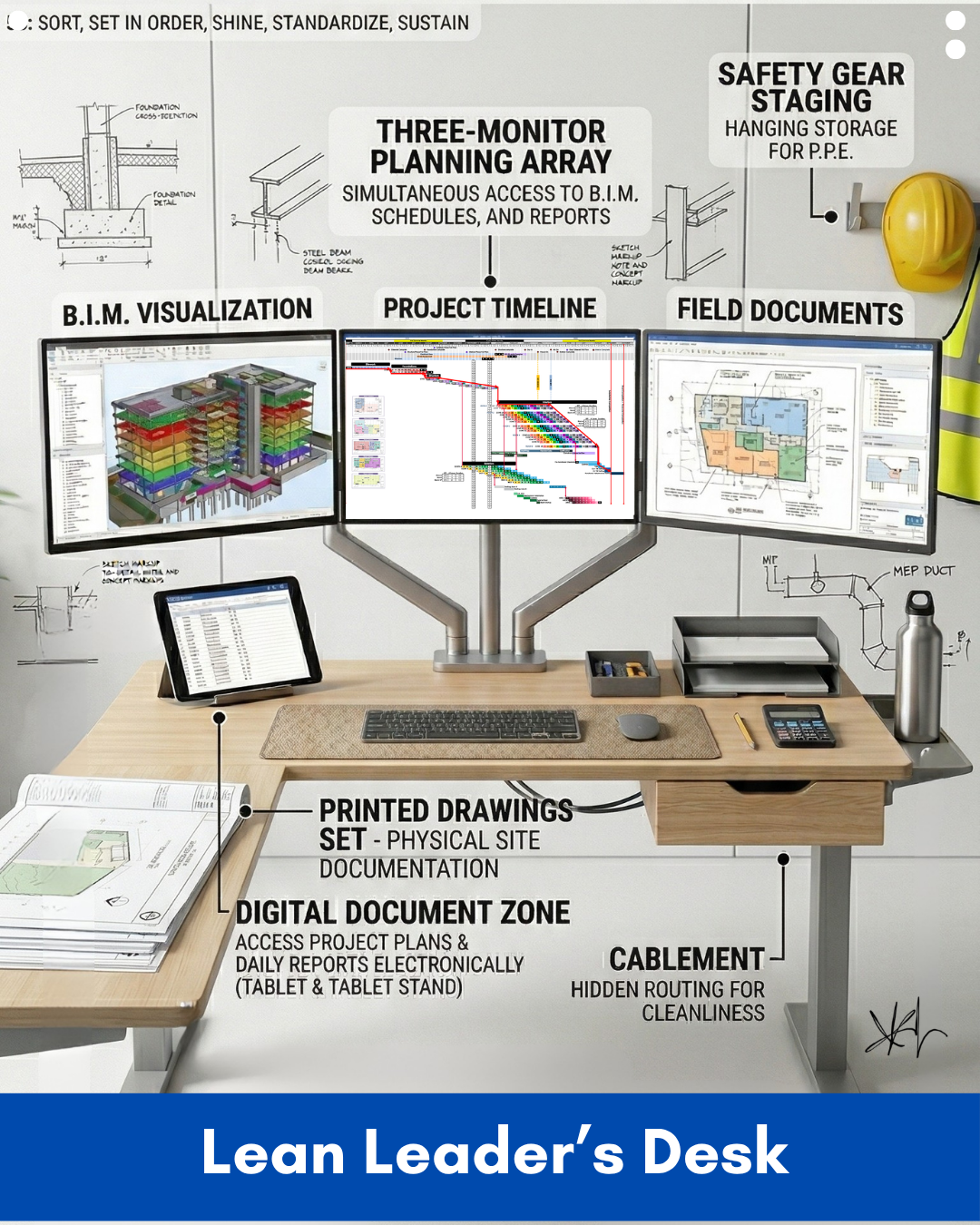
The image in this post shows what a workspace looks like when it’s designed with the same intention applied to the gang box, the staging yard, and the morning huddle intentionally, visually, and with the work it enables firmly in mind.
The three-monitor planning array is the operational center. One screen carries the BIM model for spatial visualization and coordination review. The center screen holds the project timeline schedule, Takt plan, or look-ahead for real-time production reference. The third screen holds field documents: submittals, RFIs, daily reports, and inspection records. All three are visible simultaneously. This is not a luxury. It is a seeing system. Jason Schroeder teaches that every good tool used to manage a project is a seeing system. Multiple screens mean the leader can see the whole picture at once rather than toggling between windows and losing context with every switch.
The printed drawings set on the left side of the desk is physical documentation that stays current. When a subcontractor foreman walks into the trailer with a coordination question, the super is not fumbling to find the right drawing or waiting for a file to load. The set is organized, accessible, and within arm’s reach. That five-second difference having the plan in hand before the conversation starts rather than after changes the quality of the conversation and the confidence with which the decision gets made.
Watch for these signals that a project leader’s workspace is costing the project rather than supporting it:
- Leaders arriving at the desk and spending the first fifteen minutes locating documents needed for the morning meeting
- Submittals, RFIs, and daily reports spread across the desk surface with no organized filing system
- A single monitor requiring constant toggling between the BIM model, schedule, and field documents
- No whiteboard or designated visual thinking space, meaning planning stays in email and conversation rather than becoming visible
- PPE not staged at the workstation, requiring the leader to locate gear before every field walk
The Digital Document Zone and Cable Management
The tablet and tablet stand create a dedicated digital document zone a designated spot for accessing project plans and daily reports electronically that is always in the same place and always ready to use. This is Set in Order applied to the desk: every tool has a home, every tool is accessible without searching, and the desk surface itself is clear enough to work on.
Cable management is routed hidden through the desk structure, keeping the surface clean and organized. This is not an aesthetic preference. Cord clutter on a desk creates the same friction as cord clutter on the floor it signals disorder, slows access to equipment, and adds visual noise that competes with the information the leader is trying to process. A clean desk surface is a clean thinking surface. The physical environment shapes the mental environment, and the mental environment shapes every decision that comes out of it.
Safety gear staging hardhat and vest hung at the workstation means the leader is never fumbling for PPE before a field walk. The gear is in the same place every time. The transition from desk to field takes seconds rather than the low-level searching that compounds across every site visit over a six-month project.
The Sit-Stand Desk and What It Signals
The sit-stand desk is a non-negotiable on long project days. A superintendent or project manager who sits for ten straight hours does not arrive at the afternoon coordinator meeting with the same clarity they had at the morning huddle. Physical position directly affects cognitive performance, and construction leaders are making decisions that affect schedules, budgets, safety, and people’s livelihoods every hour of every day. A desk that supports movement is not a wellness choice disconnected from production it is a tool for sustained cognitive performance in a role that demands it from mobilization to closeout.
The whiteboards on the wall complete the system. Ideas should not live in someone’s head or buried in an email thread. They should be visible, sketchable, revisable, and shared. A whiteboard is where a coordination conflict gets mapped. Where a zone transition gets sequenced. Where the afternoon foreman huddle agenda gets built. A blank wall is the cheapest collaboration tool a leader can install, and it produces more useful planning output than any software subscription on the market when the person standing at it knows what they’re solving for.
Why This Is a Lean Question, Not a Comfort Question
The Lean Leader’s Desk is not about making the trailer nicer. It is about applying the same discipline to the leader’s workspace that the leader is responsible for applying everywhere else on the project. 5S the desk the same way you 5S the field. If you are holding foremen to a gang box standard with shadow boards and labeled bins, your own desk should be held to the same standard. If you are requiring trade partners to maintain organized staging areas with designated zones and clear access paths, your own workspace should meet that standard too.
Culture is shaped by the worst behavior the leader is willing to tolerate and the leader’s own behavior is the most visible example on the project. When the superintendent’s desk is organized, current, and fully equipped, it communicates the same thing that a clean gang box communicates to the crew: we take this seriously, and that standard applies everywhere, starting with us. If your project needs superintendent coaching, project support, or leadership development, Elevate Construction can help your field teams stabilize, schedule, and flow. That starts with the leaders who run the work and the workspace they use to run it from.
5S the Desk Before the Project Starts
Here is the challenge. Before the next project mobilizes or this week if the project is already running walk into the job site trailer and apply 5S to the leadership workspace. Sort: remove everything that doesn’t belong. Set in Order: give every document, every tool, every piece of PPE a labeled home. Shine: clean the surface and commit to ending every day with it returned to the standard. Standardize: decide what the desk should look like and hold to it. Sustain: make it a daily habit the same way crews do morning 5S in their zones.
Then add the three-monitor array. Mount the whiteboard. Set up the tablet stand. Route the cables. Stage the PPE. Organize the printed plan set on the left side.
Do that before the first trade mobilizes and see how different the conversations in that trailer feel from day one.
As Jason Schroeder teaches: “A clean, controlled environment reveals problems early and prevents hidden waste from compounding.” Build the workspace that makes you the leader your project needs from the first morning huddle to the final punch walk.
On we go.
Frequently Asked Questions
How does the sit-stand desk connect to project performance?
Physical position directly affects cognitive clarity over a long day. A leader who can shift position stays sharper through the full range of morning meetings, coordination calls, and afternoon field walks.
Why is the printed plan set on the left side non-negotiable?
Because when a foreman or trade walks in with a question, the super needs to respond with the plan in hand in seconds not waiting for a file to load. Physical access to current drawings is a decision-making tool, not a backup.
How does a Lean desk workspace connect to project culture?
If leadership holds the field to a 5S standard but operates from a chaotic desk, the standard is visibly hollow. A 5S’d workspace communicates that the discipline starts with the leader which is the only place it ever credibly starts.
If you want to learn more we have:
-Takt Virtual Training: (Click here)
-Check out our Youtube channel for more info: (Click here)
-Listen to the Elevate Construction podcast: (Click here)
-Check out our training programs and certifications: (Click here)
-The Takt Book: (Click here)
Discover Jason’s Expertise:
Meet Jason Schroeder, the driving force behind Elevate Construction IST. As the company’s owner and principal consultant, he’s dedicated to taking construction to new heights. With a wealth of industry experience, he’s crafted the Field Engineer Boot Camp and Superintendent Boot Camp – intensive training programs engineered to cultivate top-tier leaders capable of steering their teams towards success. Jason’s vision? To expand his training initiatives across the nation, empowering construction firms to soar to unprecedented levels of excellence.