
If Duct Bank Keeps Showing Up on the Critical Path, the System Needs a New Approach
Here’s the deal: cast-in-place duct bank is one of those scopes that looks manageable on the schedule until you’re actually running it. The form work. The rebar. The conduit spacing. The concrete placement. The curing time. The stripping. And then the wait because nothing else can happen in that zone until the curing is done, and curing does not negotiate with your Takt time. The duct bank sits there, controlling the sequence around it, holding up the train while the schedule absorbs the hit and the team figures out what to do next.
Most project teams treat it as a fixed constraint. It takes what it takes. You plan around it, buffer it, and hope the curing schedule holds. The best teams ask a different question: does this have to happen on site at all?
What the On-Site Process Is Actually Costing
Cast-in-place duct bank on a construction site is an eleven-step field operation happening in an environment that was not designed for controlled manufacturing. The formwork setup requires precision in conditions that are anything but controlled. Concrete placement and vibration happen alongside active construction traffic. Curing requires time that the production plan cannot shrink regardless of how much schedule pressure exists. And throughout the entire sequence, the crew executing it is consuming critical path time that could have been spent on installation rather than manufacturing.
Add up the crew hours in formwork, rebar, conduit spacing, concrete placement, curing management, and form stripping. Then add the site real estate the operation consumes during the process. Then add the quality variation that comes from field pours compared to controlled yard conditions vibration from nearby construction, inconsistent curing in varying weather, formwork that’s been repaired three times. The on-site duct bank process is not just slow. It’s variable. And variability is what breaks production rhythms.
Jason Schroeder teaches that procurement feeds production and the supply chain must be zoned to match the production plan. When a manufacturing process that can be controlled offsite is instead happening in the zone consuming space, crew capacity, and schedule it is waste embedded in the critical path. The system was designed that way by default. It doesn’t have to stay that way.
A Story About What a Schedule Bottleneck Actually Costs
I was part of a team on a large data center project where duct bank was running through a critical sequence of the civil scope. The cast-in-place approach was what had always been used on similar projects, so nobody questioned it going in. Within the first three weeks, it was clear the curing windows were compressing the sequence downstream. Two trades were delayed waiting for zones to clear. The buffer we had built into that phase was consumed entirely by the duct bank sequence. By week five, the team was in recovery mode on a scope that should have been straightforward.
What we needed was a manufactured product that showed up ready to install. What we had was a field manufacturing operation on the critical path. The design of the supply chain had failed the production plan not because anyone made a bad decision, but because nobody had asked whether there was a better system.
What Pre-Fabricated Duct Bank Actually Is
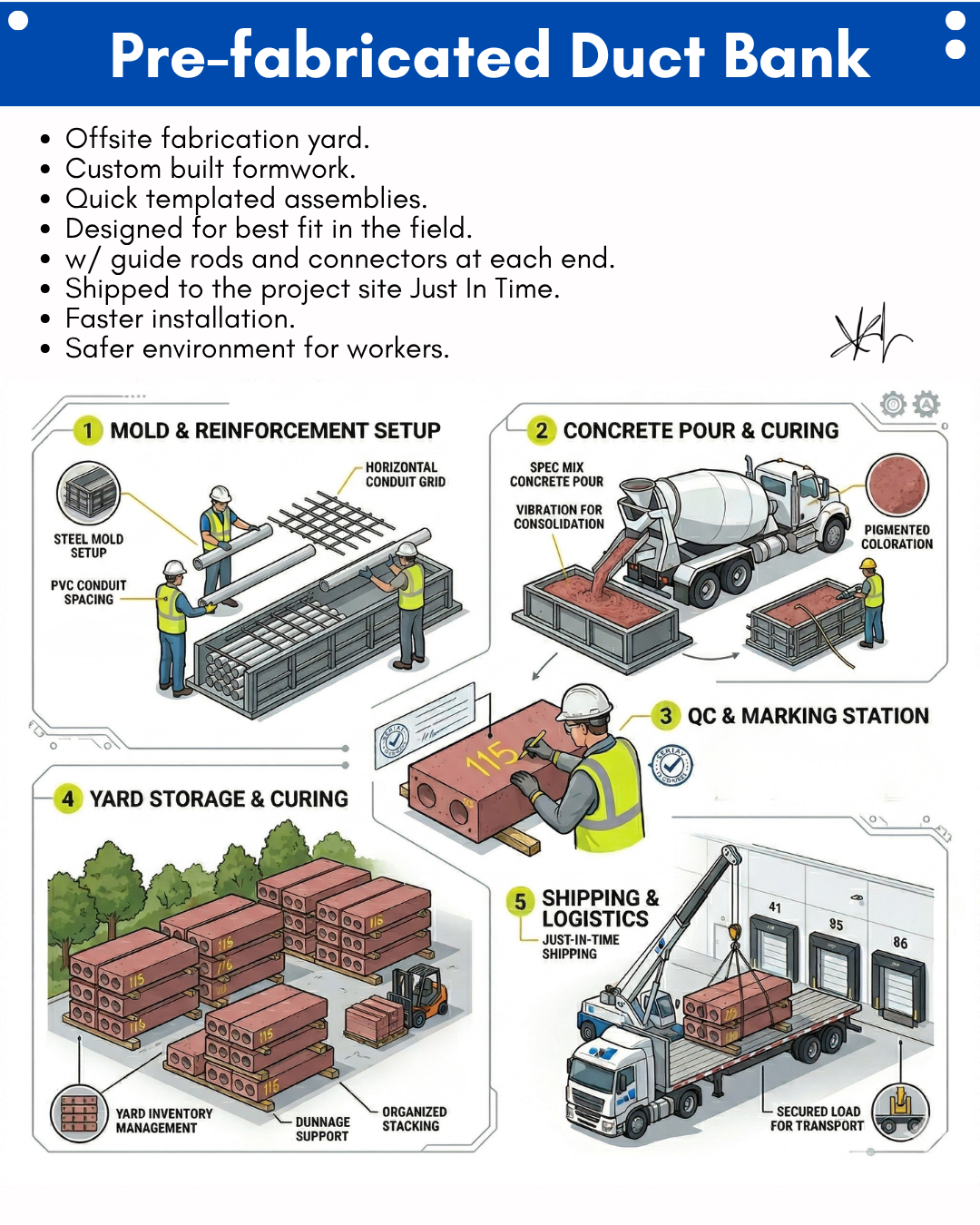
Pre-fabricated duct bank is exactly what it sounds like: duct bank sections manufactured in a controlled offsite fabrication yard using steel molds, spec mix concrete, and precision conduit spacing and then delivered to the project site just in time for installation. The image in this post shows the five-step process clearly.
Step one is mold and reinforcement setup at the fabrication yard. Steel mold forms hold the PVC conduit spacing in a horizontal conduit grid, creating a consistent geometry that is repeated precisely across every section. The mold controls the tolerances. The conduit spacing is set by template, not by field measurement. Every section that comes out of this mold is identical to the one before it. This is Poka-Yoke applied to concrete manufacturing the form physically prevents the wrong conduit spacing from being cast in, so variation is designed out before the pour happens.
Step two is the concrete pour and curing. Spec mix concrete is placed under controlled conditions, vibrated for consolidation, and pigment-colored for identification. The curing happens in the yard not in the zone, not on the critical path, not consuming field crew time and site real estate. The concrete cures while the project’s production work continues uninterrupted. That parallel activity is the core schedule advantage of prefabrication: the manufacturing time does not consume installation time.
Watch for these signals that duct bank is functioning as a production bottleneck on your project:
- Duct bank curing windows are holding up trades in adjacent or downstream zones
- The field crew executing duct bank could otherwise be advancing critical installation scope
- Site real estate consumed by duct bank forms and curing areas is limiting logistics flow
- Quality variation between sections is requiring remediation before the next scope can proceed
- Schedule compression is forcing curing times shorter than specification requires
Step Three Through Five: Quality Control, Storage, and Just-In-Time Delivery
The QC and marking station in the yard is where each section is inspected and numbered before it leaves the facility. This is quality verification at the point of manufacture not at the point of installation where fixing a defect requires a field repair in an active construction zone. Every section that passes QC is marked with its sequence number so installation sequencing in the field is unambiguous. The crew setting sections doesn’t make decisions about what goes where. The marking communicates it.
Yard storage and curing uses organized stacking with dunnage support and yard inventory management to maintain section integrity during storage. Sections are ready when the production plan requires them not staged on site weeks early consuming staging area and creating coordination obstacles for other trades. Just-in-time delivery means the truck arrives at the site when the zone is ready to receive, not before and not after. The sections come off the truck, go into position, and installation begins.
The guide rods and connectors at each end of every section make field alignment fast and precise. Two sections brought together reference the guide rod geometry rather than requiring field measurement and adjustment. The alignment is built into the product. The installation crew spends their time setting sections, not solving geometry problems on the jobsite. This is what designing to the work package looks like in practice the manufacturing decision was made upstream to make the installation work easier and faster downstream.
Why This Is a Lean Question, Not Just a Concrete Question
Jason Schroeder teaches that leveraging prefabrication and modularization is one of the two major ways to speed up a project the other being proper zoning. When scope that can be manufactured in a controlled environment is instead manufactured in the field, the project absorbs all the variation that field manufacturing produces weather, congestion, crew interruption, quality variability as schedule loss that compounding affects every trade behind it in the Takt sequence.
The pre-fabricated duct bank eliminates that variation at the source. The product is manufactured to consistent tolerances in a controlled yard. It arrives in a condition verified by a QC station that has better inspection conditions than any active construction site. And it installs in a fraction of the time of the cast-in-place approach because the manufacturing work is already done. Less waiting. Less rework. Less congestion. The critical path shortens not because the team pushed harder, but because the work was designed better upstream.
If your project needs superintendent coaching, project support, or leadership development, Elevate Construction can help your field teams stabilize, schedule, and flow. Prefabrication is one of the most practical tools available to shorten schedule duration, and the conversation starts in preconstruction before the critical path is already locked.
Ask the Question Before the Scope Is Locked
Here is the challenge. On your next civil or MEP project with significant duct bank scope, bring pre-fabricated duct bank into the preconstruction conversation before the schedule is built around the cast-in-place assumption. Ask the fabricator what lead time looks like, what the delivery schedule requires, and what the cost comparison is when you factor in crew hours, site congestion, curing time, and quality management on the cast-in-place approach.
The answer will almost always reveal that the on-site manufacturing cost, when fully accounted for, is not far from the prefabricated cost and the schedule advantage of pulling that work offsite is significant. Design to the work package. Move the manufacturing out of the zone. Let the production plan run without a concrete curing window on the critical path.
Taiichi Ohno taught that the most dangerous waste is the waste you cannot see. The cast-in-place duct bank bottleneck is hiding in plain sight on every project schedule that treats it as a fixed constraint. It doesn’t have to be fixed. It can be solved in the fab yard, before the project even starts.
On we go.
Frequently Asked Questions
What is pre-fabricated duct bank and how is it different from cast-in-place?
It’s duct bank manufactured offsite in a controlled fabrication yard using steel molds and spec mix concrete, then delivered just in time for installation. Cast-in-place happens in the field and consumes critical path time for forming, pouring, and curing.
How does prefabrication eliminate schedule bottlenecks caused by duct bank?
Curing happens in the yard while field production continues. The manufacturing time does not consume installation time the two activities run in parallel rather than in sequence, which is the direct source of the schedule advantage.
What does the QC and marking station in the yard accomplish?
It verifies each section before it leaves the facility and marks sequence numbers for field installation. Quality defects are caught in a controlled environment rather than discovered at the point of install where correction is far more expensive.
If you want to learn more we have:
-Takt Virtual Training: (Click here)
-Check out our Youtube channel for more info: (Click here)
-Listen to the Elevate Construction podcast: (Click here)
-Check out our training programs and certifications: (Click here)
-The Takt Book: (Click here)
Discover Jason’s Expertise:
Meet Jason Schroeder, the driving force behind Elevate Construction IST. As the company’s owner and principal consultant, he’s dedicated to taking construction to new heights. With a wealth of industry experience, he’s crafted the Field Engineer Boot Camp and Superintendent Boot Camp – intensive training programs engineered to cultivate top-tier leaders capable of steering their teams towards success. Jason’s vision? To expand his training initiatives across the nation, empowering construction firms to soar to unprecedented levels of excellence.