
The Waste Stream on Your Site Is Either Designed or It’s Chaos
Here’s the deal: every construction project generates significant waste, and almost none of it is managed by design. A dumpster goes in at mobilization. Crews throw whatever they have into whatever is nearest. By week three, all five waste streams wood, metal, drywall, general debris, and concrete are mixed in a single container that costs a premium to dispose of because nobody can recycle commingled material. The site gets messier week by week, the disposal costs climb, and nobody thinks to question the system because this is how it has always been done.
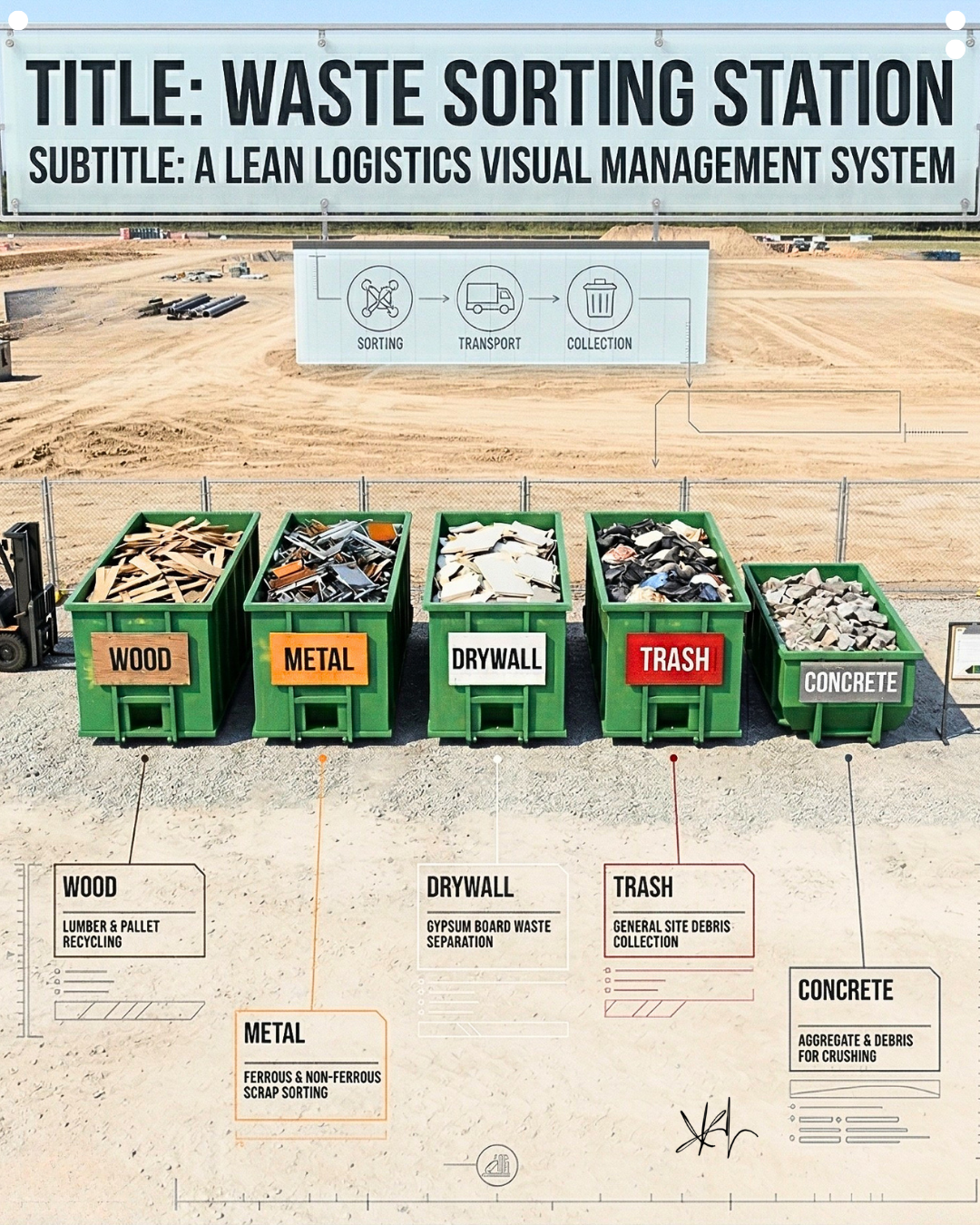
The Waste Sorting Station changes the question entirely. Instead of asking how we dispose of construction waste, it asks: how do we design the waste system so the right behavior is the automatic behavior? The answer is five clearly labeled, color-coded bins one for each major waste stream positioned at the staging yard with a visual flow sequence from sorting to transport to collection. Simple. Immediate. And exactly the kind of system change that produces results without requiring anyone to work harder or care more.
What Happens Without a Designed Waste System
The pattern on most construction sites is predictable. Waste follows the path of least resistance wherever the nearest container happens to be. Wood offcuts, metal scrap, drywall remnants, and concrete debris all land in the same bin because nobody designed a specific place for each one. By the time a sorting conversation happens, the waste is already mixed, the recycling opportunity is gone, and the project is paying general waste disposal rates for material that could have been hauled for significantly less.
The direct cost is real but it isn’t the only cost. Mixed waste accumulating near active work areas creates floor clutter. Floor clutter creates motion waste, safety hazards, and a visual environment that signals disorder. And disorder as Jason Schroeder teaches consistently is not just an aesthetic problem. You cannot see production bottlenecks in a dirty environment. You cannot see low morale. You cannot see quality gaps or zone constraints when the floor communicates that the standard is low. A cluttered waste environment hides every signal the site is trying to send to leadership.
I walked a large commercial project years ago where the staging yard looked like a compression of every bad waste management decision the project had made in the first eight weeks. Mixed bins overflowing. Cardboard and packaging scattered across the access lane. Metal scrap mixed with wood mixed with drywall in a single dumpster that the waste hauler was charging triple for because it required sorting at the facility. When I asked the superintendent how the waste system had been set up at mobilization, the answer was honest: it hadn’t been. A dumpster went in. The rest happened by default. Nobody’s fault. The system was never designed. The system failed them. They didn’t fail the system.
What the Waste Sorting Station Is Built Around
The image in this post shows a five-bin waste sorting station with clear visual labels and color coding that makes the right behavior obvious to anyone approaching the area without instruction, without reminders, and without supervision.
Wood lumber and pallet recycling has its own bin. This is the stream most often undervalued in waste management planning. Clean dimensional lumber and pallet material has recycling value and hauls at a lower cost than mixed waste when separated. A dedicated bin with a clear label ensures it never gets mixed with other streams and the value is not lost.
Metal ferrous and non-ferrous scrap sorting has its own bin. Scrap metal separated at the source has significant recycling value. The metal generated by a mid-size commercial MEP package is a meaningful volume over the project duration. Mixed into a general waste bin, it goes to the landfill. Separated into its own container, it often hauls out at no cost or at a credit because the recycling value covers the transportation. The bin makes the separation automatic.
Watch for these signals that your project’s waste stream is not designed:
- Multiple waste types are consistently ending up in the same container, driving up disposal costs
- Cardboard and packaging waste from deliveries are accumulating in work areas rather than being separated at the staging yard
- Crews are throwing waste in the nearest container regardless of type because there’s no visual system that indicates where each material goes
- The project is paying general waste disposal rates for material that would qualify for lower-cost or no-cost recycling streams
Drywall, Trash, and Concrete: Completing the System
Drywall gypsum board waste separation is one of the highest-volume waste streams on any interior fit-out project, and it has a distinct disposal or recycling pathway from general trash. Gypsum can be recycled into new board or agricultural soil amendments in most markets, but only when it’s separated. The moment it’s mixed with general debris, that option closes. A dedicated drywall bin keeps the pathway open throughout the project.
The general trash bin handles site debris that doesn’t fall into a specific recyclable stream. This is the catch-all, but it functions correctly only when the other four streams have their own designated bins. When the system has five containers, general trash stays general trash. When the system has one container, everything becomes general trash and the project pays for it.
Concrete aggregate and debris for crushing rounds out the system. Concrete waste is heavy and expensive to dispose of as mixed general waste. Separated concrete can be processed for aggregate base at a fraction of the cost, or hauled by a concrete recycler who may take it at no cost. On any project with significant concrete pour, forming, or demolition activity, the concrete bin pays for itself in disposal savings.
The visual flow sequence above the bins sorting, transport, collection is not decoration. It is a system map that communicates the full waste management process to every person who approaches the station. Sorting is the first step. Transport is who handles it and when. Collection is where the material ultimately goes. A worker who has never seen the system before can read the three icons and understand the process in seconds. That’s visual management doing exactly what it’s supposed to do.
Why This Is a 5S and Production Question, Not Just a Waste Question
Jason Schroeder teaches that nothing hits the floor one of the most practical and most powerful 5S principles in construction. When material hits the floor instead of going to a designated home, the site accumulates the friction, hazard, and visual disorder that compounds across every zone and every trade. The waste sorting station applies that principle to the staging yard: every waste stream has a home, the home is labeled, and the system makes putting waste in the right place easier than putting it in the wrong place.
This is Poka-Yoke applied to waste management. The bin labeled METAL makes it difficult to throw drywall in it not impossible, but visually wrong. The color coding makes each bin identifiable from a distance so the decision about which container gets this scrap is made before the worker even arrives at the station. The system is self-explaining. It doesn’t require a supervisor standing at the bins. It doesn’t require a daily reminder at the huddle. The labels and color tell the story, every time, for every person who approaches.
Staging areas are specifically called out by Jason Schroeder as one of the six primary areas to implement 5S on a construction project. A staging area that is organized, labeled, and visually clear communicates the project standard before any leader opens their mouth. The waste sorting station is the 5S staging area applied to the waste stream a designed system that makes the environment self-managing at the place where waste is generated.
If your project needs superintendent coaching, project support, or leadership development, Elevate Construction can help your field teams stabilize, schedule, and flow. That flow extends to every corner of the project environment, including the waste system that either supports it or quietly works against it every day.
Design the Waste System Before the First Delivery Arrives
Here is the challenge. Before your next project mobilizes, put the Waste Sorting Station on the preconstruction checklist with the same seriousness you give to the staging yard layout and the hoist schedule. Identify the five primary waste streams for this project’s scope. Designate a bin for each one. Color-code and label every bin. Position them at the staging yard entry where material handling happens daily. Post the sorting, transport, and collection sequence above the station.
Then introduce the system at the morning worker huddle on day one. Walk through which bin takes which material. Explain why it matters not just for the environment but for disposal cost, haul frequency, and site cleanliness. Reinforce it for the first two weeks until the system runs itself.
A site where every waste stream has a home, every bin is labeled, and every worker knows the system without being told that’s a site that Lean principles have reached all the way to the staging yard. That’s the standard.
As Jason Schroeder teaches: “Nothing hits the floor. Everything has a home. The environment is the standard.” Build the waste system that proves it.
On we go.
Frequently Asked Questions
What is a Waste Sorting Station and what waste streams does it separate?
It’s a five-bin visual management system with color-coded, labeled containers for wood, metal, drywall, general trash, and concrete each with a distinct disposal or recycling pathway positioned at the staging yard with a sorting-to-collection flow sequence posted above.
How does separating waste streams reduce disposal costs?
Wood, metal, drywall, and concrete each have lower-cost or no-cost recycling pathways when separated. Mixed in general waste, those streams lose their recycling value and are disposed of at premium rates. Separation at the source captures the cost reduction that most projects leave on the table.
When should the station be set up and how should it be introduced to crews?
Before the first delivery arrives, during site mobilization. Introduce it at the morning worker huddle on day one, walk through which bin takes which material, and explain the cost and cleanliness rationale. Two weeks of consistent reinforcement is typically enough for the system to become self-sustaining.
If you want to learn more we have:
-Takt Virtual Training: (Click here)
-Check out our Youtube channel for more info: (Click here)
-Listen to the Elevate Construction podcast: (Click here)
-Check out our training programs and certifications: (Click here)
-The Takt Book: (Click here)
Discover Jason’s Expertise:
Meet Jason Schroeder, the driving force behind Elevate Construction IST. As the company’s owner and principal consultant, he’s dedicated to taking construction to new heights. With a wealth of industry experience, he’s crafted the Field Engineer Boot Camp and Superintendent Boot Camp – intensive training programs engineered to cultivate top-tier leaders capable of steering their teams towards success. Jason’s vision? To expand his training initiatives across the nation, empowering construction firms to soar to unprecedented levels of excellence.