
The Permit Board Problem: What a $12 Fix Teaches About Lean Construction
The best lean improvements are usually the quiet ones. Nobody writes a case study about them. There’s no kickoff meeting, no rollout plan, no consultant in the room. Somebody just notices friction, fixes it, and the friction is gone.
Here’s the deal. On our project in Tucson, I needed a permitting area in the trailer. Hazmat signs, emergency response plans, blue stake tickets, project-specific permits all the documentation crews actually need to see, in one place they can find it. Straightforward requirement. And it fought me for weeks.
The Pain That Nobody Logs
Pinning anything into drywall is a pain. That sounds trivial until you’re doing it forty times. Push pins bend or won’t seat. You push harder, you punch through the paper facing, the pin sits crooked and the permit hangs at an angle. Screwing permits directly to the wall isn’t much better now you need a driver, you’re making a bigger hole, and the permit tears at the screw head the first time somebody bumps it.
And permits change. Constantly. That’s not a flaw in the process, that’s the process. A blue stake ticket has a life measured in days. An emergency response plan gets revised. A hazmat sign gets superseded. Every single change means another set of holes.
So a few months in, the wall looks like it lost a fight. Hundreds of holes, most of them ragged, scattered across a surface that’s supposed to read as professional. And when a crew walks in to check a permit, the first thing they see isn’t organization. It’s a mess.
The Failure Pattern Underneath
Here’s what’s actually going on, and it’s worth naming precisely because it repeats everywhere.
We treat the wall as free. It isn’t. Every hole is a small withdrawal from a shared resource the trailer’s condition, the demob budget, the visual standard of the space. Nobody accounts for those withdrawals because each one is nearly zero. Then at the end of the job, someone gets handed the bill in the form of patch and paint, or a landlord conversation, or a wall that just stays ugly for eighteen months.
That’s the pattern: friction gets absorbed by the person doing the work, and damage gets deferred to whoever is standing there at the end. Neither cost shows up in a system anyone is watching.
And notice what the pattern is not. It’s not that superintendents are careless with trailers. It’s not that crews don’t respect the space. Nobody wakes up wanting to put four hundred holes in drywall. They put four hundred holes in drywall because the environment gave them exactly one way to hang a piece of paper, and that way damages the environment. The behavior is a rational response to the setup.
They Didn’t Fail the System
I want to be direct about this because it’s the part people skip.
When a field team is working in a trailer that looks beat up, or a laydown yard that’s disorganized, or a gang box that nobody can find anything in the instinct in this industry is to say somebody isn’t holding a standard. Get after them. Do a walk, take pictures, send an email about professionalism.
That’s the wrong diagnosis nearly every time. The team didn’t fail the standard. The system never gave them a way to meet it. Nobody designed a permit interface, so they improvised with what was in front of them. Nobody designed a staging plan, so material landed wherever the truck could get to. Nobody built a kitting process, so tools ended up in a pile.
People meet standards when the environment makes meeting them the easy path. When meeting the standard requires fighting the environment forty times a day, the standard loses. Every time. That’s not a character finding, it’s a design finding.
The Fix Took Ten Minutes
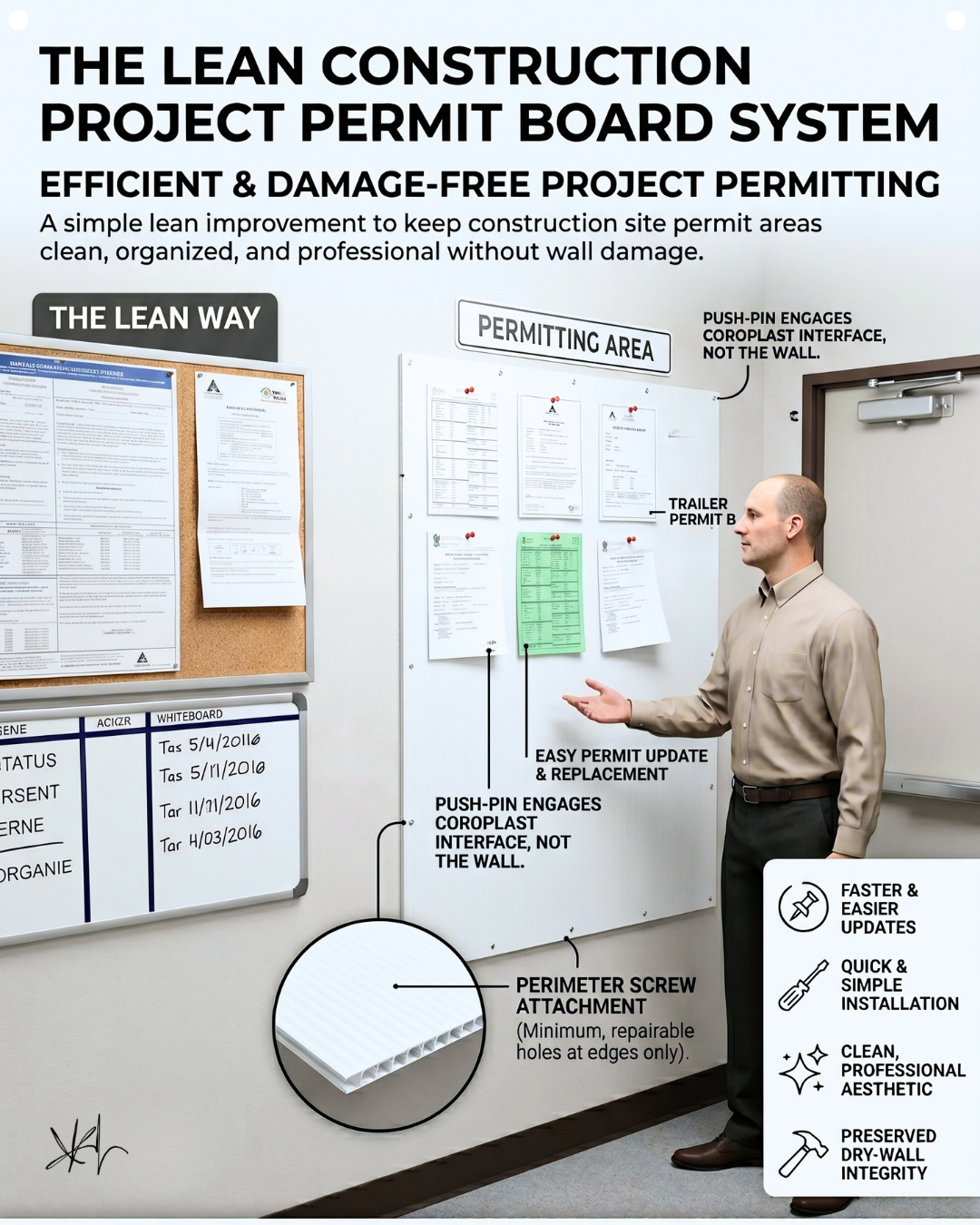
A sheet of Coroplast, screwed into the wall at the perimeter only.
That’s it. That’s the whole intervention. But look at what it changes.
The push pins now engage the Coroplast, not the drywall. Coroplast is fluted plastic the pins seat cleanly, hold reliably, and pull out without tearing anything. Permits swap in and out in seconds. The drywall behind it never gets touched, because the only fasteners going into the wall are the handful of perimeter screws holding the sheet up. When we demob, there are a few repairable holes at the edges instead of hundreds scattered across the surface.
And it looks sharp. A small “Permitting Area” sign up top, permits arranged in a grid on a clean white field, and the whole space reads organized and professional. A crew walking in to check a blue stake ticket sees a system, not a bulletin board that lost control of itself.
Ten minutes of work. Materials cost less than lunch. The friction is permanently gone, and so is the deferred damage.
What Made It Work
The mechanism is worth understanding, because it generalizes. What the Coroplast did was insert a sacrificial interface between a high-change activity and a permanent surface.
That’s the whole idea. Permits change often. Drywall is permanent and expensive to repair. Putting a cheap, replaceable layer between them means the frequent activity happens against the cheap layer and the permanent surface stays untouched.
Once you see that pattern, you see it everywhere. Plywood over a finished floor in a work zone. A magnetic whiteboard sleeve over a printed Takt plan so it can be marked and wiped instead of reprinted. Protective film on a window that’s going to have a hundred stickers on it. Same logic every time: identify what changes often, identify what you can’t afford to damage, and put something disposable in between.
That’s not a hack. That’s a design principle. And it costs almost nothing to apply once you’re looking for it.
Signals You Have a Friction Problem Worth Fixing
Most of these small opportunities announce themselves if you’re paying attention. Watch for:
- A task you do frequently that requires more force, tools, or patience than it should
- Accumulating damage that nobody has decided is a problem yet
- A space that looks worse than the standard you’d claim to hold, with no one obviously at fault
- People developing workarounds tape, weights, propped-up things to make an environment work
- A recurring small annoyance you’ve stopped noticing because you’ve adapted to it
That last one is the hardest to catch and usually the most valuable. Adaptation hides waste. You stop seeing the problem because you got good at absorbing it.
Why the Small Stuff Actually Matters
Somebody reading this is thinking: it’s a permit board. We have a schedule to hit.
Fair. Here’s the connection.
Flow is not built by one large intervention. Flow is built by removing a hundred small collisions between people and their environment. The permit board is one. The material laydown location is another. The distance from the gang box to the work face. The clarity of the Takt zone markings. The time it takes to find the current version of a drawing. Each of those is small. Together they are the difference between a crew that gets a productive day and a crew that spends two hours a day fighting the jobsite.
And when crews fight the jobsite, the schedule slips. When the schedule slips, someone works a Saturday. That Saturday is a family dinner, a kid’s game, a day off that got taken from somebody. The chain from a small friction to a real human cost is shorter than most people think.
There’s also a signal effect that’s harder to quantify but easy to feel. A trailer with a clean, well-organized permitting area tells every crew that walks through it: somebody is paying attention here. A wall full of holes tells them the opposite. Standards are contagious in both directions, and the environment communicates the standard before any human does.
Watch-Outs Before You Start Improving
If you’re going to go looking for these, a few things I’d keep in mind:
- Fix the friction you actually experience, not the one that would look good in a photo
- Keep the intervention cheap and reversible expensive fixes invite debate and delay
- Don’t announce it as an initiative; just do it and let people notice
- Solve for the person doing the task forty times, not for the person inspecting it once
- Respect the space you’re borrowing, even when it’s temporary, because temporary is where most of the damage happens
The Mission Underneath a Sheet of Plastic
This is what Lean looks like most days. Not a massive initiative. Not a transformation program. Just noticing friction, fixing it, and respecting the space and the people working in it.
That respect part isn’t decorative. When you make someone’s frequent task easier, you’re telling them their time is worth designing for. When you keep a shared space intact and organized, you’re telling every person who uses it that they’re working somewhere that’s cared for. Dignity in construction is built out of exactly these small signals, accumulated daily. It’s not built in the all-hands meeting.
That’s also why this work is teachable rather than mysterious. Go look, find the catch, insert a cheap interface, move on. If your project needs superintendent coaching, project support, or leadership development, Elevate Construction can help your field teams stabilize, schedule, and flow and in practice that work starts with exactly this habit, applied a hundred times across a project until stability stops being an accident. It’s the same discipline that makes Takt planning work at scale, and Jason Schroeder teaches it the same way: observe first, then fix what you actually saw.
Your Challenge This Week
Find one. Just one.
Walk your trailer, your gang box, your laydown yard, your permitting wall, and find the single most annoying small thing you’ve stopped noticing. Not the biggest problem on your project. The most frequent one. Then fix it this week, cheaply, without asking permission for something that doesn’t require permission.
Edwards Deming said it as directly as it can be said: “It is not enough to do your best; you must know what to do, and then do your best.” Knowing what to do starts with going and looking. The looking is the skill. The fixing is usually ten minutes.
On we go.
Frequently Asked Questions
Isn’t this too small to count as a Lean improvement?
It’s exactly the right size. Lean isn’t a set of large programs, it’s a habit of removing waste where you find it. A ten-minute fix that eliminates a recurring friction and prevents accumulating damage is a textbook improvement. The industry’s mistake is assuming Lean has to arrive as an initiative with a budget attached.
Why Coroplast specifically instead of plywood or cork?
Coroplast is fluted plastic, so push pins seat into the channels and hold well without needing thickness or weight. It’s light enough to hang with a few perimeter screws, cheap, and it looks clean and white rather than industrial. Plywood works but is heavier and needs more fastening. Cork works but wears out and looks tired fast. The principle matters more than the material use what gives you a cheap sacrificial layer.
How do I convince my team to spend time on things like this?
Don’t ask, just do it, then let the result speak. Most of these fixes are under an hour and under fifty dollars, which is well inside the discretion of anyone running a trailer. Permission-seeking is what kills small improvements the approval process costs more than the fix.
If you want to learn more we have:
-Takt Virtual Training: (Click here)
-Check out our Youtube channel for more info: (Click here)
-Listen to the Elevate Construction podcast: (Click here)
-Check out our training programs and certifications: (Click here)
-The Takt Book: (Click here)
Discover Jason’s Expertise:
Meet Jason Schroeder, the driving force behind Elevate Construction IST. As the company’s owner and principal consultant, he’s dedicated to taking construction to new heights. With a wealth of industry experience, he’s crafted the Field Engineer Boot Camp and Superintendent Boot Camp – intensive training programs engineered to cultivate top-tier leaders capable of steering their teams towards success. Jason’s vision? To expand his training initiatives across the nation, empowering construction firms to soar to unprecedented levels of excellence.