
The Construction Craft BBQ: Why Recognition Is a System, Not a Party
Nothing builds a team quite like good food, cold drinks, and a little friendly cornhole competition.
That’s true, and it’s also the wrong reason to host a crew event. Here’s the deal. If recognition only happens when someone decides to feel generous, it isn’t a system. It’s a mood. And moods don’t produce stable crews, predictable schedules, or projects where people actually show up on Monday ready to work. The Construction Craft BBQ isn’t a party that happens to take place on a jobsite. It’s a leadership tool, and the people who treat it that way get different results from the ones who don’t.
The Pain That Goes Unnamed
Walk any active project and ask yourself how often the crew hears something other than a problem. Think honestly about the answer.
In construction, the feedback loop is almost entirely negative. The pour was late. The layout was off. The punch list is long. The foreman got a call because something didn’t pass inspection. These are real problems that need real conversations and nobody is arguing otherwise. But when correction is the only communication people receive, they build a model of what leadership notices, and that model is: mistakes get seen, and good work disappears into the schedule.
A welder who hits every connection right, every day, for six months hears nothing. The week one connection gets flagged, they hear about it immediately. Over time, that asymmetry lands as a signal, even when nobody intends it as one. The signal is: you are invisible when things go well and visible only when things go wrong. That is a system communicating something about how the organization values its people, and the people receive it clearly whether management knows it’s being sent or not.
This is the pain that nobody logs. It doesn’t show up on a punch list. It doesn’t get reported in a safety meeting. It accumulates quietly in the form of turnover, disengagement, and the kind of crew that does enough to stay employed rather than the kind that takes real ownership of the work.
The Failure Pattern
The failure pattern here is familiar. We design systems for the work and assume the people will manage themselves.
We have a schedule for material delivery. We have a process for RFIs. We have a submittal log, an inspection protocol, a safety program with documented procedures and regular audits. The operations of the project get designed with real intention. Then someone asks about crew morale and the answer is a pause followed by “I try to say good morning.” That’s not a system. That’s a habit, and habits skip the day you’re stressed about the budget.
The same superintendent who would never let material delivery happen on gut feeling is running crew engagement entirely on intuition. When the project is going well, they’re in a good mood, the crew feels it, things stay loose and positive. When the schedule is tight, the mood changes, the conversations get shorter, and the recognition disappears entirely. That’s exactly when people most need to know that the organization sees them.
Morale doesn’t need a party. It needs a cadence. It needs a decision made upstream that recognition is a scheduled input, not a reaction to a good week.
They Didn’t Fail the System
When a crew isn’t engaged, when the energy is flat, when people are punching in and doing the minimum, when turnover is high and ownership is low, the diagnosis in this industry is usually about the workers. They don’t care. They’re not that crew. Hard to get good people anymore.
That diagnosis protects the system from having to change. The problem gets attributed to the people, and since you can’t fix people, nothing gets fixed.
Here’s what I’d ask instead. What does this project do to make people feel like their work is seen? How often does a craftsperson hear something other than a correction or a deadline? What has the project invested in letting the crew know they matter to the outcome? If the answer is “not much,” that’s a system gap, not a workforce gap. And system gaps can be closed.
The craftsperson who stopped caring used to care. Something in the environment taught them not to. It wasn’t a character failure. It was a rational adaptation to working in a place that stopped communicating their value.
What the BBQ Actually Builds
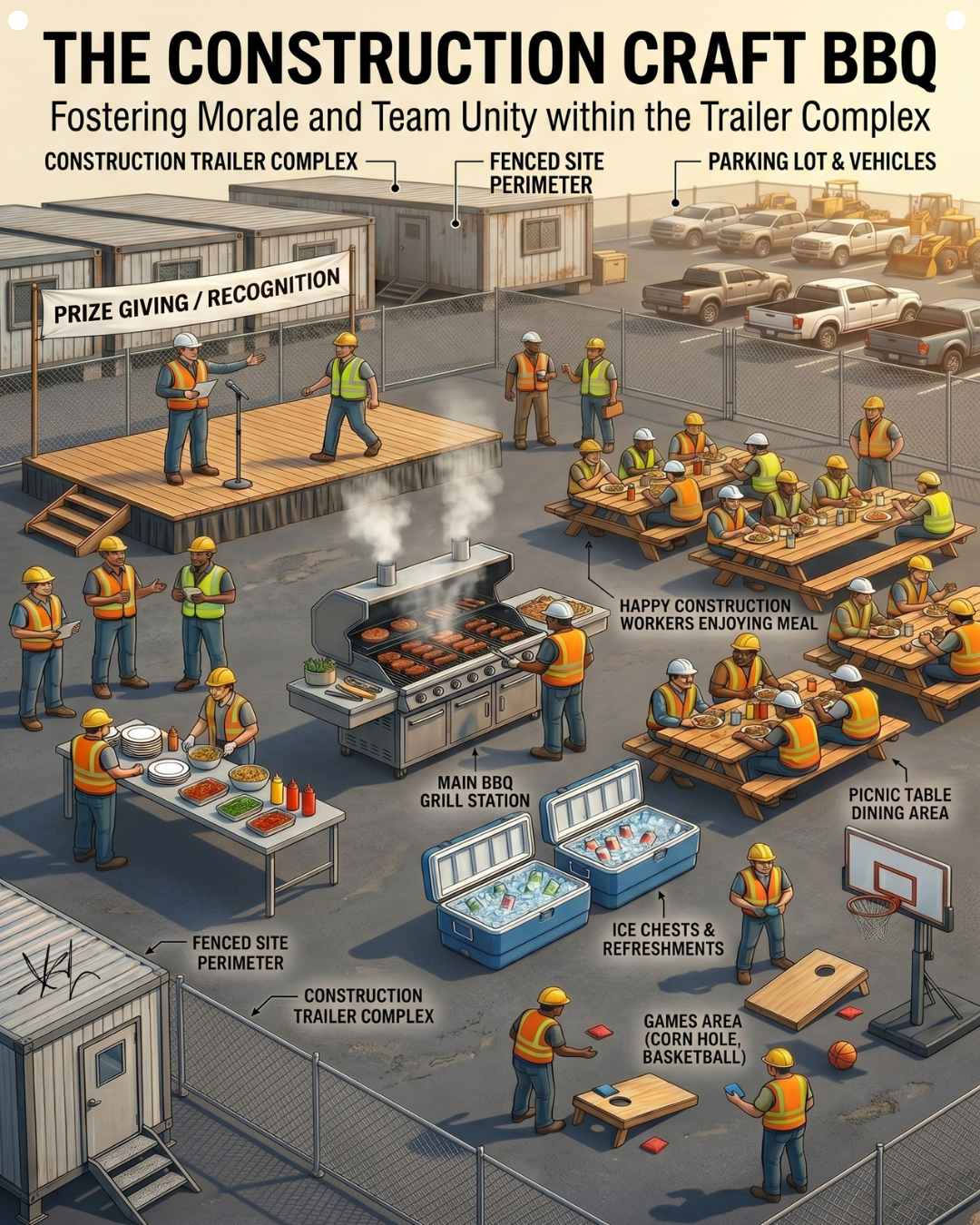
We pulled the whole crew away from the tools for a few hours of recognition, good food, and genuine connection. Prize giving, a main grill station, picnic tables, ice chests, cornhole, basketball, a stage for recognition, all built into a fenced perimeter that turned a parking lot into a community for a few hours.
What that event actually builds can’t be grilled or poured into a cup, but it is real and it is durable.
The first thing it builds is visibility. Recognition in front of peers is categorically different from recognition in a one-on-one or a foreman’s verbal comment at the end of a shift. When a craftsperson gets called out in front of their crew and hears appreciation acknowledged publicly, it communicates something the schedule can’t: your work was noticed, and the people around you know it was noticed. That’s not a small thing. It’s the kind of signal that carries through weeks of difficult work.
The second thing it builds is horizontal trust, the trust between crew members, between trades, between the people who have to coordinate their work every single day. Sitting at the same picnic table outside of a work context is not the same as working alongside someone. Problems get solved differently by people who have eaten together. Coordination happens faster, conflicts resolve quicker, and the social friction that costs real hours on a project starts to reduce. That’s not a theory about workplace culture. That’s what happens when people become more than their role to each other.
The third thing it builds is a signal about the kind of project this is. Projects develop reputations in trades communities faster than most GCs realize. The project that hosts a craft BBQ, calls people by name, and runs a recognition event is the project that gets calls when a skilled tradesperson is choosing where to put their labor. Over a long project, the ability to attract and retain good craftspeople is a scheduling variable, not just an HR concern.
Recognition as a Lean Tool
This is where the thinking gets important, because it’s where most operations-focused people either tune in or tune out.
Lean construction is about flow. Smooth, predictable, uninterrupted work. Takt planning is the method most commonly associated with that idea, and it works when the crews are stable, motivated, and operating with a shared sense of where the project is going. Takt doesn’t work well with high turnover. It doesn’t work well with disengaged crews. It doesn’t work well on projects where the trades feel like interchangeable inputs rather than skilled contributors to a shared outcome.
Morale is a flow input. That statement will sound soft to some people and obvious to others. The ones it sounds obvious to are usually running the better projects. When the crew is engaged, problems surface earlier, coordination happens more naturally, quality issues get caught at the source rather than at inspection, and the schedule benefits from dozens of small acts of ownership that never appear in a project report. When the crew is disengaged, the opposite is true, and no schedule update will fix it, because the schedule never was the problem.
Watch-Outs Before You Plan One
A few things that will determine whether a crew event actually lands or just runs up a food cost:
- Recognition that isn’t specific rings hollow; call people out by name for actual work, not generic appreciation
- If leadership only shows up to eat and leaves early, the crew notices and the signal goes the wrong direction
- Frequency matters; a single annual event is better than nothing and far less effective than a consistent cadence
- Don’t use the platform to deliver project updates or reminders about safety compliance; let it be what it is
- Ask the crew what they’d want before you plan it, because the planning process is itself a form of respect
Why Families Are in the Equation
Every craftsperson on that site goes home to someone. A partner, a parent, a kid, a roommate. Someone is calibrating their relationship to this job partly based on how the person they care about comes through the door. When someone comes home energized, valued, and proud of where they’re working, that shows up at home. When they come home beaten down by a project that never sees them, that shows up at home too.
This is not a soft point about feelings. It is a point about sustainability. Construction is hard work. Long days, tight schedules, and weather that rarely cooperates. People can sustain that level of difficulty when they feel like the work is worth it and the organization sees them clearly. They cannot sustain it indefinitely when the return is only a paycheck. Turnover costs are visible. The cost of the disengaged worker who stayed is invisible and much larger.
Culture that respects the people doing the work is not a morale program separate from the schedule and the budget. It is the substrate on which everything else is built. If your project needs superintendent coaching, project support, or leadership development, Elevate Construction can help your field teams stabilize, schedule, and flow, and that work is grounded in the recognition that the people behind the project are the system, and systems that respect their people perform better. Jason Schroeder and the Elevate team bring that philosophy to every engagement, from Takt planning to leadership development to building the culture that makes the schedule achievable.
Go See Who You’re Missing
Here’s your challenge. This week, before you plan any event, go walk your project and identify the person whose work has been excellent and invisible. The one who shows up on time, does the work right, doesn’t create problems, and hasn’t heard anything from leadership in thirty days. Find that person. Say something specific and true about what you’ve seen.
That’s the smallest possible version of this. The BBQ is the larger version. Both matter. Neither one requires a budget approval or a planning committee. The crew that knows it is seen will outwork, outstay, and outperform the crew that doesn’t, and the difference lives entirely in decisions leaders make before the schedule gets tight.
- Edwards Deming said it plainly: “A bad system will beat a good person every time.” Your people are good. The recognition system is yours to build. Go build it.
On we go.
FAQ
Isn’t a crew BBQ just a morale booster that doesn’t change how the project runs?
It changes the project in ways that don’t show up in the budget but do show up in the schedule. Horizontal trust between crew members, willingness to flag problems early, and ownership of quality all improve in environments where people feel seen. Those behaviors are schedule variables, not cultural niceties, and they compound over a long project in ways that matter to the outcome.
How do you make recognition feel real instead of performative?
Specificity is everything. “Thanks for being here” lands differently than “On the north wall pour last Thursday, you caught that mix issue before the truck left and that mattered and I want everyone to know it.” The more specific the recognition, the more credibly it communicates that someone was actually paying attention to the work.
How often should something like this happen?
Often enough to establish a cadence. Once a quarter is a reasonable minimum on a multi-year project. The event itself matters less than the regularity. A crew that can anticipate recognition has a different relationship to the work than a crew waiting to see if management happens to feel generous that month.
If you want to learn more we have:
-Takt Virtual Training: (Click here)
-Check out our Youtube channel for more info: (Click here)
-Listen to the Elevate Construction podcast: (Click here)
-Check out our training programs and certifications: (Click here)
-The Takt Book: (Click here)
Discover Jason’s Expertise:
Meet Jason Schroeder, the driving force behind Elevate Construction IST. As the company’s owner and principal consultant, he’s dedicated to taking construction to new heights. With a wealth of industry experience, he’s crafted the Field Engineer Boot Camp and Superintendent Boot Camp – intensive training programs engineered to cultivate top-tier leaders capable of steering their teams towards success. Jason’s vision? To expand his training initiatives across the nation, empowering construction firms to soar to unprecedented levels of excellence.