
The Situation Room: How a Construction Command Center Changes What Leadership Can Do
Generals cannot be everywhere. So we build the room that brings everywhere to them.
That sentence is the whole idea, and it is not a metaphor. It is an operational design decision that changes what a general superintendent can see, what they can respond to, and how fast a large, complex project can move when something goes wrong. The situation room is not a luxury for oversized egos. It is the logical answer to an impossible problem: how does one leader maintain strategic visibility across multiple active zones, dozens of trade partners, and hundreds of concurrent decisions without spending all day walking and none of it thinking?
The Pain of Leading Without Visibility
Here is what leading a large project without a command center actually looks like. The general superintendent starts the day in a field meeting, walks the gemba, catches a problem in Zone 3, spends forty minutes on it, misses the trade huddle in Zone 7, hears about a logistics conflict secondhand at lunch, gets to the trailer at two in the afternoon with a stack of messages, and spends the rest of the day reacting to things that already happened instead of positioning for things that are coming.
That is not a personal failure. That is what happens when a leadership role is designed around physical presence as the primary information channel. When the only way to know what is happening is to go look at it, the leader’s information is always incomplete, always delayed, and always limited by how many places a single person can physically be in a day.
The schedule suffers because decisions that should happen in the morning happen in the afternoon. Constraints that should get driven out on Monday are still open on Thursday. The make-ready planning for the next Takt phase happens in whatever time is left after everything urgent has been handled, which means it often does not happen well. The trades are waiting on answers while the general is physically unavailable, because physically unavailable is the only mode the system offers.
The Failure Pattern
The failure pattern is not that general superintendents are bad leaders. The failure pattern is that we give senior leaders a physical presence model and then wonder why they cannot achieve strategic outcomes.
A project engineer has a desk, a screen, a filing system, and a set of tools designed for the kind of work a project engineer does. A foreman has a plan table, a communication channel to their crew, and a daily rhythm designed for the kind of work a foreman does. A general superintendent has a trailer with a desk, a phone, and a pair of boots, and is expected to hold strategic visibility across a multi-million dollar operation by walking around and asking questions.
The mismatch between the role and the infrastructure provided for it is the failure, not the person filling it. When the information environment cannot support the decisions required, the decisions suffer, and the project absorbs the cost in schedule, quality, and constraint resolution that always runs behind where it needs to be.
They Didn’t Fail the System
When a general superintendent is behind on constraint removal, slow on decision-making, or perpetually reactive rather than strategic, the organization’s instinct is to say they need better time management, or more discipline, or a stronger system for follow-through.
Those diagnoses almost always miss the real problem. A leader operating without adequate information infrastructure cannot make better decisions through discipline alone. You cannot be more strategic when the only input stream available to you is what you can personally observe by walking the site. You cannot drive out constraints faster when the mechanism for learning about constraints is someone finding you on the deck and telling you about it.
The information environment is the constraint. Upgrade the environment and the leadership capability that was always there becomes visible. Leave the environment the same and add more accountability pressure, and the result is a better-disciplined leader who is still missing half of what is happening on their project.
What the Situation Room Actually Is
The situation room is a command center, not a corner office. The distinction matters.
A corner office is designed for separation. It signals status, provides quiet, and puts distance between the senior leader and the operational noise of the project. A command center is designed for integration. It pulls information in from every active zone and gives the leader real-time visibility into what is happening across the whole project without requiring physical presence in each location.
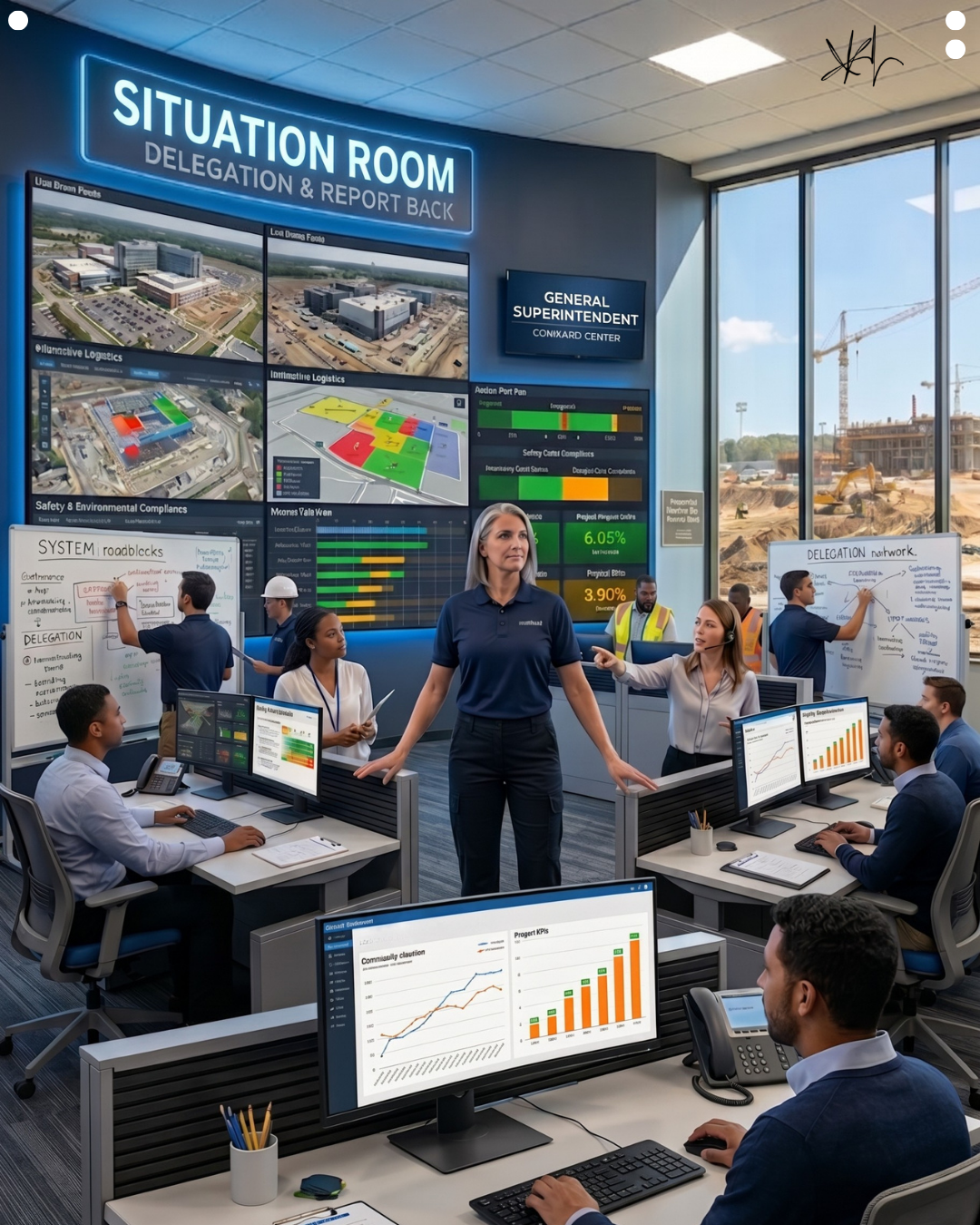
The physical setup centers on an open workspace where the core executive team sits together without walls of separation. Elevated desks around the perimeter create space for direct reports to come in, brief, strategize, and leave without the overhead of a scheduled meeting. A wall of screens brings in live jobsite camera feeds, drone footage, logistics maps, zone overviews, the Macro Takt plan, and key project KPIs simultaneously. Whiteboards cover available wall space for brain dumps, constraint tracking, delegation networks, and capturing decisions in real time. A clock on the wall. A view of the actual jobsite through the windows. The field is never fully out of sight.
The rhythm that makes it work is the movement between field and room. The day starts in the field. Walk the gemba, run the trade huddles, be physically present where the work is happening. Then return to the room to observe, decide, delegate, track, and prepare. The room is not a replacement for field presence. It is the platform that makes field presence more effective by ensuring that when the general is in the room, they are working from complete information rather than the partial picture that physical presence alone can provide.
What the Screens Are Actually For
The wall of screens is not a status symbol and it is not theater. Each feed serves a specific operational function that would otherwise require a person to be physically present or a meeting to be scheduled.
Live jobsite cameras and drone footage give the general superintendent real-time visual access to zones they are not standing in. When a logistics conflict develops on the north elevation while the general is in a meeting on the south side of the project, the camera feed surfaces it without requiring a runner or a radio call. The problem enters the room, not the leader’s voicemail.
The Macro Takt plan on screen makes schedule status visible as a live document rather than a report that gets generated and distributed. When a zone falls behind its Takt rhythm, the deviation is visible in the room before it becomes a crisis in the field. That time advantage is the entire value of Takt planning at the leadership level. Seeing a problem two days before it compounds is the difference between a constraint removal conversation and a recovery plan.
KPI dashboards for safety compliance, project margin, and zone performance turn information that typically arrives in weekly reports into something the leadership team can see and respond to daily. The lag between what happens on a project and what leadership knows about it is one of the most expensive gaps in construction. The screens close that gap.
Signals Your Leadership Infrastructure Has Gaps
Before you design the room, look for these patterns in how your leadership currently operates:
- The general superintendent learns about significant field problems in the afternoon that happened in the morning
- Constraint removal conversations are scheduled as meetings rather than happening as continuous visibility
- The make-ready planning for the next Takt phase consistently happens later than it should because current phase problems consume all available leadership attention
- Direct reports are physically searching for the general superintendent rather than having a known place to find them and brief them
- Strategic decisions are getting deferred because the leader does not have enough current information to make them confidently
Any one of those patterns is evidence that the information environment is the constraint. All five together describe a leadership system that is running on incomplete data and burning capacity on information retrieval that the room would make automatic.
The Delegation Network That Makes It Real
The situation room is not effective without a delegation network that connects the room to the field. The Empire State Building ran on runners carrying intelligence between leadership and the trades. The modern version is field engineers, project coordinators, live camera feeds, and dashboards all feeding the general at once, and the general deploying decisions and direction back out through the same channels.
This means the role of the field engineer and project coordinator changes in a situation room model. They are not just processing paperwork and managing submittals. They are the information infrastructure of the project, bringing field intelligence into the room with enough speed and specificity that the general can act on it while it is still actionable. That role is worth investing in, training for, and designing around, because the room is only as good as the quality of information flowing through it.
The whiteboards in the room exist for exactly this reason. When a field engineer brings in a constraint, it goes on the board. When the general assigns it, the delegation goes on the board. When it gets resolved, it comes off. The board is the live system record of what is in motion and who owns it, visible to everyone in the room, which means accountability is environmental rather than reliant on anyone’s memory or follow-through.
Why This Is About More Than Operations
A general superintendent operating from a well-designed command center leads differently, not just more efficiently.
When you can see the whole project at once, you stop reacting to the loudest problem and start managing toward the most important one. You make faster decisions because you have current information. You delegate more effectively because you can track what you have delegated. You invest in make-ready planning for future phases because your attention is not entirely consumed by the current one. You bring your direct reports into strategic thinking because the room creates space for that conversation to happen naturally rather than in stolen minutes between field emergencies.
That is the leader the project needs, and it is the leader most general superintendents are capable of being. The situation room does not create that capability. It removes the infrastructure constraint that was preventing it from showing up. If your project needs superintendent coaching, project support, or leadership development, Elevate Construction can help your field teams stabilize, schedule, and flow. Jason Schroeder and the Elevate team build the systems, the room design, the delegation networks, and the Takt rhythms that give field leaders the platform to lead at the level the project requires.
Build the Room Before You Need It
Here is your challenge. You do not need a full command center to start. You need a wall, a screen, a whiteboard, and a decision about what information should be visible to leadership in real time rather than arriving in a report after the fact. Start there. Identify the three things you most often learn about too late. Design a system that gets those three things into your field of view before they compound.
Edwards Deming said: “A bad system will beat a good person every time.” The general superintendent who is working without a command center is working inside a bad system, regardless of their talent or experience. Build the system. Then lead.
On we go.
FAQ
Is a situation room realistic for a smaller project or a smaller company?
The principle scales down significantly. A single screen with a live camera feed, a Takt plan on the wall, and a whiteboard for active constraints is a situation room at a smaller scale. The concept is about designing for information visibility rather than physical presence as the primary input. That design decision is available at any project size.
How do you keep the room from becoming a place where leaders hide from the field?
By building the field walk into the daily rhythm as a non-negotiable first event. The room does not replace gemba. It extends the value of gemba by giving the leader a place to process what they observed, delegate what they identified, and track what they assigned. Leaders who skip the field walk and operate only from screens lose the ground-level intelligence that makes the screens meaningful.
What should be on the wall of screens?
Start with the information you most often learn about too late. Live cameras covering the highest-risk or highest-complexity zones. The current Takt plan showing zone status. A safety compliance dashboard. A logistics map showing material flow. Add from there based on what your specific project needs to surface faster than it currently does.
If you want to learn more we have:
-Takt Virtual Training: (Click here)
-Check out our Youtube channel for more info: (Click here)
-Listen to the Elevate Construction podcast: (Click here)
-Check out our training programs and certifications: (Click here)
-The Takt Book: (Click here)
Discover Jason’s Expertise:
Meet Jason Schroeder, the driving force behind Elevate Construction IST. As the company’s owner and principal consultant, he’s dedicated to taking construction to new heights. With a wealth of industry experience, he’s crafted the Field Engineer Boot Camp and Superintendent Boot Camp – intensive training programs engineered to cultivate top-tier leaders capable of steering their teams towards success. Jason’s vision? To expand his training initiatives across the nation, empowering construction firms to soar to unprecedented levels of excellence.