What is Construction Management?

Read 6 min

In this blog, we delve into the intricate world of construction management, aiming to demystify its core principles and shed light on its importance in the construction industry. From serving the field to effective planning and resource management, we’ll explore the key components that make up successful construction management.

  1. Understanding Construction Management: Construction management is not about being served but serving others in the field. It’s about enabling the foremen, crews, designers, and trade partners to do their work effectively. This shift in mindset is crucial for effective project management.
  2. Planning: The Foundation of Success: Proper project planning lays the foundation for a successful construction project. It involves creating a detailed plan that outlines logistics, timelines, resources, and overall project flow. Planning allows teams to visualize the project, identify potential challenges, and address them proactively.
  3. Cost Estimation and Budgeting: Accurate cost estimation and budgeting are essential for ensuring project feasibility and financial stability. By estimating costs and creating a comprehensive budget, construction managers can provide cost certainty to project owners and stakeholders.
  4. Scheduling and Coordination: Effective scheduling and coordination are key to keeping projects on track and within budget. Construction managers must develop detailed schedules that align with project plans and allocate resources efficiently to meet project milestones.
  5. Risk Management: Identifying and managing risks is crucial for mitigating potential threats to project success. Construction managers must maintain a risk and opportunity register, proactively addressing risks and capitalizing on opportunities to minimize project disruptions.
  6. Resource Management: Managing resources involves ensuring the timely delivery of materials, equipment, and labor to the project site. Construction managers must coordinate resource allocation to support project timelines and maintain productivity.
  7. Quality Assurance and Compliance: Maintaining high standards of quality assurance is essential for delivering a successful construction project. Construction managers must implement quality control measures and conduct regular inspections to ensure that work meets established standards.
  8. Effective Communication: Clear and open communication is vital for fostering collaboration and resolving issues throughout the project lifecycle. Construction managers must communicate effectively with project stakeholders, including owners, designers, and trade partners, to ensure alignment and transparency.
  9. Change Management: Adapting to changes is inevitable in construction projects. Construction managers must effectively manage changes to project scope, schedule, and budget, ensuring that adjustments are made efficiently without compromising project objectives.

Conclusion:

Construction management is a multifaceted discipline that requires a combination of technical expertise, leadership skills, and strategic planning. By understanding the core principles of construction management and implementing best practices, construction managers can navigate complex projects successfully and deliver exceptional results. At Elevate, we are committed to providing comprehensive construction management services to support the success of your projects.

If you want to learn more we have:

-Takt Virtual Training: (Click here)
-Check out our Youtube channel for more info: (Click here) 
-Listen to the Elevate Construction podcast: (Click here) 
-Check out our training programs and certifications: (Click here)
-The Takt Book: (Click here)

Discover Jason’s Expertise:

Meet Jason Schroeder, the driving force behind Elevate Construction IST. As the company’s owner and principal consultant, he’s dedicated to taking construction to new heights. With a wealth of industry experience, he’s crafted the Field Engineer Boot Camp and Superintendent Boot Camp – intensive training programs engineered to cultivate top-tier leaders capable of steering their teams towards success. Jason’s vision? To expand his training initiatives across the nation, empowering construction firms to soar to unprecedented levels of excellence.

On we go!

What is a Construction Management Degree?

Read 6 min

In this comprehensive guide , we’ll delve into the intricacies of pursuing a CM degree, exploring its significance, key components, and essential insights to help you navigate through your educational journey and beyond. 

The Significance of a Construction Management Degree

Let’s address the burning question: Do you need a construction management degree? While it’s true that a degree may not be an absolute necessity for career progression within the construction industry, it often serves as a crucial entry point for many aspiring professionals. Recruiters often look for candidates with a combination of a CM degree and relevant experience, making it a prerequisite for securing certain roles. However, once you’re immersed in the industry, your ability to excel and advance relies more on continuous learning and skill development than the mere possession of a degree.

Tips for Maximizing Your Learning Experience

As you embark on your CM degree journey, it’s essential to adopt the right mindset towards learning. Avoid falling into the trap of resenting the educational process and instead, cultivate a genuine passion for acquiring knowledge. Whether you’re attending lectures, participating in projects, or engaging in hands-on experiences, approach each opportunity with enthusiasm and a willingness to learn.

Key Components of a CM Degree

A typical construction management degree curriculum encompasses a wide array of subjects, ranging from construction processes and project management to business administration and technical skills. While you’ll be exposed to various topics, it’s crucial to focus on honing specific areas that are directly relevant to your career goals. Prioritize subjects such as project planning, budgeting, risk management, and leadership, as these form the cornerstone of effective construction management.

The Catalyst for Professional Growth

One of the most invaluable aspects of pursuing a CM degree is the opportunity for hands-on experience. Whether through internships, field trips, or project collaborations, these practical encounters allow you to apply theoretical knowledge in real-world scenarios, solidifying your understanding and enhancing your skill set. Make the most of these experiences, as they will serve as a springboard for your future endeavors in the construction industry.

Navigating Towards Success

As you navigate through your CM degree program, keep your eyes firmly set on your career goals. Set clear objectives, stay organized, and cultivate good study habits to maximize your learning potential. Additionally, prioritize building relationships, both within your academic community and the industry at large, as networking plays a crucial role in opening doors to future opportunities.

Conclusion

In conclusion, pursuing a construction management degree is not merely about obtaining a piece of paper—it’s about embracing a transformative journey of learning and growth. By approaching your education with dedication, enthusiasm, and a proactive mindset, you’ll be well-equipped to navigate the challenges and opportunities that lie ahead in your construction management career.

If you want to learn more we have:

-Takt Virtual Training: (Click here)
-Check out our Youtube channel for more info: (Click here) 
-Listen to the Elevate Construction podcast: (Click here) 
-Check out our training programs and certifications: (Click here)
-The Takt Book: (Click here)

Discover Jason’s Expertise:

Meet Jason Schroeder, the driving force behind Elevate Construction IST. As the company’s owner and principal consultant, he’s dedicated to taking construction to new heights. With a wealth of industry experience, he’s crafted the Field Engineer Boot Camp and Superintendent Boot Camp – intensive training programs engineered to cultivate top-tier leaders capable of steering their teams towards success. Jason’s vision? To expand his training initiatives across the nation, empowering construction firms to soar to unprecedented levels of excellence.

On we go!
What Does A Design Manager Do In Construction?

Read 6 min

Have you ever wondered what exactly a design manager does in the realm of construction? Perhaps you’re considering a career as a design manager, or maybe you’re already collaborating with one and want to understand their role better. In this blog post, we’ll delve into the importance of design managers, the intricacies of their responsibilities, and what makes them crucial for successful construction projects. 

Design managers play a pivotal role in construction projects, and understanding their functions is key to appreciating their significance. Think of them as the orchestrators behind the scenes, ensuring that everything falls into place seamlessly from conception to completion.

At the core of a design manager’s role is project planning. They oversee the entire design process, working closely with various stakeholders to ensure alignment with project objectives. From setting timelines to managing resources, they play a crucial role in laying the groundwork for successful project execution.

But their responsibilities don’t end there. Design managers are also tasked with team coordination, overseeing communication channels, and ensuring that information flows smoothly between disciplines. They facilitate collaboration among team members, streamline workflows, and address any challenges that may arise along the way.

Moreover, design managers are responsible for overseeing design development, ensuring that plans and specifications align with budgetary and regulatory requirements. They conduct thorough quality assurance checks to maintain standards and mitigate risks, all while keeping clients informed and engaged throughout the process.

In essence, design managers navigate the complex terrain of construction projects, balancing creativity with practicality, and ensuring that every aspect of the design process runs smoothly. Their ability to juggle multiple tasks while keeping sight of the project’s overarching goals is what sets them apart.

So, whether you’re considering a career as a design manager or collaborating with one on a construction project, understanding their role is essential. They are the unsung heroes behind every successful project, bridging the gap between creativity and functionality.

In conclusion, design managers are integral to the construction industry, and their contributions are invaluable. By understanding their role and responsibilities, we can better appreciate the complexity of construction projects and the vital role that design managers play in bringing them to fruition.

If you’re interested in learning more about design management or need assistance with your construction project, don’t hesitate to reach out. Our team is here to help you navigate the intricacies of construction and ensure the success of your project from start to finish.

If you want to learn more we have:

-Takt Virtual Training: (Click here)
-Check out our Youtube channel for more info: (Click here) 
-Listen to the Elevate Construction podcast: (Click here) 
-Check out our training programs and certifications: (Click here)
-The Takt Book: (Click here)

Discover Jason’s Expertise:

Meet Jason Schroeder, the driving force behind Elevate Construction IST. As the company’s owner and principal consultant, he’s dedicated to taking construction to new heights. With a wealth of industry experience, he’s crafted the Field Engineer Boot Camp and Superintendent Boot Camp – intensive training programs engineered to cultivate top-tier leaders capable of steering their teams towards success. Jason’s vision? To expand his training initiatives across the nation, empowering construction firms to soar to unprecedented levels of excellence.

On we go!

What is A Pay Application in Construction?

Read 7 min

The Importance of Cash Flow in Construction Businesses

Cash flow is the lifeline of any business, including construction. A healthy cash flow ensures that a business can cover its expenses and avoid financial distress. The concept of cash flow is emphasized heavily in the popular book “Rich Dad Poor Dad,” which introduces the idea through a game designed to teach financial management. 

In construction, managing cash flow is critical because of the delay between incurring costs (like labor, materials, and equipment) and receiving payment. This gap requires construction companies to act like banks, providing financing by covering upfront costs until payment is received. This can tie up large amounts of capital, especially for small businesses which might invest hundreds of thousands of dollars before seeing any returns.

What is a Pay Application?

A pay application, also known as a payment application or progress payment request, is a formal document submitted by contractors to clients or owners. It requests payment for completed work and is typically submitted monthly, serving as an invoice for that period’s work.

Key Steps in Creating Effective Pay Applications

  1. Contract Information Accuracy: Ensure all contract details like job number and payment period are correct. Errors can lead to rejections, delays, and further complications.
  2. Accurate Time Period Coverage: The pay application must clearly state the period it covers. This precision ensures no overlaps or billing for unperformed work, maintaining transparency and trust with clients.
  3. Following the Schedule of Values: The schedule of values should be strictly adhered to in the pay application. It lists the costs associated with each scope of work, helping track and bill accurately.
  4. Describing Work Completed: Provide detailed descriptions of the work done, including any milestones reached and materials installed. Supporting documents such as inspection reports or progress photos should accompany these descriptions to validate the claims.
  5. Clarity in Quantities and Units: Clear documentation of quantities and units installed allows clients to easily verify and approve pay applications against unit rates.
  6. Inclusion of Change Orders: Any change orders or adjustments should be clearly noted to distinguish them from the base contract, ensuring they are properly accounted for in the payment process.
  7. Final Review and Signatures: Before submission, a pay application must be reviewed and signed by relevant internal and external parties. This step is crucial to ensure all information is accurate and complete.

Pro Tips for Streamlining the Pay Application Process

  • Document Everything As You Go: Regular documentation helps avoid end-of-the-month rushes and ensures all necessary information is on hand when needed.
  • Adhere to Contract Terms and Submit Timely: Understanding and sticking to contract terms can prevent rejections. Timely submissions help maintain a regular payment rhythm, which is beneficial for both contractor and client.
  • Use Clear and Consistent Formatting: Consistency in pay applications makes it easier for the client to review and process them.
  • Communication and Follow-Up: Maintain open lines of communication with all stakeholders and track the progress of your pay applications to handle any disputes or delays promptly.

In conclusion, mastering pay applications in construction is not just about ensuring payment for completed work; it’s about actively managing your business’s cash flow and building trust with your clients. Proper handling of pay applications can significantly improve a company’s financial stability and operational efficiency.

If you want to learn more we have:

-Takt Virtual Training: (Click here)
-Check out our Youtube channel for more info: (Click here) 
-Listen to the Elevate Construction podcast: (Click here) 
-Check out our training programs and certifications: (Click here)
-The Takt Book: (Click here)

Discover Jason’s Expertise:

Meet Jason Schroeder, the driving force behind Elevate Construction IST. As the company’s owner and principal consultant, he’s dedicated to taking construction to new heights. With a wealth of industry experience, he’s crafted the Field Engineer Boot Camp and Superintendent Boot Camp – intensive training programs engineered to cultivate top-tier leaders capable of steering their teams towards success. Jason’s vision? To expand his training initiatives across the nation, empowering construction firms to soar to unprecedented levels of excellence.

On we go!

How to Find a Mentor in Construction

Read 7 min

In the dynamic world of construction, the journey towards success is often challenging, filled with unforeseen obstacles and complex projects. One of the most powerful tools at your disposal, however, is not found in the toolbox but in the relationships you cultivate—specifically, the relationship with a mentor. A mentor’s influence can be the catalyst for achieving your goals, offering guidance, knowledge, and wisdom that can dramatically shorten your path to success. Let’s explore the significance of mentorship in construction and how you can find the right mentor to propel your career forward. 

The Unmatched Value of a Mentor

The impact of a good mentor goes beyond occasional advice. Mentors have the unique ability to compress decades of learning into days, offering insights and strategies that can save you years of trial and error. Drawing from personal experience and the teachings of renowned figures like Tony Robbins, it’s evident that proximity to those who have already achieved what you aspire to is invaluable. Whether your goal is to become wealthy, start a successful business, or excel in your field, finding someone who embodies your aspirations is crucial.

Personal Journey: A Testament to Mentorship

My own journey underscores the transformative power of mentorship. From starting a podcast to venturing into coaching and consulting, mentors have been pivotal. Figures such as Tony Robbins and business leader David Brown have provided invaluable guidance, drastically accelerating my learning curve and contributing to my success. This mentorship extended into areas like construction scheduling and lean methodologies, further enhancing my career and business ventures. The result? In just a few years, our company emerged as a leader in field operations consulting, tax planning, and is on the brink of establishing a groundbreaking construction company.

How to Find and Engage with a Mentor

Finding a mentor requires self-awareness, effort, and proactive networking. Here are essential steps to guide you on this journey:

  1. Identify Your Goals: Understand what you want to achieve. Clarity about your objectives is crucial before seeking mentorship.
  2. Network Within Your Industry: Engage with your community through conferences, social media, and industry events. Networking is key to finding potential mentors.
  3. Seek Out Role Models: Manifest your desire for a mentor by expressing it openly within your professional and social circles.
  4. Leverage Online Platforms: Utilize platforms like LinkedIn, YouTube, and Instagram to find mentors or gain access to their teachings.
  5. Approach Thoughtfully: When you’ve identified a potential mentor, approach them with preparation and respect. Ensure your inquiries are meaningful and show that you value their time.
  6. Be Open to Different Forms of Mentorship: Mentorship can come in various forms. Be receptive to advice and guidance, even if it’s delivered in an unexpected manner.
  7. Express Gratitude: Always show appreciation for your mentor’s time and input. Gratitude fosters a positive and mutually beneficial mentor-mentee relationship.

Final Thoughts: The Essence of Mentorship

Mentorship in construction, or any field, is not just about professional development. It’s about leveraging experience, achieving your dreams, and ultimately, making a difference. If you’re on the path to finding a mentor, remember to engage thoughtfully, be open to learning, and always express gratitude. The right mentor can indeed turn decades into days, propelling you towards your goals with unparalleled momentum.

Whether you’re a seasoned professional or just starting out, embrace the quest for mentorship. It might just be the key to unlocking your full potential and achieving unprecedented success in the world of construction.

If you want to learn more we have:

-Takt Virtual Training: (Click here)
-Check out our Youtube channel for more info: (Click here) 
-Listen to the Elevate Construction podcast: (Click here) 
-Check out our training programs and certifications: (Click here)
-The Takt Book: (Click here)

Discover Jason’s Expertise:

Meet Jason Schroeder, the driving force behind Elevate Construction IST. As the company’s owner and principal consultant, he’s dedicated to taking construction to new heights. With a wealth of industry experience, he’s crafted the Field Engineer Boot Camp and Superintendent Boot Camp – intensive training programs engineered to cultivate top-tier leaders capable of steering their teams towards success. Jason’s vision? To expand his training initiatives across the nation, empowering construction firms to soar to unprecedented levels of excellence.

On we go!

How Does A Construction Bond Work?

Read 7 min

Construction bonds play a crucial role in ensuring the successful completion of construction projects while providing financial security for all parties involved. In this blog post, we’ll dive into the fundamentals of construction bonds, exploring how they work, the different types available, and essential tips for obtaining them. 

How Construction Bonds Work

A construction bond, also known as a surety bond, is a three-party agreement between the owner, the contractor, and the surety company. Its primary purpose is to guarantee that a construction project will be completed according to the terms and conditions outlined in the contract. Here’s a breakdown of the main types of construction bonds:

  1. Bid Bond: Submitted by the contractor along with their bid proposal, this bond ensures that the contractor will enter into a contract with the owner if their bid is accepted.
  2. Performance Bond: Guarantees that the contractor will perform the work as per the contract specifications. If the contractor defaults, the surety company compensates the owner for any financial losses.
  3. Payment Bond: Ensures that subcontractors, suppliers, and other parties are paid for their labor, materials, and services. It prevents liens from being placed on the property.
  4. Maintenance Bond: Also known as a warranty bond, it covers defects in workmanship discovered after the project’s completion. The contractor is obligated to correct any deficiencies during the maintenance period.

Steps in the Bond Process

Understanding the bond process is essential for all parties involved in a construction project:

  1. Contract Agreement: The owner and contractor enter into an agreement, outlining the bond requirements.
  2. Surety Company Involvement: The surety company assesses the contractor’s financial stability and creditworthiness.
  3. Bond Submission: The contractor submits the required bond(s) as part of their bid or contract agreement.
  4. Bond Activation: In case of default or non-compliance, the bond may need to be activated.
  5. Surety Investigation: The surety company conducts an investigation to verify the legitimacy of the claim.
  6. Surety Response: Upon completion of the investigation, the surety company responds accordingly.
  7. Contractor Obligations: The contractor may be required to reimburse the surety company for any payments made.

Helpful Tips for Obtaining Construction Bonds

Here are some tips to navigate the process of obtaining construction bonds effectively:

  1. Familiarize yourself with the different types of bonds and where they apply.
  2. Select reliable surety companies with a good reputation.
  3. Thoroughly review bond requirements outlined in contracts.
  4. Obtain bonds early to avoid delays.
  5. Maintain good financial standing and build business credit.
  6. Establish open communication with surety companies.
  7. Understand the bond claims process and seek training if necessary.
  8. Document every step of the process for reference.
  9. Monitor subcontractor bonds to ensure compliance.
  10. Address bond issues promptly and ask questions when in doubt.

By following these tips and understanding the bond process, contractors and owners can navigate the complexities of construction projects with confidence.

Conclusion

Construction bonds serve as essential tools for mitigating risks and ensuring project success. By familiarizing yourself with how construction bonds work and following best practices for obtaining them, you can streamline the process and protect your interests in construction projects. Stay informed, ask questions, and leverage the expertise of surety companies to navigate the complexities of construction bonding effectively.

If you want to learn more we have:

-Takt Virtual Training: (Click here)
-Check out our Youtube channel for more info: (Click here) 
-Listen to the Elevate Construction podcast: (Click here) 
-Check out our training programs and certifications: (Click here)
-The Takt Book: (Click here)

Discover Jason’s Expertise:

Meet Jason Schroeder, the driving force behind Elevate Construction IST. As the company’s owner and principal consultant, he’s dedicated to taking construction to new heights. With a wealth of industry experience, he’s crafted the Field Engineer Boot Camp and Superintendent Boot Camp – intensive training programs engineered to cultivate top-tier leaders capable of steering their teams towards success. Jason’s vision? To expand his training initiatives across the nation, empowering construction firms to soar to unprecedented levels of excellence.

On we go!
What Does OAC Mean In Construction?

Read 5 min

In the dynamic world of construction, acronyms abound, each representing a crucial aspect of project management. One such acronym, OAC, often pops up in discussions but can sometimes remain shrouded in mystery for those unfamiliar with its significance. So, what does OAC mean, and how can you harness its potential to transform your construction projects? 

Understanding OAC Meetings

OAC stands for Owner-Architect-Contractor, and an OAC meeting serves as the cornerstone for effective project management. This meeting brings together the key stakeholders—namely, the owner, architect, and contractor—on a regular basis, usually weekly, to collaboratively oversee the project’s progress.

The primary objectives of an OAC meeting include facilitating communication, addressing project issues, removing roadblocks, and making pivotal decisions. By fostering open dialogue and alignment among all parties involved, OAC meetings play a pivotal role in ensuring project success.

The Core Functionality of OAC Meetings

At its core, an OAC meeting serves as a platform for problem-solving and decision-making. Each session should focus on identifying, discussing, and resolving critical issues that impact the project’s timeline, budget, and quality.

From procurement status to change orders and design progress, every agenda item should serve as a catalyst for problem-solving and decision-making. By normalizing transparency and embracing a culture of accountability, project teams can leverage OAC meetings to streamline operations and mitigate risks effectively.

Key Principles for Remarkable OAC Meetings

  1. Attendance Matters: Ensure that the right decision-makers with the necessary authority attend OAC meetings to expedite decision-making and problem-solving processes.
  2. Craft a Purposeful Agenda: Move beyond superficial updates and ensure that each agenda item contributes to identifying and resolving project challenges.
  3. Effective Communication: Foster open communication channels to promote transparency, alignment, and cohesive teamwork among all stakeholders.
  4. Embrace Problem-Solving: View OAC meetings as opportunities to tackle real problems head-on, fostering a culture of collaboration and innovation.
  5. Optimize Decision-Making: Accelerate decision-making by establishing clear timelines and protocols for resolving critical issues that arise during the meeting.
  6. Document Everything: Maintain comprehensive meeting minutes to document discussions, decisions, and action items, providing a historical record for future reference and accountability.


Conclusion

In essence, OAC meetings serve as the heartbeat of construction projects, pulsating with the energy of collaboration, problem-solving, and progress. By adhering to the principles outlined above and embracing the transformative power of OAC meetings, project teams can unlock new levels of efficiency, effectiveness, and success in their endeavors.

If you want to learn more we have:

-Takt Virtual Training: (Click here)
-Check out our Youtube channel for more info: (Click here) 
-Listen to the Elevate Construction podcast: (Click here) 
-Check out our training programs and certifications: (Click here)
-The Takt Book: (Click here)

Discover Jason’s Expertise:

Meet Jason Schroeder, the driving force behind Elevate Construction IST. As the company’s owner and principal consultant, he’s dedicated to taking construction to new heights. With a wealth of industry experience, he’s crafted the Field Engineer Boot Camp and Superintendent Boot Camp – intensive training programs engineered to cultivate top-tier leaders capable of steering their teams towards success. Jason’s vision? To expand his training initiatives across the nation, empowering construction firms to soar to unprecedented levels of excellence.

On we go!

What Is The Role Of A Consultant In Construction?

Read 6 min

Welcome to our latest blog post where we dive deep into the world of consulting, revealing key insights and essential criteria for selecting the perfect consultant for your needs. Get ready to appreciate the content, but be prepared – some feathers might get ruffled along the way, unless, of course, you’re already amazing. So let’s embark on this journey together. 

Understanding the Consultant

What exactly is a consultant? What distinguishes a good one from a bad one? Let’s dissect this. According to traditional definitions, a consultant is someone who provides expert advice professionally. The emphasis here is on expertise and professionalism. It’s not just about tossing out advice; it’s about offering expert guidance in a professional manner. But how is this achieved?

The Secret Behind Successful Companies

Before we delve into the nitty-gritty, let’s address a common misconception. Some argue against the necessity of consultants, citing examples of successful individuals and companies who claim they don’t need external guidance. However, upon closer inspection, you’ll find that many of these success stories actually began with consultant involvement. From Paul Akers to renowned corporations like Google and Netflix, consultants have played pivotal roles in their achievements.

The Importance of Expertise & Experience

Now, let’s talk about what truly makes a consultant effective. Firstly, expertise is non-negotiable. Consultants must possess real-world experience, not just theoretical knowledge. Would you trust someone to run your business if they’ve never set foot in your industry? Probably not. Therefore, ensure your consultant has hands-on experience in the field.

How Consultants Must Tell the Truth

Transparency is another critical factor. Consultants must be unafraid to tell the naked truth, even if it means risking their business relationships. Authenticity breeds trust, and clients deserve nothing less than honest, unfiltered advice. This principle extends to delivering on promises. A consultant’s track record should speak for itself, demonstrating their ability to drive tangible results.

What Consultants Should Never Do

Lastly, let’s address what consultants should never do. Charging for mere advice without delivering results is unacceptable. Consultants should be action-oriented, not just invoice generators. They should also avoid regurgitating information without verifying its effectiveness. Flexibility is key too; consultants must adapt their approach to meet the unique needs of each client.

Conclusion

In conclusion, hiring the right consultant can be a game-changer for your business. Whether you’re stuck in a rut or seeking to elevate your performance, don’t hesitate to seek expert guidance. Remember to prioritize expertise, transparency, and a track record of success when selecting a consultant. With the right partner by your side, the sky’s the limit for your business’s potential.

We hope this guide has equipped you with the knowledge needed to make an informed decision. If you’re ready to take the next step, don’t hesitate to reach out and secure the consulting support you need. Here’s to your continued success!

If you want to learn more we have:

-Takt Virtual Training: (Click here)
-Check out our Youtube channel for more info: (Click here) 
-Listen to the Elevate Construction podcast: (Click here) 
-Check out our training programs and certifications: (Click here)
-The Takt Book: (Click here)

Discover Jason’s Expertise:

Meet Jason Schroeder, the driving force behind Elevate Construction IST. As the company’s owner and principal consultant, he’s dedicated to taking construction to new heights. With a wealth of industry experience, he’s crafted the Field Engineer Boot Camp and Superintendent Boot Camp – intensive training programs engineered to cultivate top-tier leaders capable of steering their teams towards success. Jason’s vision? To expand his training initiatives across the nation, empowering construction firms to soar to unprecedented levels of excellence.

On we go!
How Do You Build Trust With Your Team?

Read 7 min

Introduction: 

In this illuminating Blog, we unravel the intricate process of building trust within your team. Trust, the bedrock of effective collaboration, is cultivated through small yet significant actions. Join us as we explore the essential components and practical steps for fostering trust, drawing from real-world experiences and time-tested principles. 

How Micro actions Build Trust In An Organization: Trust isn’t forged through grand gestures but rather through the cumulative impact of micro actions. Consider how small behaviors, such as actively soliciting feedback and genuinely listening to input, shape perceptions of trust within a team. By consistently prioritizing these micro actions, leaders lay the groundwork for a culture rooted in trust and transparency.

Importance Of Understanding Intentions: Before trust can take root, individuals must grasp each other’s intentions. Transparency regarding motives and objectives fosters clarity and alignment. By articulating genuine intentions, leaders pave the way for authentic connections and mutual understanding within the team.

How Your Track Record Affects Trust: A track record serves as a tangible indicator of credibility and competence. Past successes and achievements instill confidence in one’s abilities and integrity. Leaders must uphold a consistent track record of reliability and accountability to earn the trust of their team members.

How Your Experience Affects Trust: While a strong track record is essential, relevant experience is equally vital. Demonstrating proficiency in specific domains instills confidence and credibility. Leaders must possess the requisite expertise and proficiency to inspire trust among team members.

My Experience With Building Trust In A Team: Drawing from personal anecdotes, we delve into the transformative power of trust-building efforts. By embracing openness, vulnerability, and transparency, leaders can overcome initial skepticism and resistance within their teams. Through authentic communication and genuine collaboration, trust flourishes, paving the way for collective success.

How To Build Trust With Your Team: Practical strategies abound for nurturing trust within teams. From transparent communication to mutual respect and integrity, each element contributes to a culture of trust and cohesion. By embodying these principles and fostering an environment of openness and accountability, leaders lay the groundwork for sustained trust and collaboration.

Other Ways To Build Trust With Your Team: A wealth of additional strategies exists for cultivating trust within teams. From demonstrating loyalty and delivering results to exhibiting coachability and extending trust to others, each practice reinforces the bonds of trust and mutual respect. By incorporating these behaviors into daily interactions, leaders can cultivate a culture of trust that permeates every aspect of the organization.

Helpful Resources For Building Trust In Teams: For those seeking further guidance on trust-building strategies, a plethora of resources are available. Books such as “Leading at the Speed of Trust” offer invaluable insights and practical frameworks for fostering trust within teams. Additionally, specialized resources tailored to the construction industry provide targeted strategies for cultivating trust and collaboration on projects of any scale.

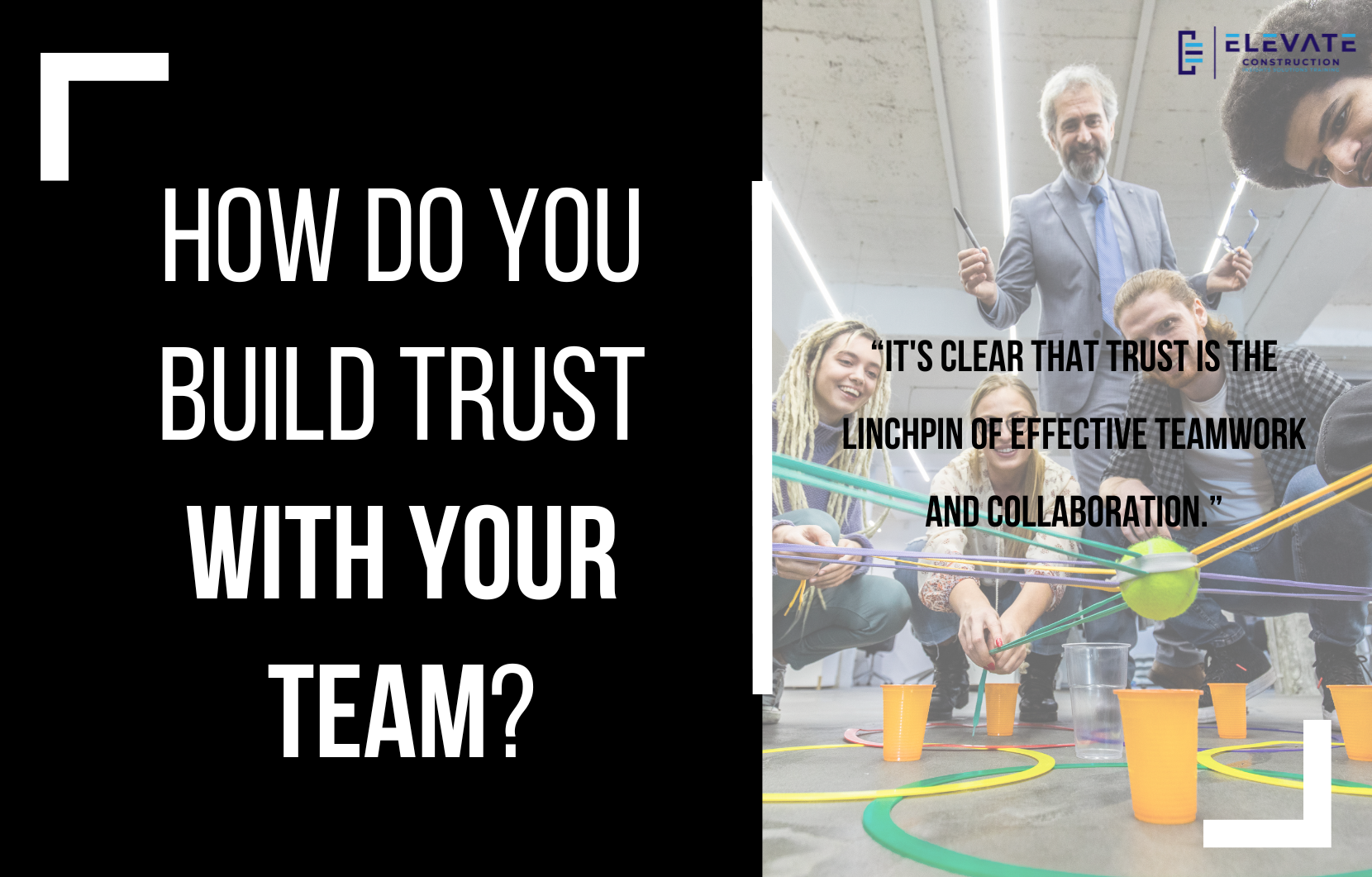
Conclusion: As we conclude our exploration of trust-building strategies, it’s clear that trust is the linchpin of effective teamwork and collaboration. By prioritizing transparency, integrity, and accountability, leaders can sow the seeds of trust within their teams, fostering an environment where innovation thrives and relationships flourish. With commitment and dedication, trust becomes not just a virtue but a cornerstone of organizational success. Let’s embark on this journey of trust-building together, forging stronger bonds and achieving greater heights of excellence.

If you want to learn more we have:

-Takt Virtual Training: (Click here)
-Check out our Youtube channel for more info: (Click here) 
-Listen to the Elevate Construction podcast: (Click here) 
-Check out our training programs and certifications: (Click here)
-The Takt Book: (Click here)

Discover Jason’s Expertise:

Meet Jason Schroeder, the driving force behind Elevate Construction IST. As the company’s owner and principal consultant, he’s dedicated to taking construction to new heights. With a wealth of industry experience, he’s crafted the Field Engineer Boot Camp and Superintendent Boot Camp – intensive training programs engineered to cultivate top-tier leaders capable of steering their teams towards success. Jason’s vision? To expand his training initiatives across the nation, empowering construction firms to soar to unprecedented levels of excellence.

On we go!
How To Grow A Construction Business

Read 9 min

Introduction: 

In this insightful Blog post, we delve into the realm of expanding and scaling a construction business. We uncover common challenges faced by entrepreneurs in this industry and unveil eight critical factors to heed in order to avoid stagnation and propel your business forward. Let’s embark on this journey together and equip ourselves with the knowledge needed to thrive in the construction landscape. 

Common Challenges In Growing A Construction Business: 

As seasoned professionals deeply embedded in the construction sector, we’ve witnessed firsthand the hurdles that impede business growth. Despite the brilliance and dedication of entrepreneurs, many find themselves at a standstill, lacking a crucial element in their business strategy. Through extensive research and immersion in the world of construction, we’ve identified a recurring theme—the absence of a visionary and an integrator.

Importance Of Having A Visionary & An Integrator In Business: 

At the core of every successful business lies the dynamic interplay between visionaries and integrators. Drawing insights from seminal works such as “Traction” and “Rocket Fuel,” we discern the distinct roles of these two archetypes—the visionary, with their audacious ideas and forward-thinking outlook, and the integrator, who brings order and stability, transforming visions into reality.

Importance Of Building The Right Leadership Team: 

Central to this dynamic duo is the formation of a robust leadership team. Aligning the right people in the right roles, guided by shared values and a unified vision, lays the foundation for organizational success. By heeding the principles outlined in “The Five Dysfunctions of a Team,” leaders can cultivate a culture of collaboration and synergy, driving the company towards its goals.

How To Analyze If The Right People Are In The Right Seats: 

Assessing whether individuals occupy the appropriate roles necessitates a comprehensive evaluation. Beyond mere qualifications, it involves gauging their passion, aptitude, and alignment with organizational objectives. Leveraging tools like personality profiles and performance assessments empowers leaders to make informed decisions regarding team composition.

Importance Of Having Meetings, Interactions & Proximity: 

However, assembling the right team is just the beginning. Fostering meaningful interactions and fostering proximity among team members is equally crucial. Through regular meetings and engagement activities, leaders cultivate a culture of collaboration, laying the groundwork for effective problem-solving and innovation.

Importance Of Having Clarity In The Leadership Team: 

Guided by a shared vision, the leadership team must steer the organization towards clarity and coherence. Every initiative and decision should align with the overarching goals, eliminating silos and fostering cross-departmental collaboration. By upholding clarity as the guiding principle, leaders instill a sense of purpose and direction throughout the organization.

Importance Of Scaling Clarity In The Whole Organization: 

Scaling clarity beyond the leadership team entails cascading the vision throughout the organization. Every employee becomes a steward of the company’s mission, working in unison towards shared objectives. By reinforcing clarity through communication and alignment, leaders galvanize their workforce, propelling the organization towards sustained growth.

How To Solve Problems As An Organization: 

Empowered by a clear vision and aligned objectives, the organization becomes adept at problem-solving. By prioritizing collective goals over individual agendas, teams leverage their combined expertise to overcome challenges effectively. This collaborative approach fosters resilience and adaptability, enabling the organization to thrive amidst adversity.

How To Keep Growing Your Business: 

In essence, these eight principles serve as the cornerstone of organizational success. Leaders must address each factor diligently, ensuring that no aspect becomes a bottleneck to progress. By embracing these principles and leveraging resources such as “Traction” and “Rocket Fuel,” entrepreneurs can propel their businesses to new heights of excellence.

Helpful Resources For Growing Your Business: 

For those seeking further insights and guidance, we recommend delving into the wealth of knowledge offered by “Traction” and “Rocket Fuel.” These invaluable resources provide actionable strategies and frameworks tailored to the unique challenges of the construction industry. Armed with these insights, entrepreneurs can navigate the complexities of business growth with confidence and clarity.

Conclusion: 

As we conclude our exploration of growth strategies for construction businesses, it’s evident that success hinges on a delicate balance of visionary leadership, effective teamwork, and unwavering clarity of purpose. By heeding the principles outlined in this video and leveraging the recommended resources, entrepreneurs can surmount obstacles, unlock their full potential, and usher their businesses into a new era of prosperity. Let’s forge ahead with determination and foresight, knowing that the path to success is within our grasp.

If you want to learn more we have:

-Takt Virtual Training: (Click here)
-Check out our Youtube channel for more info: (Click here) 
-Listen to the Elevate Construction podcast: (Click here) 
-Check out our training programs and certifications: (Click here)
-The Takt Book: (Click here)

Discover Jason’s Expertise:

Meet Jason Schroeder, the driving force behind Elevate Construction IST. As the company’s owner and principal consultant, he’s dedicated to taking construction to new heights. With a wealth of industry experience, he’s crafted the Field Engineer Boot Camp and Superintendent Boot Camp – intensive training programs engineered to cultivate top-tier leaders capable of steering their teams towards success. Jason’s vision? To expand his training initiatives across the nation, empowering construction firms to soar to unprecedented levels of excellence.

On we go!

    Related Books

    The First Planner System: The Project Planning System for Executives, Project Managers, and Superintendents in Pre-construction - Book 2
    Pull Planning For Builders: How to Pull Plan Right, Respect People, and Gain Time (The Art of the Builder)
    The Ten Improvements to Production Planning: What Lean Builders Can Do To Improve Short Interval Planning (The Art of the Builder)

    Related Books

    The First Planner System: The Project Planning System for Executives, Project Managers, and Superintendents in Pre-construction - Book 2
    Built to Fail: Why Construction Projects Take So Long, Cost Too Much, And How to Fix It

    Related Books

    The First Planner System: The Project Planning System for Executives, Project Managers, and Superintendents in Pre-construction - Book 2
    The 10 Myths of CPM: How The Critical Path Method Systematizes Disrespect for People
    Calumet "K"

    faq

    General Training Overview

    What construction leadership training programs does LeanTakt offer?
    LeanTakt offers Superintendent/PM Boot Camps, Virtual Takt Production System® Training, Onsite Takt Simulations, and Foreman & Field Engineer Training. Each program is tailored to different leadership levels in construction.
    Who should attend LeanTakt’s training programs?
    Superintendents, Project Managers, Foremen, Field Engineers, and trade partners who want to improve planning, communication, and execution on projects.
    How do these training programs improve project performance?
    They provide proven Lean and Takt systems that reduce chaos, improve reliability, strengthen collaboration, and accelerate project delivery.
    What makes LeanTakt’s training different from other construction courses?
    Our programs are hands-on, field-tested, and focused on practical application—not just classroom theory.
    Do I need prior Lean or takt planning experience to attend?
    No. Our programs cover foundational principles before moving into advanced applications.
    How quickly can I apply what I learn on real projects?
    Most participants begin applying new skills immediately, often the same week they complete the program.
    Are these trainings designed for both office and field leaders?
    Yes. We equip both project managers and superintendents with tools that connect field and office operations.
    What industries benefit most from LeanTakt training?
    Commercial, multifamily, residential, industrial, and infrastructure projects all benefit from flow-based planning.
    Do participants receive certificates after completing training?
    Yes. Every participant receives a LeanTakt Certificate of Completion.
    Is LeanTakt training recognized in the construction industry?
    Yes. Our programs are widely respected among leading GCs, subcontractors, and construction professionals.

    Superintendent / PM Boot Camp

    What is the Superintendent & Project Manager Boot Camp?
    It’s a 5-day immersive training for superintendents and PMs to master Lean leadership, takt planning, and project flow.
    How long does the Superintendent/PM Boot Camp last?
    Five full days of hands-on training.
    What topics are covered in the Boot Camp curriculum?
    Lean leadership, Takt Planning, logistics, daily planning, field-office communication, and team health.
    How does the Boot Camp improve leadership and scheduling skills?
    Yes. You’ll learn how to run day huddles, team meetings, worker huddles, and Lean coordination processes.
    Who is the Boot Camp best suited for?
    Construction leaders responsible for delivering projects, including Superintendents, PMs, and Field Leaders.
    What real-world challenges are simulated during the Boot Camp?
    Schedule breakdowns, trade conflicts, logistics issues, and communication gaps.
    Will I learn Takt Planning at the Boot Camp?
    Yes. Takt Planning is a core focus of the Boot Camp.
    How does this Boot Camp compare to traditional PM certification?
    It’s practical and execution-based rather than exam-based. You learn by doing, not just studying theory.
    Can my entire project team attend the Boot Camp together?
    Yes. Teams attending together often see the greatest results.
    What kind of real-world challenges do we simulate?
    Improved project flow, fewer delays, better team communication, and stronger leadership confidence.

    Takt Production System® Virtual Training

    What is the Virtual Takt Production System® Training?
    It’s an expert-led online program that teaches Lean construction teams how to implement takt planning.
    How does virtual takt training work?
    Delivered online via live sessions, interactive discussions, and digital tools.
    What are the benefits of online takt planning training?
    Convenience, global accessibility, real-time learning, and immediate application.
    Can I access the virtual training from anywhere?
    Yes. It’s fully web-based and accessible worldwide.
    Can I access the virtual training from anywhere?
    Yes. It’s fully web-based and accessible worldwide.
    What skills will I gain from the Virtual TPS® Training?
    Macro and micro Takt planning, weekly updates, flow management, and CPM integration.
    How long does the virtual training program take?
    The program is typically completed in multiple live sessions across several days.
    Can I watch recordings if I miss a session?
    Yes. Recordings are available to all participants.
    Do you offer group access or company licenses for the virtual training?
    Yes. Teams and companies can enroll together at discounted rates.
    How does the Virtual TPS® Training integrate with CPM tools?
    We show how to align Takt with CPM schedules like Primavera P6 or MS Project.

    Onsite Takt Simulation

    What is a Takt Simulation in construction training?
    It’s a live, interactive workshop that demonstrates takt planning on-site.
    How does the Takt Simulation workshop work?
    Teams participate in hands-on exercises to learn the flow and rhythm of a Takt-based project.
    Can I choose between a 1-day or 2-day Takt Simulation?
    Yes. We offer flexible formats to fit your team’s schedule and needs.
    Who should participate in the Takt Simulation workshop?
    Superintendents, PMs, site supervisors, contractors, and engineers.
    How does a Takt Simulation improve project planning?
    It shows teams how to structure zones, manage flow, and coordinate trades in real time.
    What will my team learn from the onsite simulation?
    How to build and maintain takt plans, manage buffers, and align trade partners.
    Is the simulation tailored to my specific project type?
    Yes. Scenarios can be customized to match your project.
    How do Takt Simulations improve trade partner coordination?
    They strengthen collaboration by making handoffs visible and predictable.
    What results can I expect from an onsite Takt Simulation?
    Improved schedule reliability, better trade collaboration, and reduced rework.
    How many people can join a Takt Simulation session?
    Group sizes are flexible, but typically 15–30 participants per session.

    Foreman & Field Engineer Training

    What is Foreman & Field Engineer Training?
    It’s an on-demand, practical program that equips foremen and engineers with leadership and planning skills.
    How does this training prepare emerging leaders?
    By teaching communication, crew management, and execution strategies.
    Is the training on-demand or scheduled?
    On-demand, tailored to your team’s timing and needs.
    What skills do foremen and engineers gain from this training?
    Planning, safety leadership, coordination, and communication.
    How does the training improve communication between field and office?
    It builds shared systems that align superintendents, engineers, and managers.
    Can the training be customized for my team’s needs?
    Yes. Programs are tailored for your project or company.
    What makes this program different from generic leadership courses?
    It’s construction-specific, field-tested, and focused on real project application.
    How do foremen and field engineers apply this training immediately?
    They can use new systems for planning, coordination, and daily crew management right away.
    Is the training suitable for small construction companies?
    Yes. Small and large teams alike benefit from building flow-based leadership skills.

    Testimonials

    Testimonials

    "The bootcamp I was apart of was amazing. Its was great while it was happening but also had a very profound long-term motivation that is still pushing me to do more, be more. It sounds a little strange to say that a construction bootcamp changed my life, but it has. It has opened my eyes to many possibilities on how a project can be successfully run. It’s also provided some very positive ideas on how people can and should be treated in construction.

    I am a hungry person by nature, so it doesn’t take a lot to get to participate. I loved the way it was not just about participating, it was also about doing it with conviction, passion, humility and if it wasn’t portrayed that way you had to do it again."

    "It's great to be a part of a company that has similar values to my own, especially regarding how we treat our trade partners. The idea of "you gotta make them feel worse to make them do better" has been preached at me for years. I struggled with this as you will not find a single psychology textbook stating these beliefs. In fact it is quite the opposite, and causing conflict is a recipe for disaster. I'm still honestly in shock I have found a company that has based its values on scientific facts based on human nature. That along with the Takt scheduling system makes everything even better. I am happy to be a part of a change that has been long overdue in our industry!"

    "Wicked team building, so valuable for the forehumans of the sub trades to know the how and why. Great tools and resources. Even though I am involved and use the tools every day, I feel like everything is fresh and at the forefront to use"

    "Jason and his team did an incredible job passing on the overall theory of what they do. After 3 days of running through the course I cannot see any holes in their concept. It works. it's proven to work and I am on board!"

    "Loved the pull planning, Takt planning, and logistic model planning. Well thought out and professional"

    "The Super/PM Boot Camp was an excellent experience that furthered my understanding of Lean Practices. The collaboration, group involvement, passion about real project site experiences, and POSITIVE ENERGY. There are no dull moments when you head into this training. Jason and Mr. Montero were always on point and available to help in the break outs sessions. Easily approachable to talk too during breaks and YES, it was fun. I recommend this training for any PM or Superintendent that wants to further their career."

    agenda

    Day 1

    Foundations & Macro Planning

    day2

    Norm Planning & Flow Optimization

    day3

    Advanced Tools & Comparisons

    day4

    Buffers, Controls & Finalization

    day5

    Control Systems & Presentations

    faq

    UNDERSTANDING THE TRAINING

    What is the Virtual Takt Production System® Training by LeanTakt?
    It’s an expert-led online program designed to teach construction professionals how to implement Takt Planning to create flow, eliminate chaos, and align teams across the project lifecycle.
    Who should take the LeanTakt virtual training?
    This training is ideal for Superintendents, Project Managers, Engineers, Schedulers, Trade Partners, and Lean Champions looking to improve planning and execution.
    What topics are covered in the online Takt Production System® course?
    The course covers macro and micro Takt planning, zone creation, buffers, weekly updates, flow management, trade coordination, and integration with CPM tools.
    What makes LeanTakt’s virtual training different from other Lean construction courses?
    Unlike theory-based courses, this training is hands-on, practical, field-tested, and includes live coaching tailored to your actual projects.
    Do I get a certificate after completing the online training?
    Yes. Upon successful completion, participants receive a LeanTakt Certificate of Completion, which validates your knowledge and readiness to implement Takt.

    VALUE AND RESULTS

    What are the benefits of Takt Production System® training for my team?
    It helps teams eliminate bottlenecks, improve planning reliability, align trades, and reduce the chaos typically seen in traditional construction schedules.
    How much time and money can I save with Takt Planning?
    Many projects using Takt see 15–30% reductions in time and cost due to better coordination, fewer delays, and increased team accountability.
    What’s the ROI of virtual Takt training for construction teams?
    The ROI comes from faster project delivery, reduced rework, improved communication, and better resource utilization — often 10x the investment.
    Will this training reduce project delays or rework?
    Yes. By visualizing flow and aligning trades, Takt Planning reduces miscommunication and late handoffs — major causes of delay and rework.
    How soon can I expect to see results on my projects?
    Most teams report seeing improvement in coordination and productivity within the first 2–4 weeks of implementation.

    PLANNING AND SCHEDULING TOPICS

    What is Takt Planning and how is it used in construction?
    Takt Planning is a Lean scheduling method that creates flow by aligning work with time and space, using rhythm-based planning to coordinate teams and reduce waste.
    What’s the difference between macro and micro Takt plans?
    Macro Takt plans focus on the overall project flow and phase durations, while micro Takt plans break down detailed weekly tasks by zone and crew.
    Will I learn how to build a complete Takt plan from scratch?
    Yes. The training teaches you how to build both macro and micro Takt plans tailored to your project, including workflows, buffers, and sequencing.
    How do I update and maintain a Takt schedule each week?
    You’ll learn how to conduct weekly updates using lookaheads, trade feedback, zone progress, and digital tools to maintain schedule reliability.
    Can I integrate Takt Planning with CPM or Primavera P6?
    Yes. The training includes guidance on aligning Takt plans with CPM logic, showing how both systems can work together effectively.
    Will I have access to the instructors during the training?
    Yes. You’ll have opportunities to ask questions, share challenges, and get real-time feedback from LeanTakt coaches.
    Can I ask questions specific to my current project?
    Absolutely. In fact, we encourage it — the training is designed to help you apply Takt to your active jobs.
    Is support available after the training ends?
    Yes. You can access follow-up support, coaching, and community forums to help reinforce implementation.
    Can your tools be customized to my project or team?
    Yes. We offer customizable templates and implementation options to fit different project types, teams, and tech stacks.
    When is the best time in a project lifecycle to take this training?
    Ideally before or during preconstruction, but teams have seen success implementing it mid-project as well.

    APPLICATION & TEAM ADOPTION

    What changes does my team need to adopt Takt Planning?
    Teams must shift from reactive scheduling to proactive, flow-based planning with clear commitments, reliable handoffs, and a visual management mindset.
    Do I need any prior Lean or scheduling experience?
    No prior Lean experience is required. The course is structured to take you from foundational principles to advanced application.
    How long does it take for teams to adapt to Takt Planning?
    Most teams adapt within 2–6 weeks, depending on project size and how fully the system is adopted across roles.
    Can this training work for smaller companies or projects?
    Absolutely. Takt is scalable and especially powerful for small teams seeking better structure and predictability.
    What role do trade partners play in using Takt successfully?
    Trade partners are key collaborators. They help shape realistic flow, manage buffers, and provide feedback during weekly updates.

    VIRTUAL FORMAT & ACCESSIBILITY

    Can I access the virtual training from anywhere?
    Yes. The training is fully accessible online, making it ideal for distributed teams across regions or countries.
    Is this training available internationally?
    Yes. LeanTakt trains teams around the world and supports global implementations.
    Can I watch recordings if I miss a session?
    Yes. All sessions are recorded and made available for later viewing through your training portal.
    Do you offer group access or company licenses?
    Yes. Teams can enroll together at discounted rates, and we offer licenses for enterprise rollouts.
    What technology or setup do I need to join the virtual training?
    A reliable internet connection, webcam, Miro, Spreadsheets, and access to Zoom.

    faq

    GENERAL FAQS

    What is the Superintendent / PM Boot Camp?
    It’s a hands-on leadership training for Superintendents and Project Managers in the construction industry focused on Lean systems, planning, and communication.
    Who is this Boot Camp for?
    Construction professionals including Superintendents, Project Managers, Field Engineers, and Foremen looking to improve planning, leadership, and project flow.
    What makes this construction boot camp different?
    Real-world project simulations, expert coaching, Lean principles, team-based learning, and post-camp support — all built for field leaders.
    Is this just a seminar or classroom training?
    No. It’s a hands-on, immersive experience. You’ll plan, simulate, collaborate, and get feedback — not sit through lectures.
    What is the focus of the training?
    Leadership, project planning, communication, Lean systems, and integrating office-field coordination.

    CURRICULUM & OUTCOMES

    What topics are covered in the Boot Camp?
    Takt planning, day planning, logistics, pre-construction, team health, communication systems, and more.
    What is Takt Planning and why is it taught?
    Takt is a Lean planning method that creates flow and removes chaos. It helps teams deliver projects on time with less stress.
    Will I learn how to lead field teams more effectively?
    Yes. This boot camp focuses on real leadership challenges and gives you systems and strategies to lead high-performing teams.
    Do you cover daily huddles and meeting systems?
    Yes. You’ll learn how to run day huddles, team meetings, worker huddles, and Lean coordination processes.
    What kind of real-world challenges do we simulate?
    You’ll work through real project schedules, logistical constraints, leadership decisions, and field-office communication breakdowns.

    LOGISTICS & FORMAT

    Is the training in-person or virtual?
    It’s 100% in-person to maximize learning, feedback, and team-based interaction.
    How long is the Boot Camp?
    It runs for 5 full days.
    Where is the Boot Camp held?
    Locations vary — typically hosted in a professional training center or project setting. Contact us for the next available city/date.
    Do you offer follow-up coaching after the Boot Camp?
    Yes. Post-camp support is included so you can apply what you’ve learned on your projects.
    Can I ask questions about my actual project?
    Absolutely. That’s encouraged — bring your current challenges.

    PRICING & VALUE

    How much does the Boot Camp cost?
    $5,000 per person.
    Are there any group discounts?
    Yes — get 10% off when 4 or more people from the same company attend.
    What’s the ROI for sending my team?
    Better planning = fewer delays, smoother coordination, and higher team morale — all of which boost productivity and reduce costs.
    Will I see results immediately?
    Most participants apply what they’ve learned as soon as they return to the jobsite — especially with follow-up support.
    Can this replace other leadership training?
    In many cases, yes. This Boot Camp is tailored to construction professionals, unlike generic leadership seminars.

    SEO-BASED / HIGH-INTENT SEARCH QUESTIONS

    What is the best leadership training for construction Superintendents?
    Our Boot Camp offers real-world, field-focused leadership training tailored for construction leaders.
    What’s included in a Superintendent Boot Camp?
    Takt planning, day planning, logistics, pre-construction systems, huddles, simulations, and more.
    Where can I find Lean construction training near me?
    Check our upcoming in-person sessions or request a private boot camp in your city.
    How can I improve field and office communication on a project?
    This Boot Camp teaches you tools and systems to connect field and office workflows seamlessly.
    Is there a training to help reduce chaos on construction sites?
    Yes — this program is built specifically to turn project chaos into flow through structured leadership.