Detailed Crane Schedule Analysis: Your Crane Doesn’t Punish You for Being Busy, It Punishes You for Being Unprepared
Your crane is your most expensive bottleneck. Do you actually know where it is busy and where it is free?
Here is the deal. Most jobsites run the tower crane on tribal knowledge. The operator knows. The superintendent kind of knows. Everybody else guesses. And then trades stack up at the hook like cars at a four way stop with no signals, each one assuming their pick is next, none of them actually knowing where they stand in the queue until they are already standing there waiting. A crane is one of the most expensive pieces of equipment on any project, billed by the day whether it is lifting or idle, and running it on guesswork is one of the most expensive habits construction has never quite broken.
The Pain of a Resource Nobody Can See
Picture a typical morning around the base of a tower crane without a visible demand schedule. The rebar trade shows up expecting to set a mat. The general contractor’s crew needs a deck placement. A third trade has material sitting on a truck that needs to come up before the driver’s window closes. All three of them believe their need is urgent, and none of them can actually see where they fall in the sequence, because the sequence exists only in the operator’s head and the superintendent’s rough sense of the day’s priorities.
What happens next is predictable. Someone waits longer than they should because nobody told them the crane was committed to another lift for the next ninety minutes. Someone else gets bumped without warning, disrupting whatever plan they had built around an assumed pick time. The crane itself, meanwhile, may sit idle for a stretch because nobody thought to schedule an opportunistic pick during a genuine gap in demand, a gap that existed and went completely unused simply because nobody had a way to see it coming. The crane is expensive every single hour, whether it is lifting steel or sitting still, and a schedule that lives in someone’s head cannot protect against either kind of waste.
The Failure Pattern
The failure pattern is treating the crane as a resource that gets allocated reactively, in the moment, rather than one that gets planned in advance the same way every other constrained resource on the project should be.
Most schedules plan trades, sequences, and milestones in detail. Very few plan the crane with the same rigor, even though the crane is frequently the single resource every other trade’s sequence actually depends on. A Takt plan can define exactly when a wall assembly needs embeds set or when a deck needs to be placed, but if the crane capacity required to execute that plan was never mapped against actual demand, the Takt plan is aspirational rather than reliable. The crane becomes the silent constraint that determines whether the plan holds, and yet it is frequently the piece of the plan given the least explicit, most visible scheduling attention.
They Didn’t Fail the System
When trades stack up at the hook, or a crane sits idle during a window that could have absorbed a deliverable pick, the instinct is to look at coordination discipline. The trades should communicate better. The superintendent should manage the queue more actively.
Before landing on that explanation, it is worth asking what tool anyone actually had to coordinate with. If the crane’s demand exists only in the operator’s memory and a superintendent’s general sense of priority, then every trade partner showing up expecting a pick is operating without the information they would need to plan around anyone else’s needs, let alone their own. The stacking at the hook is not a communication failure between people who should have talked more. It is the predictable result of a resource with zero visible schedule, where every party is guessing simultaneously and none of those guesses are coordinated with each other.
What a Detailed Crane Demand Analysis Actually Shows
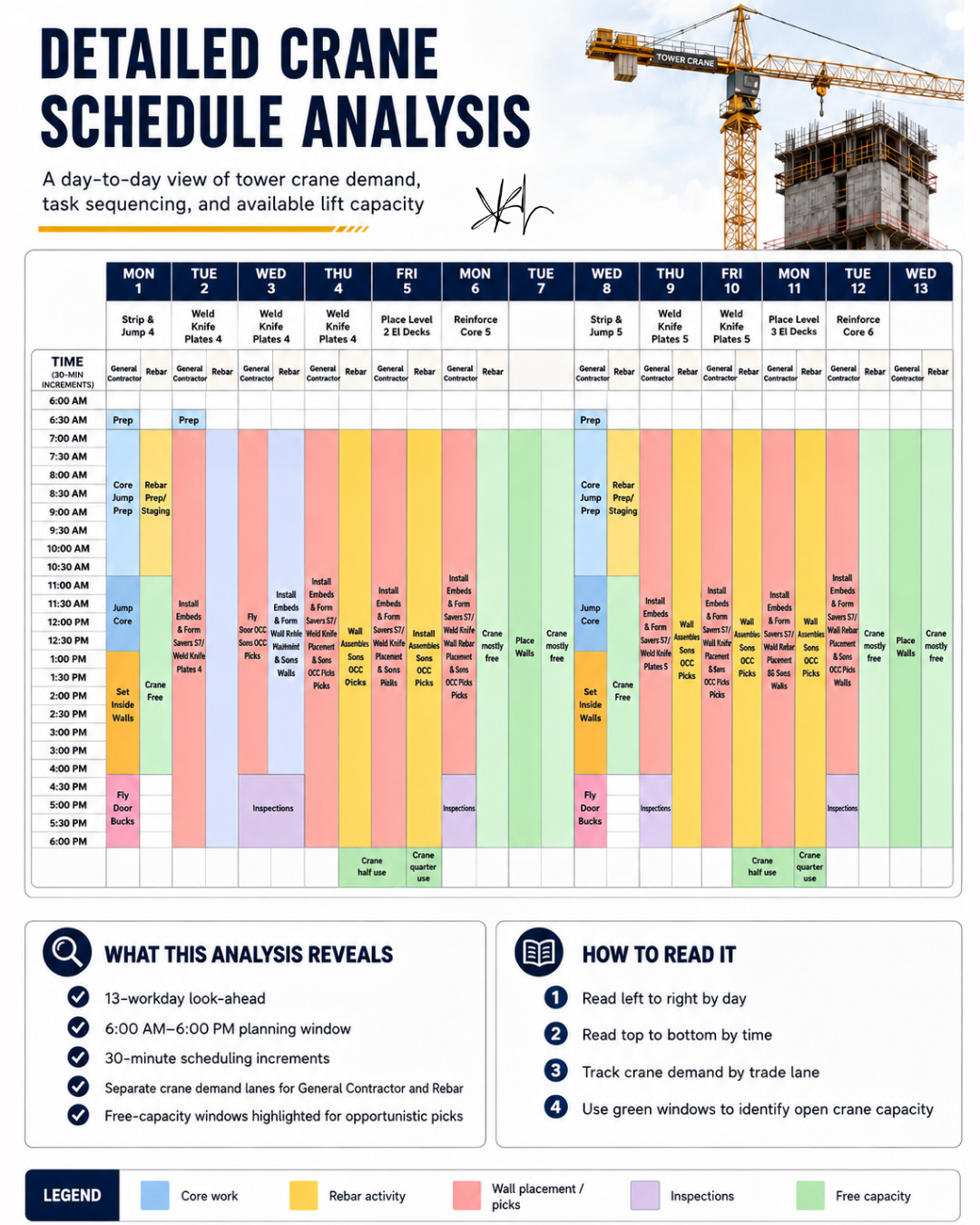
A day to day crane demand analysis maps thirteen workdays out, in thirty minute increments, across a six AM to six PM planning window, giving the project a granular, forward looking view of exactly when the crane is committed and exactly when it is free.
Separate demand lanes for each trade partner, the general contractor and the rebar trade in this case, show precisely who needs the hook and when, rather than folding every trade’s demand into one undifferentiated block of crane time. This separation matters because different trades have different lift profiles, and seeing them side by side reveals conflicts and gaps that a single merged schedule would obscure.
Every lift is tied directly to the production rhythm, strip and jump, weld knife plates, place decks, reinforce the core. The crane plan follows the Takt plan, not the other way around. This ordering matters enormously. A crane schedule built independently of the Takt sequence risks becoming its own competing plan, one that may not actually support the pace the rest of the project depends on. A crane schedule derived directly from the Takt rhythm ensures the crane is serving the production plan rather than constraining it in ways nobody anticipated.
Free capacity windows, highlighted clearly, become the project’s opportunistic pick windows. Material staging, dunnage, trash out, deliveries, all of it becomes plannable rather than improvised. Those windows exist on every crane schedule whether anyone identifies them or not. The difference between a project that captures that value and one that wastes it is entirely whether anyone made those windows visible far enough in advance for trades to actually plan around them.
Why This Belongs Two Weeks Out, Not Two Hours Out
The value of this analysis depends heavily on its planning horizon. A thirteen workday look ahead means trade partners are not discovering their crane windows the morning of. They are seeing them roughly two weeks in advance, which is enough lead time to actually pre stage material, coordinate delivery trucks to arrive during a genuine window rather than showing up and hoping, and flag any conflict with enough runway to resolve it before it becomes a lost cycle.
This is the same logic behind make ready planning and full kit readiness in Advanced Work Packaging. A resource that is only visible in the moment it is needed cannot be planned around. A resource that is visible weeks in advance becomes something the whole project can build a plan against, rather than something everyone reacts to individually and separately.
The Crane Punishes Unpreparedness, Not Busyness
Here is the principle underneath the entire practice. The crane does not punish a project for being busy. A fully booked crane schedule, every window committed to a productive lift, is not a problem. It is the sign of a well planned sequence making full use of an expensive resource. What actually costs a project is unpreparedness, a trade that did not know its window was coming and was not staged when the hook became available, a gap in the schedule that nobody identified in advance and therefore nobody used, a conflict between two trades’ demand that only became visible once both of them showed up expecting the same thirty minute slot.
When demand is visible far enough out, trade partners can pre stage. Roadblocks get identified and removed before they cost an actual cycle. The hook stays in flow, moving from one planned pick to the next without the gaps and collisions that come from everyone guessing independently. That flow is not a matter of luck or unusually good coordination between people. It is the direct output of making an expensive, constrained resource visible far enough in advance that the whole project can plan around it together.
How to Read the Analysis
The structure of the tool matters as much as the data inside it. Reading left to right by day gives a chronological view of the entire look ahead window. Reading top to bottom by time shows exactly what is happening within any given day, in thirty minute resolution fine enough to actually plan a specific pick around. Tracking crane demand by trade lane separately reveals where two trades’ needs might be converging on the same window before that convergence becomes a problem in the field. And using the green free capacity windows to identify open crane time turns what would otherwise be invisible idle time into a specific, plannable opportunity for opportunistic picks that would otherwise never happen.
Signals Your Crane Schedule Is Actually Just Hope
Look for these patterns on your current project:
- Trade partners regularly arrive at the crane without knowing in advance whether their window is confirmed
- The crane sits idle during stretches that nobody identified in advance as available capacity
- Coordination about crane priority happens reactively in the field rather than through a schedule everyone can reference in advance
- Different trades’ demand for the crane has never been mapped side by side to reveal potential conflicts before they happen
- The crane schedule exists primarily in the operator’s or superintendent’s memory rather than as a document the whole team can see
Any one of these signals a project running its most expensive piece of equipment on tribal knowledge rather than a visible plan, and that gap is exactly what a detailed crane demand analysis is built to close.
Schedule the Hook the Way You Schedule the Work
If your crane schedule lives in someone’s head, it is not a schedule. It is a hope. A hope that the operator remembers every commitment correctly, that the superintendent’s mental model of the day matches reality, that trades stacking up at the hook sort themselves out without losing real cycles. Hope is not a plan, and an asset this expensive deserves better than hope.
Building a genuine crane demand analysis, tied directly to the Takt plan, visible two weeks out, with clear demand lanes and highlighted free capacity, turns the crane from a source of daily uncertainty into one of the most reliably planned resources on the project. If your project needs superintendent coaching, project support, or leadership development, Elevate Construction can help your field teams stabilize, schedule, and flow. Jason Schroeder and the LeanTakt team build crane schedules directly off the Takt rhythm because a plan that does not account for its most expensive constraint is not really a plan at all, it is a hope wearing a schedule’s clothing.
Map Your Crane’s Next Two Weeks
Here is your challenge. Take your current Takt plan and map every lift it requires against your crane’s actual capacity, thirty minute increments, thirteen days out. Find the gaps. Find the conflicts. Highlight the free windows before someone else discovers them by accident, or worse, never discovers them at all.
Marcus Aurelius wrote that we have power over our own minds, not outside events, and that realizing this gives us strength. A crane schedule you cannot see is an outside event happening to you. A crane schedule you have mapped and planned is something you have taken command of. Take command of the hook before the hook takes command of your week.
On we go.
FAQ
Why separate demand lanes by trade partner instead of tracking crane use as a single combined schedule?
Different trades have different lift profiles, priorities, and staging requirements, and a single combined lane can hide conflicts between them until those conflicts show up physically at the hook. Separate lanes let the team see exactly where two trades’ demand might be converging on the same window well before that convergence becomes a problem in the field, giving everyone time to resolve it on paper instead of in real time.
Why does the crane schedule need to follow the Takt plan rather than being built independently?
A crane schedule built independently of the Takt sequence risks becoming its own competing plan, one that may not actually support the pace the rest of the project depends on. Tying every lift directly to the production rhythm, strip and jump, weld knife plates, deck placement, keeps the crane serving the plan rather than quietly constraining it in ways nobody accounted for.
How far in advance should crane demand actually be visible to trade partners?
A thirteen workday look ahead, roughly two weeks, gives trade partners enough lead time to pre stage material, coordinate delivery trucks to specific windows, and flag conflicts early enough to resolve them without losing a cycle. A shorter window leaves too little time to actually act on the information, while a much longer window may not reflect the level of detail needed for accurate thirty minute scheduling.
If you want to learn more we have:
-Takt Virtual Training: (Click here)
-Check out our Youtube channel for more info: (Click here)
-Listen to the Elevate Construction podcast: (Click here)
-Check out our training programs and certifications: (Click here)
-The Takt Book: (Click here)
Discover Jason’s Expertise:
Meet Jason Schroeder, the driving force behind Elevate Construction IST. As the company’s owner and principal consultant, he’s dedicated to taking construction to new heights. With a wealth of industry experience, he’s crafted the Field Engineer Boot Camp and Superintendent Boot Camp – intensive training programs engineered to cultivate top-tier leaders capable of steering their teams towards success. Jason’s vision? To expand his training initiatives across the nation, empowering construction firms to soar to unprecedented levels of excellence.