
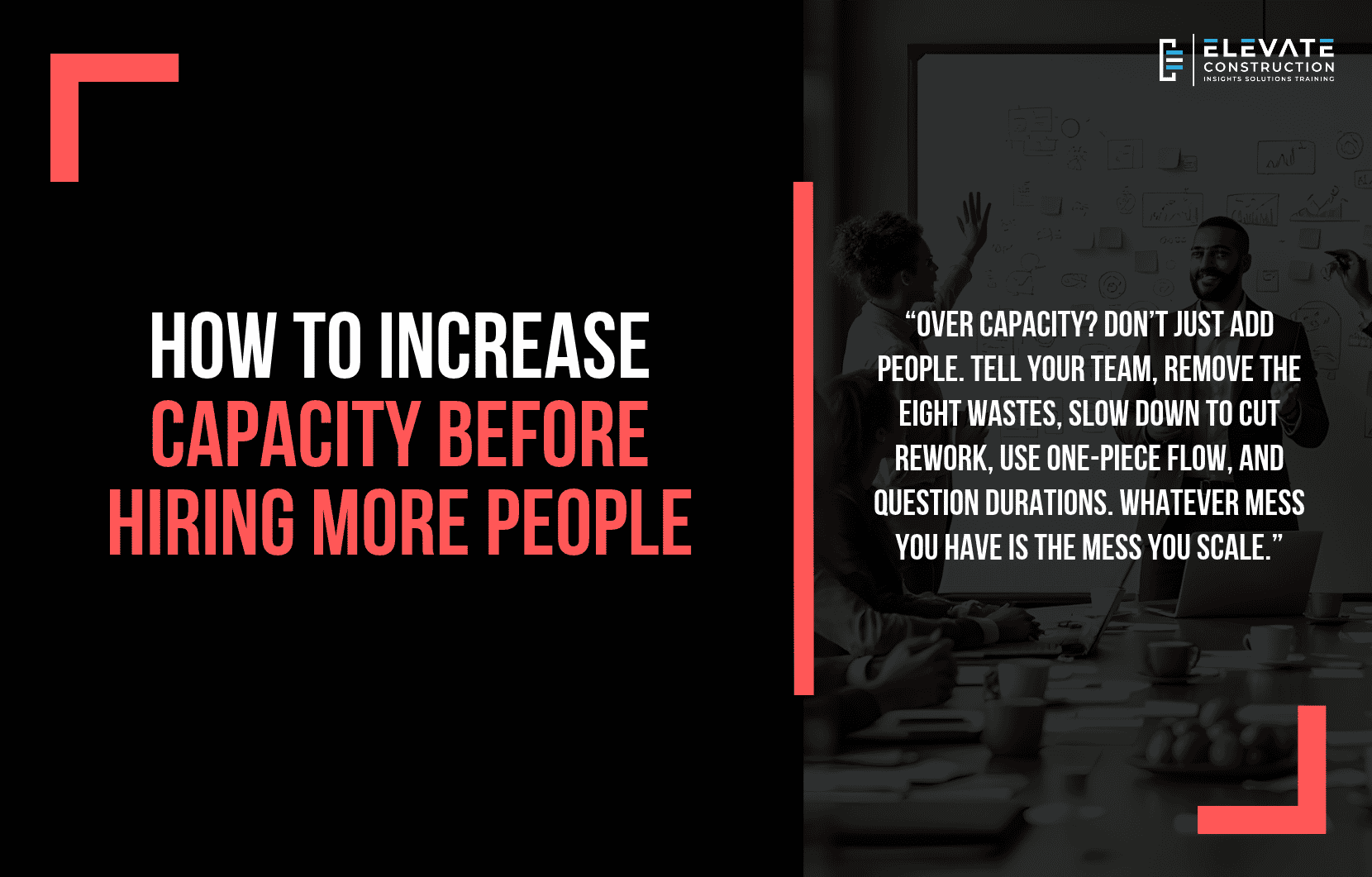
What we’re talking about tonight is creating capacity and solving problems. When we think about being over capacity, we immediately go to, and it’s a really natural response, I just need more people. I don’t think that’s the first place we should go, a hundred percent.
Short answer: To create capacity, solve the problem before you add people. Tell your team when you’re overburdened, remove the eight wastes, 5S every day, have conversations about what’s really needed, slow down to reduce rework, use one-piece flow, and question durations. Plan your week and your day, time block, and use a personal organization system.
Why Isn’t More People the Answer?
Scott Berg, a great general superintendent I worked for at Hensel Phelps, used to tell me there’s a limit on how many people you can have on a project before you start losing productivity. That stuck with me. Then Felipe Engineer taught me about Brooks’s law: especially at the end of projects with a strenuous deadline, the more labor you add, the slower you go. If you’ve read Paul Akers’ 2 Second Lean, you know the tendency is to drift toward adding resources instead of eliminating waste and 5S-ing your area.
A lot of times adding resources is just masking waste and problems. As Kevin Rice taught me today, sometimes it doesn’t mask anything. It just compounds the problem, and we do it because we don’t know any better. Adding people also brings communication, delegation, misunderstanding, training, people assuming each other has it under control, and more management and oversight. We used to live in an economy of abundance. We are firmly in an economy of scarcity, and we must get better at using the resources we have. We do that with lean.
Who Should Know When You’re Over Capacity?
If you ever feel over capacity, you’ve got to tell somebody. You can’t bear that burden alone. No problems belong to individuals. All problems belong to the team. Everybody has weak moments, everybody gets over capacity, and everyone needs help, so the team has to rally together.
Have You Memorized the Eight Wastes?
This is how I got started on my lean journey. Memorizing the eight wastes was huge for me. I don’t have them written down anywhere. Overproduction leads to excess inventory. Excess inventory has to be moved and transported, which causes defects, and fixing them causes motion. Fixing defects means over-processing. Then you have workers waiting on work or work waiting on workers, and it’s all waste, because we could have solved it by using the genius of the team. Add mura and muri, unevenness and overburden, and like Paul Akers says, let it really bother you.
Everyone has to have them memorized, especially when we scale, or we’re just adding waste upon waste. If someone is batching work and has no personal organization system, they might do six to 12 hours of productive work in a week. To get a full week of output, are you going to hire four people? Eight? As Katie, our CEO and my partner, always says, whatever mess you have is the mess you’re going to scale. And as Paul Akers says, 5S your areas every day so you can see the waste, then fix it, shoot a before-and-after video, and scale that culture. See Lean Onboarding Series – The 8 Wastes.
What Can a Conversation Take Off Your Plate?
We can’t help overburden without great conversations. Can the team cover you? Has the team already done it? Is work duplicated? Does the project manager know something isn’t urgent? Does somebody have a resource? Once you’ve worked on the eight wastes and you’re 5S-ing and still over capacity, say, hey, I’m a little overburdened, does anybody have ideas? The answers sound like this:
- With that submittal, you don’t have to go through every detail. Those details are solid because someone already reviewed them.
- For those three quotes, you don’t need to research new companies. I have a booklet of business cards.
- With that lift drawing, we don’t need the whole wall. Just the first two sections in the next two weeks.
- For schedule development, once we have the macro, we only need the first 90 days. Lock that in, get our first pull plan, and we’re off to the races.
Being transparent about workloads is crucial. If you’re not making it home on time, speak up. One of the biggest premises of Scrum is a collaborative team. You have a board with backlog, in progress, and completed. If you’re not getting things done, the team doesn’t beat you over the head. You get to say, what can I do? Can we lean in and swarm it?
Should You Speed Up or Slow Down?
Speeding up is usually not the answer, just like in construction scheduling. The faster you go, the less you ask for help and the more work you do that might need to be reworked. A prominent leader I respected once said when a plane hits turbulence, it slows down. When cars hit speed bumps, unless you’re crazy and have great shocks like on my 4Runner, you slow down. If you want to go faster, reduce rework.
What Else Creates Capacity?
| Option | How it creates capacity |
|---|---|
| One-piece flow | Time block and focus, use buffers, cut email dependence, no back-to-back meetings. I guarantee 12 to 24 hours back in a week. |
| Question durations | Is that due? Can I get the first part done? Can we level this out? |
| Automation and innovation | Use the genius of your team |
| Training and capability | Like Adam Hootz always says, capability increases capacity |
| The right level of people | The right number, not more than the needed levels of labor |
Can you imagine if designers, trade partners, builders, and foremen asked, what’s the realistic duration? I can get to it this day, give it 100% focus, do it right, and not come back to it. Our industry would change overnight. Read You Are Not Authorized To Overburden Resources too.
A couple of updates. I’m not flying anywhere more than twice a month, targeting once a month, and we’ll spend most of our time on scheduling services because that’s the most scalable way to help people. We’re up to almost 30 people. I also hope you had a good Memorial Day reflecting on our fallen soldiers and the freedoms we have. And a listener wrote that our podcasts are inspiring and heartfelt. Thank you.
So here is the challenge. This week, plan your week, plan each day, time block it, and use your personal organization system. Then speak up about one thing that’s overburdening you and ask your team for ideas.
Bottom line: You don’t need more people than the needed levels of labor. What you need is for the people who are there to be effective first.
If your project needs superintendent coaching, project support, or leadership development, Elevate Construction can help your field teams stabilize, schedule, and flow.
On we go.
FAQ
Is adding people the best way to create capacity?
Usually not first. Scott Berg taught Jason there’s a limit on how many people a project can have before productivity drops, and Brooks’s law says adding labor late makes you go slower. Adding resources often masks waste, or, as Kevin Rice says, compounds the problem. Make the people you have effective first.
What are the eight wastes?
Overproduction, excess inventory, transportation, defects, motion, over-processing, waiting, and not utilizing the genius of the team. Jason says to memorize them, along with overburden and unevenness, see them everywhere, and let them bother you.
How does one-piece flow create capacity?
Don’t try to do multiple things at once. Time block and focus, give yourself buffers, don’t be a victim to distractions, reduce your dependence on email, and avoid back-to-back meetings. Jason guarantees 12 to 24 hours back in a week.
People Also Read:
The 8 Wastes – Lean Series
Lean Onboarding Series – Waste, Unevenness, & Overburden
The Capacity to Sustain
3S & 5S – Sort, Straighten, Sweep, Standardize, Sustain
If you want to learn more we have:
-Takt Virtual Training: (Takt Virtual Training)
-Check out our YouTube channel for more info: (Elevate Construction on YouTube)
-Listen to the Elevate Construction podcast: (Elevate Construction Podcast)
-Check out our training programs and certifications: (Training Programs and Certifications)
-The Takt Book: (The Takt Book on Amazon)
Discover Jason’s Expertise:
Meet Jason Schroeder, the driving force behind Elevate Construction. As the company’s Founder and COO, he’s dedicated to taking construction to new heights. With a wealth of industry experience, he’s crafted the Field Engineer Boot Camp and Superintendent Boot Camp – intensive training programs engineered to cultivate top-tier leaders capable of steering their teams towards success. Jason’s vision? To expand his training initiatives across the nation, empowering construction firms to soar to unprecedented levels of excellence.