
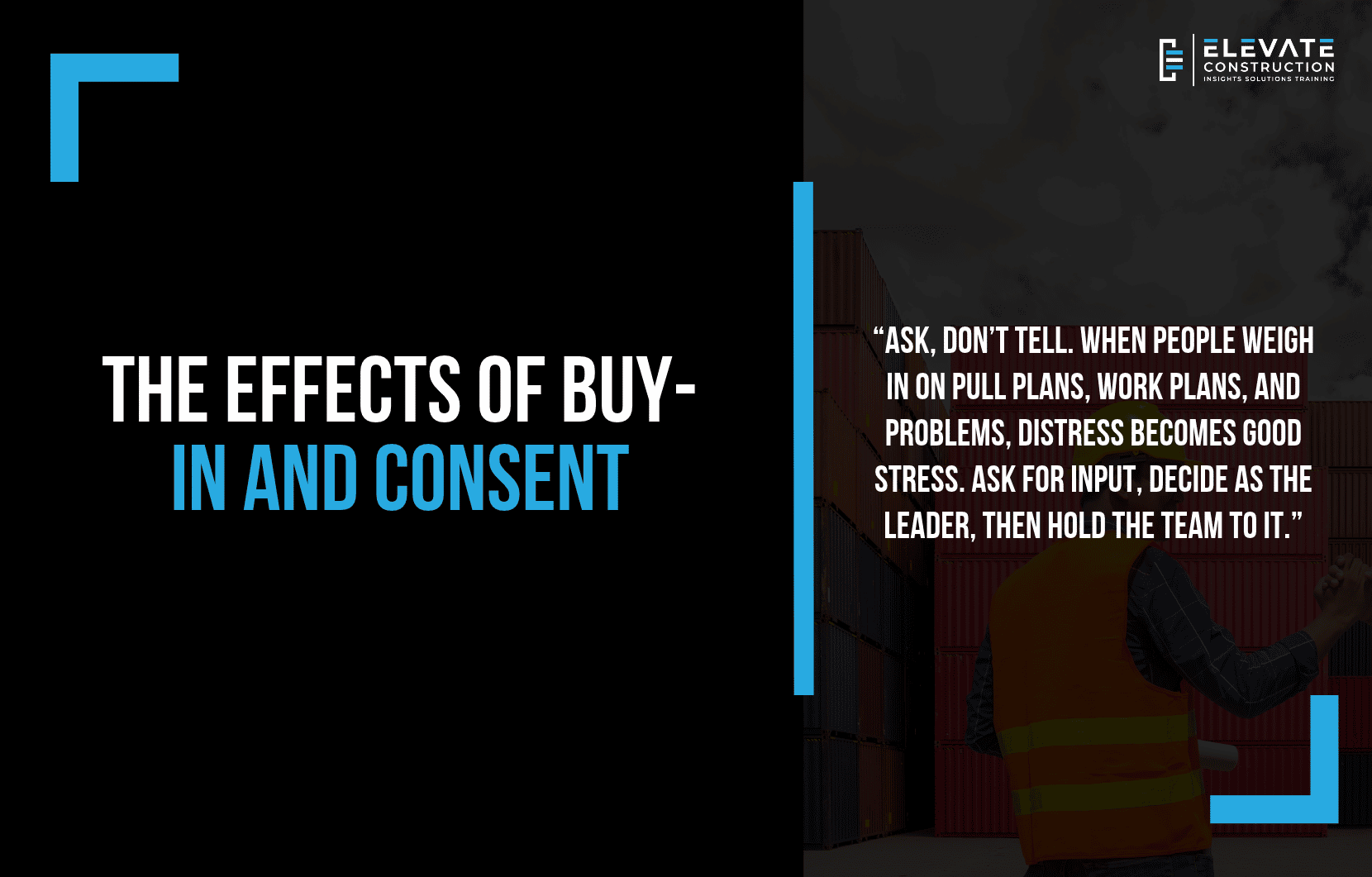
What I want to talk about today is a subject that has been on my mind and on my heart lately: getting buy-in and asking questions. When we tell people what to do, not only do people not like to be bossed around and lorded over, especially newer generations, but if it’s a stressful thing, you can feel hopeless, like it’s not your choice and you’re a victim. That’s not a good feeling.
Short answer: Getting buy-in means asking instead of telling. When people weigh in and buy in, in a pull plan, a weekly work plan, a daily plan, or a problem the team is solving, their bodies release oxytocin, which turns distress into good stress and builds the team. Ask for permission, ask for input, make the decision as the leader, and then hold the team accountable to it.
What Happens in the Brain When You Boss People Around?
I’ve explained this before. I’m not a doctor, but generally this is true. When you have distress, most of the time your body releases cortisol, a stress hormone, and without other hormones, it can create human disconnection or isolation. That’s not what we want when we’re building teams.
So remember: when the Last Planner System, integrated project delivery, and people in our industry say let’s get weigh-in and buy-in, like Patrick Lencioni says all the time, there’s some neuroscience behind it. If you ask somebody to weigh in and buy in, then in a situation that might be stressful their body also releases oxytocin. That enables the person to turn distress into eustress, or good stress, where they’re working with other humans to solve a problem, and you build the team. I’ve explained this before but never given examples, so here they are.
Will People Follow Rules They Helped Set?
I don’t like to compare children with adults. I don’t like to give adults that much praise to call them children. I’m just kidding. I have a lot of respect for children, and I know people don’t like to be called that, so this is a general analogy. I learned this when I was learning how to teach children. There was a book at my church called Teaching, No Greater Call, and it suggested that when it came to discipline or standards in a class, you ask the class to create the rules themselves.
I tried that in primary-age children’s classes, and in the years I was active in the Boy Scouts of America. What does this primary class agree to? What does this Scout unit agree to? Then I started doing it in trainings: let’s set some agreements at the beginning of this class. I found out that people will follow rules they helped set, or at least consented to.
Why Ask Permission When It’s Already Implied?
Right now I’m in a Super PM Boot Camp, and last week I was in a project engineer and field engineer boot camp. Sometimes in exercises I’ll touch somebody’s shoulder, or at church I’ll put my hands on somebody’s head to give them a blessing. I’ve gotten into the habit: even if it’s already implied, I ask for permission. Even if it’s implied that we’re going to do a plan or a weekly work plan with our trades, I’m going to ask for buy-in and permission.
I’ve told this story before, and I don’t know if it’s true. A mother in the delivery room was struggling and wouldn’t receive an IV. They brought in a doctor, who very politely asked everyone else to leave, and then, for just a minute, asked the mother, do I have permission to give you this IV and put this needle in your arm? She calmed down and gave permission, the needle went right in, and they were able to move forward. I don’t care if the story is real or made up. It still brings me to tears, because we are put in situations where we don’t have a choice. It’s implied that you’ll get an IV, but typically nobody asks for consent. How powerful would it be if that became a common practice?
Is Buy-In the Same as Consensus?
Patrick Lencioni says that in leadership team meetings, we do not decide by consensus or by committee. There is a leader who makes decisions. But the team weighs in and buys in, and once the decision is made, the team gives a thumbs-up, gets on the same page, and stands unitedly behind it. I love, love, love that concept.
Where Do You Get Buy-In on a Job Site?
| Where | How buy-in happens |
|---|---|
| Pull plan | It’s not just stickies on the wall. People weigh in and buy in. |
| Weekly work plan | Prepare it and base it on the takt plan, then trades weigh in, decide, and commit. It’s their decision, and you have their consent. |
| Daily plan | Same thing: the people doing the work weigh in and commit. |
| A problem | Present it to the team, ask for ideas, then make the decision as the leader. |
When trades get to weigh in, decide, and commit, their brains also release oxytocin, and it builds the team. See Pull Planning Step-by-Step for Construction and Weekly Work Planning Explained.
How Should a Leader Present a Problem?
If you have a problem, why not go into a meeting and say, team, this is our group, this is the leadership of this group, this is the problem, and I’d like your ideas? Even if you have an idea yourself, wait. Don’t go in with any preconceived notions. Ask for the input. Then, as the leader, make a decision considering that input. Even if everyone didn’t get their way, you will have made so much goodwill if you sincerely listened to and acknowledged the input from the rest of the team.
That’s how you leverage the power of teams. People go to trainings or read books about teams and ask, how do I build a team? Then they revert to their old habits. This is the habit: get the right people on the bus and in the right seats. Build trust. Be open. Then present a problem: this is what I’m dealing with, this is what I’m worried about, let’s get your input, I want everyone to speak up. That’s how you start to get healthy conflict. Make the decision together, set that standard, and hold the team accountable to it. That is powerful.
Does Feedback Really Change Our Content?
A listener heard our leveling episode and pointed out that work density might confuse people, because density is usually measured per unit of volume. What I mean is that we never split zones by square feet or square meters. We break zones up by the level of effort, the actual work or energy that has to be applied to that zone. I don’t disagree, and we’re working on it. Anyone who gives us feedback: we use it and tie it into our books and content.
So here is the challenge. This week, before you solutionize, as Jen Lacey and Jesse Hernandez say, take one problem to your team. Ask for their input before you share yours.
Bottom line: Present it to the team, get everyone to weigh in and buy in, and at the same time get their consent and goodwill. This applies to every interaction you have.
If your project needs superintendent coaching, project support, or leadership development, Elevate Construction can help your field teams stabilize, schedule, and flow.
On we go.
FAQ
Why does getting buy-in matter on a construction team?
When you tell people what to do in a stressful situation, they can feel hopeless and like a victim, and distress releases cortisol, which can create disconnection. When people weigh in and buy in, their bodies also release oxytocin, which turns distress into eustress, good stress where people solve a problem together and build the team.
Does weigh in and buy in mean deciding by consensus?
No. Patrick Lencioni says leadership teams don’t decide by consensus or committee. A leader makes the decision. But the team weighs in and buys in, and once the decision is made, everyone gives a thumbs-up and stands unitedly behind it.
How do you get buy-in on a problem?
Go to the team and say, this is the problem, I’d like your ideas. Even if you have an idea, wait. Ask for input, and then as the leader make a decision considering it. Even if not everyone gets their way, you build goodwill by listening and acknowledging the input.
People Also Read:
The Five Dysfunctions of a Team – Winning Teams
Are You Asking the Right Questions?
How Production Plans Are Built From Work Density to Trade Flow
Pull Planning
If you want to learn more we have:
-Takt Virtual Training: (Takt Virtual Training)
-Check out our YouTube channel for more info: (Elevate Construction on YouTube)
-Listen to the Elevate Construction podcast: (Elevate Construction Podcast)
-Check out our training programs and certifications: (Training Programs and Certifications)
-The Takt Book: (The Takt Book on Amazon)
Discover Jason’s Expertise:
Meet Jason Schroeder, the driving force behind Elevate Construction. As the company’s Founder and COO, he’s dedicated to taking construction to new heights. With a wealth of industry experience, he’s crafted the Field Engineer Boot Camp and Superintendent Boot Camp – intensive training programs engineered to cultivate top-tier leaders capable of steering their teams towards success. Jason’s vision? To expand his training initiatives across the nation, empowering construction firms to soar to unprecedented levels of excellence.