
The Faster You Go, the Farther You Must Look: Why Reactive Construction Leadership Is a Crash Waiting to Happen
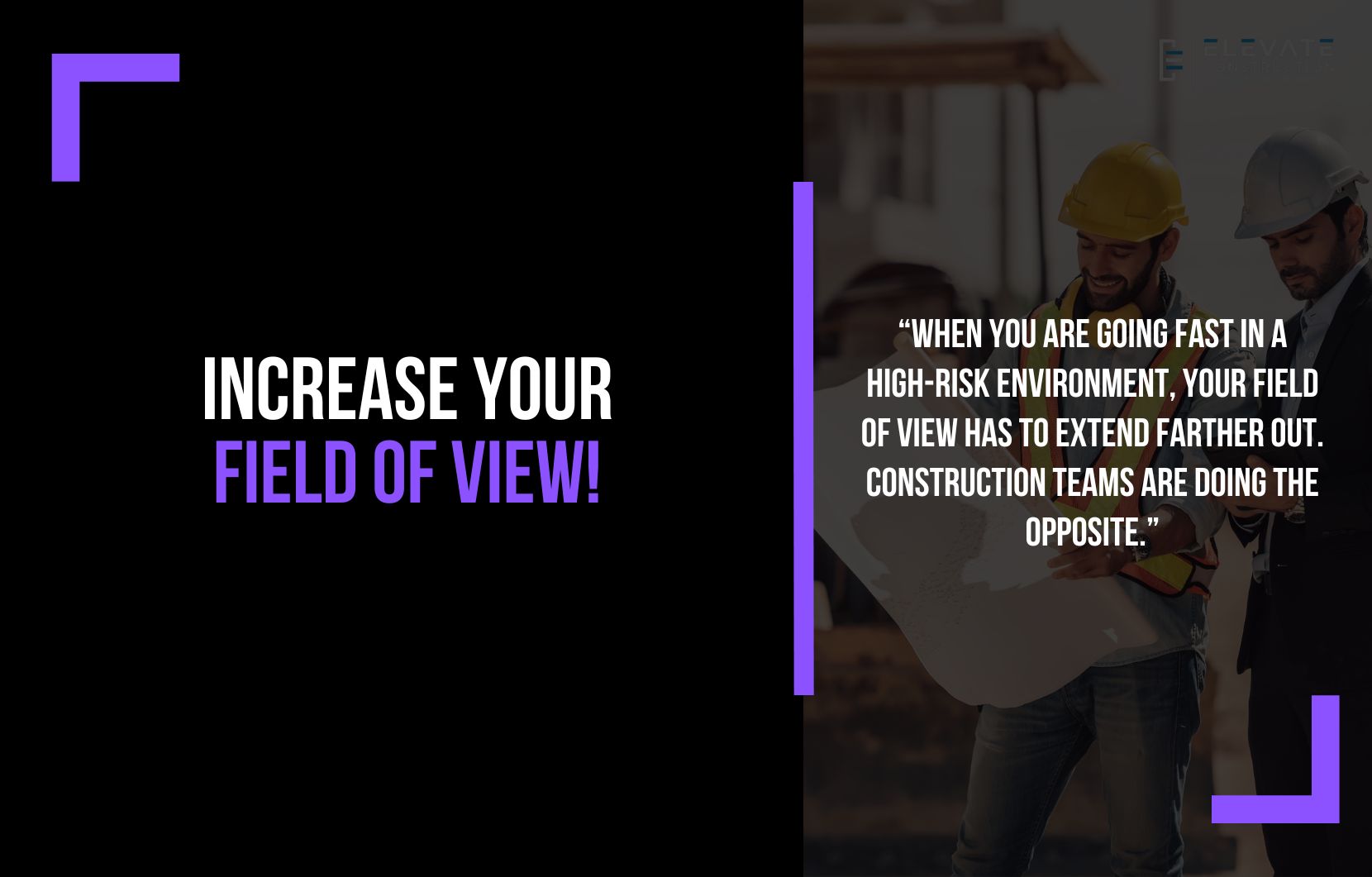
Jason Schroeder was riding a motorcycle on a dry lake bed north of Los Angeles when the analogy hit him. The lake bed looks open and fast, but it is not. There is barbed wire. There are divots and holes. There are fence posts driven into the ground. There are rocks and debris left by other riders. And the faster you go across that terrain, the farther out you have to be looking, because at forty-five miles per hour, the ten feet in front of you is already under your wheels before you can react to what is there. The rider who keeps their eyes close gets thrown and breaks their neck. The one who extends their field of view sees the fence post coming with enough time to go around it. The physics are unavoidable: speed plus risk equals longer look-ahead required. Construction teams are going fast in a high-risk environment and looking at the ten feet directly in front of them. That is a crash waiting to happen.
The Problem That Is Hiding Behind Busyness
The most common description of a busy construction project sounds like competence: we handled twelve issues today, responded to three RFIs, found the missing material, fixed the layout problem, and rerouted the crew when the coordination conflict showed up. That is not competence. That is reactive management, which is the professional equivalent of riding across the lake bed at full speed with your eyes on the ground directly in front of your wheel. Every problem that was solved today was a problem that should have been prevented last week. Every material that was found in an emergency was a material that should have been on the site before the installation window opened. Every coordination conflict that was walked and resolved was a conflict that should have been surfaced and addressed in a make-ready meeting before the zone was live.
The construction leader who is riddled with problems and issues every day is not managing a project. They are chasing it. And the project, left to be chased rather than led, will produce the outcome that any unmanaged high-speed high-risk system produces: an accident at a moment when nobody had enough lead time to prevent it.
The System That Normalized Looking Too Close
The last planner system introduced an important principle: plan in more detail as work gets closer. Do not lock in granular commitments for activities that are six months away, because the conditions in six months are unknowable in the detail that would be required. That principle is correct. But somewhere in the translation from principle to practice, it became permission to stop looking far out at all. The rolling wave of three weeks, six weeks, twelve weeks became the entire field of view. And the upstream questions, the ones that determine whether the rolling wave will have anything to produce when the time comes, stopped being asked because the culture decided that far-out planning was not the lean way.
That is a misreading of the principle. The last planner system presupposes a master schedule. It says plan the details when the work is close, not abandon strategic visibility for the entire project. The misreading produced a generation of construction leaders who are excellent at near-term planning and blind to the conditions forming six months ahead of them. Procurement is the most common casualty. The exterior skin that should have been in the ground for fabrication eight months ago was not started because nobody’s field of view extended to where that conversation needed to happen.
What Proactively Paranoid Actually Looks Like
The shift from reactive to proactive is not about adding more meetings to a schedule that is already full. It is about changing the orientation of the leader’s attention from the problems that are in front of them now to the conditions that are forming in the distance. Here is what that shift produces in practice:
- Procurement is managed twice a week against a schedule that shows every critical release point between now and delivery, not tracked monthly against a log that nobody updates
- Trade flow is visible on the Takt plan from the current zone all the way to the finish, with buffer days tracked against the end date so schedule creep is visible before it becomes unrecoverable
- Make-ready look-ahead meetings surface roadblocks six to twelve weeks before they affect production, when there is still time to remove them without accelerating or compressing
- Just-in-time material deliveries are scheduled against the production plan, not called in when the crew arrives at a zone and nothing is there
- Pre-install meetings happen before the trade enters the zone, not after the first installation reveals a coordination problem that requires rework
Every one of those is a look-ahead behavior. Every one of them requires a field of view that extends beyond the current week. And every one of them produces a project where the leader is clearing the path rather than reacting to what the path left in their way.
The Four Stages of Competence and Where Most Leaders Are Stuck
Tony Robbins describes four stages of development that apply directly to the shift from reactive to proactive leadership. Understanding which stage a leader is in determines what intervention will actually help them move forward.
The first stage is unconscious incompetence: the leader is not doing the right things, and they do not know it. They believe that solving today’s problems is the job, because nobody has told them otherwise and the feedback loop from the job does not distinguish between a leader who prevented problems and one who solved them. The second stage is conscious incompetence: the leader now knows there is a gap between where they are and where they need to be. The problems that occupied all of last week were not inevitable. They were the result of not looking far enough out. The third stage is conscious competence: the leader is deliberately and intentionally doing the planning behaviors that prevent problems, and it is working, but it requires focus and effort to maintain. The fourth stage is unconscious competence: proactive planning has become muscle memory. The leader does not think about whether to run the procurement meeting. They run it because not running it would feel wrong. They do not decide to look twelve months out. Looking twelve months out is how they see.
The goal is to get leaders to the fourth stage, where proactive paranoia is the default and reactive management feels as uncomfortable as it should.
The War Map Your Project Deserves
Jason invokes General Patton and General Bradley studying their war maps before advancing. They are not looking at the ground directly under their feet. They are reading the entire theater of operations, identifying where the enemy is positioned, where the supply lines run, where the terrain creates risk, and what the sequence of moves looks like from the current position all the way to the objective. That is the superintendent’s job. The Takt plan is the war map. The procurement schedule is the supply line. The buffer tracking is the risk assessment. And the leader who can look at that map and tell you where the project is, what the next twelve weeks look like, where the roadblocks are, how many buffers remain, and what trades are flowing through which zones on what rhythm is doing the job. The one who can only tell you what problems they solved today is still fighting the last battle.
The schedule is the primary tool that makes all of this possible. Without a Takt plan that runs from current production all the way to substantial completion, there is no field of view beyond the immediate. There is no way to align procurement, because there is nothing to align it to. There is no way to see schedule creep coming, because there is no finish date that is connected to the actual sequence of work. There is no way to plan pre-install meetings, because the installation sequence is not visible far enough in advance. A project without a complete plan to finish is a rider crossing the lake bed without looking up. If your project needs superintendent coaching, project support, or leadership development, Elevate Construction can help your field teams stabilize, schedule, and flow.
Extend the Field of View Before You Hit the Fence Post
The challenge from this episode is not to slow down. It is to look farther out. A project that is moving fast with high risk, which describes virtually every commercial construction project in the current market, cannot afford to manage from the near term. The terrain is too variable. The stakes are too high. The consequences of hitting something at speed are too severe. The leader who extends their field of view to twelve months for procurement, twelve weeks for the foreman, and twelve hours for the workers is the leader who sees the fence posts before they become emergencies. As W. Edwards Deming observed: it is not necessary to change. Survival is not mandatory. The construction leaders who make proactive planning their default will be the ones still standing when the reactive ones have finished cleaning up the wreckage of the last crash.
On we go.
FAQ
What is the dry lake bed analogy and how does it apply to construction?
At high speed on an unpredictable surface, you must extend your field of view far ahead or you will hit something before you can react. Construction teams operating fast in a high-risk environment with a short look-ahead horizon are in the same position.
Why is solving today’s problems a sign that the planning system is broken?
Because every problem solved in real time was a problem that could have been prevented with adequate look-ahead. A leader who is constantly reacting is operating without the field of view required to see what was forming before it became a crisis.
What does the last planner system actually say about long-range planning?
It says plan in increasing detail as work gets closer, not that long-range planning should be abandoned. The last planner system presupposes a master schedule extending to the end of the project. The misreading that produced short look-ahead cultures is a corruption of the original principle.
What are the four stages of competence and which one should construction leaders aim for?
Unconscious incompetence, conscious incompetence, conscious competence, and unconscious competence. The goal is the fourth stage, where proactive planning behaviors are so habitual they happen without deliberate effort.
Why is the Takt plan the war map that every project requires?
Because without a complete plan from current production to substantial completion, there is no visibility into procurement alignment, trade flow, buffer availability, or the conditions forming six to twelve months ahead. Without the map, the leader is guessing.
If you want to learn more we have:
-Takt Virtual Training: (Click here)
-Check out our Youtube channel for more info: (Click here)
-Listen to the Elevate Construction podcast: (Click here)
-Check out our training programs and certifications: (Click here)
-The Takt Book: (Click here)
Discover Jason’s Expertise:
Meet Jason Schroeder, the driving force behind Elevate Construction IST. As the company’s owner and principal consultant, he’s dedicated to taking construction to new heights. With a wealth of industry experience, he’s crafted the Field Engineer Boot Camp and Superintendent Boot Camp – intensive training programs engineered to cultivate top-tier leaders capable of steering their teams towards success. Jason’s vision? To expand his training initiatives across the nation, empowering construction firms to soar to unprecedented levels of excellence.