
Operational Excellence Does Not Happen By Accident
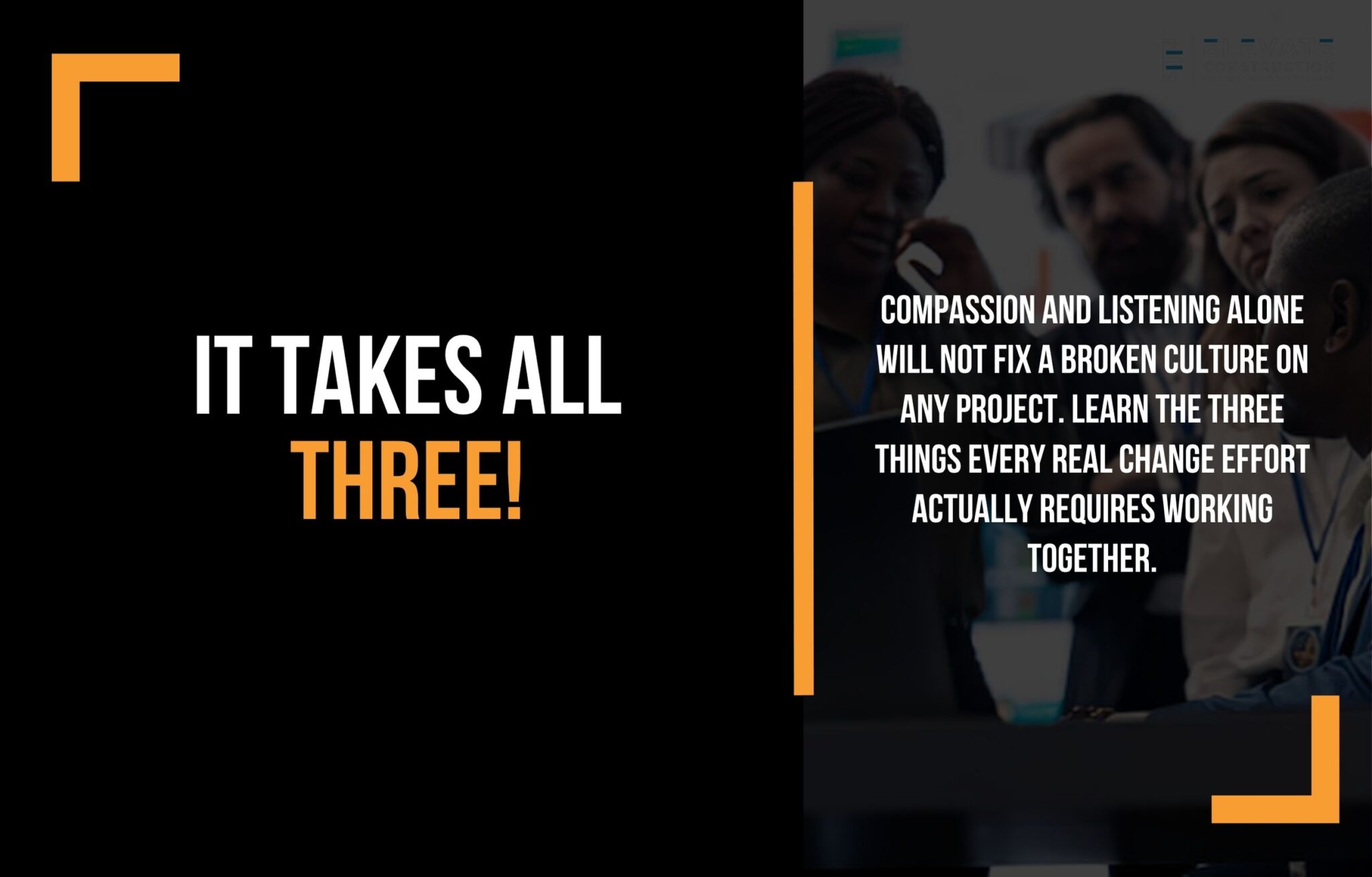
We cannot just expect operational excellence to magically happen. That line captures a real, common mistake happening across the construction industry right now, well meaning teams believing that good intentions alone are enough to create lasting change, when the actual work required goes much further than intentions ever could.
Where Good Intentions Quietly Run Out Of Road
Ask people how to fix a struggling culture, and a familiar answer comes back constantly across the industry, on almost every project. Be more open minded. Listen more. Show more compassion. Every part of that answer is genuinely true and worth doing. None of it, on its own, actually changes anything. Teams that stop there end up with better intentions and the exact same results they started with, project after project, year after year.
Treating One Ingredient Like The Whole Recipe
The failure pattern is simple. Listening and compassion get treated as a complete solution instead of one piece of a larger one. A team polls its workers, genuinely listens to their feedback, and then waits for improvement to follow. When it does not, leadership concludes that people just are not engaged, when the real issue is that listening was never going to be enough by itself in the first place, no matter how sincerely it was done.
The System Failed Them, They Didn’t Fail The System
The system failed them, they did not fail the system. Nobody explained that real, lasting change requires three things working together, not one thing working alone. According to the widely read book Switch by Chip and Dan Heath, people need to know how to do something, be genuinely motivated to do it, and have the actual circumstances and systems in place that let them succeed. Remove any one of those three, and the other two cannot carry the weight by themselves, no matter how much good intention gets poured into the effort.
A Company That Built The Sequence In The Right Order
One civil contracting company offers a clean example of what doing this correctly actually looks like across a real operation, on multiple active projects at once. Before asking workers and foremen to drive improvement themselves, the company built the structures first. They got the right people into the right seats across every level of the company. They put real operational systems in place. They provided genuine training and built real capability across every level of the organization. Only after all of that was in place did workers and foremen start making improvements of their own free will and choice, because the environment finally gave that choice somewhere real to go on a daily basis. Visual huddle boards get used every single morning, filled out by hand with real conversation behind them and real decisions coming out of them. Standard forms guide surveying and leveling work consistently across every crew on every phase. Quality checklists are everywhere, not just on paper but actually in active use throughout the day. Morale is genuinely high, and production numbers back it up rather than contradicting the story being told about the culture on site.
Why This Distinction Matters
This matters because skipping straight to listening without building the systems underneath it leads nowhere for the team trying to make real progress. A worker cannot act on feedback if there is no stable environment, no clear direction, and no operational structure to actually implement it inside. Continuous improvement only works once respect for people and real stability already exist underneath it, and trying to skip that order rarely produces the results a team is actually hoping for in the long run. That is true at Toyota, it is true across Lean thinking broadly, and it is true on any construction project attempting the same transformation, regardless of how much energy and good intention gets thrown at it.
Continuous Improvement Comes Last, Not First
This is the part almost everyone gets backward on a project or inside a company culture, no matter how many years of experience sit in the room. Continuous improvement is the last step in a real transformation, not the first one. Every serious Lean implementation, going back to Toyota itself, followed the same sequence: build respect for people and stability first, then bring everyone into genuine participation, and only then start continuously improving together as one unified team. Ideas and improvement genuinely do come from the people doing the work, and Lean literature often points out that front line workers still contribute a meaningful share of the ideas that move a company forward, but that only happens once they know the target, understand the direction, and are standing inside a stable, respectful environment that makes a good idea possible to actually act on in the first place, day after day, project after project, year after year.
Why Rigid Scheduling Quietly Cancels Out Every Improvement
One detail deserves special attention here. A rigid, sequential CPM schedule tends to cancel out the very improvements a well trained, well motivated crew comes up with, because there is no flexible system in place to actually absorb the change once someone identifies it on the ground. A team can do everything right, build capability, motivate people, and listen closely, and still get flattened by a scheduling system that was never designed to bend around real improvement once it actually shows up in the field. That is one more reason the operational system underneath a culture change matters just as much as the culture itself.
What Real Change Actually Requires
Keep these three together the next time a culture shift feels stuck despite everyone’s genuinely best efforts and good intentions.
- Genuine knowledge and training in how to actually do the work correctly
- Real motivation built through respect, vision, and clear direction for the team
- The operational systems and circumstances that make lasting success possible
Connect To Mission
None of this means listening does not matter, because it absolutely does, and no real leader should ever stop doing it. If your project needs superintendent coaching, project support, or leadership development, Elevate Construction can help your field teams stabilize, schedule, and flow. It means building the systems and training underneath that listening, so the feedback a team gathers actually has somewhere real to go once it is heard, instead of dissolving into good intentions with nowhere to land.
Questions To Ask Before You Try To Change Your Culture
Run through these before assuming listening alone will fix things once and for all.
- Do our people genuinely know how to do what we are asking of them
- Have we given them a real reason to be motivated, beyond just being told to
- Do the operational systems in place actually support the change we want
- Are we asking for participation before or after building real stability
A Challenge For Every Leader
Here is the challenge this week. Before assuming your culture problem is a listening problem, check whether the training, motivation, and operational systems underneath it are actually in place first. As has been said plainly, continuous improvement is last in the system, it was never first, not at Toyota, not in Lean, not anywhere it has actually worked in practice.
On we go.
Frequently Asked Questions
Why doesn’t just listening more actually fix a struggling culture on its own? Listening surfaces real feedback, but without the training, motivation, and operational systems to act on that feedback, the feedback has nowhere real to go, which means nothing actually changes no matter how genuinely it was gathered.
What three things does real change actually require working together at the same time? People need to know how to do the work, be genuinely motivated to do it, and have the operational systems and circumstances in place that make success achievable, and all three have to be present at once for lasting change to actually take hold.
Why does continuous improvement come last in Lean, not first? Continuous improvement depends on people already having a stable, respectful environment and a clear direction to improve toward, which is why respect for people and stability always come before participation and improvement in every serious Lean transformation.
Why can rigid CPM scheduling undermine worker driven improvement on a real project? A rigid, sequential schedule often has no flexibility to absorb a genuine improvement once a crew identifies one, which means the schedule can cancel out the very gains that training and motivation were supposed to produce in the first place.
What does doing this the right way actually look like on a real project? It looks like a company that builds the right team, puts operational systems and training in place first, and then watches workers and foremen start improving processes on their own, because the environment finally gives that initiative somewhere real to go.
If you want to learn more we have:
-Takt Virtual Training: (Click here)
-Check out our Youtube channel for more info: (Click here)
-Listen to the Elevate Construction podcast: (Click here)
-Check out our training programs and certifications: (Click here)
-The Takt Book: (Click here)
Discover Jason’s Expertise:
Meet Jason Schroeder, the driving force behind Elevate Construction IST. As the company’s owner and principal consultant, he’s dedicated to taking construction to new heights. With a wealth of industry experience, he’s crafted the Field Engineer Boot Camp and Superintendent Boot Camp – intensive training programs engineered to cultivate top-tier leaders capable of steering their teams towards success. Jason’s vision? To expand his training initiatives across the nation, empowering construction firms to soar to unprecedented levels of excellence.
Lorem ipsum dolor sit amet, consectetur adipiscing elit. Ut elit tellus, luctus nec ullamcorper mattis, pulvinar dapibus leo.