
The Superintendent Stuck in the Trailer Is the Most Expensive Problem on Your Project
Here’s the deal: the most valuable person on a construction project is the superintendent. They see the whole system. They know where the train is, where it’s stalling, where a trade is about to run into a constraint that nobody else has identified yet. They carry the production plan in their head and translate it into real field decisions dozens of times a day. And on most projects, that person spends a significant portion of their day in a trailer. On the phone. At the desk. Processing paperwork. Approving timesheets. Responding to emails. Doing work that needs to happen but doing it in a place that is as far as possible from where their presence would actually change the outcome of the project.
That’s not a superintendent problem. That’s a system problem. And the Lean Field Desk is one of the most practical answers the industry has produced to it.
What Happens When the Superintendent Leaves the Field
Jason Schroeder teaches that field presence is non-negotiable not optional, not delegated. Safety and quality cannot be managed from an office. The one-on-one relationships between leaders and craft workers that drive morale, trust, and honest communication cannot be built through email and morning meetings. And the zone control walk the twice-daily field observation that identifies constraints, catches quality gaps, and removes roadblocks before they stall the production rhythm cannot happen from a desk sixty feet from the work.
When the superintendent is in the trailer, problems that would have taken sixty seconds to catch and correct in the field turn into RFIs, punch list items, and coordination failures that show up in the schedule days later. A foreman who would have flagged a question on a zone control walk waits because it doesn’t feel worth a trip to the trailer. A safety condition that was visible from the corridor for two hours gets normalized because nobody with authority walked past it. The quality gap in a handoff that would have been obvious on a field walk becomes a dispute in the closeout meeting.
Distance from the work is not neutral. It is expensive. And the system that keeps the superintendent in the trailer is the system that produces those costs not the superintendent.
A Story About What Field Presence Changes
I remember early in my career watching two superintendents manage nearly identical phases on a large healthcare project. Same trade partners, same scope, same complexity. One superintendent ran the zone from the trailer excellent at documentation, always reachable by phone, sharp on the schedule. The other was in the field by 7 AM and didn’t leave except for coordination meetings. When I asked the trades which project they preferred working on, the answer was unanimous. The field super. Not because the other super wasn’t capable because presence changed everything. Problems surfaced immediately. Decisions got made in the zone. Trades didn’t wait. The rhythm held because someone with the authority and the context to remove roadblocks was physically there when they appeared.
The trailer super learned the same things but thirty minutes later, through a phone call, filtered through whoever made the call. By then, the cost was already incurred. The field super caught it in real time, at the place of work, with the people doing the work.
What the Lean Field Desk Is Built Around
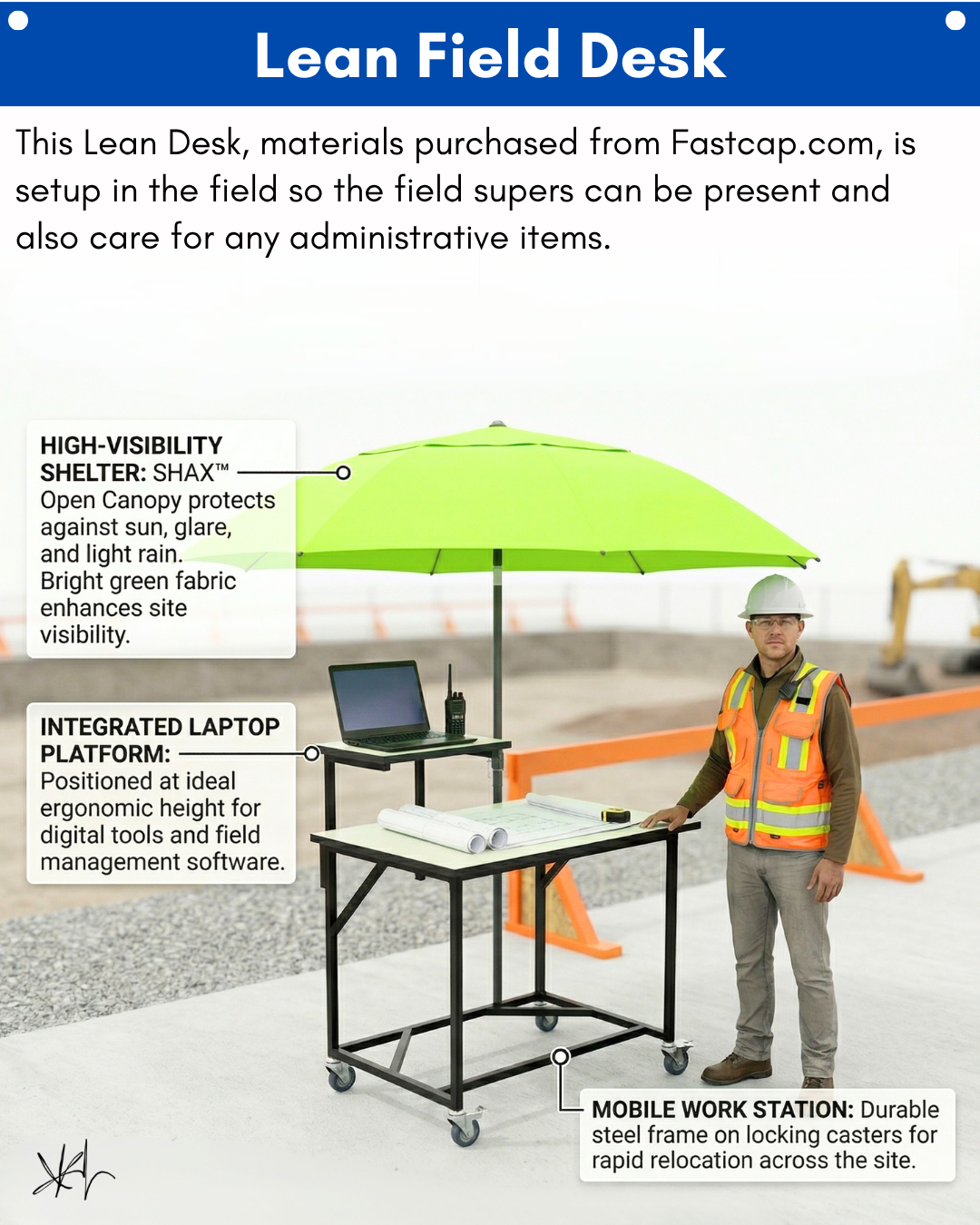
The Lean Field Desk materials sourced from Fastcap.com is not a piece of furniture. It is a system that enables a superintendent to stay in the field without abandoning the administrative work the role requires. That distinction matters. The goal is not to eliminate the administrative load. It’s to move it to the place where the super belongs on the floor, in the zone, present and visible.
The mobile work station is a durable steel frame on locking casters that repositions as fast as the crew does. As the work moves through zones, the field desk moves with it. This is the same principle applied to the gang box, the kitting cart, the spider box, and the safety station: support systems follow the work, not the other way around. A superintendent who can lock the desk in position, open the laptop, and handle a submittal review while standing thirty feet from the active work area doesn’t have to choose between field presence and administrative responsibility. The system resolves the conflict by putting both in the same place.
Watch for these signals that field leadership is spending too much time out of the field on your project:
- Problems that should have been caught visually are being discovered through phone calls or foreman reports
- Zone control walks are happening once a day or less rather than twice
- Trades are waiting for decisions that require the superintendent’s input but can’t get a timely response
- Quality gaps are showing up in inspections that were visible in the zone during installation
- Foremen are making independent judgment calls on scope and sequence because the super wasn’t present to weigh in
The SHAX Canopy and the Visibility Signal
The SHAX high-visibility canopy bright green, open, weather-resistant does something beyond protecting the desk from sun and light rain. It makes the superintendent visible from a distance on the site. That visibility is not a vanity feature. It is a signal. Every worker who looks up and sees the green canopy knows the super is in the field. Trades know decisions can be made quickly. Foremen know the roadblock conversation can happen in person, right now, without scheduling. Safety conditions get addressed because the person responsible for them is physically present and identifiable.
In Lean thinking, the leader’s presence at the place of work is not background it’s a primary mechanism for maintaining standards. Jason Schroeder teaches that when leadership breaks down and communication fails, workers begin to disrespect safety, quality, cleanliness, and every other key indicator. The inverse is equally true: when leadership is visibly present, consistently, at the place of work, the standard reinforces itself through proximity. The canopy makes that presence unmistakable from anywhere in the zone.
The integrated laptop platform at ergonomic height keeps the digital tools field management software, submittal review, daily logs, photo documentation accessible in the field without forcing the superintendent into a physically compromised position. Field work is physical work. A laptop platform at the right height means the super can do administrative tasks standing, in the field, without the fatigue that comes from bending over a makeshift surface or sitting in a low chair for extended periods. Ergonomics is not a comfort feature it is a sustained-performance feature.
Why Field Presence Is the Lean Action
Jason Schroeder requires zone control walks twice daily one upstream and one downstream as part of the standard superintendent routine. These walks are not optional or aspirational. They are how the production system stays honest. The walk surfaces constraints before they become roadblocks. It catches quality gaps before they become rework. It identifies trade stacking before it becomes conflict. And it communicates to every worker on every floor that the person responsible for the project’s success is paying attention not from a distance, but in person, at the place of work.
The Lean Field Desk makes those walks possible without sacrificing the administrative integrity the role requires. If your project needs superintendent coaching, project support, or leadership development, Elevate Construction can help your field teams stabilize, schedule, and flow. Field presence is how that stability is built and the Lean Field Desk is the tool that makes it sustainable across the full length of a project.
Bring the Office to the Work
Here is the challenge. This week, count how many hours your field superintendent spends in the trailer versus on the floor. Then ask: what problems could have been caught earlier if that ratio were reversed? What decisions got delayed because the super wasn’t accessible in the zone? What quality or coordination gaps showed up in the field that a zone control walk would have caught before they cost the project anything?
If the answer reveals a pattern, the Lean Field Desk is not a luxury it is a tool worth building. Durable steel frame, locking casters, ergonomic laptop platform, high-visibility canopy. Set it up before the next phase begins. Take it to the floor. Lock it in the zone. Let the superintendent be where they belong.
As Jason Schroeder teaches: “Field presence is not optional. Safety and quality cannot be managed from an office.” Build the system that keeps the super in the field.
On we go.
Frequently Asked Questions
Why can’t a superintendent just walk the field more without a mobile desk?
Because the administrative load doesn’t disappear. A mobile workstation resolves the conflict between field presence and documentation by making both possible in the same location rather than forcing a choice between them.
How does the bright green SHAX canopy support site operations?
It makes the superintendent’s position instantly visible across the site, signaling to trades and foremen that decision-making authority is present and accessible which accelerates problem resolution and reinforces the standard.
What is a zone control walk and why does it require field presence?
It’s a structured twice-daily field observation that surfaces constraints, catches quality gaps, and removes roadblocks in real time. It can only happen by being physically in the zone phone calls and reports are lagging indicators; the walk is a leading one.
If you want to learn more we have:
-Takt Virtual Training: (Click here)
-Check out our Youtube channel for more info: (Click here)
-Listen to the Elevate Construction podcast: (Click here)
-Check out our training programs and certifications: (Click here)
-The Takt Book: (Click here)
Discover Jason’s Expertise:
Meet Jason Schroeder, the driving force behind Elevate Construction IST. As the company’s owner and principal consultant, he’s dedicated to taking construction to new heights. With a wealth of industry experience, he’s crafted the Field Engineer Boot Camp and Superintendent Boot Camp – intensive training programs engineered to cultivate top-tier leaders capable of steering their teams towards success. Jason’s vision? To expand his training initiatives across the nation, empowering construction firms to soar to unprecedented levels of excellence.