
The Clean and Tidy Desk: Why a Superintendent’s Workspace Is a Leadership System
The project in the field is an exact physical representation of the superintendent’s mind.
That statement lands differently depending on where you are in your career. If you have been in the field long enough, you have probably walked a jobsite and known within ten minutes what kind of leader was running it. Not from the schedule. Not from a conversation. From the state of the laydown yard, the condition of the gang boxes, the way materials were staged, the cleanliness of the work areas. The site told you everything before anyone said a word. What most people don’t follow that observation all the way back to is this: that site started at a desk.
The Pain Nobody Wants to Admit
Here’s the deal. A superintendent’s office or trailer desk is usually one of the most chaotic spaces on any project, and it is treated that way on purpose, or at least with permission. The chaos gets reframed as busyness. Stacks of documents mean you are handling a lot. A screen full of icons means you have a complex job. Tangled cables and coffee cups and scattered blueprints mean you are in the middle of things, which means things are getting done.
That story is comfortable and almost entirely wrong.
A cluttered desk does not signal a busy leader. It signals a system that has no home for incoming information, no cadence for processing decisions, and no standard for what done looks like. Every misplaced document is a small decision that got deferred. Every tangled cable is a hazard that got normalized. Every stack of unprocessed paper is a constraint on the work that nobody has named yet. These are not aesthetic problems. They are operational ones, and they cost real time every single day.
The superintendent who spends four minutes finding a permit that should have taken four seconds is not just losing four minutes. They are in a system that produces those losses dozens of times a day, trains everyone who walks in the door that disorganization is the standard, and leaks decision-making capacity into friction that should not exist.
The Failure Pattern
The failure pattern is this: we apply standards to the field that we do not apply to the office, and we call that a leadership hierarchy.
On the deck, we have a place for everything. Tools go in the gang box. Materials stage in the designated laydown area. PPE has a home. Waste goes in the dumpster. We enforce those standards because we understand that when things are not in their place, work slows down, hazards appear, and the schedule takes the hit. That logic is correct and the enforcement of it is right.
Then the superintendent walks back to the trailer and sets a blueprint on top of three other blueprints on a desk that has not been organized since mobilization. And nobody calls that out, because the trailer is leadership space and leadership space is apparently exempt from the standards that govern everything else.
That exemption communicates something. It communicates that organization is for the crew and not for the people running the crew. It communicates that the standard stops at the trailer door. And crews are observant. They notice where the logic applies and where it doesn’t, and they apply the same exceptions to their own space over time.
They Didn’t Fail the System
When a superintendent is working out of a chaotic desk, the instinct in most organizations is to either ignore it or treat it as a personal failing. They’re just not organized. That’s how they are. Some people work better in chaos.
That is almost never the real explanation. Most superintendents running a disorganized desk were never shown a system. Nobody taught them how a superintendent’s desk should be set up, what a filing protocol looks like for active permits and submittals, how to manage a digital desktop the same way you manage a physical one, or why the discipline of the workspace connects directly to the discipline of the project. They were handed a trailer, told to run the job, and absorbed whatever habits the previous superintendent left behind.
The behavior is a system output. The system just never got designed. And a system that never got designed will produce whatever result the environment happens to generate, which on most projects is scatter.
What the Desk Actually Signals
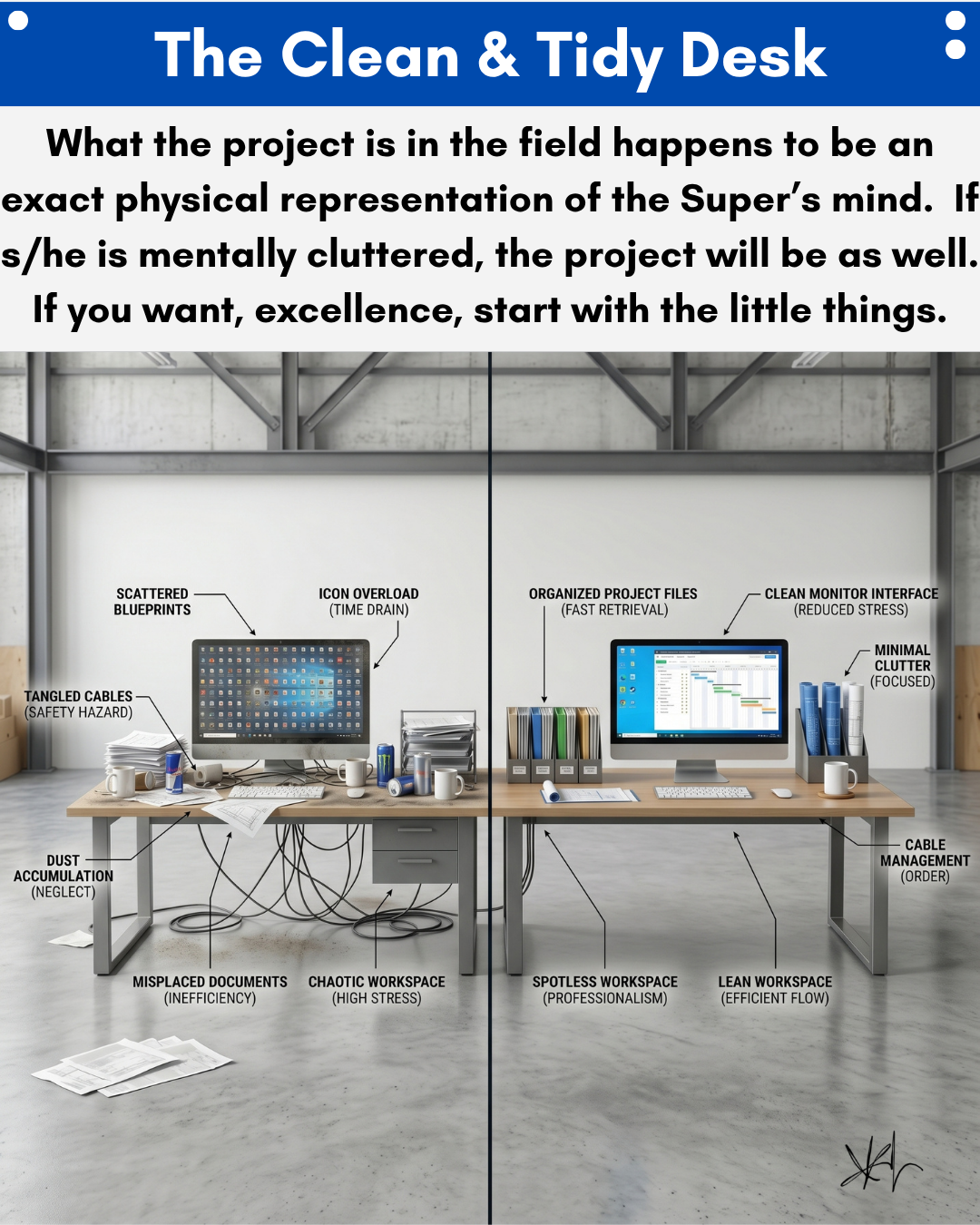
Look at the two versions of a superintendent’s desk side by side and what you are actually looking at is two different theories of leadership.
The cluttered desk operates on the theory that volume signals value. The more things visibly in motion, the more important the work must be. Documents everywhere means documents are being handled. A full screen means a full plate. The chaos is evidence of effort.
The clean desk operates on a different theory entirely. It says that the work has a system, and the system is what produces results. Documents have a place because finding them fast matters. Cables are managed because a tangle is a hazard and a signal that small things are not being maintained. The monitor has a clean interface because cognitive load is real and reducing unnecessary visual noise makes better decisions more likely. The workspace is organized because the person who works in it made a decision that their environment is a tool and tools perform better when they are maintained.
That second theory scales. The superintendent who applies it to their desk applies it to their laydown yard, their Takt zones, their material staging plan, their look-ahead schedule. The habit is the same habit at every scale. And the superintendent who tolerates chaos at their desk will find that they are tolerating it everywhere else too, usually without noticing, because the tolerance becomes the standard.
What a Clean System Actually Looks Like
Organized project files with fast retrieval means one thing above everything else: you decided in advance where documents live and you maintained that decision under pressure. That is harder than it sounds. The natural force on a busy project is to put things down wherever there is space and deal with the organization later. Later never comes. The decision has to be made once, upstream, and then protected.
A clean monitor interface is not about minimalism as a philosophy. It is about reducing the decision cost of finding what you need. An icon-overloaded desktop is a visual search problem that taxes the same cognitive resources you need for scheduling decisions, crew coordination, and problem solving. Clean it up and you recover capacity that was being spent on navigation.
Cable management is the smallest item on the list and the most symbolic. A tangle of cables is a hazard nobody has decided is worth ten minutes to fix. The ten minutes will never feel available. You take the ten minutes anyway, because the cable on the floor is the same logic as the material in the wrong zone, and you would not leave that alone on the deck.
Scattered blueprints and misplaced documents are the most costly items in operational terms. A document that cannot be found quickly is a constraint on every decision that document should be informing. On a project where an RFI response or a permit needs to be located in the middle of a field conversation, the four minutes it takes to find it in a pile is four minutes the crew is standing still. That cost is invisible in the ledger and very real in the schedule.
Signals Your Workspace System Has Gaps
Walk your desk the way you would walk a jobsite. Watch for these:
- You have opened the same document twice this week because you could not remember where you saved it the first time
- There are items on your desk that have been there for more than two weeks without a decision being made about them
- Finding a specific permit or submittal takes more than sixty seconds
- Your screen has icons you do not recognize or applications you have not opened in a month
- Cables on or near your work surface are creating a tangle you have simply stopped seeing
None of those are personal failings. Every one of them is a design gap you can close in an afternoon.
Why the Little Things Are Actually the Big Things
If you want excellence, start with the little things. That phrase is on the image and it is the heart of the whole teaching.
Every small habit scales. The superintendent who straightens the desk at the end of every day is building the same habit that straightens the laydown yard, enforces the Takt zone boundaries, and keeps the punch list from growing faster than it shrinks. The discipline is not different at different scales. It is the same discipline applied to different contexts, and it develops or atrophies based on what you practice in the small moments.
This is also why the desk matters for leadership credibility. Crews do not just follow instructions. They watch behavior. A superintendent who enforces organization on the deck and operates from a chaotic trailer is teaching that the standard is for them, not for leadership. A superintendent who holds the same standard in their own workspace is teaching that the standard is the standard, everywhere, including where nobody is checking. That is the kind of credibility that makes a crew actually internalize what you are asking for instead of just performing compliance when someone is watching.
The desk is visible. The project is visible. They are the same thing at different scales, and the discipline that connects them is available to every leader on any project, starting today. If your project needs superintendent coaching, project support, or leadership development, Elevate Construction can help your field teams stabilize, schedule, and flow. That work begins exactly here, with leaders who hold the same standard for themselves that they hold for the project, because that consistency is what the LeanTakt approach to field leadership is built on. Jason Schroeder teaches it this way: the project is a reflection of the leader, and the leader starts at the desk.
Start With the Desk
Here is your challenge. Before you walk the site today, walk your own workspace. Not to judge it. To read it the way you would read a jobsite. Find the tangled cable. Find the document stack that has no processing system. Find the three-week-old printout that never got filed. Fix one thing. Then fix one thing tomorrow.
Edwards Deming said: “It is not enough to do your best; you must know what to do, and then do your best.” Knowing what to do with your workspace is not complicated. The desk told you this morning what the standard has been. You get to decide what the standard is going to be.
On we go.
FAQ
Is desk organization really connected to project performance, or is this just a productivity trend?
The connection is causal, not correlational. A disorganized workspace produces specific operational failures: slow document retrieval, deferred decisions, missed items, and a cultural signal that standards are optional. Each of those has a direct cost on the project. Clean the workspace and those specific costs go down. It is not a productivity philosophy. It is a system design question.
What if I genuinely work better with some clutter?
There is a difference between a workspace that is actively being used and one that has no system. Active use means things are in motion toward a decision. No system means things land and stay wherever there was space. The test is whether you can find what you need in under sixty seconds and whether every item on your desk has a next action. If yes, the apparent clutter is managed. If no, it is a system gap.
How do you maintain organization during peak project phases when everything is moving fast?
You maintain it by making the reset a fixed daily habit rather than a reaction to the level of activity. Five minutes at the end of every day to clear the desk, file documents, and close open loops is easier to protect than a periodic reorganization that only happens when the chaos becomes unbearable. The busier the project, the more the system needs to be automatic rather than effortful.
If you want to learn more we have:
-Takt Virtual Training: (Click here)
-Check out our Youtube channel for more info: (Click here)
-Listen to the Elevate Construction podcast: (Click here)
-Check out our training programs and certifications: (Click here)
-The Takt Book: (Click here)
Discover Jason’s Expertise:
Meet Jason Schroeder, the driving force behind Elevate Construction IST. As the company’s owner and principal consultant, he’s dedicated to taking construction to new heights. With a wealth of industry experience, he’s crafted the Field Engineer Boot Camp and Superintendent Boot Camp – intensive training programs engineered to cultivate top-tier leaders capable of steering their teams towards success. Jason’s vision? To expand his training initiatives across the nation, empowering construction firms to soar to unprecedented levels of excellence.