
The Project Delivery Team Profile Wall: Why We Spend Weeks Aligning the Schedule and Minutes Aligning the People
A man on my project hated me. I had no idea why.
Here is the deal. What helped me figure it out was not a difficult conversation or a mediated sit down. It was a player card, a simple visual profile that our project delivery team filled out together, covered in team meetings, and posted on the wall. That card, and a companion document called “This Is Me,” a plain list of how each person on the team interacts best with others, gave me the answer I had been missing for weeks. He hated emails. He thought they were an irresponsible form of communication, something that let people avoid the accountability of a real conversation. And I loved emails. Writing one felt like writing a book, thorough and complete. So I stopped sending him non essential emails and started walking over to talk to him instead. The relationship repaired almost immediately.
The Pain That Hides Behind a Closed Door
Every project has at least one relationship like this, two people who should be working well together and instead are working around each other, and neither one can articulate exactly why. It does not look like conflict from the outside. Nobody is yelling. Nobody files a complaint. It looks like distance, a coolness in interactions, a slight delay in responses, a preference for working with anyone other than that one person when a choice is available.
The person on the receiving end of that coolness usually assumes something personal is going on. A perceived slight. A competence question. A character judgment. What is actually going on, far more often than anyone expects, is a communication mismatch that nobody ever surfaced because nobody ever built a mechanism for surfacing it. I was sending emails because emails were how I processed and communicated information best. He was reading those emails as evidence that I did not respect him enough to have a real conversation. Neither of us was wrong about our own preference. We were simply operating on two completely different assumptions about what respectful communication looked like, and nothing on the project ever gave either of us the chance to learn the other’s assumption before the friction had already built up.
The Failure Pattern
The failure pattern is investing enormous planning discipline into the schedule and almost none into the team that has to execute it.
Every project I have run has spent weeks building the schedule. Sequencing logic, milestone dates, Takt zones, look ahead planning, all of it debated, refined, and posted where the whole team can see it. That discipline is correct. A schedule deserves that level of attention. But the team executing that schedule, the actual humans who have to coordinate, communicate, and trust each other well enough to make the plan work, typically gets almost no equivalent planning attention. We assume people will figure out how to work together. We assume goodwill and professionalism will bridge whatever differences exist in how people communicate, what motivates them, and how they prefer to receive information.
Sometimes that assumption holds. Often it does not, and the cost shows up as exactly the kind of quiet friction I experienced, a relationship that never quite works, a communication style that keeps landing wrong, a misunderstanding that compounds because nobody had the information needed to interpret it correctly the first time.
They Didn’t Fail the System
When two people on a project are not working well together, the instinct is to assume a personality clash, a character issue, or a lack of professionalism on someone’s part. He is difficult. She does not communicate well. They just do not get along.
Look past that instinct and the real explanation is usually simpler and far more fixable. Neither person had the information needed to understand how the other actually processes communication, receives feedback, or prefers to be approached. I did not fail as a communicator by sending emails. I was communicating exactly the way that worked best for me, the way I had always communicated successfully with other people. He did not fail by preferring in person conversation. He was communicating exactly the way that worked best for him. The problem was never either person’s individual approach. The problem was that neither of us had a mechanism for discovering that our approaches conflicted before the conflict had already damaged the relationship.
What the Profile Wall Actually Does
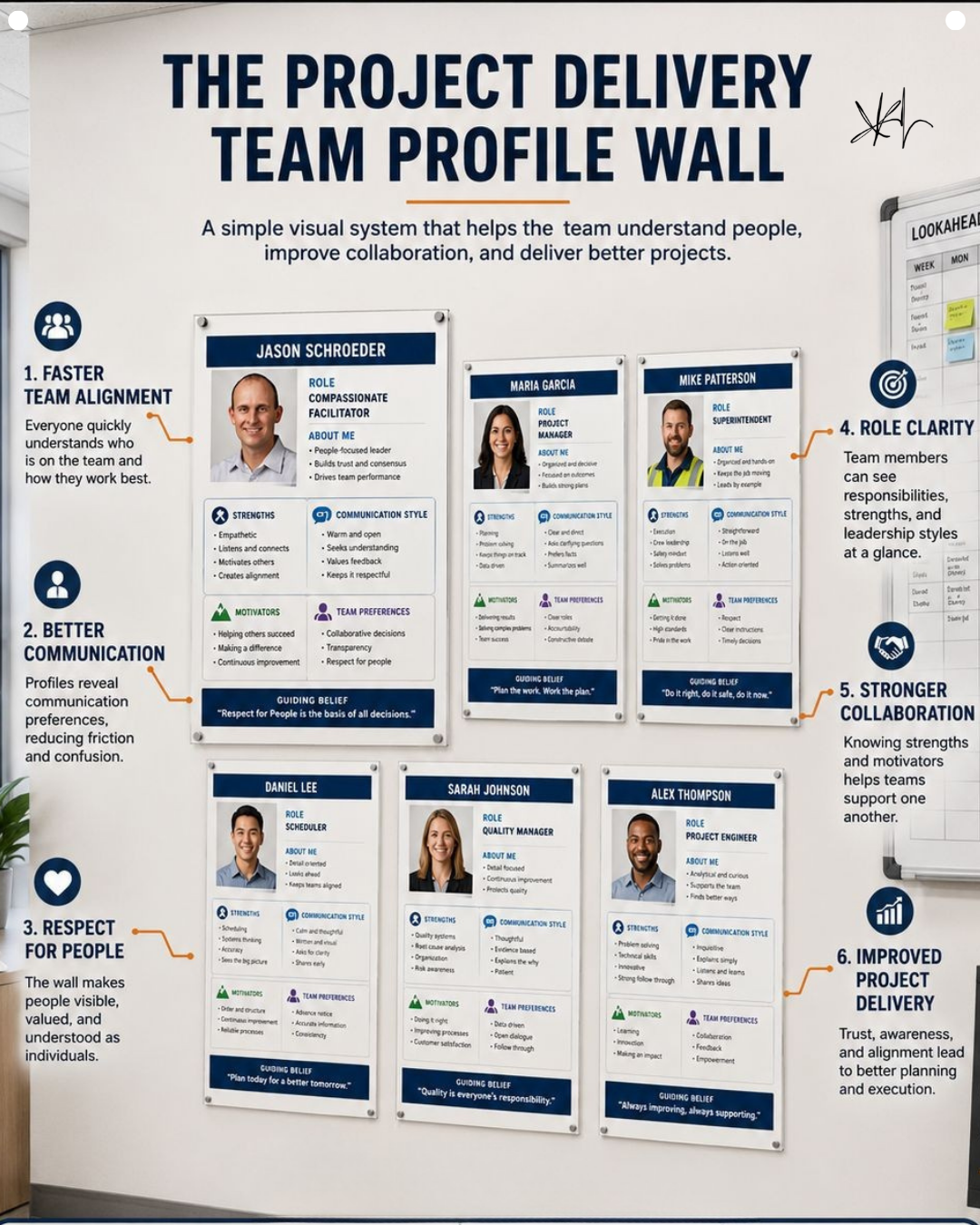
The Project Delivery Team Profile Wall is a simple visual system, and its simplicity is exactly what makes it work. Each team member’s card includes their role, a short personal description, their strengths, their communication style, what motivates them, their team preferences, and a guiding belief that captures how they approach the work.
That information, posted where the whole team sees it regularly, does something a private personnel file or a one on one conversation never accomplishes. It makes the information ambient. Nobody has to remember to ask a colleague how they prefer to receive feedback. It is on the wall. Nobody has to guess whether someone prefers written communication or a direct conversation. It is on the wall. The friction I experienced with that team member existed for weeks because the information that would have resolved it instantly was locked inside each of our own heads, invisible to the other person, and invisible to the project as a whole.
Faster team alignment happens because everyone quickly understands who is on the team and how they work best, without requiring weeks or months of trial and error to learn it the hard way, the way I did. Better communication follows directly, because profiles reveal communication preferences upfront, reducing the friction and confusion that comes from two people unknowingly operating on incompatible assumptions about how information should be shared.
Respect for people is built directly into the mechanism, not as an abstract value statement but as a concrete practice. The wall makes people visible, valued, and understood as individuals, rather than simply as roles filling positions on an org chart. Role clarity means team members can see responsibilities, strengths, and leadership styles at a glance, which matters not just for communication but for knowing who to bring a specific kind of problem to.
Stronger collaboration follows from knowing what motivates and drives each person, because understanding someone’s motivators lets you support them in a way that actually lands, rather than offering the kind of support you would want yourself but that may mean nothing to them. And improved project delivery is the compound result of all of the above. Trust, awareness, and alignment across the team translate directly into better planning and execution, because a team that understands each other coordinates with fewer of the invisible frictions that otherwise eat into every schedule.
Why This Matters Beyond the Individual Relationship
My relationship with that team member repaired almost immediately once I understood his communication preference. But something larger happened after that, something I did not expect. My career started to take off, not because I suddenly became smarter or more technically skilled, but because people started to know me. They understood my goals. They knew how to work with me, and I knew how to work with them.
That shift happens at the team level too, not just the individual level. A project delivery team that understands each other’s communication styles, motivators, and working preferences does not just avoid friction between any two specific people. It builds a collective fluency, a shared understanding that makes every interaction across the whole team faster and more accurate. Decisions get made with less back and forth because people already understand how their colleagues process information and what they need to feel confident moving forward. Feedback lands better because it is delivered in the style the recipient actually receives well, rather than the style the giver happens to default to.
Signals Your Team Needs This
Look at your own project delivery team and ask honestly whether these patterns exist:
- A relationship on the team that feels persistently off, without a clear, articulated reason why
- Team members who consistently default to working with certain colleagues and avoiding others, without a stated explanation
- Communication that keeps landing wrong despite good intentions on both sides
- New team members who take months to understand how to work effectively with established members, purely through trial and error
- A team that has invested heavily in schedule alignment but has never had a direct conversation about how each person prefers to communicate and be supported
Any one of those patterns is a signal that the team is missing information that would resolve itself quickly with the right tool.
Building the Wall on Your Own Project
Creating a profile wall does not require sophisticated tools or a formal assessment process, though structured personality profiles can add depth. The essential element is simpler than that. Each team member fills out a short, honest description of their own strengths, communication style, motivators, and preferences, in their own words. A companion document, a plain list titled something like “This Is Me,” captures the practical specifics, how they prefer to receive feedback, what kind of communication frustrates them, what makes them feel respected and heard.
The wall only works if the team actually covers it together, in a meeting, rather than posting it silently and hoping people read it on their own time. The conversation that happens while reviewing each card together is often where the real value gets unlocked, because people ask questions, clarify, and start building the mental model of their colleagues that the wall is designed to accelerate.
Aligning the People, Not Just the Plan
We spend weeks aligning the schedule and minutes aligning the people. Flip that early, and watch what happens. This is not about me and it never was. It is about teaming on a construction project, and every project I have led since that experience has treated team alignment with the same seriousness as schedule alignment, because the schedule only works if the people executing it actually understand each other well enough to coordinate without friction. If your project needs superintendent coaching, project support, or leadership development, Elevate Construction can help your field teams stabilize, schedule, and flow, and that work always starts with building a team that genuinely understands each other, because the plan is only as strong as the people executing it together.
Build Your Wall This Week
Here is your challenge. Take fifteen minutes at your next team meeting and have every person on your project delivery team fill out a simple card, strengths, communication style, motivators, and a guiding belief. Post it where the team sees it daily. Watch how quickly friction that has been quietly costing the project starts to resolve itself.
Jason Schroeder’s own guiding belief captures the whole idea in one line: “Respect for people is the basis of all decisions.” The schedule tells you what to build. The wall tells you who you are building it with.
On we go.
FAQ
Isn’t this just personality testing, and does that actually work in a construction context?
Formal personality assessments can add value, but the core practice here is simpler and more universally applicable: each person honestly describing their own communication style, motivators, and preferences in their own words. That self description does not require validated psychometric tools to be useful. It requires honesty and a team willing to actually read and discuss what each person shares.
How do you get a team, especially field crews, to actually engage with something that can feel like a soft or corporate exercise?
Frame it around the practical outcome rather than the process. Team members who understand this will reduce friction and miscommunication on the project quickly buy in once they see it work, the same way this relationship repaired almost immediately once the right information surfaced. Starting with a real story, like the email example, helps a skeptical team see the concrete value before asking them to fill out their own card.
Should this only include office and management staff, or does it apply to field crews too?
The principle applies at every level of the project delivery team, though the specific format may need to adapt for field crews who may not have a dedicated wall space the way an office team does. The underlying goal, giving people the information needed to understand how their colleagues communicate and what motivates them, matters just as much on the deck as it does in the trailer.
If you want to learn more we have:
-Takt Virtual Training: (Click here)
-Check out our Youtube channel for more info: (Click here)
-Listen to the Elevate Construction podcast: (Click here)
-Check out our training programs and certifications: (Click here)
-The Takt Book: (Click here)
Discover Jason’s Expertise:
Meet Jason Schroeder, the driving force behind Elevate Construction IST. As the company’s owner and principal consultant, he’s dedicated to taking construction to new heights. With a wealth of industry experience, he’s crafted the Field Engineer Boot Camp and Superintendent Boot Camp – intensive training programs engineered to cultivate top-tier leaders capable of steering their teams towards success. Jason’s vision? To expand his training initiatives across the nation, empowering construction firms to soar to unprecedented levels of excellence.