
Construction projects succeed or fail based on how well your people work together. When communication breaks down, deadlines slip, trades clash, and productivity suffers.
At a glance:
- Team building activities help construction teams develop communication skills, problem-solving skills, and trust
- Effective collaboration on the job site starts with relationships built off the job site
- Activities range from quick exercises during toolbox talks to full-day team building events
- The best construction team building activities mirror real challenges like time limits, limited resources, and working toward a common goal
- Investing in your team’s ability to work together pays off in fewer delays, less rework, and higher morale
Strong teams don’t happen by accident. They’re built through intentional effort, shared experiences, and a commitment to continuous improvement. This guide covers the best construction team building activities to strengthen your crew, improve communication, and boost productivity on every construction project.
What Is Team Building and Why Does It Matter in Construction?
Team building refers to activities and exercises designed to improve how a group of people works together. In the construction industry, this means helping superintendents, foremen, project managers, and field crews communicate more effectively, solve problems faster, and trust each other under pressure.
Construction work is inherently collaborative. A single construction project might involve dozens of trades, each with their own priorities and timelines. When one team member drops the ball, the ripple effects hit everyone. Missed handoffs lead to rework. Poor communication leads to conflicts. And when team spirit is low, productivity follows.
Team building activities address these issues by:
- Strengthening communication skills through practice and repetition
- Building trust between team members who may not interact daily
- Encouraging creative problem solving in low-stakes environments
- Creating opportunities for open dialogue between field crews and leadership
- Fostering a company culture where collaboration is the norm
The construction process is stressful enough. Teams that have built stronger relationships off the site handle that stress better when deadlines loom and problems arise.
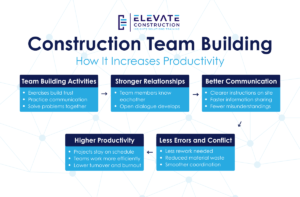
How Team Building Increases Productivity
The connection between team building and productivity isn’t abstract. It’s measurable. Teams that communicate well waste less time on misunderstandings. Teams that trust each other ask for help sooner rather than letting problems snowball. Teams with strong leaders and clear expectations stay focused on the common goal.
Here’s how team building directly impacts productivity on construction projects:
Better Communication Reduces Errors
When team members practice active listening and verbal communication in team-building exercises, those skills transfer to the job site. Clearer instructions mean fewer mistakes. Fewer mistakes mean less rework and wasted construction materials.
Stronger Relationships Improve Coordination
Trades that know and respect each other coordinate better. A framer who has built a free-standing structure out of duct tape and rubber bands alongside an electrician during a team challenge is more likely to communicate proactively when their work overlaps on a real construction site.
Trust Enables Faster Problem Solving
When something goes wrong, teams with high trust address it immediately. They don’t hide problems or point fingers. This kind of effective collaboration saves days or weeks on a troubled construction project.
Higher Morale Reduces Turnover
Construction teams with strong team spirit and positive company culture experience less burnout and lower turnover. Replacing experienced workers is expensive and disruptive. Keeping good people is one of the best investments you can make.
Top Construction Team Building Activities
The following activities are designed with construction teams in mind. They emphasize the skills your crews need most: communication, problem solving, time management, and working under pressure. Some work well for a small team during a lunch break. Others are better suited for large group events or company-wide training days.
1. The Marshmallow Challenge
This classic team building exercise tasks small groups with building the tallest free-standing structure using only spaghetti, tape, string, and a marshmallow that must sit on top. Teams have a strict time limit, usually 18 minutes.
Why it works for construction teams:
- Mimics the pressure of real deadlines
- Requires planning, communication, and creative thinking
- Reveals how teams handle failure and iterate on innovative solutions
- Sparks friendly competition between crews
The Marshmallow Challenge is a perfect opportunity to discuss how construction management principles apply even to a silly exercise. Debrief afterward to talk about what worked and what didn’t.
2. Blind Build Challenge
In this team-building exercise, one team member gives verbal instructions to another who is blindfolded. The blindfolded person must assemble a simple structure using blocks, PVC pieces, or other construction materials based only on what they hear.
Why it works for construction teams:
- Emphasizes the importance of clear verbal communication
- Builds active listening skills
- Highlights how easily instructions can be misunderstood
- Works well for smaller groups or breakout sessions
This activity pushes people out of their comfort zone and demonstrates that effective communication requires both a good sender and a good receiver.
3. Construction Site Scavenger Hunt
Organize a scavenger hunt that takes place on a job site (during downtime or on a dedicated training day). Teams compete to find specific items, answer questions about safety protocols, or complete small tasks scattered across the site.
Why it works for construction teams:
- Gets people moving and engaged
- Reinforces site familiarity and safety awareness
- Encourages collaboration between team members who don’t usually work together
- Scalable for small groups or a large group
A scavenger hunt adds energy and friendly competition to what might otherwise be a routine training day. It’s also a great way for newer group members to learn the site layout.
4. Bridge Building Competition
Divide your team into small groups and challenge them to build a bridge using limited materials like popsicle sticks, rubber bands, cardboard, and duct tape. The bridge must span a set distance and hold a specified weight. The team whose bridge holds the most weight wins.
Why it works for construction teams:
- Directly relates to construction concepts like load bearing and structural integrity
- Requires planning, resource management, and time management
- Encourages teams to test, fail, and improve before final judging
- Demonstrates best practices in iterative design
This activity is ideal for team building events focused on the construction process itself. It gives field crews and office staff a shared experience that relates to their actual work.

5. Two Truths and a Lie (Construction Edition)
This quick team building activity works well at the start of meetings or during breaks. Each team member shares three statements about their career or experience in the construction industry. Two are true, one is a lie. The group guesses which is false.
Why it works for construction teams:
- Helps team members learn about each other’s backgrounds
- Builds rapport and trust in a low-pressure setting
- Takes only a few minutes per person
- Works for any group size
Simple activities like this foster trust and open dialogue without requiring extensive planning or equipment. They’re especially useful for integrating new hires into an existing team.
6. Problem Solving Relay
Set up a series of stations, each with a different problem to solve. These could include puzzles, logic problems, or construction-related challenges like reading a blueprint section or calculating material quantities. Teams rotate through stations with a time limit at each.
Why it works for construction teams:
- Tests a variety of problem-solving skills
- Requires teams to divide tasks based on individual strengths
- Adds time pressure that mimics real project deadlines
- Encourages knowledge sharing between group members
This relay format keeps energy high and gives every team member a chance to contribute. It’s a great option for larger team building events.
7. Virtual Team-Building Activities for Remote Teams
Not all team members are on site every day. Project managers, engineers, and remote teams benefit from virtual team-building activities that can be done over video calls. Options include online escape rooms, trivia competitions, or collaborative planning exercises using digital whiteboards.
Why it works for construction teams:
- Includes office staff and remote teams in team building efforts
- Builds connections between field and office personnel
- Flexible scheduling for dispersed teams
- Reinforces that everyone contributes to project success
Virtual activities shouldn’t replace in-person team building, but they’re a valuable supplement for construction companies with distributed teams.
8. After-Action Reviews
While not a traditional game, after-action reviews function as a powerful team-building exercise. Following a project milestone or completed phase, gather the team to discuss what went well, what didn’t, and what the team would do differently next time.
Why it works for construction teams:
- Builds a culture of continuous improvement
- Encourages honest feedback and open dialogue
- Identifies best practices worth repeating
- Gives every team member a voice
After-action reviews position the team leader as a facilitator rather than a critic. When done well, they strengthen relationships and improve performance on the next construction project.
Making Team Building Part of Your Company Culture
One team building event per year won’t transform your construction team. The most successful companies integrate team building into their regular operations. This might mean:
- Starting weekly meetings with a quick team building exercise
- Holding quarterly team building events tied to project milestones
- Encouraging team leaders to organize informal activities for their crews
- Celebrating wins together to reinforce team spirit
- Creating mentorship pairings to foster trust between experienced workers and newer team members
The goal is to make effective collaboration a habit, not an exception. When team building becomes part of your company culture, the benefits compound over time.
Build a Stronger Team With Elevate Construction
Great construction teams do more than build structures. They build trust, communication, and a shared commitment to excellence. The team building activities in this guide offer a starting point, but lasting change requires more than a few exercises.
Elevate Construction helps construction companies reverse productivity decline by developing balanced teams, respected trades, and systems that stick. From leadership training for superintendents and foremen to project recovery for troubled builds, Elevate provides the tools and coaching your team needs to perform at their best.