
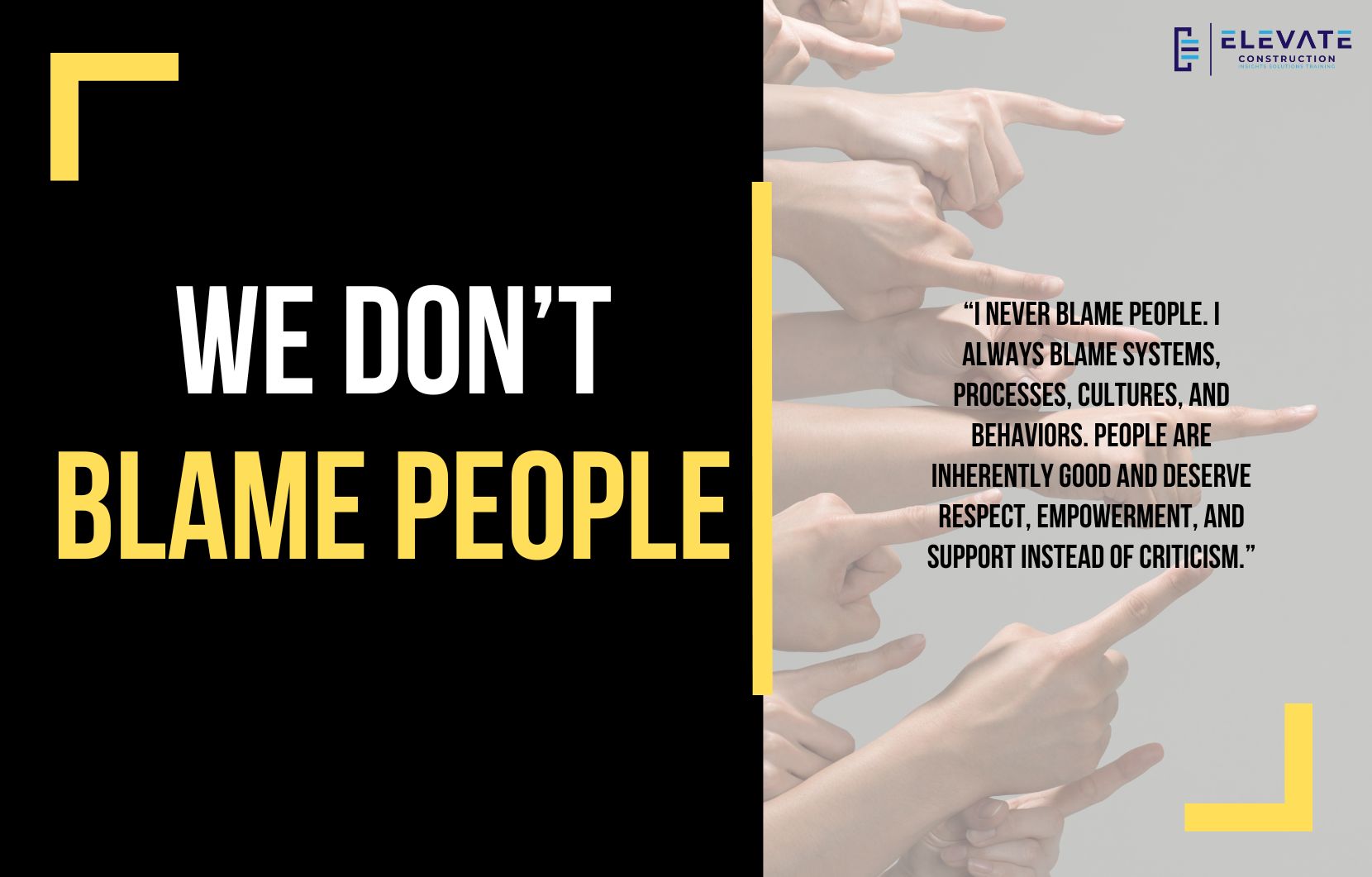
In construction and in life, I have learned that it is far too easy to point fingers when things go wrong. But I truly believe that people are inherently good. The real problems do not come from the individuals themselves but from the systems, processes, behaviors, and cultures that surround them.
Short answer: We don’t blame people because people are inherently good. When something goes wrong, the cause is almost always the system, process, behavior, or culture around them. Blaming people destroys trust and morale. Fixing the system protects people’s dignity and actually improves the work.
Why Should Leaders Blame the System, Not the People?
Whenever I see someone blaming people, I see the damage it creates. It destroys trust, lowers morale, and creates toxic environments that are hard to repair. When I hold the system accountable instead, I find opportunities to make real improvements that actually help the people I care about.
For me, respecting people means believing in their potential, standing up for them, and not letting broken or harmful systems hold them back. Whether it is unsafe practices, poor planning methods, or ineffective management tools, I feel a responsibility to challenge the process while protecting the dignity of those doing the work.
I also know that telling the truth about broken systems is one of the most respectful things I can do. If I stay quiet, people continue to get hurt by methods that do not serve them. By speaking up, I help others avoid harm and open the door for growth.
I have seen over and over again that leadership is about empowerment. Foremen, field engineers, and superintendents are closest to the work. They should be trusted and supported to prepare and execute work packages. To sideline them is diminishing leadership. To elevate them is multiplier leadership.
This mindset is not always easy. It takes patience, and it takes investment in people. But I know the alternative is worse. If I blame individuals, give up on them, and tolerate broken systems, then nothing ever improves. The path I choose is to believe in people, work on improving the systems around them, and commit to creating a culture of respect.
What Do We Mean by “We Don’t Blame People”?
When we say we do not blame people, we do not blame their true selves: their core self, soul, conscience, or present self, depending on your worldview.
Our bodies and brains are survival machines, always scanning for threat, always reacting, always protecting. Eckhart Tolle calls that part of us the ego. The ego lives in fear, in the past, in the future. It lashes out, hides, fights, and defends.
Our true self is something different. It is conscious. It can override instinct. It can choose.
So when someone behaves poorly, what are we really seeing? Their true self? Or something else? That question changes everything.
What Shapes Behavior, If Not the Person?
When someone falls short, the cause is almost always one of these forces, not their true self:
- System
- Process
- Environment
- Culture
- Learned and prompted behavior
Any one of these can override a person’s intentions. When we focus on the person instead of the conditions, we fail to solve the real problem.
What Changes When We Stop Blaming People?
When we stop blaming people and start addressing root causes, extraordinary things start to happen:
- Teams stop attacking each other and start attacking problems.
- Conflict turns into collaboration.
- People feel safe to speak up.
- High performance becomes possible.
- Respect for people becomes a lived reality, not a slogan.
Why Does Lean Thinking Require Respect for People?
Lean thinking is built on this foundation. The Japanese culture that birthed lean holds a deep belief in the inherent value of every human being. Not that every behavior is good, but that every person contains a true self worth honoring.
If we want to be true lean thinkers, we do not blame the person. We find the system issues, the process issues, the environment, the culture, and the prompts, and we fix the root cause. That is how we elevate people. That is how we elevate construction.
Key Takeaway
I never blame people. I always blame systems, processes, cultures, and behaviors. People are inherently good and deserve respect, empowerment, and support instead of criticism.
For more on this, see Respect for People, Nature, & Resources.
So here is the challenge: the next time something goes wrong, look at the system, process, behavior, or culture before you look at the person.
Bottom line: Blame the system, never the people, and fix the system so the people doing the work can succeed.
If your project needs superintendent coaching, project support, or leadership development, Elevate Construction can help your field teams stabilize, schedule, and flow.
On we go.
FAQ
Why shouldn’t construction leaders blame people?
Blaming people destroys trust, lowers morale, and creates toxic environments that are hard to repair. Holding the system accountable shows you where to make real improvements.
Who should prepare and execute work packages?
Foremen, field engineers, and superintendents, because they are closest to the work. Sidelining them is diminishing leadership. Elevating them is multiplier leadership.
People Also Read:
See People, See the System
There Is No Such Thing as Firing Someone
If you want to learn more we have:
-Takt Virtual Training: (Takt Virtual Training)
-Check out our YouTube channel for more info: (Elevate Construction on YouTube)
-Listen to the Elevate Construction podcast: (Elevate Construction Podcast)
-Check out our training programs and certifications: (Training Programs and Certifications)
-The Takt Book: (The Takt Book on Amazon)
Discover Jason’s Expertise:
Meet Jason Schroeder, the driving force behind Elevate Construction. As the company’s Founder and COO, he’s dedicated to taking construction to new heights. With a wealth of industry experience, he’s crafted the Field Engineer Boot Camp and Superintendent Boot Camp – intensive training programs engineered to cultivate top-tier leaders capable of steering their teams towards success. Jason’s vision? To expand his training initiatives across the nation, empowering construction firms to soar to unprecedented levels of excellence.