
Something has been on my mind lately. This post is a quick overview of leadership and what people think leadership is.
Short answer: Leadership isn’t just telling people what to do, and it isn’t only influence. It’s integrity, casting a vision, influence, a teaspoon of power, praising your team, self-awareness, listening first and speaking last, and empathy.
Does a Superintendent Need a College Degree?
Someone asked me: he’s 43, didn’t attend college, has worked in construction for over 20 years, and is moving into the superintendent role. Do I believe a superintendent needs a college education?
I started working in construction as a teenager, finishing concrete, setting forms, and operating equipment. Around 18, I got a job as a finisher at Hensel Phelps in Victorville, California. I was an apprentice when I hurt my shoulder and told them I was out. They said, we want to keep you, come be a rod man for our field engineers until you heal. I fell in love with it, learned the total station, bought my own computer, taught myself AutoCAD, and started doing lift drawings. The rest is history.
Around 31 or 32, I went back to school for a year, got straight A’s, and built a good base in English and math. I was going to become a doctor because I had a passion to help people. Then I realized I could help just as many people in construction. So I stopped and progressed through my career with other training, certifications, and books.
I don’t think school is the defining characteristic. I know college-educated people it benefited, and people who didn’t go and aren’t doing well, and people who went and aren’t doing well. The difference is whether the person has a growth mindset and keeps learning the right things. Take certifications, learn lean from the AGC, learn design-build, take scheduling and safety courses. To be a warrior, do you need an axe? No. You need to be able to wield a weapon. And there’s no substitute for experience. College is another wonderful option, and I praise those who make it through the grind. Read How to Become a Construction Project Manager Without a Degree.
What Do People Think Leadership Is?
I saw a LinkedIn post by Aaron Johnson on what people think leadership is: telling people what to do. That’s a misconception, and I’ve done it quite a bit myself. I also see quotes that say leadership is only about influence. Come on. These radical statements likely aren’t true. Leadership is a mixture, and his post had a neat summary of how complex it is. It isn’t everything, but it’s a brilliant list. Let’s turn it into a little assessment.
| Leadership element | What it means |
|---|---|
| Integrity | Be who you are, consistently, so people know what they’re following. |
| Casting a vision | Explain the what and the parameters, and let the team own the how. |
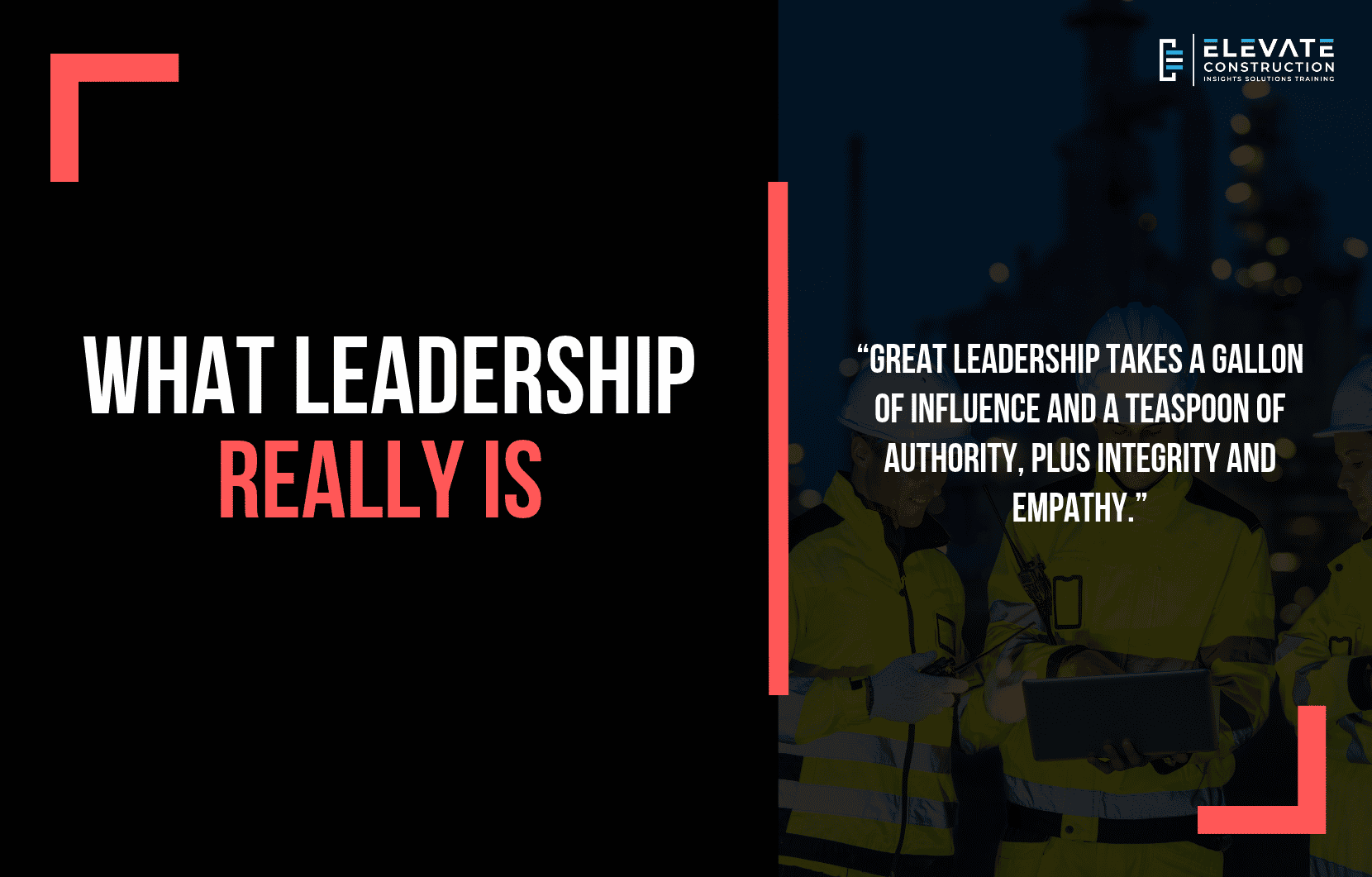
| Using influence and power | A gallon of influence and a teaspoon of authority. |
| Praising your team | People need to be recognized, known, and relevant. |
| Self-awareness | Admit mistakes and ask for help. |
| Listening first, speaking last | Gather information from your people before steering. |
| Empathy | Listen to their story and believe them. |
What Does Integrity Look Like?
What e’er thou art, act well thy part. Whoever you are, be that, and show it consistently. If you’re a vulnerable, kind, loving person, don’t put on a rough superintendent shell. Being two-faced confuses people, and they don’t know whether to follow you. Integrity doesn’t mean following what I believe. It means following what you believe, so people can decide whether to follow you. Read Build a Little Better – Honesty & Integrity.
How Do You Cast a Vision?
This is one of my favorites. I’ve been rightfully accused of chucking things over the wall: here’s what we need to do, please figure out how. I give training, follow up, and provide instruction, but I expect a lot of the how to be figured out. Now I do it better. When feedback, observation in the field, and data show we need a new direction, our leadership team crafts it, and I get everyone together and say, this is where we’re headed, and these are the parameters.
When we transitioned to different leadership structures at Elevate and LeanTakt, the parameters were: move at the pace of customer care, don’t go all at once, train our replacements, and don’t burn people out. Then I asked the organization to figure out how. The managers felt so empowered that they owned it. It was remarkable.
Why a Gallon of Influence and a Teaspoon of Power?
Influence means people like you, want to follow you, feel relevant around you, are aligned with you, and want to do what you ask. But people in organizations naturally look for hierarchy. My father-in-law, a trade partner, once realized mid-meeting that the assistant super he was talking to couldn’t authorize anything. He asked, who am I talking to? Who can make this decision? A teaspoon of authority removes that barrier.
At DPR, which I love, superintendents have complete autonomy. As a superintendent, our team ran a world-class project. But when I acted as a general superintendent, it was like pushing a rope. Without that teaspoon of authority, no matter how much influence I had, teams reverted to what they wanted to do.
Why Do Praise, Self-Awareness, Listening, and Empathy Matter?
I praise my team all the time, authentically. People need to be recognized. On self-awareness, I mess up every day. I told our team, we may not always get it right, but we will always make it right. A general superintendent once told me never to let anyone figure me out or admit a mistake. That’s categorically wrong. When you’re vulnerable, people see you’re human and come to help.
Listen first and speak last, or you’ll make siloed decisions in an ivory tower, disconnected from the field. Go listen, gather information, and say, we listened and we’re responding. And empathy means listening to someone’s story and believing them, even when you don’t want it to be your fault. Let me believe you, ask what you need, and provide it, even if it hurts my ego. Read Empathy & Connection.
So here is the challenge. Score yourself on all seven elements, and pick the one where your team would say you’re weakest.
Bottom line: Leadership isn’t just telling people what to do. Lead with integrity, vision, influence, a teaspoon of power, praise, self-awareness, listening, and empathy.
If your project needs superintendent coaching, project support, or leadership development, Elevate Construction can help your field teams stabilize, schedule, and flow.
Want your team trained on this? See our Last Planner® System and Takt training.
On we go.
Frequently Asked Questions
Is leadership just telling people what to do?
No. Leadership includes integrity, casting a vision, using influence, using power, praising your team, self-awareness, listening first and speaking last, and empathy. It isn’t only about influence either.
How much power should a leader use?
My rule is a gallon of influence and a teaspoon of authority. Influence makes people want to follow. A little authority removes the barrier of not knowing who can make the decision.
Does a superintendent need a college degree?
I don’t think college is the defining characteristic. What matters is a growth mindset, continual learning of the right things, such as certifications and lean, scheduling, and safety courses, and real experience.
People Also Read:
How to Win Friends and Influence People
Safety Leadership for Field Engineers
Can You Be a Construction Manager With an Associate’s Degree?
Executive Level Leadership Development
If you want to learn more we have:
-Takt Virtual Training: (Takt Virtual Training)
-Check out our YouTube channel for more info: (Elevate Construction on YouTube)
-Listen to the Elevate Construction podcast: (Elevate Construction Podcast)
-Check out our training programs and certifications: (Training Programs and Certifications)
-The Takt Book: (The Takt Book on Amazon)
Discover Jason’s Expertise:
Meet Jason Schroeder, the driving force behind Elevate Construction. As the company’s Founder and COO, he’s dedicated to taking construction to new heights. With a wealth of industry experience, he’s crafted the Field Engineer Boot Camp and Superintendent Boot Camp – intensive training programs engineered to cultivate top-tier leaders capable of steering their teams towards success. Jason’s vision? To expand his training initiatives across the nation, empowering construction firms to soar to unprecedented levels of excellence.