
The Most Important Meeting in Construction Deserves Better Than a Gravel Parking Lot
Here’s the deal: the morning worker huddle is the most important meeting in construction. That’s not an opinion. Jason Schroeder has taught it consistently across hundreds of projects, and the data bears it out I have never seen a Lean, operationally excellent project without a Morning Worker Huddle. The meeting creates one social group. It aligns the team on the plan, communicates the safety focus, delivers training, and builds the shared understanding that makes a hundred separate workers function as one team for the next eight hours.
And on most job sites, we hold it in a gravel parking lot. In the rain. In ninety-five-degree heat. Workers half-listening because they’re already cold, wet, or standing in direct sun before the day has even started. The most important meeting in construction is being held in the worst possible conditions for communication, retention, and care.
We can do better. And the Worker Huddle Building is how we do it.
What the Parking Lot Huddle Communicates
Before a single word is spoken in a huddle, the environment has already sent a message. When workers file into an open parking lot in the Arizona July heat, stand for thirty minutes on pavement, and try to absorb a safety briefing over the noise of generators the message is clear: the project didn’t think about them before they arrived. They are here to produce. Where they stand while preparing to produce is not anybody’s concern.
That message does not stay in the parking lot. It follows workers through the gate, down to the floor, and into their approach to the work. People who feel unvalued produce at the level the environment communicates they are worth. Not because they are choosing to underperform because culture flows directly from the conditions leadership creates. The culture of any organization is shaped by the worst behavior the leader is willing to tolerate. Tolerating an outdoor gravel huddle in a Phoenix summer as the setting for the most important meeting of the day is a leadership decision. It produces a leadership result.
A Story About What the Environment Signals
I set up a project early in my career where we prioritized the morning worker huddle from day one. We had a covered, conditioned space ready before the first trade mobilized. Tables. Chairs. A display screen for the daily agenda. Refreshments for the morning. Workers walked in on day one and the reaction was immediate and unmistakable. These were experienced trade crews who had worked on dozens of projects. Most of them had never had a place to sit for the morning briefing, let alone a climate-controlled one with food. By the end of the first week, attendance was remarkable. Workers were arriving early because the huddle was worth arriving early for.
The platform didn’t just improve the meeting. It transformed the relationship between the project team and the workforce. Foremen were more engaged. Workers raised problems faster. Training topics got remembered because people weren’t distracted by discomfort. The whole project ran differently not because the Takt plan changed or the schedule improved, but because the daily social foundation of the team was built in a space that communicated: you matter here.
What the Worker Huddle Building Is Built Around
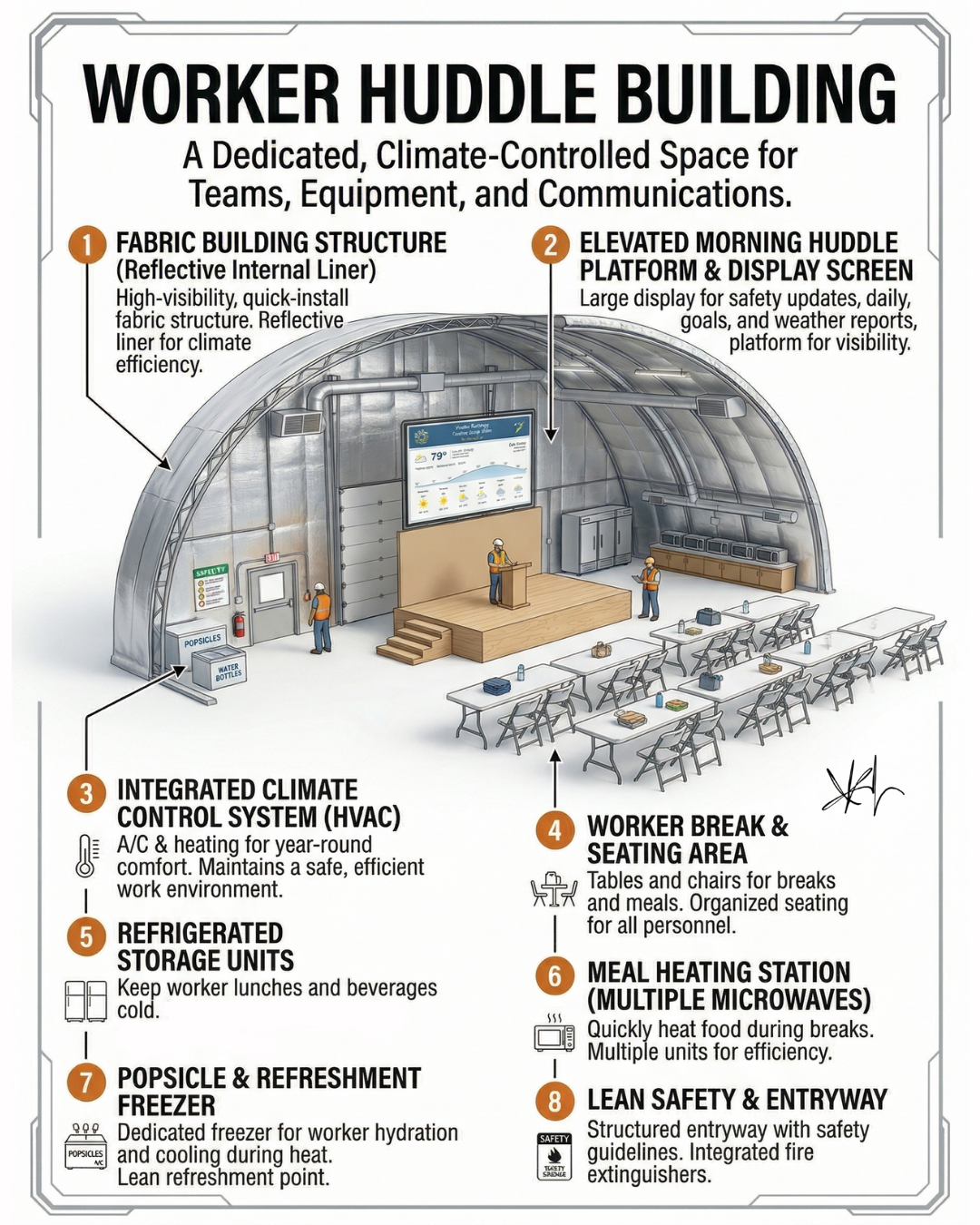
The image in this post shows what a fully designed Worker Huddle Building looks like when it’s built for a large project. The fabric building structure with reflective internal liner is high-visibility, quick to install, and climate-efficient keeping the interior cooled in summer and heated in winter with the integrated HVAC system. The structure is not a tent. It is a dedicated, purpose-built space for the most important daily event on the project.
The elevated morning huddle platform and large display screen are the operational center of the space. The platform gives the huddle leader visibility to the whole crowd and projects authority in the room. The display screen shows safety updates, daily goals, weather reports, and any project-specific communications the team needs before entering the site. This is not a clipboard and a verbal briefing it’s a structured communication environment that matches the importance of what’s being communicated.
The worker break and seating area with tables and chairs serves double duty: the morning huddle gathering space and the break environment throughout the day. Refrigerated storage units keep lunches and beverages cold. Multiple microwaves in the meal heating station mean fifty workers don’t queue for twenty minutes during a thirty-minute break. And the popsicle and refreshment freezer small gesture, enormous signal says we thought about the 105-degree afternoon you’re going to work through, and we planned for it.
Watch for these signals that the huddle environment is undermining the huddle itself on your project:
- Workers are visibly distracted by heat, cold, or noise before the safety briefing even begins
- Training topics delivered in the huddle are not being retained because of environmental discomfort
- Attendance is inconsistent because the huddle space feels like a punishment rather than a valued gathering
- Workers linger near the gate after the huddle because there is nowhere else to go before crews prep
- The break experience is so inadequate that workers are spending breaks off-site, reducing the afternoon start efficiency
The Lean Safety Entryway and the Culture It Creates
The lean safety entryway with integrated fire extinguishers and safety guidelines is the first contact every worker has with the building before they enter the huddle space. This is orientation-level communication at the daily scale. Safety requirements are visible. Fire suppression equipment is staged at the entry, not stored somewhere harder to find. The standard is communicated before anyone sits down, and it is communicated by the environment itself not by a verbal reminder that competes with conversation and noise.
This is visual management applied to the worker’s first thirty seconds in the building. When the entryway communicates the standard, the standard doesn’t need to be enforced through friction and confrontation. The space says it. Workers absorb it on the way in, before the huddle even starts. That ambient communication is one of the most undervalued mechanisms in construction safety culture. Standards that are visible in the environment become part of the environment. Standards that only live in meetings live only as long as the meeting lasts.
Why Scale Doesn’t Change the Principle
Here’s what’s important to understand about the Worker Huddle Building: it is not a solution only for billion-dollar programs. The principle behind it applies at every scale. On a large data center program, it’s a purpose-built climate-controlled building. On a mid-size hospital project, it’s a conditioned trailer configured for a morning meeting of one hundred people. On a smaller commercial renovation, it’s a cleared room inside the building with a portable display and a water cooler. The dollar amount changes. The principle doesn’t.
The principle is this: the morning worker huddle is the most important meeting in construction, and it deserves a space worthy of its purpose. Whatever that space looks like on a given project, it should be designed with the same intention as the staging yard, the logistics system, and the Takt plan. It should communicate care before anyone speaks a word. It should be comfortable enough that workers are paying attention when the safety focus is delivered. It should be the part of the day that workers actually want to show up to because when they want to show up, everything about the day goes better.
If your project needs superintendent coaching, project support, or leadership development, Elevate Construction can help your field teams stabilize, schedule, and flow. The morning worker huddle and the space that holds it is where that stability begins every single day.
Carve Out the Space. Hold the Huddle. Every Day.
Here is the challenge. Before your next project mobilizes, make the morning worker huddle space a preconstruction deliverable not an afterthought. What structure will hold the full workforce? Is it climate-controlled for your project’s season and location? Does it have a platform and display capability for the daily briefing? Are there enough tables and seating for the full crew to sit for breaks? Is there food and refrigeration? Is there a clean, designated entryway with safety communication visible from the moment workers arrive?
Answer those questions with the same rigor you apply to the zone plan. Then build the space before the first trade mobilizes. Feed the crews. Cool them down in summer. Warm them up in winter. Look them in the eye every morning and tell them the plan. Because how we care for our workers is exactly how they will care for the building.
As Jason Schroeder teaches: “When workers feel listened to and respected, magic happens, and the outcome is a project team that sees as a group, knows as a group, and acts as a group.” Build the space that makes that possible. Every morning. Every project.
On we go.
Frequently Asked Questions
What is the Worker Huddle Building and what does it include?
It’s a dedicated, climate-controlled structure for the daily morning worker huddle equipped with a display platform, seating, refrigeration, meal heating, refreshments, and a Lean safety entryway. The size and budget scale with the project; the principle applies everywhere.
Why does the huddle space need to be climate-controlled?
Because workers who are hot, cold, wet, or physically uncomfortable cannot fully attend to safety briefings, training topics, or alignment conversations. The environment determines the quality of the communication it holds.
What does the elevated platform and display screen accomplish?
The platform gives the huddle leader visibility to the entire crowd and communicates authority in the space. The display screen shows safety updates, daily goals, weather, and project communications in a format every worker can see simultaneously.
If you want to learn more we have:
-Takt Virtual Training: (Click here)
-Check out our Youtube channel for more info: (Click here)
-Listen to the Elevate Construction podcast: (Click here)
-Check out our training programs and certifications: (Click here)
-The Takt Book: (Click here)
Discover Jason’s Expertise:
Meet Jason Schroeder, the driving force behind Elevate Construction IST. As the company’s owner and principal consultant, he’s dedicated to taking construction to new heights. With a wealth of industry experience, he’s crafted the Field Engineer Boot Camp and Superintendent Boot Camp – intensive training programs engineered to cultivate top-tier leaders capable of steering their teams towards success. Jason’s vision? To expand his training initiatives across the nation, empowering construction firms to soar to unprecedented levels of excellence.