The Situation Room

Read 23 min

The Situation Room: How a Construction Command Center Changes What Leadership Can Do

Generals cannot be everywhere. So we build the room that brings everywhere to them.

That sentence is the whole idea, and it is not a metaphor. It is an operational design decision that changes what a general superintendent can see, what they can respond to, and how fast a large, complex project can move when something goes wrong. The situation room is not a luxury for oversized egos. It is the logical answer to an impossible problem: how does one leader maintain strategic visibility across multiple active zones, dozens of trade partners, and hundreds of concurrent decisions without spending all day walking and none of it thinking?

The Pain of Leading Without Visibility

Here is what leading a large project without a command center actually looks like. The general superintendent starts the day in a field meeting, walks the gemba, catches a problem in Zone 3, spends forty minutes on it, misses the trade huddle in Zone 7, hears about a logistics conflict secondhand at lunch, gets to the trailer at two in the afternoon with a stack of messages, and spends the rest of the day reacting to things that already happened instead of positioning for things that are coming.

That is not a personal failure. That is what happens when a leadership role is designed around physical presence as the primary information channel. When the only way to know what is happening is to go look at it, the leader’s information is always incomplete, always delayed, and always limited by how many places a single person can physically be in a day.

The schedule suffers because decisions that should happen in the morning happen in the afternoon. Constraints that should get driven out on Monday are still open on Thursday. The make-ready planning for the next Takt phase happens in whatever time is left after everything urgent has been handled, which means it often does not happen well. The trades are waiting on answers while the general is physically unavailable, because physically unavailable is the only mode the system offers.

The Failure Pattern

The failure pattern is not that general superintendents are bad leaders. The failure pattern is that we give senior leaders a physical presence model and then wonder why they cannot achieve strategic outcomes.

A project engineer has a desk, a screen, a filing system, and a set of tools designed for the kind of work a project engineer does. A foreman has a plan table, a communication channel to their crew, and a daily rhythm designed for the kind of work a foreman does. A general superintendent has a trailer with a desk, a phone, and a pair of boots, and is expected to hold strategic visibility across a multi-million dollar operation by walking around and asking questions.

The mismatch between the role and the infrastructure provided for it is the failure, not the person filling it. When the information environment cannot support the decisions required, the decisions suffer, and the project absorbs the cost in schedule, quality, and constraint resolution that always runs behind where it needs to be.

They Didn’t Fail the System

When a general superintendent is behind on constraint removal, slow on decision-making, or perpetually reactive rather than strategic, the organization’s instinct is to say they need better time management, or more discipline, or a stronger system for follow-through.

Those diagnoses almost always miss the real problem. A leader operating without adequate information infrastructure cannot make better decisions through discipline alone. You cannot be more strategic when the only input stream available to you is what you can personally observe by walking the site. You cannot drive out constraints faster when the mechanism for learning about constraints is someone finding you on the deck and telling you about it.

The information environment is the constraint. Upgrade the environment and the leadership capability that was always there becomes visible. Leave the environment the same and add more accountability pressure, and the result is a better-disciplined leader who is still missing half of what is happening on their project.

What the Situation Room Actually Is

The situation room is a command center, not a corner office. The distinction matters.

A corner office is designed for separation. It signals status, provides quiet, and puts distance between the senior leader and the operational noise of the project. A command center is designed for integration. It pulls information in from every active zone and gives the leader real-time visibility into what is happening across the whole project without requiring physical presence in each location.

The physical setup centers on an open workspace where the core executive team sits together without walls of separation. Elevated desks around the perimeter create space for direct reports to come in, brief, strategize, and leave without the overhead of a scheduled meeting. A wall of screens brings in live jobsite camera feeds, drone footage, logistics maps, zone overviews, the Macro Takt plan, and key project KPIs simultaneously. Whiteboards cover available wall space for brain dumps, constraint tracking, delegation networks, and capturing decisions in real time. A clock on the wall. A view of the actual jobsite through the windows. The field is never fully out of sight.

The rhythm that makes it work is the movement between field and room. The day starts in the field. Walk the gemba, run the trade huddles, be physically present where the work is happening. Then return to the room to observe, decide, delegate, track, and prepare. The room is not a replacement for field presence. It is the platform that makes field presence more effective by ensuring that when the general is in the room, they are working from complete information rather than the partial picture that physical presence alone can provide.

What the Screens Are Actually For

The wall of screens is not a status symbol and it is not theater. Each feed serves a specific operational function that would otherwise require a person to be physically present or a meeting to be scheduled.

Live jobsite cameras and drone footage give the general superintendent real-time visual access to zones they are not standing in. When a logistics conflict develops on the north elevation while the general is in a meeting on the south side of the project, the camera feed surfaces it without requiring a runner or a radio call. The problem enters the room, not the leader’s voicemail.

The Macro Takt plan on screen makes schedule status visible as a live document rather than a report that gets generated and distributed. When a zone falls behind its Takt rhythm, the deviation is visible in the room before it becomes a crisis in the field. That time advantage is the entire value of Takt planning at the leadership level. Seeing a problem two days before it compounds is the difference between a constraint removal conversation and a recovery plan.

KPI dashboards for safety compliance, project margin, and zone performance turn information that typically arrives in weekly reports into something the leadership team can see and respond to daily. The lag between what happens on a project and what leadership knows about it is one of the most expensive gaps in construction. The screens close that gap.

Signals Your Leadership Infrastructure Has Gaps

Before you design the room, look for these patterns in how your leadership currently operates:

  • The general superintendent learns about significant field problems in the afternoon that happened in the morning
  • Constraint removal conversations are scheduled as meetings rather than happening as continuous visibility
  • The make-ready planning for the next Takt phase consistently happens later than it should because current phase problems consume all available leadership attention
  • Direct reports are physically searching for the general superintendent rather than having a known place to find them and brief them
  • Strategic decisions are getting deferred because the leader does not have enough current information to make them confidently

Any one of those patterns is evidence that the information environment is the constraint. All five together describe a leadership system that is running on incomplete data and burning capacity on information retrieval that the room would make automatic.

The Delegation Network That Makes It Real

The situation room is not effective without a delegation network that connects the room to the field. The Empire State Building ran on runners carrying intelligence between leadership and the trades. The modern version is field engineers, project coordinators, live camera feeds, and dashboards all feeding the general at once, and the general deploying decisions and direction back out through the same channels.

This means the role of the field engineer and project coordinator changes in a situation room model. They are not just processing paperwork and managing submittals. They are the information infrastructure of the project, bringing field intelligence into the room with enough speed and specificity that the general can act on it while it is still actionable. That role is worth investing in, training for, and designing around, because the room is only as good as the quality of information flowing through it.

The whiteboards in the room exist for exactly this reason. When a field engineer brings in a constraint, it goes on the board. When the general assigns it, the delegation goes on the board. When it gets resolved, it comes off. The board is the live system record of what is in motion and who owns it, visible to everyone in the room, which means accountability is environmental rather than reliant on anyone’s memory or follow-through.

Why This Is About More Than Operations

A general superintendent operating from a well-designed command center leads differently, not just more efficiently.

When you can see the whole project at once, you stop reacting to the loudest problem and start managing toward the most important one. You make faster decisions because you have current information. You delegate more effectively because you can track what you have delegated. You invest in make-ready planning for future phases because your attention is not entirely consumed by the current one. You bring your direct reports into strategic thinking because the room creates space for that conversation to happen naturally rather than in stolen minutes between field emergencies.

That is the leader the project needs, and it is the leader most general superintendents are capable of being. The situation room does not create that capability. It removes the infrastructure constraint that was preventing it from showing up. If your project needs superintendent coaching, project support, or leadership development, Elevate Construction can help your field teams stabilize, schedule, and flow. Jason Schroeder and the Elevate team build the systems, the room design, the delegation networks, and the Takt rhythms that give field leaders the platform to lead at the level the project requires.

Build the Room Before You Need It

Here is your challenge. You do not need a full command center to start. You need a wall, a screen, a whiteboard, and a decision about what information should be visible to leadership in real time rather than arriving in a report after the fact. Start there. Identify the three things you most often learn about too late. Design a system that gets those three things into your field of view before they compound.

Edwards Deming said: “A bad system will beat a good person every time.” The general superintendent who is working without a command center is working inside a bad system, regardless of their talent or experience. Build the system. Then lead.

On we go.

FAQ

Is a situation room realistic for a smaller project or a smaller company?
The principle scales down significantly. A single screen with a live camera feed, a Takt plan on the wall, and a whiteboard for active constraints is a situation room at a smaller scale. The concept is about designing for information visibility rather than physical presence as the primary input. That design decision is available at any project size.

How do you keep the room from becoming a place where leaders hide from the field?
By building the field walk into the daily rhythm as a non-negotiable first event. The room does not replace gemba. It extends the value of gemba by giving the leader a place to process what they observed, delegate what they identified, and track what they assigned. Leaders who skip the field walk and operate only from screens lose the ground-level intelligence that makes the screens meaningful.

What should be on the wall of screens?
Start with the information you most often learn about too late. Live cameras covering the highest-risk or highest-complexity zones. The current Takt plan showing zone status. A safety compliance dashboard. A logistics map showing material flow. Add from there based on what your specific project needs to surface faster than it currently does.

If you want to learn more we have:

-Takt Virtual Training: (Click here)
-Check out our Youtube channel for more info: (Click here) 
-Listen to the Elevate Construction podcast: (Click here) 
-Check out our training programs and certifications: (Click here)
-The Takt Book: (Click here)

Discover Jason’s Expertise:

Meet Jason Schroeder, the driving force behind Elevate Construction IST. As the company’s owner and principal consultant, he’s dedicated to taking construction to new heights. With a wealth of industry experience, he’s crafted the Field Engineer Boot Camp and Superintendent Boot Camp – intensive training programs engineered to cultivate top-tier leaders capable of steering their teams towards success. Jason’s vision? To expand his training initiatives across the nation, empowering construction firms to soar to unprecedented levels of excellence.
Why Do Construction Meetings Waste So Much Time?

Read 19 min

Why Construction Meetings Waste So Much Time

Here’s the deal. Construction meetings do not waste time because meetings are inherently a waste of time. They waste time because most of them are run badly, and bad meetings are a skill problem, not a meeting problem.

Patrick Lencioni wrote a book called Death by Meeting that gets at exactly this. Every meeting system, every board, and every rhythm we run at Elevate is aligned with the method in that book, because it names the actual disease instead of just complaining about the symptom.

The Meeting You Have Sat Through a Hundred Times

You know this meeting. It opens five minutes late because half the room is still finding chairs. There is no agenda, or there is one nobody looks at. The first fifteen minutes cover safety, then the schedule, then a submittal question, then a personnel issue, then back to the schedule again because somebody remembered something. Nobody assigned who owns what. Two people are on their phones. One trade partner sits through forty minutes of content that has nothing to do with his scope, waiting for the two minutes that do. It ends without anyone stating what happens next, and everybody leaves less clear than when they walked in.

That is not a schedule problem or a personality problem. That is a format problem, and it is exactly the format Death by Meeting diagnoses.

The Real Disease Is Meeting Stew

Lencioni’s core insight is that most organizations run what he calls meeting stew. Every topic gets thrown into one pot. Strategic issues sit next to daily tactical issues sit next to long range planning, all in the same sixty minutes, with no distinction between them. Nobody can focus, because focus requires knowing what kind of conversation you are actually in.

Construction inherits this problem badly, because a jobsite genuinely has multiple kinds of meetings that need to happen at different rhythms. A daily huddle is not the same conversation as a weekly look ahead, and a weekly look ahead is not the same conversation as a monthly strategic review with the owner. When all of that gets batched into one undifferentiated meeting, or when a single meeting drifts across all three without anyone noticing, you get exactly what everybody complains about. Long, unfocused, low value time that people resent attending.

The fix starts with a simple distinction: separate meetings by type, and protect each type from bleeding into the others. Daily huddles stay short and tactical. Weekly coordination stays focused on the next two to three weeks of work. Strategic conversations get their own separate time, on their own separate cadence, so they never eat the daily huddle’s five minutes or the weekly meeting’s hour.

Good Meetings Do Not Suck, Bad Meetings Suck

Here is the sentence worth putting on the wall of every jobsite trailer. Good meetings do not suck. Bad meetings suck. The problem was never the format called meeting. The problem is what most people do with that format.

A meeting adds value when it does a handful of specific things, every time, without exception.

  • Invite the right people, and only the right people, for the topic at hand
  • Bring a real agenda, known in advance, not assembled on the spot
  • Capture attention in the first sixty seconds instead of easing in
  • Keep it interesting all the way through, not just at the open
  • Make it applicable to every person in the room, or do not make them sit through it

Notice what is missing from that list. There is nothing about making meetings shorter for the sake of being shorter, and nothing about eliminating meetings altogether. The goal is not less meeting. The goal is a meeting that earns the time it takes.

Solve Real Problems With Healthy Conflict

The next requirement is the one most construction meetings skip entirely. Solve real problems, and let healthy conflict happen while you do it.

A lot of jobsite meetings avoid conflict on purpose, because conflict feels uncomfortable and everybody wants to get back to work. So real disagreements about sequencing, access, or quality get smoothed over in the room and then fought out later through change orders, RFIs, and hallway conversations that never should have needed to happen. That is slower and more expensive than just having the argument in the meeting where it belongs.

Healthy conflict means disagreeing about the work itself, directly and respectfully, until the room actually resolves something. It does not mean personal attacks, and it does not mean one person dominating the room. It means a superintendent and a trade partner hashing out a real access conflict until there is an actual answer, instead of both nodding along and letting the conflict resurface next week in a worse form.

Then, as you go, assign action items in real time. Not as a follow up email sent an hour later that half the room never reads. Name the owner, name the deadline, and say it out loud in the room before you move to the next topic. That single habit prevents more rework than almost anything else on this list, because vague ownership is where accountability goes to die.

Close With Real Purpose

The end of a meeting matters as much as the middle, and it is the part almost everyone skips. Close with real purpose. Do not let the meeting just trail off when the clock runs out. State what was decided, who owns what, and what happens next, out loud, before anyone leaves the room.

Here is a test that works well. Pretend you are being watched and judged the entire time. Would an outside observer walk away thinking that was a genuinely good use of everyone’s time, or would they think it was a waste? Run every meeting as if that judgment is actually happening, because in a sense it is. Every person in that room is silently making exactly that judgment, and it shapes whether they show up engaged next time or show up already checked out.

The System Failed the Meeting, Not the People in It

I want to be clear about where the blame actually belongs, because a lot of superintendents and project managers carry guilt about meetings that were never set up to succeed.

If nobody ever taught you how to structure a meeting by type, protect an agenda, or close with clear ownership, then running a bad meeting was not a personal failure. It was the predictable result of never being given the format. Most construction professionals learned meetings by watching other unstructured meetings, which is how meeting stew spreads from one generation of leaders to the next. You cannot inherit a bad pattern and be blamed for repeating it before anyone shows you a better one.

That is exactly why this is a skill issue rather than a meeting problem, and skill issues are fixable. Nobody needs a personality transplant to run a good meeting. They need a format, a little practice, and the discipline to protect it once they have it.

Good Meetings Are the Price of Alignment

Here is the reframe that changes how a team feels about the time itself. Good meetings are the price we pay for alignment. Bad meetings waste time. Those are two different costs, and only one of them is actually worth resenting.

Alignment is not free. Seeing as a group, knowing as a group, and acting as a group requires some amount of shared time, and that time is not waste when the meeting is run well. It is the mechanism that keeps trades from working at cross purposes, keeps a schedule from drifting silently for two weeks before anyone notices, and keeps a superintendent from being the only person who understands what is actually happening on the project. A well run huddle, a well run look ahead, a well run coordination meeting, each of those buys something real. The resentment people feel toward meetings is really resentment toward meeting stew, buried agendas, and closes with no purpose, not toward the concept of gathering people together.

If your project needs superintendent coaching, project support, or leadership development, Elevate Construction can help your field teams stabilize, schedule, and flow, including the meeting rhythms that either protect that flow or quietly destroy it. Fixing meetings is rarely the hardest system on a project to fix, and it is often the highest leverage one, because every other system depends on people actually being aligned.

So here is the challenge for this week. Take your worst recurring meeting, the one everyone privately dreads, and run it once against this list. Separate the topics by type. Invite only who belongs. Bring a real agenda. Solve one real problem with honest conflict. Assign the action items out loud. Close with a clear statement of what happens next. Then ask the room, honestly, whether that felt like a good use of their time.

Edwards Deming said it plainly: “A bad system will beat a good person every time.” A meeting with no structure is a bad system, no matter how good the people in the room are. Give them a structure worth their time.

On we go.

FAQ

How many types of meetings should a typical construction project run?
Most projects benefit from separating at least three: a short daily tactical huddle, a weekly coordination or look ahead meeting focused on the next two to three weeks, and a longer term strategic or planning meeting on a monthly or milestone based cadence. Keeping these distinct prevents daily tactical noise from consuming the time meant for longer range decisions.

What is the fastest fix for a meeting that has become meeting stew?
Split the agenda by type before the next meeting happens. Pull out anything strategic or long range and schedule it separately, then protect the remaining meeting for only the tactical topics it was originally meant to cover. This single change often cuts meeting length significantly without removing any real content.

How do you invite healthy conflict without meetings turning into arguments?
Set the expectation up front that disagreeing about the work is expected and welcome, while disagreeing about people is not. Direct the conflict at the decision on the table, such as a sequencing choice or an access conflict, and keep pushing until the room reaches an actual resolution rather than a polite non answer. A facilitator who names unresolved tension out loud usually gets better results than one who lets it go unspoken.

If you want to learn more we have:

-Takt Virtual Training: (Click here)
-Check out our Youtube channel for more info: (Click here) 
-Listen to the Elevate Construction podcast: (Click here) 
-Check out our training programs and certifications: (Click here)
-The Takt Book: (Click here)

Discover Jason’s Expertise:

Meet Jason Schroeder, the driving force behind Elevate Construction IST. As the company’s owner and principal consultant, he’s dedicated to taking construction to new heights. With a wealth of industry experience, he’s crafted the Field Engineer Boot Camp and Superintendent Boot Camp – intensive training programs engineered to cultivate top-tier leaders capable of steering their teams towards success. Jason’s vision? To expand his training initiatives across the nation, empowering construction firms to soar to unprecedented levels of excellence.
Can AI Actually Replace Construction Managers?

Read 17 min

Can AI Replace Construction Managers? Yes and No, and the Line Between Them Matters

Here’s the deal. I am not going to pretend AI is not already replacing people, because it is, and I have watched it happen to my own work. What I want to do is draw an honest line between the work that is genuinely at risk and the work that is not, so you can plan your career instead of just being anxious about it.

What I Have Already Watched AI Replace

I write books, and almost every week, at minimum every month, I see AI quietly take over a task that used to require a person. It happened to me accidentally, not as some grand strategic decision. Tools like ChatGPT and Claude got so good at formatting that I stopped needing formatters to prepare manuscripts for the publisher. Then it got good enough that I stopped needing an editor. Then researchers. Now, to a real extent, I do not need lawyers for contract review, and I do not need as many programs or people to review contract drawings for quantities and similar takeoffs.

None of that happened because I planned a layoff. It happened because a tool crossed a quality threshold and the human step became unnecessary. That is the pattern to pay attention to, because it is going to keep repeating.

The Test That Actually Predicts Who Is Safe

Here is the answer I landed on after watching this play out in my own work. AI will replace the PMI style project manager, because that role is largely button pushing and administration. It will not replace a real builder, and I would be stunned if that changed in the next forty or fifty years.

The dividing line is not the job title on somebody’s badge. It is whether the work is administrative processing of information that already exists, or whether it is judgment, physical knowledge, and leadership applied to conditions that have not happened yet. Administrative work follows rules on existing inputs. Building work requires reading a room, reading a wall, reading a crew, and making a call nobody wrote down in advance.

Why Administration Is the Most Exposed Work in Construction

Think about what a lot of traditional project management actually is day to day. Updating status reports. Moving line items between columns. Producing documentation that restates decisions someone else already made. Formatting submittals. Chasing signatures. That is exactly the category of work AI has already eaten in other industries, and it is the category it will keep eating here.

I will say something that will annoy some people in the industry. The Project Management Institute style of paper management is going to get replaced by AI, and honestly, I am glad, because most of what PMI teaches is a waste of time. It optimizes for documentation and process compliance rather than for actually building anything. If the entire value of a role is producing and moving documents, a language model is going to do that faster, cheaper, and more consistently than a person, and there is no version of loyalty to tradition that changes that outcome.

Watch for these as leading indicators that a role sits in the exposed category:

  • The job is measured mainly by reports produced, not decisions made in the field
  • Most of the day is spent restating information that already exists somewhere else
  • Success depends on formatting, tracking, and compliance rather than judgment under uncertainty

If two or three of those describe a role, that role is on the clock, and the person in it should be building field skill now, not later.

Why Real Builders Are a Different Category Entirely

Now the other side of the line. Real builders, strategists, tacticians, logisticians, people who actually know how to build, know how to review work, know how to lead a team, know how to move people through a site, know how to organize a job, and have a trade or a hands on skill, are not in the same category as a paper pusher, and I do not say that to be dramatic.

Building requires reading physical conditions that were never fully documented anywhere. It requires standing in a zone and knowing that the framing looks slightly off before you can articulate why. It requires looking at a crew on a Tuesday morning and knowing whether they are ready for the day or whether something is wrong that has not been said out loud yet. It requires leading people through a hard week, which means understanding fear, pride, fatigue, and motivation well enough to move a group of humans toward a deadline they did not choose. None of that is administration. None of that is button pushing. That is judgment built from years of pattern recognition in the physical world combined with the ability to lead other human beings, and it is nowhere close to what a language model does.

The System Failed the Managers Who Only Learned Administration

I want to be fair to the people currently sitting in exposed roles, because none of this is their fault.

A lot of construction professionals were trained into a system that told them administration was the path to advancement. Get the PMI certification. Master the software. Learn to produce the reports the owner wants. Nobody sat them down and said the real long term security in this industry is field competence, leadership, and trade skill, because for a long time the administrative path looked like the safer bet. That was a reasonable choice inside the system that existed at the time. The system is what changed underneath them, not their effort or their intelligence.

That means the fix is not shame. It is a clear signal about where to invest the next stretch of a career, and enough support to make that pivot possible.

What To Build Instead, Starting Now

If administration is exposed and field leadership is not, the path is straightforward even if it is not easy. Get closer to the actual work. Learn to read drawings against physical conditions rather than just processing them. Learn to run a Takt board and lead the handoffs that keep a schedule honest, because that is judgment applied to people and space, not paperwork. Learn to lead a morning huddle, hold a standard, and read a crew, because none of that can be automated by a tool that has never stood in a zone.

If your project needs superintendent coaching, project support, or leadership development, Elevate Construction can help your field teams stabilize, schedule, and flow. The teams that invest in field leadership now, rather than administrative process, are the ones that will still have irreplaceable people in ten years, because you cannot download the judgment that comes from actually building things.

Why This Is Ultimately Good News for the People Who Build

I know this can sound alarming, so let me end with the part that should actually be reassuring.

AI eating administrative waste is not a threat to the people who build. It is a correction. Construction has spent decades over rewarding paperwork and under rewarding the craft knowledge and leadership that actually deliver a project. If AI strips out the button pushing and the redundant reporting, that frees up money and attention for the people who read walls, lead crews, and solve problems that were never written down anywhere. That is not a smaller future for real builders. It is a future where their value is finally undeniable, because the administrative noise that used to obscure it is gone.

So here is the challenge. Look honestly at your own week. Count how many hours went into producing or moving documentation versus how many hours went into leading people or solving a physical problem in the field. Wherever that ratio is upside down, that is exactly where to start rebalancing, starting Monday.

Edwards Deming said it plainly: “A bad system will beat a good person every time.” A system that rewarded paperwork over craft was the bad system. Building real skill and real leadership is how you get on the right side of the correction that is already underway.

On we go.

FAQ

Will AI eventually replace superintendents too?
Not in any timeframe worth planning around. Superintendents lead people, read physical conditions in real time, and make judgment calls under uncertainty on the spot, none of which resembles the pattern matching a language model performs on existing data. Administrative tasks a superintendent handles, like reports and schedules, are more exposed than the leadership and field judgment core to the role.

Is it wasteful to get a PMI certification at this point?
The certification itself is not worthless as a credential, but the underlying skill set it emphasizes, heavy documentation and process compliance, is the part most exposed to automation. If someone is early in their career, time is better spent building field competence, leadership skill, and trade knowledge alongside any administrative credential, not instead of it entirely.

How quickly should someone in an administrative construction role start shifting their skills?
Now, and gradually rather than all at once. Start by seeking out field time, shadowing a superintendent, learning to read drawings against real conditions, and practicing leading a small group task. The goal is to build the judgment based skills that stay valuable while AI continues absorbing the reporting and documentation work.

If you want to learn more we have:

-Takt Virtual Training: (Click here)
-Check out our Youtube channel for more info: (Click here) 
-Listen to the Elevate Construction podcast: (Click here) 
-Check out our training programs and certifications: (Click here)
-The Takt Book: (Click here)

Discover Jason’s Expertise:

Meet Jason Schroeder, the driving force behind Elevate Construction IST. As the company’s owner and principal consultant, he’s dedicated to taking construction to new heights. With a wealth of industry experience, he’s crafted the Field Engineer Boot Camp and Superintendent Boot Camp – intensive training programs engineered to cultivate top-tier leaders capable of steering their teams towards success. Jason’s vision? To expand his training initiatives across the nation, empowering construction firms to soar to unprecedented levels of excellence.
What’s The Biggest Mistake Every Superintendent Makes?

Read 19 min

The Biggest Mistake Every Superintendent Makes, and It Is Not What You Think

Here’s the deal. I am about to say something that will make some people mad, and I want to say it anyway, because it is true and because I care about the people it affects most. The biggest mistake every superintendent makes is being weak.

Not lazy. Not dumb. Weak, in the specific sense of being permissive. Not demanding perfect cleanliness. Not demanding beautiful safety. Not demanding good organization. Not controlling the environment. Wanting to be buddy with the trades instead of running the site. That is the mistake, and it shows up on more jobsites than any of us want to admit.

What Weak Actually Looks Like on a Jobsite

Walk a lot of active sites and you will see the same pattern. The fence is beat up and the entryway is nasty. The trailers are dirty. Trades show up whenever they feel like it, sometimes claiming they have to because they are paid by the piece. Work happens on whatever rhythm each crew invents for itself, whenever they want. People walk around without their safety glasses. Nobody can find anything, so everybody spends half the morning on a treasure hunt for tools, material, or information. Trades come to meetings inconsistently, if at all. There is no morning worker huddle. There are no standards posted anywhere that anyone actually holds to.

None of that is one bad day. That is what a site looks like when nobody is willing to enforce a standard, and it is more common than it should be.

The System Failed These Supers Before They Failed Anyone Else

I want to be careful here, because I do not want this to land as an attack on superintendents. I love supers. I have been one. What I am describing is a behavior, and the behavior did not appear out of nowhere.

Most supers were never taught how to hold a standard with confidence. Nobody modeled it for them. Nobody gave them the posture, the language, or the backup to walk up to a foreman and say the entryway is unacceptable and it will be fixed today. So they learned the only alternative they had, which is to go along to get along, because going along feels safer than confrontation when you have never been trained for it. That is not a character flaw. That is an enablement gap. We asked people to run sites without ever building the mindset and the confidence that job requires.

I say this from experience. I had to watch the movie Patton multiple times just to get my own shoulders back and find that confidence. I had to listen to mentors like Paul Akers, who does not put up with anything, until some of that rubbed off on me. If I needed the reps, most supers need the reps too. That is not weakness in the person. That is a gap in how we develop the person.

Command and Control Was Never the Real Problem

The Lean community likes to say that command and control is the biggest problem in construction. I disagree, and I will say why.

If you gave me a choice between milktoast, permissive superintendents running dirty, unsafe, disorganized sites, or old fashioned command and control that actually holds a standard, I would take command and control every time. At least that gets you a clean, safe, organized jobsite. The real failure mode is not too much authority. It is a total absence of it, dressed up as being easygoing.

Here is the test I use. Could you imagine Toyota putting up with a filthy entryway and inconsistent safety glasses? Could you imagine Google tolerating that? Could you imagine SpaceX tolerating it? Could you imagine Paul Akers tolerating it? Could you imagine a Japanese sensei tolerating it? The answer is no, every time, and it is not because those organizations run on fear. It is because they never confused kindness with permissiveness. They hold a hard line on the standard and they are genuinely good to their people at the same time. Those are not opposites. We just act like they are.

Confidence and Standards Beat Rules Alone

Here is where I want to be precise, because there is a wrong way to fix this and a right way.

The wrong way is to swing back to old school command and control built on fear, yelling, and disrespect. That creates its own damage and its own turnover, and it is not what I am asking for. The right way is a superintendent who holds a firm, non negotiable standard for cleanliness, safety, and organization, and does it from a place of confidence and genuine respect for the trades, not from a place of needing to be liked by them.

The biggest problem we actually have is supers who cannot control the environment or the rhythm on their own project, because nothing else is possible once that control is gone. You cannot run a Takt plan on a site where trades show up whenever they want. You cannot protect a buffer if nobody respects the schedule enough to show up for the huddle. You cannot hand off a clean zone if nobody has ever been told that a dirty handoff is unacceptable. Every other system we teach depends on this one thing being true first: the superintendent controls the site, and everyone on it knows it.

Watch for these signs the environment has slipped out of a superintendent’s control:

  • Trades setting their own start times and calling it piecework logic
  • No consistent morning huddle, or one that half the trades skip without consequence
  • Safety glasses, hard hats, or basic PPE treated as optional depending on who is watching
  • An entryway, fence line, or trailer area that nobody owns

Any one of those is a signal. Two or three of them together mean the standard has already collapsed.

What Confidence Looks Like in Practice

Confidence here does not mean volume. It means clarity, consistency, and follow through, held with respect for the people you are holding it with.

It starts with naming the standard out loud and in writing, so it is not a matter of the superintendent’s mood that day. Clean means clean, defined specifically enough that a trade partner knows exactly what it looks like before they leave a zone. Safe means safe, with no gray area on PPE, and no exceptions made because a crew is behind schedule. Organized means the huddle happens every morning, the trades who commit to being there are there, and the plan for the day is visible to everyone instead of living in one person’s head.

Then it requires actually enforcing it the first time it is tested, because the first time you let a standard slide is the day everyone learns the standard is optional. That does not mean humiliating anyone in front of their crew. It means a direct, respectful, immediate conversation the moment the line gets crossed, followed by the same conversation again if needed, until the standard is simply how the site operates. Consistency is what builds the confidence, not the other way around. You do not wait to feel confident before you hold the line. You hold the line, and the confidence catches up.

If your project needs superintendent coaching, project support, or leadership development, Elevate Construction can help your field teams stabilize, schedule, and flow. A lot of supers do not need a personality transplant. They need somebody to model what firm and respectful looks like until it becomes their own default, the same way I needed mentors and repetition before it became mine.

Why This Is Actually About Respect, Not Control

I want to connect this back to the people on your site, because that is the whole point.

A superintendent who lets standards slide is not being kind to the trades. It feels like kindness in the moment, because nobody gets told no. But permissiveness produces a dirty, disorganized, unsafe environment, and that environment is what your craft workers have to live inside for eight or ten hours a day. Letting the fence stay broken and the trailers stay filthy is not respect. It communicates that nobody cares enough to fix it. A superintendent who holds a real standard, clearly and consistently, is telling every person on that site that their safety and their working conditions matter enough to defend.

That is what LeanTakt and Elevate Construction are built around at the root. Flow, stability, and respect all depend on somebody controlling the rhythm of the site with confidence. Without that, none of the rest of it is even possible.

So here is the challenge. Walk your site this week the way a stranger would walk it. Look at the entryway, the fence, the trailers, and the PPE compliance with fresh eyes. Wherever you find yourself making an excuse for what you see, that is exactly where your standard has slipped, and that is exactly where to start holding the line again tomorrow morning.

  1. Edwards Deming put it plainly: “A bad system will beat a good person every time.” An enablement gap that leaves supers without the confidence to hold a standard is exactly that kind of system failure, and it is fixable.

On we go.

FAQ

Isn’t holding a hard line on cleanliness and safety just command and control by another name?
No, and the difference matters. Command and control as it is usually criticized relies on fear, disrespect, and one way authority. Holding a firm standard for cleanliness, safety, and organization can be done with genuine respect for the trades and without raising your voice. The behavior looks similar from a distance, a superintendent who does not accept excuses, but the posture underneath it is completely different.

How does a new superintendent build this kind of confidence if it does not come naturally?
The same way anyone builds a skill, through modeling and repetition. Watch and listen to people who hold standards well, whether that is a mentor on your own project or documented examples of leaders who never accepted a lowered bar. Then practice holding small standards consistently, like the morning huddle or PPE compliance, before tackling bigger confrontations. Confidence tends to follow consistent action rather than precede it.

What is the first standard a superintendent should fix if the site has slipped?
Start with whatever is most visible to everyone who enters the site, because visible standards set the tone for everything less visible. The entryway, the fence line, and the trailer area are usually the fastest wins, followed immediately by a consistent morning huddle. Once people see that visible standards are actually enforced, less visible ones like schedule discipline and quality tend to follow.

If you want to learn more we have:

-Takt Virtual Training: (Click here)
-Check out our Youtube channel for more info: (Click here) 
-Listen to the Elevate Construction podcast: (Click here) 
-Check out our training programs and certifications: (Click here)
-The Takt Book: (Click here)

Discover Jason’s Expertise:

Meet Jason Schroeder, the driving force behind Elevate Construction IST. As the company’s owner and principal consultant, he’s dedicated to taking construction to new heights. With a wealth of industry experience, he’s crafted the Field Engineer Boot Camp and Superintendent Boot Camp – intensive training programs engineered to cultivate top-tier leaders capable of steering their teams towards success. Jason’s vision? To expand his training initiatives across the nation, empowering construction firms to soar to unprecedented levels of excellence.
The Clean and Tidy Desk

Read 22 min

The Clean and Tidy Desk: Why a Superintendent’s Workspace Is a Leadership System

The project in the field is an exact physical representation of the superintendent’s mind.

That statement lands differently depending on where you are in your career. If you have been in the field long enough, you have probably walked a jobsite and known within ten minutes what kind of leader was running it. Not from the schedule. Not from a conversation. From the state of the laydown yard, the condition of the gang boxes, the way materials were staged, the cleanliness of the work areas. The site told you everything before anyone said a word. What most people don’t follow that observation all the way back to is this: that site started at a desk.

The Pain Nobody Wants to Admit

Here’s the deal. A superintendent’s office or trailer desk is usually one of the most chaotic spaces on any project, and it is treated that way on purpose, or at least with permission. The chaos gets reframed as busyness. Stacks of documents mean you are handling a lot. A screen full of icons means you have a complex job. Tangled cables and coffee cups and scattered blueprints mean you are in the middle of things, which means things are getting done.

That story is comfortable and almost entirely wrong.

A cluttered desk does not signal a busy leader. It signals a system that has no home for incoming information, no cadence for processing decisions, and no standard for what done looks like. Every misplaced document is a small decision that got deferred. Every tangled cable is a hazard that got normalized. Every stack of unprocessed paper is a constraint on the work that nobody has named yet. These are not aesthetic problems. They are operational ones, and they cost real time every single day.

The superintendent who spends four minutes finding a permit that should have taken four seconds is not just losing four minutes. They are in a system that produces those losses dozens of times a day, trains everyone who walks in the door that disorganization is the standard, and leaks decision-making capacity into friction that should not exist.

The Failure Pattern

The failure pattern is this: we apply standards to the field that we do not apply to the office, and we call that a leadership hierarchy.

On the deck, we have a place for everything. Tools go in the gang box. Materials stage in the designated laydown area. PPE has a home. Waste goes in the dumpster. We enforce those standards because we understand that when things are not in their place, work slows down, hazards appear, and the schedule takes the hit. That logic is correct and the enforcement of it is right.

Then the superintendent walks back to the trailer and sets a blueprint on top of three other blueprints on a desk that has not been organized since mobilization. And nobody calls that out, because the trailer is leadership space and leadership space is apparently exempt from the standards that govern everything else.

That exemption communicates something. It communicates that organization is for the crew and not for the people running the crew. It communicates that the standard stops at the trailer door. And crews are observant. They notice where the logic applies and where it doesn’t, and they apply the same exceptions to their own space over time.

They Didn’t Fail the System

When a superintendent is working out of a chaotic desk, the instinct in most organizations is to either ignore it or treat it as a personal failing. They’re just not organized. That’s how they are. Some people work better in chaos.

That is almost never the real explanation. Most superintendents running a disorganized desk were never shown a system. Nobody taught them how a superintendent’s desk should be set up, what a filing protocol looks like for active permits and submittals, how to manage a digital desktop the same way you manage a physical one, or why the discipline of the workspace connects directly to the discipline of the project. They were handed a trailer, told to run the job, and absorbed whatever habits the previous superintendent left behind.

The behavior is a system output. The system just never got designed. And a system that never got designed will produce whatever result the environment happens to generate, which on most projects is scatter.

What the Desk Actually Signals

Look at the two versions of a superintendent’s desk side by side and what you are actually looking at is two different theories of leadership.

The cluttered desk operates on the theory that volume signals value. The more things visibly in motion, the more important the work must be. Documents everywhere means documents are being handled. A full screen means a full plate. The chaos is evidence of effort.

The clean desk operates on a different theory entirely. It says that the work has a system, and the system is what produces results. Documents have a place because finding them fast matters. Cables are managed because a tangle is a hazard and a signal that small things are not being maintained. The monitor has a clean interface because cognitive load is real and reducing unnecessary visual noise makes better decisions more likely. The workspace is organized because the person who works in it made a decision that their environment is a tool and tools perform better when they are maintained.

That second theory scales. The superintendent who applies it to their desk applies it to their laydown yard, their Takt zones, their material staging plan, their look-ahead schedule. The habit is the same habit at every scale. And the superintendent who tolerates chaos at their desk will find that they are tolerating it everywhere else too, usually without noticing, because the tolerance becomes the standard.

What a Clean System Actually Looks Like

Organized project files with fast retrieval means one thing above everything else: you decided in advance where documents live and you maintained that decision under pressure. That is harder than it sounds. The natural force on a busy project is to put things down wherever there is space and deal with the organization later. Later never comes. The decision has to be made once, upstream, and then protected.

A clean monitor interface is not about minimalism as a philosophy. It is about reducing the decision cost of finding what you need. An icon-overloaded desktop is a visual search problem that taxes the same cognitive resources you need for scheduling decisions, crew coordination, and problem solving. Clean it up and you recover capacity that was being spent on navigation.

Cable management is the smallest item on the list and the most symbolic. A tangle of cables is a hazard nobody has decided is worth ten minutes to fix. The ten minutes will never feel available. You take the ten minutes anyway, because the cable on the floor is the same logic as the material in the wrong zone, and you would not leave that alone on the deck.

Scattered blueprints and misplaced documents are the most costly items in operational terms. A document that cannot be found quickly is a constraint on every decision that document should be informing. On a project where an RFI response or a permit needs to be located in the middle of a field conversation, the four minutes it takes to find it in a pile is four minutes the crew is standing still. That cost is invisible in the ledger and very real in the schedule.

Signals Your Workspace System Has Gaps

Walk your desk the way you would walk a jobsite. Watch for these:

  • You have opened the same document twice this week because you could not remember where you saved it the first time
  • There are items on your desk that have been there for more than two weeks without a decision being made about them
  • Finding a specific permit or submittal takes more than sixty seconds
  • Your screen has icons you do not recognize or applications you have not opened in a month
  • Cables on or near your work surface are creating a tangle you have simply stopped seeing

None of those are personal failings. Every one of them is a design gap you can close in an afternoon.

Why the Little Things Are Actually the Big Things

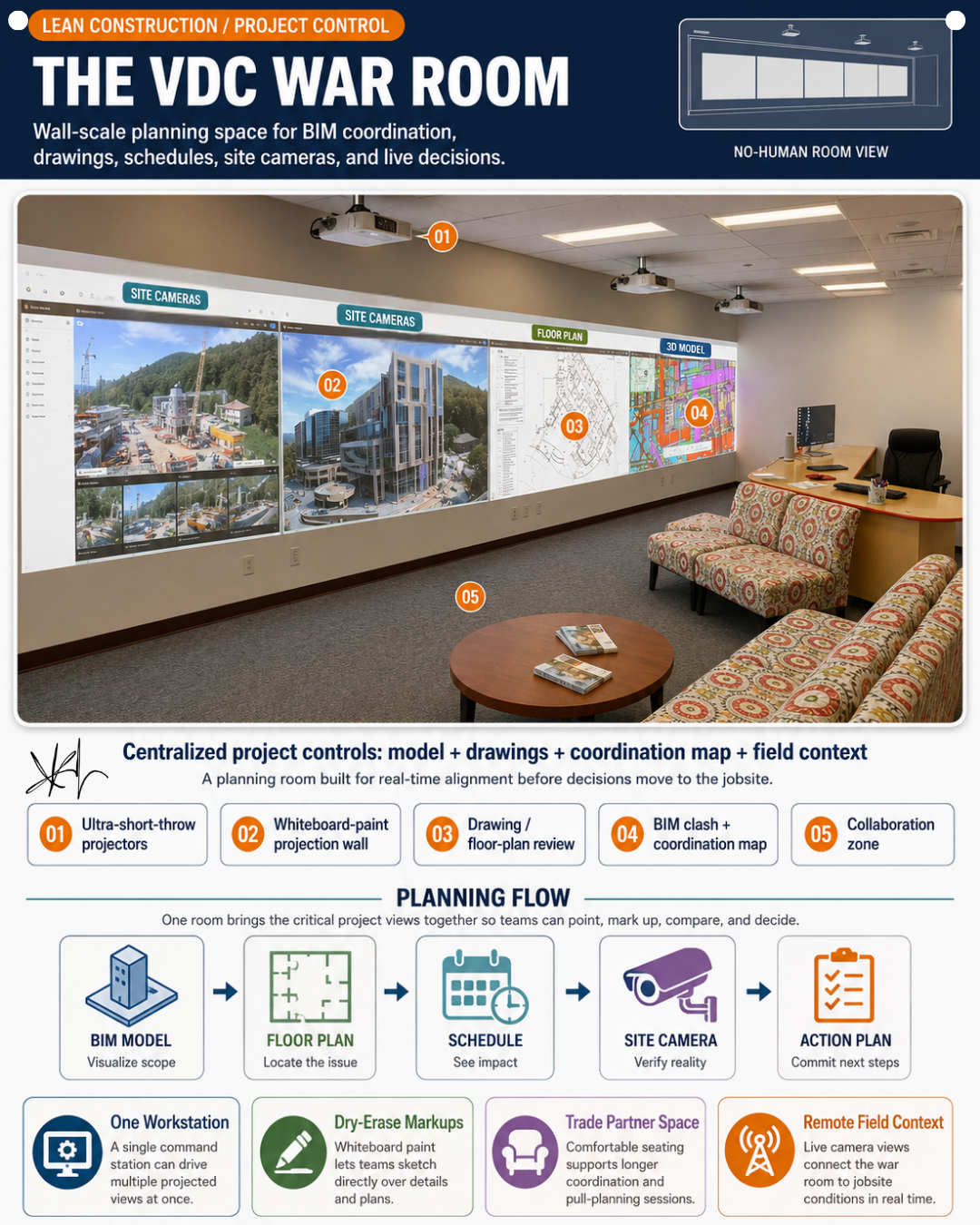
If you want excellence, start with the little things. That phrase is on the image and it is the heart of the whole teaching.

Every small habit scales. The superintendent who straightens the desk at the end of every day is building the same habit that straightens the laydown yard, enforces the Takt zone boundaries, and keeps the punch list from growing faster than it shrinks. The discipline is not different at different scales. It is the same discipline applied to different contexts, and it develops or atrophies based on what you practice in the small moments.

This is also why the desk matters for leadership credibility. Crews do not just follow instructions. They watch behavior. A superintendent who enforces organization on the deck and operates from a chaotic trailer is teaching that the standard is for them, not for leadership. A superintendent who holds the same standard in their own workspace is teaching that the standard is the standard, everywhere, including where nobody is checking. That is the kind of credibility that makes a crew actually internalize what you are asking for instead of just performing compliance when someone is watching.

The desk is visible. The project is visible. They are the same thing at different scales, and the discipline that connects them is available to every leader on any project, starting today. If your project needs superintendent coaching, project support, or leadership development, Elevate Construction can help your field teams stabilize, schedule, and flow. That work begins exactly here, with leaders who hold the same standard for themselves that they hold for the project, because that consistency is what the LeanTakt approach to field leadership is built on. Jason Schroeder teaches it this way: the project is a reflection of the leader, and the leader starts at the desk.

Start With the Desk

Here is your challenge. Before you walk the site today, walk your own workspace. Not to judge it. To read it the way you would read a jobsite. Find the tangled cable. Find the document stack that has no processing system. Find the three-week-old printout that never got filed. Fix one thing. Then fix one thing tomorrow.

Edwards Deming said: “It is not enough to do your best; you must know what to do, and then do your best.” Knowing what to do with your workspace is not complicated. The desk told you this morning what the standard has been. You get to decide what the standard is going to be.

On we go.

FAQ

Is desk organization really connected to project performance, or is this just a productivity trend?
The connection is causal, not correlational. A disorganized workspace produces specific operational failures: slow document retrieval, deferred decisions, missed items, and a cultural signal that standards are optional. Each of those has a direct cost on the project. Clean the workspace and those specific costs go down. It is not a productivity philosophy. It is a system design question.

What if I genuinely work better with some clutter?
There is a difference between a workspace that is actively being used and one that has no system. Active use means things are in motion toward a decision. No system means things land and stay wherever there was space. The test is whether you can find what you need in under sixty seconds and whether every item on your desk has a next action. If yes, the apparent clutter is managed. If no, it is a system gap.

How do you maintain organization during peak project phases when everything is moving fast?
You maintain it by making the reset a fixed daily habit rather than a reaction to the level of activity. Five minutes at the end of every day to clear the desk, file documents, and close open loops is easier to protect than a periodic reorganization that only happens when the chaos becomes unbearable. The busier the project, the more the system needs to be automatic rather than effortful.

If you want to learn more we have:

-Takt Virtual Training: (Click here)
-Check out our Youtube channel for more info: (Click here) 
-Listen to the Elevate Construction podcast: (Click here) 
-Check out our training programs and certifications: (Click here)
-The Takt Book: (Click here)

Discover Jason’s Expertise:

Meet Jason Schroeder, the driving force behind Elevate Construction IST. As the company’s owner and principal consultant, he’s dedicated to taking construction to new heights. With a wealth of industry experience, he’s crafted the Field Engineer Boot Camp and Superintendent Boot Camp – intensive training programs engineered to cultivate top-tier leaders capable of steering their teams towards success. Jason’s vision? To expand his training initiatives across the nation, empowering construction firms to soar to unprecedented levels of excellence.
The Worker Heat Stress Prevention System

Read 22 min

The Worker Heat Stress Prevention System: How to Keep Your Crew Safe When the Temperature Hits 110

Every summer, construction workers die from heat. Every single summer. And here is what gets me: almost all of it is preventable.

We are not talking about moonshot technology or a million-dollar safety overhaul. We are talking about water, shade, a fan, a vest, and a schedule that respects what extreme heat does to a human body. That is the whole system. And the projects that build it deliberately, before the heatwave arrives, are the projects where crews go home intact. The projects that treat heat safety as something to figure out when it gets bad are the ones that get the phone call nobody wants to make.

The Pain That Arrives Every June

In Phoenix, in Las Vegas, in any high-desert or Gulf Coast project running through summer, heat is not a background condition. It is an active threat to every person on the site. Temperatures above 100 degrees Fahrenheit are common. Above 110 degrees, the body’s ability to regulate its own temperature starts to lose the battle. A worker who is dehydrated, new to the job, or pushing through because the schedule is tight is a worker who is one bad hour away from heat exhaustion or heat stroke.

Heat stroke is not a slow emergency. It can move from early symptoms to a life-threatening condition in under an hour. And the early symptoms, fatigue, irritability, slight confusion, reduced coordination, are easy to miss on a busy site because they look like a tired worker on a hot afternoon. By the time someone is visibly in distress, the window for easy intervention has already closed.

This happens every summer. It happens on projects with safety programs. It happens on projects where someone sincerely believed the crew would speak up if they felt bad. The problem is not that people don’t care. The problem is that the system was not built to prevent it before it started.

The Failure Pattern

The failure pattern looks like this. A crew starts a project in spring when temperatures are manageable. Heat protocols are mentioned in the onboarding packet and reviewed at a safety meeting. Water coolers get set up near the trailer. Nobody thinks much more about it because it is not yet a problem.

Then July arrives. Temperatures climb. A new hire who started two weeks ago is working at full pace without a completed acclimatization period. The water station is two hundred feet from the work face and getting there means stopping, which means the schedule slips, which means people stop going as often as they should. The shade tent is on the other side of the building from where the most physically demanding work is happening. The misting system that was ordered in May is still waiting on a delivery.

Nobody designed that situation. It assembled itself from a dozen small decisions that each made sense individually and combined into a system that left people exposed. That is almost always how it happens. The failure is not negligence in the dramatic sense. It is the absence of a system that was built for the actual conditions.

They Didn’t Fail the System

When a worker pushes through heat symptoms without saying anything, or doesn’t drink enough water because the station is too far away, or skips a rest break because the foreman is watching the clock, that worker has not failed anyone. The system failed them.

A person in the early stages of heat exhaustion does not think clearly about risk. That is part of what heat does to cognition. Asking people to self-report symptoms and self-regulate behavior in extreme heat is asking the system to fix itself using the component that the system is currently damaging. It does not work reliably, and it is not fair to expect it to.

The decision to drink water, rest in shade, and pace the work has to be made upstream, by the people who design the schedule, position the resources, and set the cultural expectation around rest breaks. When a foreman builds mandatory rest breaks into the Takt rhythm of the day, workers rest. When a superintendent positions a chilled water station at the work face rather than at the trailer, workers drink. The behavior follows the environment. Build the environment first.

The System That Actually Works

The Worker Heat Stress Prevention System is not complicated. It has six components that work together, and all six need to be in place before extreme heat arrives, not after the first incident.

The foundation is chilled potable water, positioned at the work face, with a target of one quart per hour per worker during high-heat conditions. Room-temperature water at a trailer two hundred feet away does not meet the same need. Chilled water at the point of work eliminates the friction that stops people from drinking enough. It is the single highest-leverage intervention on the list and it costs almost nothing relative to the risk it addresses.

The second component is shade infrastructure. A designated cooling station with shade tent and seating is not a luxury. It is the physical space where mandatory rest breaks happen, and mandatory means scheduled, not optional. Shade tents with evaporative cooling capability can drop the ambient temperature significantly compared to direct sun exposure. Positioning them close to the highest-intensity work zones is a design decision that has to be made intentionally, because the default is to put them where they are convenient to set up, which is often not where the work is.

Industrial misting fans and integrated misting systems at high-intensity zones and equipment operator positions extend the reach of cooling beyond the shade tent. Point-of-source cooling for crane operators, equipment operators, and workers in confined or high-radiant-heat areas addresses the places where passive shade does not reach. These systems work through evaporative cooling and their effectiveness scales with how close to the worker they are placed.

Personal cooling equipment, including ice pack vests, circulatory cooling vests, and evaporative neck wraps, puts the cooling system on the person rather than in the environment. For workers in direct sun doing high-exertion work, personal cooling equipment is the difference between a body that can regulate and a body that cannot. Ice vests in particular are well-documented in their effectiveness and their cost is low relative to the protection they provide.

Signals Your Heat System Has Gaps

Before you evaluate what you have, look for these patterns on your site:

  • Workers are drinking less than one quart per hour during peak heat, either because they don’t know the target or because the water is not accessible enough to make it easy
  • Rest breaks are treated as optional or get skipped when schedule pressure increases
  • New hires within their first two weeks are working at the same pace and in the same conditions as experienced crew
  • The shade tent is more than one hundred feet from the highest-exertion work zones
  • Nobody has assigned a person to watch for heat illness symptoms during peak temperature hours

Any one of those gaps can be the gap that leads to an incident. All five together is a system that is waiting for a bad day.

Acclimatization Is Not Optional

The acclimatization component deserves its own attention because it is the one most often skipped under schedule pressure.

A new hire’s body is not physiologically prepared to work at full intensity in extreme heat. The cardiovascular and thermoregulatory adaptations that allow experienced workers to function in high-heat environments take seven to fourteen days of graduated exposure to develop. A worker who starts on day one at full pace in 110-degree heat is working in a body that has not yet built the systems to manage that condition. The risk of heat illness in the first week is dramatically higher than in subsequent weeks, and that risk applies regardless of the worker’s fitness level or experience in other climates.

A structured acclimatization program looks like this: reduced duration and intensity in the first three days, gradual increase through day seven, modified schedule accommodations through day fourteen, with mandatory rest breaks and supervisor observation throughout. It is not complicated and it does not require paperwork beyond a simple tracking sheet. What it requires is a decision that the schedule will accommodate the biology rather than the other way around. That decision is made by the people who write the schedule, not the people doing the work.

Why This Is About More Than Compliance

Here is the part that needs to be said directly.

Safety compliance sets a floor. It tells you the minimum required to avoid regulatory action. The projects that treat heat safety as a compliance exercise build systems designed to meet the floor, which means they are built to do the least required rather than the most effective. Those projects still have incidents, because the floor is not high enough to prevent them.

The projects that treat heat safety as a statement about how the organization values its people build something different. A chilled water station at the work face says your hydration matters to us. A shade tent with mandatory scheduled breaks says you are allowed to rest and we will protect that time. An ice vest on day one says we invested in you before the heatwave hit. A fourteen-day acclimatization plan says we are not going to throw you to the wolves because the schedule is tight.

Those signals are received. Crews that feel genuinely protected work harder, stay longer, and refer other skilled tradespeople to the project. Safety, done at the level of actual care rather than compliance, is one of the most effective recruiting and retention tools in this industry, and almost nobody talks about it that way. If your project needs superintendent coaching, project support, or leadership development, Elevate Construction can help your field teams stabilize, schedule, and flow, and that work includes building the operational systems that keep people safe when the conditions get serious. Jason Schroeder and the Elevate team know that a stable, productive crew is first a crew that goes home healthy every day.

Build It Before You Need It

Here is your challenge. Do not wait for the first heat advisory. Do not wait until someone is sitting in the shade looking pale. Build the system in spring, walk the site with the heat map in mind, and ask yourself honestly whether every component is positioned for the actual work, not for the convenience of setup.

Heat does not care about your deadline. It does not care that you are three weeks behind or that the owner is watching the schedule. What your people care about is whether you cared enough to build the system before they needed it. That is the question the ice vest and the shade tent and the water station answer before anyone has to ask it out loud.

Edwards Deming put it plainly: “A bad system will beat a good person every time.” In extreme heat, a bad system does not just slow people down. It kills them. Your people are good. Build them a system worthy of that.

On we go.

FAQ

How much water should workers drink during extreme heat conditions?

The target during high-heat work is approximately one quart, or 32 ounces, per hour. That rate needs to be supported by accessible, chilled water positioned at the work face rather than at a remote station. Workers will not consistently walk to a trailer to hydrate when they are under schedule pressure. Accessibility drives behavior, and behavior drives outcomes.

What is the difference between heat exhaustion and heat stroke?

Heat exhaustion involves heavy sweating, weakness, cold or pale skin, a weak pulse, nausea, and possible fainting. It is serious and requires immediate cooling and hydration. Heat stroke is a medical emergency involving a body temperature above 103 degrees Fahrenheit, hot and red skin, rapid and strong pulse, and possible unconsciousness. Heat stroke requires immediate emergency response. The difference matters because heat stroke is life-threatening within minutes if not treated, and the symptoms can escalate from exhaustion to stroke faster than most people expect.

Why does acclimatization take so long if someone is already physically fit?

Physical fitness improves general cardiovascular capacity but does not accelerate the specific thermoregulatory adaptations that come from heat exposure. Those adaptations, including increased plasma volume, earlier onset of sweating, and reduced cardiovascular strain in heat, develop only through graduated exposure over seven to fourteen days regardless of baseline fitness. A fit worker who is new to extreme heat conditions is still physiologically vulnerable in the first week.

If you want to learn more we have:

-Takt Virtual Training: (Click here)
-Check out our Youtube channel for more info: (Click here) 
-Listen to the Elevate Construction podcast: (Click here) 
-Check out our training programs and certifications: (Click here)
-The Takt Book: (Click here)

Discover Jason’s Expertise:

Meet Jason Schroeder, the driving force behind Elevate Construction IST. As the company’s owner and principal consultant, he’s dedicated to taking construction to new heights. With a wealth of industry experience, he’s crafted the Field Engineer Boot Camp and Superintendent Boot Camp – intensive training programs engineered to cultivate top-tier leaders capable of steering their teams towards success. Jason’s vision? To expand his training initiatives across the nation, empowering construction firms to soar to unprecedented levels of excellence.
Standing Tactical Orders

Read 21 min

Standing Tactical Orders: Ten Defaults Your Field Team Can Follow When No Leader Is Around

Here’s the deal. Most jobsites run on the memory and mood of whoever happens to be standing there. When that person is good, the day goes well. When that person is in a meeting, at another site, or having a rough week, the crew guesses. Then we call the result a discipline problem.

It is not a discipline problem. It is a missing default. Standing tactical orders are how you fix that, and they are the part of field enablement most programs never write down.

When Nobody Is There to Ask

You know this one. A crew hits a zone that is not ready. The substrate is wrong, or the last trade left equipment in the way, and nobody with authority is nearby. So the crew does what a decade of pressure trained them to do. They work around it, install over it, and keep moving, because stopping feels like the punishable option. Or a foreman spots a problem at seven in the morning and says nothing, because on his last three projects surfacing one got him a lecture about attitude. It travels downstream and shows up in month nine as rework with three trades tangled in it.

None of that is bad character. That is what happens when the standard exists only inside a leader’s head. If the rule is not written, the rule is whoever is loudest.

Where the Idea Comes From

I first learned about standing tactical orders from historical references to General Patton. He is a controversial figure, and I am not asking anybody to admire him. I am pointing at a mechanic. His standing tactical orders were written down, and his units moved faster and operated more effectively than any other American formation of the period. Because they were written, the pattern outlived him and was copied for decades.

Written defaults are why. Not charisma, and not shouting. Written defaults let a unit see as a group, know as a group, and act as a group even when the commander is nowhere in sight. That is what a construction program needs, so we distilled ours down as a group into ten. These are safe to follow anywhere on the project, with or without a leader present.

The ten standing tactical orders:

  • We build people before we build things
  • We treat everyone like our customer
  • Ensure your finished work never becomes a bottleneck for the next trade
  • One team, one build
  • We do not start until we are ready to finish, with full kit
  • Planning and preparation should make installation the easiest thing we do
  • If you see, hear, feel, or sense something wrong, stop, call, resolve
  • Problems are not a problem, hiding problems is the only problem
  • We blame the system, the process, or the behavior, not the people
  • Total participation

Ten lines, every one of them decidable by a craft worker standing alone in a zone at six in the morning.

Build People Before You Build Things

Start with the first one, because the other nine depend on it. We build people before we build things, which means enabling four things before boots hit the ground: mindset, systems and processes, culture, and skills.

The mindset piece is a real switch. Classical business management puts profits first, control of people second, and protection of the internal leadership team third. It does not work, it hurts people, and it manufactures waste, and it is still the water our industry swims in. Lean management inverts the order. Our own people first, our clients second, the business third, with the firm condition that we make money, because we focus on people, process, and quality.

The systems and processes then have to enable that mindset, and the culture has to make it normal. Culture means the common beliefs and actions of a social group, so it is not a poster. It is what your crews do at ten in the morning when something goes wrong. The skills piece is the one people misread. You are already an expert at your trade, and nobody needs to fix you. What we owe you is a match: an expert paired with a system, a process, a culture, and an environment worthy of that expertise.

Do Not Be the Bottleneck, and Do Not Start Half Cocked

Orders two and three are about what you hand the next person. Our client is our customer, and so is the project delivery team, the vendors, the neighbors, the end users, and the successor trade. When you finish a zone, hand it off clean, safe, organized, punched out, and ready, with nothing of yours left behind.

If that sounds soft, here is the hard version. We cannot hurt other trades and win ourselves. The pace of another crew is the pace of my crew. Even from a pure bottom dollar view, their success is my success financially, so protecting the next crew is not sentiment. It is arithmetic. In Japan I learned the word for this. Meiwaku carries the idea of not being a burden on others, and you see it in the cities. Everyone stands on one side of the escalator. The streets stay clean even though public trash cans are rare.

There is a related point about real bottlenecks. If your trade genuinely is the constraint, everyone should give you first pick on the forklift, the crane, the hoist, and the flow of information. Not because you are more important, but because your pace is everybody’s pace and we subordinate to the constraint. To find the true constraint, we first have to make sure the bottleneck is never bad behavior.

Orders five and six handle the front end. We do not start until we are ready to finish, with full kit. Think of an IKEA box: clear instructions, nothing missing. Full kit means materials, equipment, tools, information, permissions, layout, safety and quality planning, the space itself, and the training. Nobody should be let into a zone before that is true, not as gatekeeping but as protection. Then the pattern is plan, build, finish.

That is why planning and preparation should make installation the easiest thing we do. If anything is going to be hard, let it be the design, precon, work packaging, prefab, logistics, pull planning, and foreman planning. We discomfort the project delivery team so we can comfort the workers. Not because craft workers need coddling, they are professionals, but because planning is where the money is made. When I was finishing concrete, the harder I visibly struggled, the more people liked me. That is backwards. Inside a worker’s strike zone, the question is whether the work is frictionless, because frictionless means the planners did their job.

Stop, Call, Resolve, and Never Blame the Person

Orders seven through nine change a culture fastest.

If you see, hear, feel, or sense something wrong, pause the work, call the team, and resolve it at the source. Stop, call, resolve. Toyota reportedly stops its line on the order of two thousand times a day. Somebody senses something off, they pull the andon, and the line does not restart until the issue is resolved. On our sites the signal can be a light, a call, or a field app. The mechanism matters less than the rule: we stop and resolve before we proceed, and we never push. Pushing always hurts a project. Then, problems are not a problem. Hiding problems is the only problem. Hidden problems become stops and restarts, rework, delay, and waste. Surfaced problems get solved at the root.

Order nine is where some people trip, so stay with me. We blame the system, the process, or the behavior, and never the person’s true self. A behavior can change, a culture can change, and a system can be rebuilt. Pinning a failure on a person ends the investigation where the learning should have started. Consider Alaska Airlines Flight 261. Investigators looking for who did it found a system: a jackscrew that failed on worn threads, a maintenance interval extended for financial reasons, a regulator that approved it, and mechanics who were not permitted to replace the part. Everybody came to work that day intending to do their best, and 88 people died in the Pacific. Nobody wakes up wanting to do a bad job. So we are hard on the process and easy on our people, and easy does not mean permissive. It means supported.

Total Participation Is the One That Carries the Rest

Order ten is the multiplier. See as a group, know as a group, act as a group.

In Japan a sensei asked me what one hundred minus one is. I said ninety nine. He said no, it is zero. If one person, one crew, or one step is not participating, you do not have a system at all. That is a hard standard, and the right one. Information gets shared, teams stay aligned, and standards get followed together. We do not do this well in the Western world, and we should, because we have outstanding people.

Signs your standing tactical orders are not live yet:

  • Crews work around a not ready zone instead of stopping and calling
  • Problems surface in schedule meetings weeks after somebody in the field first saw them
  • Root cause conversations end with a name instead of a system

Why This Reaches Past the Jobsite

None of this is really about compliance. It is about what a jobsite does to a person over a career. A crew that can stop work without fear goes home with their fingers and their dignity. A foreman who can surface a problem at seven in the morning is not carrying it home at seven at night. A trade partner who gets a clean, kitted, ready zone finishes on Friday and makes his daughter’s game. Written defaults protect schedules and quality, and they protect families, which is the return nobody puts on a dashboard.

That is why these orders and Takt planning belong together. Takt gives you zones on a rhythm, so a clean handoff has a defined moment and a defined standard, and the standing tactical orders tell everyone how to behave inside that rhythm when no leader is watching. If your project needs superintendent coaching, project support, or leadership development, Elevate Construction can help your field teams stabilize, schedule, and flow. Tools like LeanTakt make the flow visible, and written defaults keep people participating in it.

So here is the challenge for this week. Pick three of the ten, write them on the wall in the trailer, read them aloud in your next huddle, and hold them yourself first when it costs you something.

Taiichi Ohno said it plainly: “Having no problems is the biggest problem of all.” Write the defaults down. Let people use them.

On we go.

FAQ

Are standing tactical orders the same thing as a safety policy or a handbook?

No. A handbook describes procedure and lives in a binder. Standing tactical orders are short defaults a craft worker can act on alone in a zone without permission. They should be few enough to remember, blunt enough to apply under pressure, and consistent enough that following them never gets somebody in trouble.

How do I stop work without getting blamed for the delay?

That is the fear the eighth and ninth orders exist to remove, and leadership removes it by responding well the first several times somebody uses it. Stopping to resolve an issue at the source costs less than pushing through and discovering it later. If your organization punishes a stop, the stop is not the problem.

How does this connect to Takt planning?

Takt gives the project zones on a rhythm, which creates a defined handoff moment and a standard for what a completed zone looks like. The standing tactical orders govern behavior inside that structure. Rhythm without agreed behavior collapses, and good behavior without rhythm has nothing to protect.

If you want to learn more we have:

-Takt Virtual Training: (Click here)
-Check out our Youtube channel for more info: (Click here) 
-Listen to the Elevate Construction podcast: (Click here) 
-Check out our training programs and certifications: (Click here)
-The Takt Book: (Click here)

Discover Jason’s Expertise:

Meet Jason Schroeder, the driving force behind Elevate Construction IST. As the company’s owner and principal consultant, he’s dedicated to taking construction to new heights. With a wealth of industry experience, he’s crafted the Field Engineer Boot Camp and Superintendent Boot Camp – intensive training programs engineered to cultivate top-tier leaders capable of steering their teams towards success. Jason’s vision? To expand his training initiatives across the nation, empowering construction firms to soar to unprecedented levels of excellence.

Why Construction Schedules Are Unrealistic

Read 21 min

Why Are Construction Schedules So Unrealistic?

Here’s the deal. I have built dozens of CPM schedules myself. As a superintendent I was required to build them, and I know the software well enough to call myself a CPM expert. I am not badmouthing something I never learned. I am telling you what I found after years of doing it and then watching the same failures repeat on every project we analyze.

Construction schedules are unrealistic for two reasons, and neither of them is that your people are careless. The method is predictive, and it is built in a silo. Everything else follows from those two facts.

One Person, One Room, Somebody Else’s Work

Picture how the schedule gets made. There is one scheduler in a room. Good person, working hard, trying to do a professional job. And that one person is asked to predict, from start to finish, at level three detail or deeper, when every piece of work on a large project will happen.

Usually without trade partner input, without historical reference classes to compare against, and without a pull plan built by the people who will do the work. Frequently that person has never come up through the field at all, which means they are producing a prediction about the work of experts without access to the expertise. Even when the intent is to collaborate, the output happens in a silo. One head, one keyboard, one set of assumptions. Then the file becomes the contractual truth for hundreds of people who never got asked. That is not a character flaw in schedulers. It is a job description nobody could fulfill.

Humans Are Terrible at Guessing Durations

Now stack the second problem on top of the first, because this is the part that is scientifically documented and almost never discussed in a scheduling meeting.

Human beings are bad at estimating durations. Not slightly bad. When you plot what people guess against what the work actually took, the guesses tend to land either within about twenty five percent of reality or off by a factor of four in either direction. Four times too long, or four times too short. That is not a rounding error. I would not even call it an error. It is a mistake, and it is well documented in the research literature.

So consider what we do with that. We take one person’s best guess, which already carries a factor of four uncertainty baked in. We ask for it at a level of detail nobody can know, which multiplies the uncertainty rather than reducing it. We do it without field input to correct it and without reference classes to calibrate it. Then we put the result in a format where nobody can double check it. That is the honest description of how most project schedules come into existence. A human guess, made ten times worse by the process around it, then hidden where nobody can audit it.

The Format Defeats the People Using It

Here is the third failure, and it is the one that finishes the job.

A CPM schedule is a time by deliverable wall of black and white text. You cannot analyze anything meaningful in it. You cannot stand in front of it with a foreman and see whether next week is possible, or understand where the work will be crowded. The information may technically be in the file, but it is not accessible to a human being standing on a jobsite in boots.

I will give you a threshold from my own experience building these. Somewhere around five to eight hundred activities, you stop being able to hold your own schedule in your head. You turn on the logic view and think, whoa, where did all of this come from? You built it, and you have lost track of what is inside it. If the author cannot follow it, the field cannot either.

Watch for these signs the format has already beaten your team:

  • Nobody in the field can describe next month’s sequence without opening the file
  • Logic ties nobody can explain, including the person who built them
  • Activity counts in the high hundreds with no zone or location structure

That is why these schedules are unpredictable and unreliable. It is not attitude. It is format.

Line CPM Up Against the Cores of Lean

People ask why I keep coming back to this. Here is my answer. Take the cores of Lean and test CPM against each one. Respect for people. Stability. Flow. Flowing together. Visual management with total participation. Quality. CPM fails all of them, and structurally, not accidentally.

It does not respect people, because it trade stacks and trade burdens them. Too many trades crowded into one area, or one trade asked to be in several areas at once with one crew. Both are produced by the method, and both land on human beings.

It does not create stability, because the plan is always moving and there is no standard for the work being done in a zone. Nobody knows what a normal week looks like, so nobody can improve one. It does not create flow either, because it is not focused on one piece flow. Crews are everywhere at once instead of moving through space in sequence, and because the plan is not organized by time and location, you have no zones on a rhythm and no way for trades to flow together. It is not visual, so people cannot participate in it. And it is not focused on quality at all. It is focused on getting things done as fast as possible, which is a different objective wearing the same clothes.

The System Failed Them, Not the Other Way Around

I want to speak to the superintendents and foremen reading this, because I have been where you are. You have probably been told the schedule slipped because your team did not execute. That is not what happened. You were handed a prediction made by one person, without your input, containing a documented factor of four error, at a detail level nobody could know, in a format you cannot verify or use. Then you were measured against it and asked what went wrong.

Nothing went wrong with you. The system failed you. You did not fail the system. The trade partner who could not hold his dates was not uncommitted, and the scheduler who produced the file was not incompetent. Everybody in that chain was doing their best inside a method that guarantees the outcome.

What to Build Instead

If the diagnosis is that the plan is a siloed prediction in an unusable format, then the fix has to change all three of those things. That is what Takt planning does.

Takt starts with time and location instead of a list of deliverables. You break the building into zones, then set a Takt time, which is the fixed duration a crew works in a zone before handing it off. Then you build a train of trades that moves through those zones at that steady beat. Now the plan is organized the way the work is actually organized, which is by place and rhythm.

Because the plan is built around zones on a rhythm, you get what CPM cannot give you. A standard for what happens in a zone, which is stability. One piece flow, because a crew finishes one area before moving to the next. Trades flowing together instead of colliding, because the sequence through each zone is defined. And a plan a foreman can read on a wall, which makes total participation possible instead of theoretical.

The estimating problem gets handled differently too. Instead of one person guessing hundreds of durations in isolation, you pull the plan with the trade partners who will do the work, use historical reference where you have it, and set a rhythm people commit to rather than a prediction imposed on them. You are replacing a hidden factor of four guess with a visible commitment plus real buffers to absorb what you could not predict.

Build People Before You Build Things

None of this is a software purchase, and I want to be blunt about that because I have watched teams try to buy their way out.

A Takt plan handed to an untrained team becomes wallpaper by month three. Somebody has to teach the superintendent how to run the board, hold a handoff, protect a buffer, and refuse a request that would burden a trade. Somebody has to teach the foremen what a ready zone looks like and what to do when it is not. Somebody has to help the trade partners believe this pull plan will be honored, because most of them have been burned before.

If your project needs superintendent coaching, project support, or leadership development, Elevate Construction can help your field teams stabilize, schedule, and flow. Most teams already know the schedule is unrealistic. What they need is somebody to build the replacement alongside them and stay long enough that it holds without a coach in the room. Tools like LeanTakt make the flow visible, and trained people keep it honest week over week.

Why This Matters Beyond the Bar Chart

An unrealistic schedule is not a paperwork problem. It converts directly into how people live. The crew works Saturday because a guess was wrong in January. The foreman stops training his apprentice because he spends every morning chasing access the plan promised and the building cannot provide. The trade partner stops raising problems early, because raising them has never changed anything. And the superintendent slowly concludes that chaos is simply what construction is, which is the most expensive belief in our industry.

Signals it is time to change the method rather than the effort:

  • Recovery plans that add manpower instead of removing work from a zone
  • Overtime authorized before anybody asks whether the plan was ever possible
  • The same slip appearing every month with a different explanation

Craft workers deserve a clean, ready area, a defined amount of time, and a predictable week. That is what dignity looks like on a jobsite, and it is a planning decision before it is a values statement.

So here is the challenge. This week, take one area of your remaining work and do three things. Pull the sequence with the trade partners who will perform it. Organize it by zone and rhythm rather than by activity list. Put it on a wall where a foreman can read it in ten seconds. Then compare the next four weeks of that plan against what your CPM file promised, and let the difference make the argument for you.

  1. Edwards Deming said it as plainly as it can be said: “It is not necessary to change. Survival is optional.” Our people are worth the change.

On we go.

FAQ

Is the scheduler to blame for an unrealistic schedule?

No, and that framing is part of the problem. Schedulers are asked to predict the work of dozens of expert crews at a detail level nobody can know, usually without trade input, without reference data, and without a pull plan. Any human given that assignment produces an unreliable result. Fix the assignment and the method, not the person.

How can a duration guess be wrong by a factor of four?

Because estimating durations is a known weak spot in human judgment. Studies of estimated versus actual durations show guesses clustering either fairly close to reality or off by roughly four times in either direction. On a project with hundreds of activities, those errors compound through the logic instead of averaging out, which is how a schedule can be impossible on day one.

Does Takt eliminate estimating uncertainty?

No. Nothing eliminates uncertainty on a construction site. Takt handles it by pulling the plan with the people who do the work, organizing by time and location, and placing real buffers where variation can be absorbed. You trade a hidden guess for a visible commitment with protection around it.

If you want to learn more we have:

-Takt Virtual Training: (Click here)
-Check out our Youtube channel for more info: (Click here) 
-Listen to the Elevate Construction podcast: (Click here) 
-Check out our training programs and certifications: (Click here)
-The Takt Book: (Click here)

Discover Jason’s Expertise:

Meet Jason Schroeder, the driving force behind Elevate Construction IST. As the company’s owner and principal consultant, he’s dedicated to taking construction to new heights. With a wealth of industry experience, he’s crafted the Field Engineer Boot Camp and Superintendent Boot Camp – intensive training programs engineered to cultivate top-tier leaders capable of steering their teams towards success. Jason’s vision? To expand his training initiatives across the nation, empowering construction firms to soar to unprecedented levels of excellence.

Is CPM Scheduling Actually Broken?

Read 21 min

Is CPM Scheduling Actually Broken? Yes, and Here Is Where It Breaks

Here’s the deal. There are good builders running CPM software right now doing real builder like work inside it. Zones. Flow. Real handoffs. They are getting away with it because they are smart and stubborn, not because the tool is helping them. The software is not the problem. The theory underneath it is, and a broken theory does not get better when you buy a newer license for it.

The Question Nobody Asks in the Scheduling Meeting

Ask a room full of superintendents whether their CPM schedule is achievable and watch what happens. Nobody says yes. A few people look at the floor. Somebody eventually says the schedule is “aggressive,” which is the industry’s polite word for impossible. Then everybody goes back to work against it anyway, because it is in the contract and because nobody has been given permission to say the underlying method is defective. So the field absorbs the gap. Foremen absorb it. Crews absorb it. Families absorb it on Saturdays. That is the part I want to fix. Not the bar chart, but the belief that the bar chart is neutral.

What the Theory Actually Requires

CPM is not a neutral container you can pour good practice into. It carries rules, and those rules produce specific outcomes on your jobsite whether you intend them or not.

Start with the algorithm. CPM runs a forward and backward pass that pushes every activity to its early start, as far left as the logic allows. That sounds efficient until you remember what it means in the field: every activity is expected to begin at the earliest theoretically possible moment, with nothing standing between it and the activity in front of it.

Then the theory requires a critical path. Not the longest path as a piece of information, which would be useful, but a critical path as a governing concept. And on that path the theory does not permit flow and does not permit buffers. That is not a misapplication by a bad scheduler. That is the definition working as designed.

Here is what I have come to believe after analyzing a lot of these. If any schedule has a critical path, it is already blown. The moment a path exists with zero protection and zero slack, on a jobsite where delays are guaranteed, you are already behind and you probably will not recover. A schedule you are actually going to hit has to have buffers, and CPM will not let you put them where they are needed most.

The Logic Ties You Are Not Allowed to Use

There is a quieter failure inside the theory, and it does more damage to people than anything else on the list.

CPM disallows certain logic relationships. You do not get to use many of what schedulers call crew ties, the relationships that keep one crew moving through space in sequence. Average out the logic ties on a typical CPM schedule and you land around three per activity, which is nowhere near enough to describe how a crew actually travels a building. Without crew ties you cannot build trade flow, and without trade flow you get the two conditions that hurt people the most.

Trade stacking is too many trades crowded into one area at the same time. Trade burdening is one trade asked to be in several areas at the same time with one crew. The schedule shows both as normal because the bar chart has no concept of a body occupying space.

Watch for these before you accept a schedule:

  • Activities carrying two or three logic ties where the real work has six or eight relationships
  • Two or more trades listed in one area with no documented handoff between them
  • One trade named in multiple areas in the same week with no added manpower
  • Zero buffers on the driving path, described as a tight schedule rather than an impossible one

Those are structural tells, and they show up long before the delay reports do.

Crashing Means What It Says

Now we get to the part most people in our industry have never been told, and it does the deepest damage.

CPM philosophy has a prescribed response for when you fall behind, and you will fall behind. The prescribed response is crashing. Crashing the path. Crashing the activity. Most people do not even know that crashing is a formal term inside CPM, but it is, and it is the only remedy the theory offers.

What does crashing mean in practice? Add resources. Work overtime. Rush, push, and panic. Bring in more material. Throw money at the problem. That is the official recommendation of the method your contract requires you to use, and it does exactly what the word says. When you crash the path, you crash the project. Quality goes, because rushed work is rework waiting to be discovered. Safety goes, because congestion and speed are the two ingredients in most incidents. Money goes, through premium time and acceleration costs that nobody itemizes honestly. Then relationships go, because trade partners remember who asked them to eat the consequences of a plan that never worked. Notice the theory never suggests anything else. It will never tell you to add a buffer, slow an activity to protect flow, or reduce the trade count in a zone. Crashing is the whole toolbox, and there is one hammer in it.

Line It Up Against Production Science

Here is the test that settled it for me. Take every philosophy and every KPI inside CPM and line them up against production theory, operations science, and Lean. Not against opinion, but against the body of knowledge that governs how work moves through a system.

CPM fails in every category. You might score forty or fifty percent on one or two items out of a hundred. Everything else fails, and not marginally. It fails structurally, because the mechanisms production science says you need are the exact mechanisms CPM forbids. Production science says protect flow with buffers, and CPM says no buffers on the critical path. It says level the load and limit work in process, and CPM pushes everything to its early start. It says reduce variation, and CPM answers variation with crashing.

That is why my position is that CPM cannot be salvaged as a philosophy. You can salvage a CPM software package, and plenty of teams do. You can build zones inside it, force in crew ties by hand, hide buffers inside durations where the algorithm cannot find them, and run something Takt like on top of a hostile engine. But you fight the tool every week to do it, and the moment somebody else touches the file, the defaults win. The philosophy will never allow flow or buffers on the critical path, never allow the logic density real crew movement requires, never stop stacking and burdening trades, and never suggest anything other than crashing. It will never be anything other than a classical top down management system, which is why it feels the way it feels to work under.

What Takt Does Instead

People ask me a fair question. Can you fail with Takt too? My answer is that you can do Takt badly, and plenty of teams do, but you still will not fail the way CPM projects fail.

The reason is structural, not motivational. Takt is built on flow, so the plan describes how crews move through zones in sequence rather than how many activities can be crammed against a wall. Takt includes buffers by design, so the plan absorbs a hit and keeps its rhythm instead of dissolving its own logic. And Takt produces a reasonable overall total project duration, which means the team is working toward a number a human being can actually hit. A badly built Takt plan with those three properties still outperforms a perfectly built CPM schedule without them. It is not that Takt practitioners are better people. It is that a system with flow, buffers, and an honest duration gives ordinary teams a chance, and a system without them punishes even excellent ones.

Build People, Then Build Things

None of this works as a software rollout, and I want to be blunt about that because I have watched teams try. A Takt plan handed to an untrained team becomes wallpaper by month three. Somebody has to teach the superintendent how to run the board, hold a handoff, protect a buffer, and say no when asked to burden a trade partner. Somebody has to teach the foremen what a ready zone looks like and what to do when it is not ready. We build things before we build people, and then act surprised when the things do not hold.

If your project needs superintendent coaching, project support, or leadership development, Elevate Construction can help your field teams stabilize, schedule, and flow. Most teams already know they are behind. What they need is somebody to build the system alongside them and stay long enough that it survives without a coach in the room. Tools like LeanTakt make the flow visible, and trained people are what keep it honest.

The Real Cost of a Broken Theory

Every one of these mechanics lands on a person. Trade stacking lands on the electrician working over somebody’s head in a congested room. Trade burdening lands on the foreman splitting a crew he does not have. Crashing lands on the whole crew, on a Saturday, on the phone explaining to somebody at home why again.

Signals your team is paying for the theory:

  • Overtime requested before anybody has questioned whether the plan was ever possible
  • Recovery plans that add manpower instead of removing work from a zone
  • Trade partners who stop raising problems early because raising them changes nothing

That is not a scheduling conversation. That is a dignity conversation. Craft workers deserve a clean, ready area, a defined amount of time, and a predictable week. The method we hand them either provides that or it does not, and CPM does not.

So here is the challenge for this week. Open your current schedule and find out whether you have a critical path with zero buffers on it. If you do, stop arguing about durations and name the real problem out loud in your next meeting. Then pick one area of remaining work, define zones, build a single trade train through it at a steady beat, and put a real buffer in front of the next milestone that matters. Prove it small before you argue it big.

  1. Edwards Deming put it plainly: “If you can’t describe what you are doing as a process, you don’t know what you’re doing.” A bar chart is not a process. Flow is.

On we go.

FAQ

Can I keep using my CPM software if my contract requires a CPM schedule?

Yes, and many good builders do exactly that. Keep the CPM schedule as the contractual artifact and run production off a Takt plan underneath it. What matters is which plan the field actually works to. If the field is asked to serve both, the CPM defaults win and you are back where you started.

What exactly is crashing, and why is it so damaging?

Crashing is CPM’s formal remedy for falling behind. It means adding resources, working overtime, adding material, and throwing money at the problem to compress a duration. It is damaging because it addresses the symptom while leaving the cause intact. The work still does not fit in the space or the time, so you are now paying premium rates for congested, rushed work, which produces rework and incidents.

Can a team really not fail with Takt?

You can absolutely execute Takt poorly, and most teams do at first. Because Takt is built on flow, includes buffers, and produces a reasonable total duration, even a rough implementation gives the project the ability to absorb problems. That is the failure mode CPM has no answer for.

If you want to learn more we have:

-Takt Virtual Training: (Click here)
-Check out our Youtube channel for more info: (Click here) 
-Listen to the Elevate Construction podcast: (Click here) 
-Check out our training programs and certifications: (Click here)
-The Takt Book: (Click here)

Discover Jason’s Expertise:

Meet Jason Schroeder, the driving force behind Elevate Construction IST. As the company’s owner and principal consultant, he’s dedicated to taking construction to new heights. With a wealth of industry experience, he’s crafted the Field Engineer Boot Camp and Superintendent Boot Camp – intensive training programs engineered to cultivate top-tier leaders capable of steering their teams towards success. Jason’s vision? To expand his training initiatives across the nation, empowering construction firms to soar to unprecedented levels of excellence.

Why Most Construction Projects Finish Late

Read 22 min

Why Most Construction Projects Finish Late

Here’s the deal. Most construction projects are late before anybody sets a single piece of steel. Not late because the crews were slow, and not late because the weather turned. Late because the schedule they were handed was never possible in the first place, and everyone signed it anyway.

That is a hard thing to say out loud in a preconstruction meeting. It is harder to live through in month fourteen, when the superintendent is getting asked why drywall is behind and the honest answer is that the plan never had room for a single bad day.

You Are Behind in Week One

You know the feeling. The durations on the bar chart do not match what your hands know about the work. You walk the zone and there are four trades in a space that comfortably holds one. The electrician is roughing in overhead while the framer is still setting track below him, and the mechanical contractor is staging pipe in the only clear lane. Nobody is doing anything wrong. There is just too much work stuffed into too little space and too little time.

Or you get the opposite version of the same problem. Your best trade partner is asked to be in Zone 2 on the third floor and Zone 5 on the first floor in the same week, with one crew. So they split the crew, both areas move at half speed, both fall behind, and the schedule still shows both on track, because a bar chart does not know that people cannot be in two places at once. Then the pressure starts. Look ahead meetings get tense, the owner asks for a recovery plan, everyone works weekends, and the project still slides.

The Failure Is in the Method

Here is the pattern underneath all of it, and it is not a people problem. It is a method problem. Most projects carry the critical path method as a contractual requirement, and CPM was designed with a specific intent, which was to find the fastest possible duration for a project. That sounds reasonable until you look at what it actually produces. What CPM produces is not the fastest path. It produces the most impossible path.

Look at what has to be true for a CPM bar chart to close. The overall duration gets compressed to its most unreasonable length. To make that math work, the schedule stacks trades, which means too many crews in one area at one time, or it burdens trades, which means asking a single trade to be in multiple areas at once. There is no float on the critical path by definition, and there are no buffers anywhere, because buffers look like waste to somebody optimizing a bar chart. So you have a plan with no room to absorb a delay, on a jobsite where delays are guaranteed. That is not a schedule. It is a bet.

I want to be clear about something, because field teams carry shame that does not belong to them. The system failed them. They did not fail the system. The superintendent who cannot hit the duration in week one is not underperforming, and the foreman who cannot cover two zones with one crew is not uncommitted. Every one of those people is being measured against a plan that was mathematically impossible on the day it printed, then blamed for the gap, and then they go home tired and convinced they are the problem. They are not the problem. The method is, and the method is changeable.

Why CPM Projects Crash at the Two Thirds Mark

Watch what happens on a CPM project when reality shows up. A delay hits. Then another delay hits. Then another. Each one eats into a duration that had no slack to give, while the contractual end date has not moved, because the contract does not care about your logic.

So the owner starts breathing down the neck of the project delivery team, and the team has exactly one move left inside CPM theory. They start dissolving logic at the end of the schedule. Activities that used to be tied together get untied. Work that clearly has to happen after other work is now shown happening at the same time, because that is the only way the bar chart closes on the contract date. The schedule looks fixed, and nothing about the actual work got easier.

That is why CPM projects crash land at the two thirds mark. It is not bad luck and it is not coincidence. Somebody on the delivery team was told to dissolve that logic, and the pretend float created at the end of the schedule finally runs out right where the work is densest and the trade count is highest. Every project we analyze with CPM shows the same shape. The dissolved logic. The crash at two thirds. The finish that happens through heroics, overtime, and burned relationships instead of through flow.

What It Actually Costs

Signals your schedule has already gone impossible:

  • More than one trade assigned to the same zone in the same period without a documented handoff
  • The same trade named in multiple zones during the same week with one crew
  • Zero float shown anywhere on the driving path
  • No named buffers between phases, only activity durations

Those are not scheduling details. They are the leading indicators of a project that will finish late, over budget, and with a worse safety record than it should have had. Trade stacking is a safety problem before it is a schedule problem, because it means people working over and under each other and rushing. Quality suffers next, since rework is what happens when trades cannot get clean access and adequate time. Then the money goes, through acceleration claims, overtime premiums, and the slow bleed of low productivity that nobody itemizes.

Then it reaches the part that matters most. Missed dinners. Saturday shifts that turn into Sunday shifts. A foreman who stops mentoring his apprentices because he is too busy expediting material. A superintendent who starts to believe that chaos is simply what construction is. That cost shows up in no report, and it is the largest cost we pay.

Build the System, Then Build the People

So what do we do instead? Two things, in this order. We use the right system, and we build the people who run it. Projects fail because of a lack of planning and the use of a method that cannot hold a plan together. The alternative is Takt planning, and Takt is not a faster bar chart. It is a different unit of thinking. Instead of asking how short each activity can be, Takt asks how work should flow through space at a steady rhythm. You define zones. You define a Takt time, which is the fixed duration a crew spends in a zone before handing it off. Then you build a train of trades that moves through those zones in sequence at that beat. Stacking goes away because each zone belongs to one trade for one Takt, and burdening goes away because a crew is assigned to one zone at a time.

Then you add what CPM refuses to include, which is buffers. Real buffers, placed on purpose, named in the plan, with rules for who can consume them and when. Buffers are not padding, and they are not slack a scheduler hides inside durations. They are the shock absorbers that let a project take a hit and keep its rhythm. A plan with buffers absorbs a late submittal or a bad weather week without dissolving its own logic. A plan without buffers has no response except pretending. The duration a Takt plan produces is reasonable, which is the entire point, because a reasonable duration the team can hold finishes earlier than an impossible one that collapses at two thirds. Slowing the individual activity speeds up the project. Tools like LeanTakt exist to keep that flow visible.

Now the second thing, and this is the one people skip. We do not train our people. We build things before we build people. A Takt plan handed to an untrained team becomes a wall chart nobody follows by month three. The superintendent needs to know how to run a Takt board, hold a handoff, protect a buffer, and say no to a request that would burden a trade. The foremen need to know what a clean handoff looks like and what to do when a zone is not ready. That is a training investment, not a software purchase. If your project needs superintendent coaching, project support, or leadership development, Elevate Construction can help your field teams stabilize, schedule, and flow. Most teams do not need to be told they are behind. They need somebody to build the system with them and stay long enough that it holds after the coach leaves.

This Is About the People on the Jobsite

None of this is really about schedules. It is about what a jobsite does to the people standing on it. A stacked, burdened, buffer free project treats craft workers as interchangeable capacity to be pushed around a bar chart. A Takt project treats them as skilled people who deserve a clean, ready area, a defined amount of time, and a predictable week. That is what dignity looks like in construction. It looks like a foreman who knows on Monday what Thursday holds, and an apprentice who learns properly because the journeyman was not sprinting.

When teams make this change, crews report predictable weeks before the schedule shows improvement, handoff conversations get shorter and less defensive, and trade partners start bringing problems forward earlier. Flow is the mechanism, stability is the result, and respect is the reason.

So here is the challenge. Pull your current schedule this week and look for the three tells. Find the zones holding more than one trade. Find the trades named in more than one zone at once. Find the buffers, and if there are none, you have your answer about how this project ends. Do not wait for the two thirds mark to confirm it.

Edwards Deming said it plainly: “A bad system will beat a good person every time.” Your people are good. Give them a system worth their effort.

On we go.

FAQ

Is CPM ever useful on a construction project?
CPM works as a contractual and analytical artifact. Where it fails is as a production system, because it has no mechanism for flow and no place for buffers. Many teams keep CPM for the contract and run production with a Takt plan underneath it.

What is the difference between trade stacking and trade burdening?
Trade stacking is too many trades in one area at the same time, which creates congestion, safety exposure, and rework. Trade burdening is asking one trade to be in multiple areas at once, which splits crews and slows both areas. CPM schedules produce both, because compressing a duration requires overlapping work that cannot actually overlap in real space with real people.

Why do CPM projects fail specifically around the two thirds point?
Because that is when the borrowed time runs out. Delays accumulate early, and the only response available inside CPM is to dissolve logic at the end of the schedule so the bar chart still closes on the contract date. That creates float that does not exist, so the project arrives at its densest, most trade heavy stretch with no reserve, and the plan collapses.

Where should a team start if they are mid project on a failing CPM schedule?
Start with zones and a single trade train through the remaining work, then place buffers ahead of the milestones that matter most. Do not try to convert the whole schedule at once. Take the next three months, make the flow visible, train the superintendent and foremen on how to run the handoffs, and let the results earn permission for the rest.

If you want to learn more we have:

-Takt Virtual Training: (Click here)
-Check out our Youtube channel for more info: (Click here) 
-Listen to the Elevate Construction podcast: (Click here) 
-Check out our training programs and certifications: (Click here)
-The Takt Book: (Click here)

Discover Jason’s Expertise:

Meet Jason Schroeder, the driving force behind Elevate Construction IST. As the company’s owner and principal consultant, he’s dedicated to taking construction to new heights. With a wealth of industry experience, he’s crafted the Field Engineer Boot Camp and Superintendent Boot Camp – intensive training programs engineered to cultivate top-tier leaders capable of steering their teams towards success. Jason’s vision? To expand his training initiatives across the nation, empowering construction firms to soar to unprecedented levels of excellence.

    Related Books

    The First Planner System: The Project Planning System for Executives, Project Managers, and Superintendents in Pre-construction - Book 2
    Pull Planning For Builders: How to Pull Plan Right, Respect People, and Gain Time (The Art of the Builder)
    The Ten Improvements to Production Planning: What Lean Builders Can Do To Improve Short Interval Planning (The Art of the Builder)

    Related Books

    The First Planner System: The Project Planning System for Executives, Project Managers, and Superintendents in Pre-construction - Book 2
    Built to Fail: Why Construction Projects Take So Long, Cost Too Much, And How to Fix It

    Related Books

    The First Planner System: The Project Planning System for Executives, Project Managers, and Superintendents in Pre-construction - Book 2
    The 10 Myths of CPM: How The Critical Path Method Systematizes Disrespect for People
    Calumet "K"

    faq

    General Training Overview

    What construction leadership training programs does LeanTakt offer?
    LeanTakt offers Superintendent/PM Boot Camps, Virtual Takt Production System® Training, Onsite Takt Simulations, and Foreman & Field Engineer Training. Each program is tailored to different leadership levels in construction.
    Who should attend LeanTakt’s training programs?
    Superintendents, Project Managers, Foremen, Field Engineers, and trade partners who want to improve planning, communication, and execution on projects.
    How do these training programs improve project performance?
    They provide proven Lean and Takt systems that reduce chaos, improve reliability, strengthen collaboration, and accelerate project delivery.
    What makes LeanTakt’s training different from other construction courses?
    Our programs are hands-on, field-tested, and focused on practical application—not just classroom theory.
    Do I need prior Lean or takt planning experience to attend?
    No. Our programs cover foundational principles before moving into advanced applications.
    How quickly can I apply what I learn on real projects?
    Most participants begin applying new skills immediately, often the same week they complete the program.
    Are these trainings designed for both office and field leaders?
    Yes. We equip both project managers and superintendents with tools that connect field and office operations.
    What industries benefit most from LeanTakt training?
    Commercial, multifamily, residential, industrial, and infrastructure projects all benefit from flow-based planning.
    Do participants receive certificates after completing training?
    Yes. Every participant receives a LeanTakt Certificate of Completion.
    Is LeanTakt training recognized in the construction industry?
    Yes. Our programs are widely respected among leading GCs, subcontractors, and construction professionals.

    Superintendent / PM Boot Camp

    What is the Superintendent & Project Manager Boot Camp?
    It’s a 5-day immersive training for superintendents and PMs to master Lean leadership, takt planning, and project flow.
    How long does the Superintendent/PM Boot Camp last?
    Five full days of hands-on training.
    What topics are covered in the Boot Camp curriculum?
    Lean leadership, Takt Planning, logistics, daily planning, field-office communication, and team health.
    How does the Boot Camp improve leadership and scheduling skills?
    Yes. You’ll learn how to run day huddles, team meetings, worker huddles, and Lean coordination processes.
    Who is the Boot Camp best suited for?
    Construction leaders responsible for delivering projects, including Superintendents, PMs, and Field Leaders.
    What real-world challenges are simulated during the Boot Camp?
    Schedule breakdowns, trade conflicts, logistics issues, and communication gaps.
    Will I learn Takt Planning at the Boot Camp?
    Yes. Takt Planning is a core focus of the Boot Camp.
    How does this Boot Camp compare to traditional PM certification?
    It’s practical and execution-based rather than exam-based. You learn by doing, not just studying theory.
    Can my entire project team attend the Boot Camp together?
    Yes. Teams attending together often see the greatest results.
    What kind of real-world challenges do we simulate?
    Improved project flow, fewer delays, better team communication, and stronger leadership confidence.

    Takt Production System® Virtual Training

    What is the Virtual Takt Production System® Training?
    It’s an expert-led online program that teaches Lean construction teams how to implement takt planning.
    How does virtual takt training work?
    Delivered online via live sessions, interactive discussions, and digital tools.
    What are the benefits of online takt planning training?
    Convenience, global accessibility, real-time learning, and immediate application.
    Can I access the virtual training from anywhere?
    Yes. It’s fully web-based and accessible worldwide.
    Can I access the virtual training from anywhere?
    Yes. It’s fully web-based and accessible worldwide.
    What skills will I gain from the Virtual TPS® Training?
    Macro and micro Takt planning, weekly updates, flow management, and CPM integration.
    How long does the virtual training program take?
    The program is typically completed in multiple live sessions across several days.
    Can I watch recordings if I miss a session?
    Yes. Recordings are available to all participants.
    Do you offer group access or company licenses for the virtual training?
    Yes. Teams and companies can enroll together at discounted rates.
    How does the Virtual TPS® Training integrate with CPM tools?
    We show how to align Takt with CPM schedules like Primavera P6 or MS Project.

    Onsite Takt Simulation

    What is a Takt Simulation in construction training?
    It’s a live, interactive workshop that demonstrates takt planning on-site.
    How does the Takt Simulation workshop work?
    Teams participate in hands-on exercises to learn the flow and rhythm of a Takt-based project.
    Can I choose between a 1-day or 2-day Takt Simulation?
    Yes. We offer flexible formats to fit your team’s schedule and needs.
    Who should participate in the Takt Simulation workshop?
    Superintendents, PMs, site supervisors, contractors, and engineers.
    How does a Takt Simulation improve project planning?
    It shows teams how to structure zones, manage flow, and coordinate trades in real time.
    What will my team learn from the onsite simulation?
    How to build and maintain takt plans, manage buffers, and align trade partners.
    Is the simulation tailored to my specific project type?
    Yes. Scenarios can be customized to match your project.
    How do Takt Simulations improve trade partner coordination?
    They strengthen collaboration by making handoffs visible and predictable.
    What results can I expect from an onsite Takt Simulation?
    Improved schedule reliability, better trade collaboration, and reduced rework.
    How many people can join a Takt Simulation session?
    Group sizes are flexible, but typically 15–30 participants per session.

    Foreman & Field Engineer Training

    What is Foreman & Field Engineer Training?
    It’s an on-demand, practical program that equips foremen and engineers with leadership and planning skills.
    How does this training prepare emerging leaders?
    By teaching communication, crew management, and execution strategies.
    Is the training on-demand or scheduled?
    On-demand, tailored to your team’s timing and needs.
    What skills do foremen and engineers gain from this training?
    Planning, safety leadership, coordination, and communication.
    How does the training improve communication between field and office?
    It builds shared systems that align superintendents, engineers, and managers.
    Can the training be customized for my team’s needs?
    Yes. Programs are tailored for your project or company.
    What makes this program different from generic leadership courses?
    It’s construction-specific, field-tested, and focused on real project application.
    How do foremen and field engineers apply this training immediately?
    They can use new systems for planning, coordination, and daily crew management right away.
    Is the training suitable for small construction companies?
    Yes. Small and large teams alike benefit from building flow-based leadership skills.

    Testimonials

    Testimonials

    "The bootcamp I was apart of was amazing. Its was great while it was happening but also had a very profound long-term motivation that is still pushing me to do more, be more. It sounds a little strange to say that a construction bootcamp changed my life, but it has. It has opened my eyes to many possibilities on how a project can be successfully run. It’s also provided some very positive ideas on how people can and should be treated in construction.

    I am a hungry person by nature, so it doesn’t take a lot to get to participate. I loved the way it was not just about participating, it was also about doing it with conviction, passion, humility and if it wasn’t portrayed that way you had to do it again."

    "It's great to be a part of a company that has similar values to my own, especially regarding how we treat our trade partners. The idea of "you gotta make them feel worse to make them do better" has been preached at me for years. I struggled with this as you will not find a single psychology textbook stating these beliefs. In fact it is quite the opposite, and causing conflict is a recipe for disaster. I'm still honestly in shock I have found a company that has based its values on scientific facts based on human nature. That along with the Takt scheduling system makes everything even better. I am happy to be a part of a change that has been long overdue in our industry!"

    "Wicked team building, so valuable for the forehumans of the sub trades to know the how and why. Great tools and resources. Even though I am involved and use the tools every day, I feel like everything is fresh and at the forefront to use"

    "Jason and his team did an incredible job passing on the overall theory of what they do. After 3 days of running through the course I cannot see any holes in their concept. It works. it's proven to work and I am on board!"

    "Loved the pull planning, Takt planning, and logistic model planning. Well thought out and professional"

    "The Super/PM Boot Camp was an excellent experience that furthered my understanding of Lean Practices. The collaboration, group involvement, passion about real project site experiences, and POSITIVE ENERGY. There are no dull moments when you head into this training. Jason and Mr. Montero were always on point and available to help in the break outs sessions. Easily approachable to talk too during breaks and YES, it was fun. I recommend this training for any PM or Superintendent that wants to further their career."

    agenda

    Day 1

    Foundations & Macro Planning

    day2

    Norm Planning & Flow Optimization

    day3

    Advanced Tools & Comparisons

    day4

    Buffers, Controls & Finalization

    day5

    Control Systems & Presentations

    faq

    UNDERSTANDING THE TRAINING

    What is the Virtual Takt Production System® Training by LeanTakt?
    It’s an expert-led online program designed to teach construction professionals how to implement Takt Planning to create flow, eliminate chaos, and align teams across the project lifecycle.
    Who should take the LeanTakt virtual training?
    This training is ideal for Superintendents, Project Managers, Engineers, Schedulers, Trade Partners, and Lean Champions looking to improve planning and execution.
    What topics are covered in the online Takt Production System® course?
    The course covers macro and micro Takt planning, zone creation, buffers, weekly updates, flow management, trade coordination, and integration with CPM tools.
    What makes LeanTakt’s virtual training different from other Lean construction courses?
    Unlike theory-based courses, this training is hands-on, practical, field-tested, and includes live coaching tailored to your actual projects.
    Do I get a certificate after completing the online training?
    Yes. Upon successful completion, participants receive a LeanTakt Certificate of Completion, which validates your knowledge and readiness to implement Takt.

    VALUE AND RESULTS

    What are the benefits of Takt Production System® training for my team?
    It helps teams eliminate bottlenecks, improve planning reliability, align trades, and reduce the chaos typically seen in traditional construction schedules.
    How much time and money can I save with Takt Planning?
    Many projects using Takt see 15–30% reductions in time and cost due to better coordination, fewer delays, and increased team accountability.
    What’s the ROI of virtual Takt training for construction teams?
    The ROI comes from faster project delivery, reduced rework, improved communication, and better resource utilization — often 10x the investment.
    Will this training reduce project delays or rework?
    Yes. By visualizing flow and aligning trades, Takt Planning reduces miscommunication and late handoffs — major causes of delay and rework.
    How soon can I expect to see results on my projects?
    Most teams report seeing improvement in coordination and productivity within the first 2–4 weeks of implementation.

    PLANNING AND SCHEDULING TOPICS

    What is Takt Planning and how is it used in construction?
    Takt Planning is a Lean scheduling method that creates flow by aligning work with time and space, using rhythm-based planning to coordinate teams and reduce waste.
    What’s the difference between macro and micro Takt plans?
    Macro Takt plans focus on the overall project flow and phase durations, while micro Takt plans break down detailed weekly tasks by zone and crew.
    Will I learn how to build a complete Takt plan from scratch?
    Yes. The training teaches you how to build both macro and micro Takt plans tailored to your project, including workflows, buffers, and sequencing.
    How do I update and maintain a Takt schedule each week?
    You’ll learn how to conduct weekly updates using lookaheads, trade feedback, zone progress, and digital tools to maintain schedule reliability.
    Can I integrate Takt Planning with CPM or Primavera P6?
    Yes. The training includes guidance on aligning Takt plans with CPM logic, showing how both systems can work together effectively.
    Will I have access to the instructors during the training?
    Yes. You’ll have opportunities to ask questions, share challenges, and get real-time feedback from LeanTakt coaches.
    Can I ask questions specific to my current project?
    Absolutely. In fact, we encourage it — the training is designed to help you apply Takt to your active jobs.
    Is support available after the training ends?
    Yes. You can access follow-up support, coaching, and community forums to help reinforce implementation.
    Can your tools be customized to my project or team?
    Yes. We offer customizable templates and implementation options to fit different project types, teams, and tech stacks.
    When is the best time in a project lifecycle to take this training?
    Ideally before or during preconstruction, but teams have seen success implementing it mid-project as well.

    APPLICATION & TEAM ADOPTION

    What changes does my team need to adopt Takt Planning?
    Teams must shift from reactive scheduling to proactive, flow-based planning with clear commitments, reliable handoffs, and a visual management mindset.
    Do I need any prior Lean or scheduling experience?
    No prior Lean experience is required. The course is structured to take you from foundational principles to advanced application.
    How long does it take for teams to adapt to Takt Planning?
    Most teams adapt within 2–6 weeks, depending on project size and how fully the system is adopted across roles.
    Can this training work for smaller companies or projects?
    Absolutely. Takt is scalable and especially powerful for small teams seeking better structure and predictability.
    What role do trade partners play in using Takt successfully?
    Trade partners are key collaborators. They help shape realistic flow, manage buffers, and provide feedback during weekly updates.

    VIRTUAL FORMAT & ACCESSIBILITY

    Can I access the virtual training from anywhere?
    Yes. The training is fully accessible online, making it ideal for distributed teams across regions or countries.
    Is this training available internationally?
    Yes. LeanTakt trains teams around the world and supports global implementations.
    Can I watch recordings if I miss a session?
    Yes. All sessions are recorded and made available for later viewing through your training portal.
    Do you offer group access or company licenses?
    Yes. Teams can enroll together at discounted rates, and we offer licenses for enterprise rollouts.
    What technology or setup do I need to join the virtual training?
    A reliable internet connection, webcam, Miro, Spreadsheets, and access to Zoom.

    faq

    GENERAL FAQS

    What is the Superintendent / PM Boot Camp?
    It’s a hands-on leadership training for Superintendents and Project Managers in the construction industry focused on Lean systems, planning, and communication.
    Who is this Boot Camp for?
    Construction professionals including Superintendents, Project Managers, Field Engineers, and Foremen looking to improve planning, leadership, and project flow.
    What makes this construction boot camp different?
    Real-world project simulations, expert coaching, Lean principles, team-based learning, and post-camp support — all built for field leaders.
    Is this just a seminar or classroom training?
    No. It’s a hands-on, immersive experience. You’ll plan, simulate, collaborate, and get feedback — not sit through lectures.
    What is the focus of the training?
    Leadership, project planning, communication, Lean systems, and integrating office-field coordination.

    CURRICULUM & OUTCOMES

    What topics are covered in the Boot Camp?
    Takt planning, day planning, logistics, pre-construction, team health, communication systems, and more.
    What is Takt Planning and why is it taught?
    Takt is a Lean planning method that creates flow and removes chaos. It helps teams deliver projects on time with less stress.
    Will I learn how to lead field teams more effectively?
    Yes. This boot camp focuses on real leadership challenges and gives you systems and strategies to lead high-performing teams.
    Do you cover daily huddles and meeting systems?
    Yes. You’ll learn how to run day huddles, team meetings, worker huddles, and Lean coordination processes.
    What kind of real-world challenges do we simulate?
    You’ll work through real project schedules, logistical constraints, leadership decisions, and field-office communication breakdowns.

    LOGISTICS & FORMAT

    Is the training in-person or virtual?
    It’s 100% in-person to maximize learning, feedback, and team-based interaction.
    How long is the Boot Camp?
    It runs for 5 full days.
    Where is the Boot Camp held?
    Locations vary — typically hosted in a professional training center or project setting. Contact us for the next available city/date.
    Do you offer follow-up coaching after the Boot Camp?
    Yes. Post-camp support is included so you can apply what you’ve learned on your projects.
    Can I ask questions about my actual project?
    Absolutely. That’s encouraged — bring your current challenges.

    PRICING & VALUE

    How much does the Boot Camp cost?
    $5,000 per person.
    Are there any group discounts?
    Yes — get 10% off when 4 or more people from the same company attend.
    What’s the ROI for sending my team?
    Better planning = fewer delays, smoother coordination, and higher team morale — all of which boost productivity and reduce costs.
    Will I see results immediately?
    Most participants apply what they’ve learned as soon as they return to the jobsite — especially with follow-up support.
    Can this replace other leadership training?
    In many cases, yes. This Boot Camp is tailored to construction professionals, unlike generic leadership seminars.

    SEO-BASED / HIGH-INTENT SEARCH QUESTIONS

    What is the best leadership training for construction Superintendents?
    Our Boot Camp offers real-world, field-focused leadership training tailored for construction leaders.
    What’s included in a Superintendent Boot Camp?
    Takt planning, day planning, logistics, pre-construction systems, huddles, simulations, and more.
    Where can I find Lean construction training near me?
    Check our upcoming in-person sessions or request a private boot camp in your city.
    How can I improve field and office communication on a project?
    This Boot Camp teaches you tools and systems to connect field and office workflows seamlessly.
    Is there a training to help reduce chaos on construction sites?
    Yes — this program is built specifically to turn project chaos into flow through structured leadership.