
Full Kit in the Zone: Where Flow Gets Won or Lost Before the Crew Ever Steps Inside
Have you ever watched a crew enter a zone and stop twenty minutes later because something was missing? A drawing. A fitting. A pipe bender. A permit.
Here is the deal. That is not a worker problem. That is a preparation problem. When we talk about flow in the Takt Production System, this is where it actually gets won or lost, before the crew ever steps into the zone. By the time a worker discovers a missing item mid-task, the damage is already done. The clock has started, the Takt duration is already ticking, and every minute spent searching for something that should have already been there is a minute the zone will never get back.
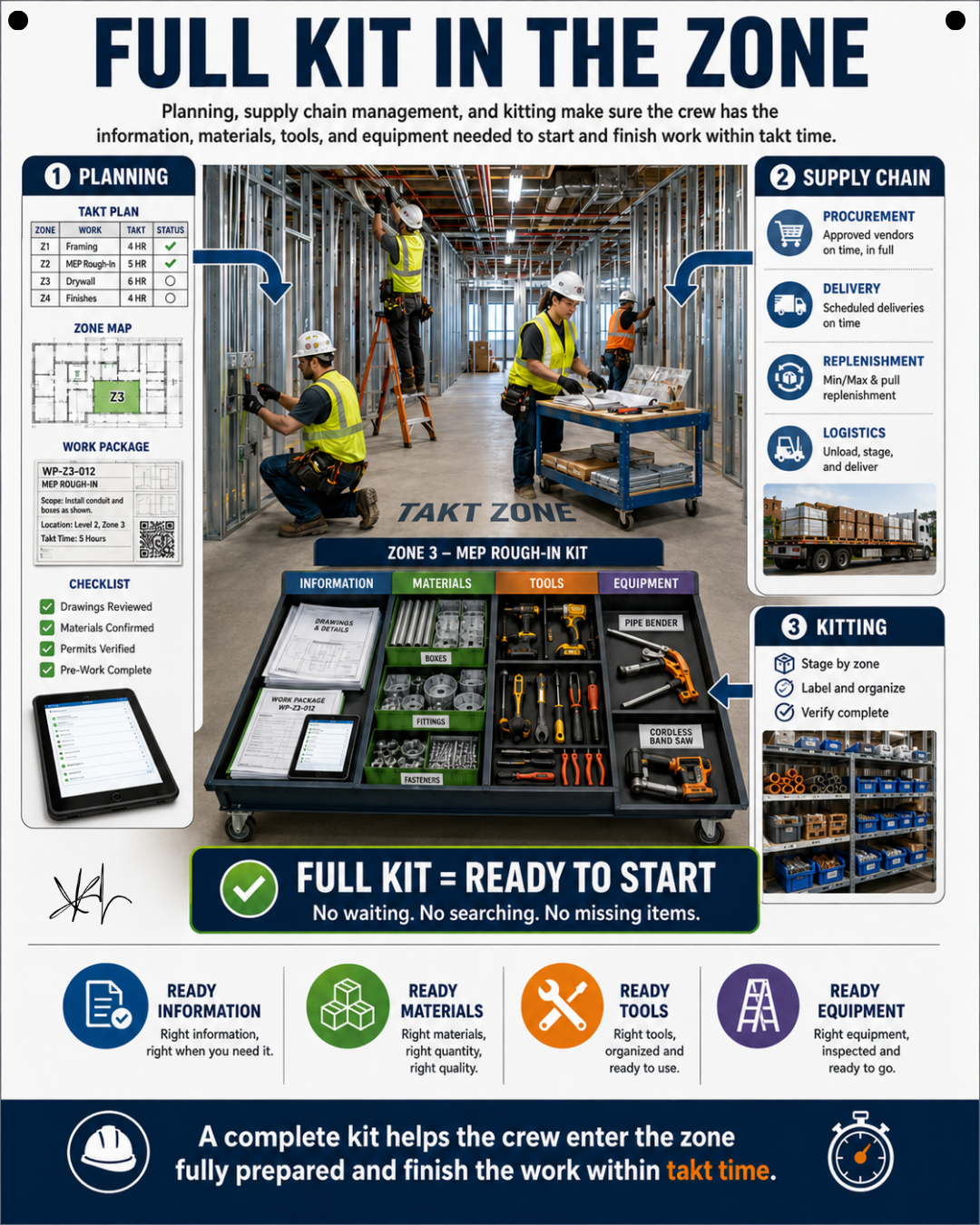
Short answer: Full kit in the zone means a crew is not released into a Takt zone until someone has physically checked four things against the work package: ready information, ready materials, ready tools, and ready equipment. Three systems make it possible: planning (the Takt plan, zone map, work package, and pre-work checklist), the supply chain, and kitting.
The Pain of a Stopped Crew
Picture this. A crew enters Zone 3 for MEP rough-in, ready to execute five hours of planned work inside the Takt duration assigned to that zone. Twenty minutes in, someone needs the pipe bender, and it is not there. Maybe it is still sitting in a connex box three hundred feet away. Maybe nobody confirmed it was actually on site before the crew started. The crew stops. Someone walks away to find it. The rest of the crew either waits or improvises around the gap, and the five-hour Takt window that was supposed to carry this zone cleanly into the next one is already compromised before the first hour is even complete.
This moment repeats across projects constantly, and it almost never gets traced back to its actual cause. A superintendent walking the zone an hour later sees a crew that looks slow, and the easy conclusion is that the crew is not moving fast enough. The actual cause was decided well before the crew ever walked in, the moment nobody verified that every piece of information, material, tool, and equipment the task required was actually present, staged, and ready.
The Failure Pattern
The failure pattern is treating readiness as something that gets planned for in general and assumed to be true in specific, rather than something that gets physically verified, zone by zone, before a crew is ever released into the space.
A Takt plan can be meticulously built, every zone sequenced, every duration calculated, every handoff defined. None of that planning automatically guarantees that the specific materials, tools, and information a specific crew needs for a specific zone are actually sitting there, ready, the moment that crew arrives. Planning tells you what should happen. It does not confirm that what should happen has actually been made physically true. That gap, between a plan that looks complete on paper and a zone that is actually ready in reality, is exactly where a Takt rhythm breaks down, one missing pipe bender at a time.
The Crew Didn’t Fail. The Zone Wasn’t Ready.
When a crew stalls inside a Takt zone, the instinct is to look at the crew. Why didn’t they move faster? Why didn’t someone flag the missing item sooner?
Before reaching that conclusion, it is worth asking what that crew actually had the chance to verify before they walked into the zone. If nobody checked, specifically and physically, that the pipe bender was staged in that zone before the crew’s Takt clock started, then the crew did not fail through carelessness. They walked into a space that was never actually confirmed ready, trusting that someone upstream had already done that verification, when in fact nobody had. The crew is not the constraint. The verification step that never happened is the constraint.
What Full Kit Actually Requires
Full Kit means the crew has everything needed to start and finish the work within Takt time, organized into four specific categories, each one answering a different question about readiness.
Ready information means the right information, right when you need it, drawings reviewed, the specific work package defined with its scope, location, and assigned Takt time clearly stated, and a checklist confirming drawings, materials, permits, and pre-work have all actually been confirmed rather than simply assumed. A crew walking into Zone 3 should not need to track down a current drawing revision once the task has already started. That information belongs at the point of use, verified, before the clock begins.
Ready materials means the right materials, right quantity, right quality, physically staged in labeled bins at the zone itself, boxes, fittings, fasteners, exactly matching what the specific work package actually requires, not a general supply somewhere on site that the crew has to locate and retrieve mid-task. This connects directly to the staging materials practice already covered in this series, applied specifically to the Takt zone level, where precision matters even more because the entire zone duration depends on it.
Ready tools means tools organized and ready to use, every hand tool, every specialty item, staged in its own labeled section of the kit rather than scattered across a general tool crib the crew has to search. Ready equipment means equipment like the pipe bender and the cordless band saw inspected and ready to go, confirmed functional and present before the crew ever needs to reach for it mid-task.
The Three Systems That Make Full Kit Possible
Full Kit does not happen by accident. It happens through three connected systems working together, and missing any one of them breaks the whole chain.
Planning starts with the Takt plan itself, the zone-by-zone breakdown of work, assigned duration, and current status, alongside a zone map that shows exactly where Zone 3 sits within the broader floor plan. The work package translates that plan into a specific, concrete scope, naming exactly what gets installed, where, and within what Takt time. The pre-work checklist, drawings reviewed, materials confirmed, permits verified, pre-work complete, is the actual verification step that turns a plan into a confirmed, ready zone rather than an assumed one.
Supply chain ensures the materials and equipment the plan calls for actually arrive, through procurement with approved vendors delivering on time and in full, scheduled deliveries that land when the plan needs them rather than whenever convenient, min and max replenishment that prevents both stockouts and overstocking, and logistics that unload, stage, and deliver material to the actual point of use rather than a general laydown area the crew then has to navigate.
Kitting is the final, physical assembly of everything the first two systems produced into one organized, mobile unit, staged by zone, labeled and organized so every item has an obvious home, and verified complete before the crew ever arrives. This is the step that turns information from a plan, material from a supply chain, and tools from a connex box into one single, trustworthy kit sitting at the zone entrance, ready for inspection before anyone starts working.
Full Kit Equals Ready to Start
No waiting. No searching. No missing items. That is the entire promise of a verified Full Kit, and it is worth noticing how different this promise is from simply having a good plan or a well-stocked supply chain. A project can have excellent planning and excellent procurement and still fail this test, if nobody physically confirms, kit by kit, zone by zone, that everything actually landed where it needed to be before the crew’s Takt clock started.
This is the same discipline already covered in this series under Advanced Work Packaging, where full kit readiness was defined as materials, tools, information, access, permits, and predecessors all verified true simultaneously before a crew gets scheduled against a package. Full Kit in the Zone applies that identical standard at the physical, tactical level of a single Takt zone, with the kit itself serving as the visible, checkable proof that the verification actually happened.
For the general case, see Full Kit: Why You Must Have Everything Before You Start and Rules of Flow in Construction: Full Kit. This post covers the single Takt zone.
Why This Is Love in Action for Workers
When a crew enters the zone fully prepared, they do not just work faster. They work safer, they work happier, and they finish within Takt time. That outcome deserves to be taken seriously rather than treated as a pleasant side effect. A crew that is never interrupted mid-task by a missing item experiences their work completely differently than a crew that spends part of every shift improvising around gaps nobody closed in advance. The first crew moves with confidence. The second crew moves with a low-grade, constant uncertainty about whether this task, too, is going to stall halfway through.
That difference is exactly what this series has already named as love in action elsewhere, the Construction Worker Care Hub and the Lean break area. Full Kit belongs in the same category. It is not primarily a scheduling tool. It is a decision that the crew deserves to walk into a zone already set up for their success, rather than discovering, task by task, what the project forgot to prepare.
Signals Your Zones Are Not Actually Full Kit
Look for these patterns on your current project:
- Crews stopping mid-task to search for a tool, material, or piece of information that should have already been staged
- A Takt plan that looks complete on paper with no corresponding pre-work checklist actually verified zone by zone
- Materials staged in a general laydown area rather than a labeled, zone-specific kit at the actual point of use
- Equipment that gets discovered as missing or non-functional only once a crew is already mid-task and needs it
- No one specifically assigned to verify kit completeness before a crew is released into a zone
Each of these signals a readiness gap that exists regardless of how good the underlying Takt plan and supply chain actually are, because none of that planning matters if nobody physically confirmed the kit before the crew walked in.
Build the Habit of Verifying Before Releasing
If your project needs superintendent coaching, project support, or leadership development, Elevate Construction can help your field teams stabilize, schedule, and flow.
Our LeanTakt team treats Full Kit verification as a non-negotiable gate, not a nice-to-have, because a Takt rhythm that looks perfect on the schedule and fails at the zone level teaches you nothing except where the real work still needs to happen.
Go deeper with the Advanced Work Packaging Done Right book and the Takt Production System Masterclass.
Here is your challenge. Pick one upcoming zone on your project and walk it yourself before the crew does, checking every category directly against the work package, information, materials, tools, equipment. Confirm it is actually there, not assumed to be there. Do that before every zone release going forward, and watch how many of your stalled tasks simply stop happening.
Want your team trained on this? See our Last Planner System and Takt training.
Bottom line: The impediment to action advances action. What stands in the way becomes the way. A Full Kit does not remove every obstacle a crew will ever face. It removes the ones that were entirely preventable, the missing pipe bender, the unverified drawing, the material that was never actually staged. Clear those before the crew walks in, and let them spend their Takt time on the work itself.
On we go.
FAQ
Who should be responsible for verifying a kit is complete before a crew is released into a zone?
A specific, assigned owner, often a project engineer or field engineer close to the work package, who physically checks each category, information, materials, tools, equipment, against what the work package actually requires. Shared or informal responsibility for this verification tends to produce exactly the gaps this practice is designed to close.
How is Full Kit in the Zone different from the Advanced Work Packaging practice already covered in this series?
Advanced Work Packaging defines full kit readiness at the level of an entire Installation Work Package, verifying materials, tools, information, access, permits, and predecessors across potentially multiple days of work. Full Kit in the Zone applies that same standard at a tighter, more tactical scale, a single Takt zone and its specific duration, with the physical kit itself serving as the visible proof that verification actually happened before the crew arrived.
What happens if a kit is found incomplete right before a crew is scheduled to start?
The crew should not be released into the zone until the gap is closed, even if that means a short delay before the Takt clock starts. Releasing a crew into an unverified zone simply moves the same stall into the middle of the task instead of catching it beforehand, which costs more time and disrupts the rhythm of every zone that follows.
How much time does kit verification actually add to a project’s schedule?
Far less time than the gap it prevents. A quick walk through a staged kit against its work package checklist takes minutes. A crew stalling mid-task because something was missing costs significantly more, both in direct lost time and in the ripple effect on every subsequent zone that depended on this one finishing on schedule.
How does Full Kit connect to the broader Takt Production System?
Takt planning defines the rhythm, the sequence, and the duration assigned to each zone. Full Kit is the verification step that makes that rhythm actually achievable in reality, confirming that everything the rhythm depends on, information, materials, tools, equipment, is physically present before the clock starts. A Takt plan without Full Kit verification is a schedule built on hope. A Takt plan with it is a schedule built on confirmed readiness.
People Also Read:
Full Kit: Why You Must Have Everything Before You Start
Rules Of Flow In Construction: Full Kit
Zone Release Checklist
If you want to learn more we have:
-Takt Virtual Training: (Takt Virtual Training)
-Check out our YouTube channel for more info: (Elevate Construction on YouTube)
-Listen to the Elevate Construction podcast: (Elevate Construction Podcast)
-Check out our training programs and certifications: (Training Programs and Certifications)
-The Takt Book: (The Takt Book on Amazon)
Discover Jason’s Expertise:
Meet Jason Schroeder, the driving force behind Elevate Construction. As the company’s Founder and COO, he’s dedicated to taking construction to new heights. With a wealth of industry experience, he’s crafted the Field Engineer Boot Camp and Superintendent Boot Camp – intensive training programs engineered to cultivate top-tier leaders capable of steering their teams towards success. Jason’s vision? To expand his training initiatives across the nation, empowering construction firms to soar to unprecedented levels of excellence.