Help Project Teams Visually Coordinate

Read 12 min

Physical Models: Why You Can’t Plan Flow on a Flat Sheet of Paper

You cannot plan flow on a flat sheet of paper.

Here is the deal. Construction is a spatial business. Where do the cranes sit? Where does material land? How do crews move through the building without stacking on top of each other? Which zones release first, and what path does the work take through them? Those questions determine whether a project runs smoothly or fights itself for the entire duration, and they are almost impossible to answer well while staring at a two dimensional site plan. A 3D printed physical model, built to real world scale and placed on a table in front of the whole team, changes what the team is actually capable of seeing and deciding together.

The Pain of Planning Space Without Seeing Space

Picture a typical logistics planning meeting run entirely from drawings. The site plan is on the screen or spread across the table. Someone points at a section and describes where the tower crane will sit. Someone else nods, translating that flat rectangle on paper into a mental model of an actual sixty foot structure occupying real three dimensional space. A third person is trying to picture how material will travel from the laydown area shown on the drawing to the actual point of installation four floors up, a journey the drawing represents as a line but that in reality involves elevators, hoists, corridors, and dozens of other trades occupying the same path at different times.

Every person in that meeting is doing the same difficult mental translation independently, converting two dimensional information into a three dimensional understanding of how people, material, and equipment will actually move. Different people do that translation with different accuracy. Some are naturally strong at spatial reasoning from a drawing. Others struggle, and their struggle is invisible in the meeting because nobody can see what mental model anyone else is actually working from. The plan that emerges from that meeting reflects whichever person’s mental translation was loudest or most confident, not necessarily the most accurate one.

This is exactly where site logistics plans go wrong in ways that only become visible once construction is underway. Two trades scheduled to occupy the same access path at the same time. A crane positioned in a spot that made sense on the drawing but conflicts with a laydown area nobody flagged during planning. A path of travel for materials that looks clean on paper but requires navigating past columns, mechanical rooms, and stair towers that the flat drawing did not make visually obvious.

The Failure Pattern

The failure pattern is asking a team to make three dimensional decisions using two dimensional tools, and then being surprised when the decisions do not hold up once the project moves into real space.

A site plan is an accurate representation of the project, but accuracy is not the same as comprehensibility. A drawing can contain every dimension needed to build correctly while still failing to help a room full of people intuitively grasp how a sequence of work will actually flow through a building. That gap between what the drawing contains and what the team can actually absorb from it is where logistics planning goes wrong, not because anyone made an error reading the drawing, but because the format itself asks too much translation of every person in the room.

Most projects accept this gap as unavoidable. Site logistics get planned from drawings because drawings are what exists, and the resulting plan gets tested for the first time when construction actually begins, which is the most expensive possible moment to discover that a crane placement conflicts with a laydown area or that two trades were never going to be able to occupy the same corridor at the same time.

They Didn’t Fail the System

When a logistics plan falls apart once construction starts, crews stacking into the same zone, material paths that turn out to be impassable, a crane position that conflicts with an access route nobody caught, the instinct is to ask why the planning team missed something so obvious in hindsight.

The honest answer is usually that the conflict was never actually visible to the planning team, because the tool they were using to plan, a flat drawing, does not make spatial conflicts visually obvious the way a physical model does. A conflict that would be immediately apparent looking down at a scale model from above, two work zones physically overlapping, a crane’s swing radius crossing directly through a laydown area, can remain completely invisible on a drawing where those same elements are represented as lines and labels that require mental translation to actually understand as occupying the same physical space.

The planning team did not fail to notice something obvious. They were working with a tool that structurally hides certain kinds of conflicts, no matter how carefully anyone reviews it. Give that same team a physical model, and the conflicts that were invisible on paper often become immediately, visually obvious, not because the team suddenly became more careful, but because the tool itself surfaces information that a flat drawing cannot.

What a Physical Model Actually Changes

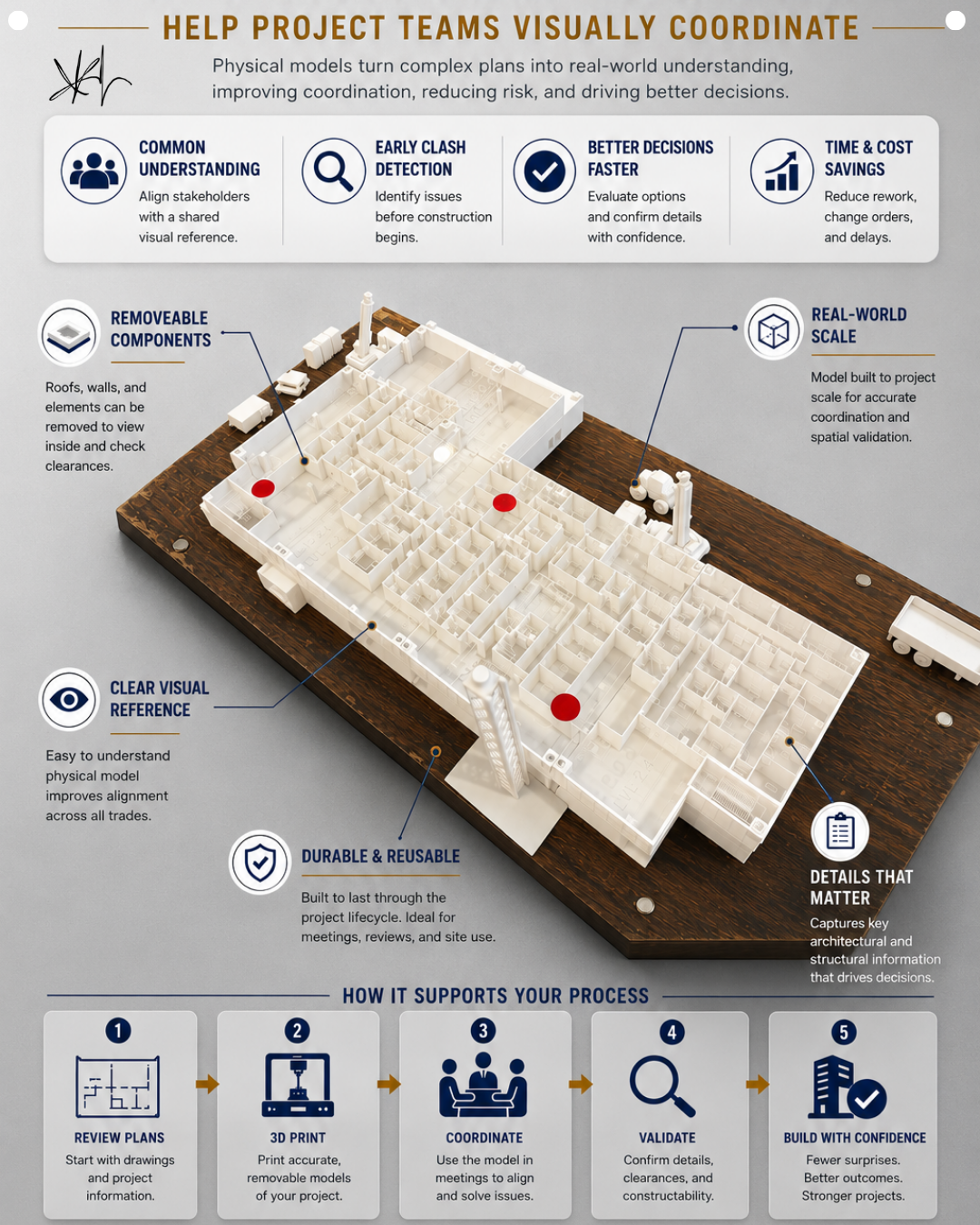
A common understanding is the first and most fundamental benefit. When the whole project team is looking at the same physical object, built to scale, there is no individual mental translation happening in isolation. Everyone in the room is aligned to a shared visual reference, which means a conversation about where the crane will sit is a conversation about an actual physical position on an actual physical model, not a description that each listener has to independently convert into their own mental picture.

Early clash detection becomes possible in a way that drawings rarely support intuitively. Identifying that two zones will conflict, that a crane’s position interferes with a planned laydown area, or that a path of travel crosses through a space that will be actively under construction, is dramatically easier when looking down at a scale model than when reading a site plan. This is spatial information, and physical models are the medium spatial information is naturally suited to.

Faster, more confident decisions follow directly from the previous two benefits. When the team shares a common understanding and can visually identify conflicts early, evaluating options and confirming details happens with far more confidence than debating an option that different people are still picturing differently in their own heads.

Reduced rework, change orders, and delays are the downstream financial consequence of catching spatial conflicts during planning instead of during construction. A crane placement conflict caught around a table with a model costs the time it takes to move a small physical piece and reconsider. The same conflict caught after the crane has actually been erected costs real money, real schedule, and a real disruption to whatever sequence depended on that crane being where it was planned to be.

The Specific Features That Make This Work

Removable components, roofs, walls, and individual elements that lift away, let the team see inside the model and check clearances that would otherwise be hidden behind an exterior surface. This matters specifically for planning crew flow through interior spaces, something a purely exterior model or a flat floor plan cannot show as intuitively as a model where you can physically remove a section and look inside.

Real world scale ensures the model supports accurate coordination and genuine spatial validation rather than a rough approximation. A model built to true scale means that distances, clearances, and relative positions on the model correspond meaningfully to actual distances and clearances on the real project, which is what makes it useful for genuine logistics validation rather than just a conversation aid.

Clear visual reference is what improves alignment across all trades specifically. A model that is easy to understand at a glance, without requiring specialized drawing literacy, means that every trade partner in a coordination meeting, regardless of their individual comfort reading construction documents, can participate in the conversation on equal footing.

Durability and reusability mean the model earns its cost over the full project lifecycle, used repeatedly across meetings, reviews, and ongoing site coordination rather than built once for a single presentation and then discarded.

And the details that matter, key architectural and structural information captured accurately in the model, ensure the tool actually drives real decisions rather than serving as a rough visual approximation that looks good but cannot bear the weight of genuine logistics planning.

The Process That Turns a Model Into a Planning Tool

A physical model only produces value if it is integrated into an actual planning process, and the process has five clear steps.

Review the plans first, starting with drawings and project information as the foundation everything else builds from. The model does not replace the drawing set. It translates it into a format the team can use more effectively for spatial coordination.

Print accurate, removable models of the project, ensuring the physical object faithfully represents the actual design rather than a simplified approximation that might miss the details that actually matter for coordination.

Coordinate by using the model in actual meetings to align the team and solve issues together, treating the model as a working tool in the room rather than a static display piece that gets admired and then set aside.

Validate details, clearances, and constructability using the physical reference the model provides, confirming that what looked workable in the abstract actually holds up when examined at scale with real spatial relationships visible.

And build with confidence, entering construction with fewer surprises because the team already walked the sequence, zone by zone, before a single crew mobilized to the site.

Why This Connects Directly to Takt Planning

A physical model is not a replacement for Takt planning. It is the tool that makes Takt planning genuinely spatial rather than purely schedule based. Takt planning defines zones and sequences. A physical model lets the team actually see those zones, walk the sequence visually, and confirm that the path the work takes through the building is physically coherent, not just logically coherent on a schedule.

Trade partners pointing at a model and planning their handoffs together in real time is Takt coordination made concrete. The abstraction of “Zone 3 releases to the mechanical trade on day four” becomes a physical conversation about an actual space, with actual clearances, that both trades can see and agree on together. If your project needs superintendent coaching, project support, or leadership development, Elevate Construction can help your field teams stabilize, schedule, and flow. Jason Schroeder and the LeanTakt team treat spatial planning tools like physical models as a natural extension of Takt discipline, because a schedule that is spatially sound is far more likely to hold than one planned entirely from a flat drawing.

Build the Model Before You Build the Building

Here is your challenge. Before your next major logistics planning meeting, whether it is crane placement, laydown planning, or a complex interior sequence, bring a physical model instead of relying solely on a drawing. Watch how quickly conflicts that would have stayed invisible on paper become obvious to everyone in the room at once.

The plan stops being abstract when everyone sees the same building, the same zones, the same flow. Build the team first, and give them something real to plan around.

On we go.

FAQ

Is a 3D printed model necessary, or can digital 3D models achieve the same result?
Digital 3D models offer real value and are already widely used for clash detection during design. A physical model adds a distinct benefit for group coordination meetings specifically, because everyone in the room can look at the same physical object simultaneously without needing a screen, a specific viewing angle, or someone controlling navigation. For collaborative logistics planning sessions with multiple trades in the room together, a physical model often produces faster alignment than passing control of a digital model back and forth.

How much does a physical model like this typically cost relative to the value it provides?
The cost varies significantly based on project scale and model detail, but the value case rests on preventing even a single significant logistics conflict from surfacing during construction rather than during planning. A crane placement error or a laydown conflict discovered after mobilization typically costs far more in rework, schedule impact, and coordination disruption than the model itself costs to produce.

At what phase of the project should a physical model be built?
Early enough that logistics decisions, crane placement, laydown areas, primary paths of travel, are still genuinely open for discussion rather than already locked in. Building the model after major logistics decisions have been finalized limits its usefulness to validation rather than genuine collaborative planning.

If you want to learn more we have:

-Takt Virtual Training: (Click here)
-Check out our Youtube channel for more info: (Click here) 
-Listen to the Elevate Construction podcast: (Click here) 
-Check out our training programs and certifications: (Click here)
-The Takt Book: (Click here)

Discover Jason’s Expertise:

Meet Jason Schroeder, the driving force behind Elevate Construction IST. As the company’s owner and principal consultant, he’s dedicated to taking construction to new heights. With a wealth of industry experience, he’s crafted the Field Engineer Boot Camp and Superintendent Boot Camp – intensive training programs engineered to cultivate top-tier leaders capable of steering their teams towards success. Jason’s vision? To expand his training initiatives across the nation, empowering construction firms to soar to unprecedented levels of excellence.
Posted in All

The VR Room

Read 12 min

The VR Room: Rehearsing the Jobsite Before Anyone Sets Foot On It

We are bringing the jobsite into the training room.

Here is the deal. Most construction training happens after a crew is already on site, learning the layout, the hazards, and the sequence of work in real time while the schedule is running. That approach has always carried a cost. Mistakes discovered in the field are mistakes that have already consumed time, material, or worse, created a safety exposure. The VR Room changes when that learning happens. Instead of waiting until crews are in the field to catch problems, teams can rehearse layouts, tasks, and workflows in a fully visualized environment before a single tool is picked up. They walk the space, interact with tools and scenarios, and build confidence before the work ever starts.

The Pain of Learning in Real Time

Walk any active jobsite during the first week of a new phase and you will see it. A crew encountering a layout for the first time while trying to execute the work at the same time. A new hire learning where the hazards are by nearly encountering one. A trade partner discovering a coordination conflict with another trade because neither team walked the sequence together before both showed up expecting the same space.

None of that is a failure of the individuals involved. It is what happens when the only place to learn a jobsite is the jobsite itself, under the pressure of an active schedule, with real consequences attached to every mistake. A new crew member cannot fully understand a complex mechanical room layout from a drawing set alone. A safety scenario described in a toolbox talk is not the same as encountering the actual spatial relationship between a hazard and a walking path. The gap between reading about a space and standing in it is where uncertainty, hesitation, and preventable error live.

This gap costs more than most projects recognize, because it is distributed across every new task, every new hire, and every unfamiliar sequence. It shows up as slower ramp-up time, more questions during execution, and safety incidents that trace back to someone encountering a hazard for the first time in the moment they needed to already understand it.

The Failure Pattern

The failure pattern is treating the jobsite as the only place training can happen, and treating training itself as something that happens before deployment in a classroom disconnected from the actual physical reality of the work.

Classroom training covers rules, procedures, and general safety principles, and it does that well. What it cannot do is give someone a spatial understanding of the actual space they are about to work in. A classroom cannot simulate the exact dimensions of a mechanical room, the actual sightlines around a specific piece of equipment, or the precise sequence in which two trades will need to occupy the same zone. That gap between general training and site-specific readiness gets filled, by default, in the field, during the first days of actual work.

Projects that accept this as normal are accepting a preventable cost. The technology to close that gap, to give a crew a spatial, interactive rehearsal of the actual work before they arrive, has existed for years in other industries. Aviation has used simulation for decades because the cost of learning in the actual environment is catastrophically high. Construction has been slower to adopt the same logic, in part because the industry has normalized learning on the job as simply how the work gets done.

They Didn’t Fail the System

When a new crew member struggles in their first days on an unfamiliar layout, or a coordination conflict surfaces between trades who never walked the sequence together, the instinct is to look at training quality or communication discipline. Better onboarding. Better pre-task briefings. More detailed coordination meetings.

Those improvements have value, but they are working within a system that never gave anyone a way to actually experience the space before entering it. A pre-task briefing describes the sequence verbally or on a drawing. It does not let the crew walk it. A safety orientation lists hazards. It does not let a new hire encounter the spatial reality of where those hazards sit relative to the tasks they will be performing. The gap is not a discipline problem. It is an infrastructure problem, and until a project has a tool that closes the gap between description and experience, the field will keep serving as the first rehearsal space by default.

What the VR Room Actually Provides

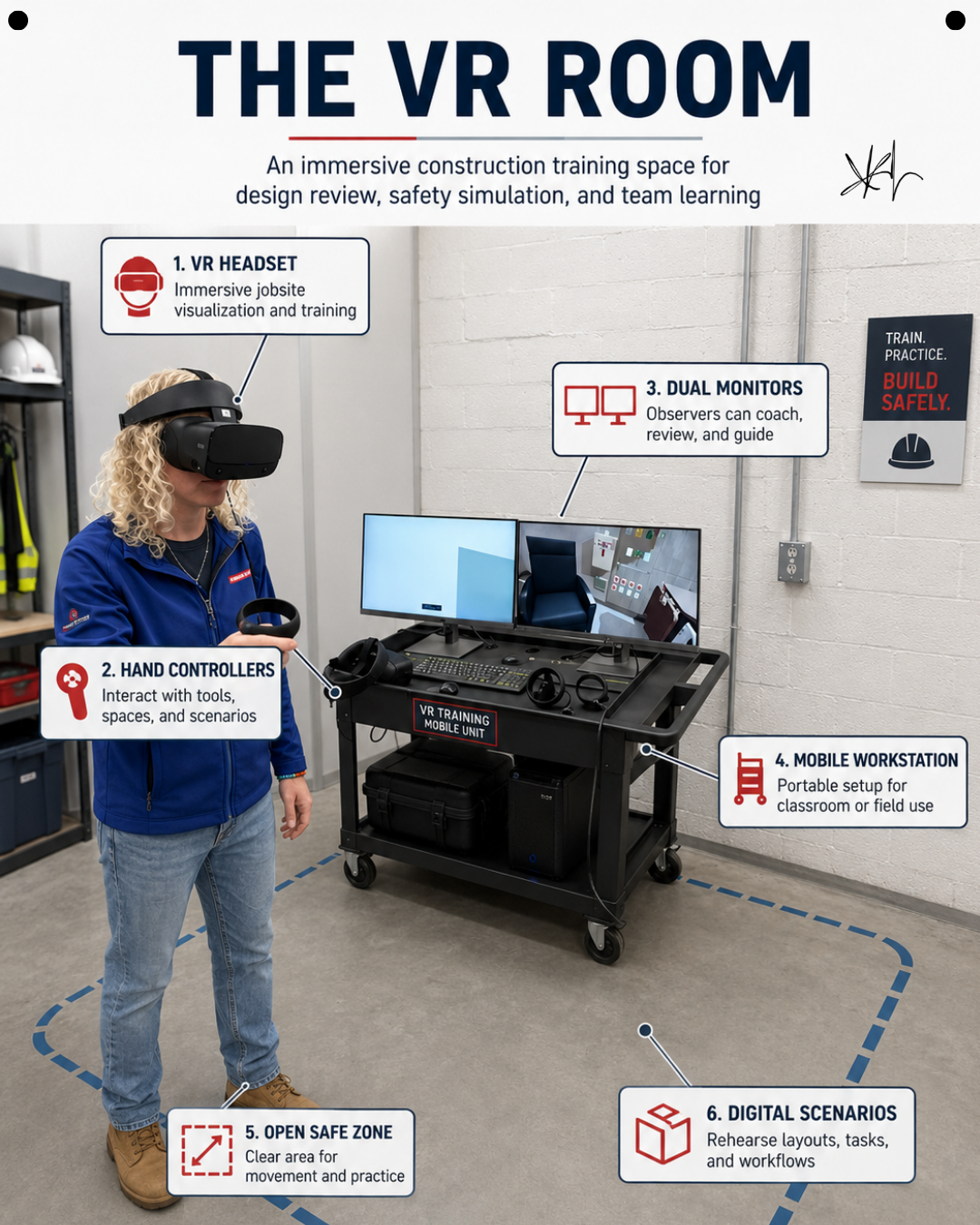
The VR Room is built around six components that together create a genuine rehearsal environment rather than a passive training video.

The VR headset provides immersive jobsite visualization, placing the trainee inside a three-dimensional representation of the actual space rather than asking them to interpret a two-dimensional drawing. Hand controllers allow direct interaction with tools, spaces, and scenarios, so the experience is not observation but participation. The trainee is not watching a walkthrough. They are moving through the space, reaching for equipment, and encountering the sequence of a task the way they would encounter it in the field.

Dual monitors give observers the ability to coach, review, and guide in real time. A supervisor or trainer watching the same scenario from outside the headset can see exactly what the trainee sees, correct a decision in the moment, and reinforce a lesson while the trainee is still inside the experience. That immediate coaching loop is difficult to replicate in field training, where the coach and the trainee are often managing the actual work at the same time as the teaching moment.

The mobile workstation makes the system portable for classroom or field use, which means the rehearsal capability is not locked into a fixed training center. It can move to where the crews are, which matters on a multi-site organization or a project where pulling an entire crew off to a distant training facility is not practical. The open safe zone provides a clear area for physical movement and practice, giving the trainee room to actually walk and interact rather than standing in one place operating controls. And the digital scenarios are the content layer, the specific layouts, tasks, and workflows built into the system that let a team rehearse the exact conditions they are about to encounter, rather than a generic training module unrelated to their specific project.

Why Rehearsal Beats Description Every Time

There is a meaningful difference between being told about a space and experiencing it, and that difference is exactly what the VR Room is designed to close.

A design review conducted around a drawing set requires everyone in the room to individually translate two-dimensional information into a mental three-dimensional model. Different people do that translation with different accuracy, which is part of why coordination conflicts surface in the field that nobody caught during the design review. A design review conducted with the team walking the same virtual space together removes that translation step entirely. Everyone is looking at the same spatial reality, from the same reference points, and conflicts that would have been invisible on paper become immediately obvious when someone tries to walk through a doorway that a piece of equipment is blocking, or reaches for a device that another trade’s rough-in has displaced.

Safety simulation carries the same advantage. A hazard described in a toolbox talk is an abstraction. A hazard encountered in a realistic virtual rehearsal, where the consequence of a wrong decision is immediate and visible without any actual physical risk, teaches a lesson that sticks in a way a verbal warning rarely does. The trainee is not just told that a fall hazard exists near a specific opening. They experience the spatial relationship between their own position and that hazard, in a scenario built specifically to reinforce the caution that a real jobsite would demand.

Pre-task planning benefits the same way. A crew that rehearses a complex or unfamiliar task in the VR Room before performing it in the field arrives at the actual work with a mental model already built. They know where they are going, what the sequence looks like, and where the coordination points with other trades occur. That familiarity translates directly into faster execution, fewer questions during the work, and fewer decisions made under time pressure without adequate preparation.

Signals Your Project Would Benefit From Rehearsal Training

Look for these patterns on your current project before deciding whether virtual rehearsal deserves investment:

  • New crew members consistently need extended orientation time before becoming productive in a complex or unfamiliar space
  • Coordination conflicts between trades are being discovered in the field rather than during design review
  • Safety incidents or near misses trace back to someone encountering a hazard for the first time in the moment they needed to already understand it
  • Design reviews conducted purely from drawings are missing spatial conflicts that only become obvious once construction begins
  • Complex mechanical, electrical, or plumbing spaces require significant field learning time before trades can work efficiently

Each of these signals a gap between description and experience that a rehearsal tool is specifically designed to close.

Building Rehearsal Into the Project Rhythm

The VR Room works best when it is integrated into the project’s existing preparation rhythm rather than treated as a separate initiative disconnected from daily planning. Design review sessions can incorporate a virtual walkthrough of the specific space under review, surfacing spatial conflicts before construction documents are finalized. New hire onboarding can include a rehearsal of the specific area they will be assigned to before their first day on that task. Safety training can move beyond generic modules to project-specific scenarios that reflect the actual hazards on the actual jobsite. Pre-task planning meetings can use the mobile unit to walk a crew through an upcoming complex task, surfacing coordination questions and sequence uncertainty in the safe zone rather than in the field.

The common thread across every one of those applications is preparation. Design review, safety training, coordination, and pre-task planning are all fundamentally about building understanding before execution. The VR Room simply gives that preparation a spatial, interactive form that description alone cannot provide. If your project needs superintendent coaching, project support, or leadership development, Elevate Construction can help your field teams stabilize, schedule, and flow. Jason Schroeder and the LeanTakt team see rehearsal tools like this as a direct extension of make ready planning, closing the gap between design intent and field readiness before the work ever begins.

Rehearse It Before You Build It

Here is your challenge. Identify one upcoming task or space on your project that is complex, unfamiliar, or has a history of coordination conflict. Before your crew executes it in the field, find a way to rehearse it, whether through virtual tools, a physical mockup, or a detailed team walkthrough. Build the mental model before the real consequences are on the table.

Taiichi Ohno taught that the goal of any system is to make problems visible as early as possible, before they compound into something expensive. The VR Room takes that principle and applies it to the moment before a crew ever steps onto the jobsite. Train. Practice. Build safely. Get it right in the virtual world first, so the real one flows the way it was designed to.

On we go.

FAQ

How is VR training different from traditional safety orientation or toolbox talks?
Traditional orientation and toolbox talks describe hazards and procedures verbally or through printed material, which requires the trainee to mentally translate that information into an understanding of the actual physical space. VR training places the trainee inside a spatial representation of the actual jobsite, letting them encounter hazards, tools, and sequences directly. That direct experience builds understanding faster and retains better than description alone.

Can the VR Room be used for design review with the full project team, not just field training?
Yes, and this is one of its strongest applications. A design team, superintendent, and trade partners can walk the same virtual space together during design review, surfacing spatial conflicts, such as equipment blocking a doorway or a device location conflicting with casework, before construction documents are finalized. Catching those conflicts during design review is far less costly than catching them in the field after material has already been installed.

Is the investment in VR training equipment justified for a single project, or is it better suited to an organization running multiple projects?
The mobile workstation design makes the system portable, which supports use across multiple projects for organizations with recurring project types or repeated space configurations, such as hospital builds or standardized commercial layouts. A single project with a highly complex or high-risk sequence can still justify the investment if the cost of field-discovered errors or safety incidents in that sequence would exceed the training investment.

If you want to learn more we have:

-Takt Virtual Training: (Click here)
-Check out our Youtube channel for more info: (Click here) 
-Listen to the Elevate Construction podcast: (Click here) 
-Check out our training programs and certifications: (Click here)
-The Takt Book: (Click here)

Discover Jason’s Expertise:

Meet Jason Schroeder, the driving force behind Elevate Construction IST. As the company’s owner and principal consultant, he’s dedicated to taking construction to new heights. With a wealth of industry experience, he’s crafted the Field Engineer Boot Camp and Superintendent Boot Camp – intensive training programs engineered to cultivate top-tier leaders capable of steering their teams towards success. Jason’s vision? To expand his training initiatives across the nation, empowering construction firms to soar to unprecedented levels of excellence.
Posted in All

The Construction Worker Care Hub

Read 11 min

The Construction Worker Care Hub: Why a Physical Space for Your Crew Is a Production Investment

The jobsite is not just where we build. It is where our people spend their days. So why do we so often treat worker welfare as an afterthought?

Here is the deal. Most projects express care for their workforce through language rather than through physical space. A sign about safety culture. A slogan on a banner near the trailer. Words that communicate intent without actually changing anything about the daily physical experience of the person doing the work. A Construction Worker Care Hub is different. It is not a message about care. It is a physical space, deliberately designed, that says something to every person who walks into it, whether or not anyone reads a single word on a wall.

The Pain of Care That Only Exists in Language

Picture a typical jobsite break period without a designed care space. Crews scatter to whatever flat surface is available, a stack of material, the tailgate of a truck, a concrete curb in whatever shade happens to exist that day. There is nowhere organized to sit. There is no dedicated place to get water or a snack without walking off site or hoping someone remembered to bring a cooler. The daily huddle happens standing in a gravel lot, competing with equipment noise, with half the crew straining to hear the plan for the day. Information about schedule changes or safety notices gets communicated verbally, once, to whoever happened to be in earshot, and never posted anywhere a person could reference it later.

None of that is dramatic. Nobody files a complaint about the lack of a proper break area. But the absence of a designed space communicates something continuously, every single day, to every person on that crew. It communicates that their comfort, their ability to actually rest during a break, their access to basic hydration, and their ability to hear and retain project information were not considered important enough to design for. That message accumulates the same way any other unaddressed friction accumulates, quietly, and it shows up eventually as disengagement, turnover, and a crew that does the minimum rather than brings real ownership to the work.

The Failure Pattern

The failure pattern is investing significant design attention in the systems that produce the building and almost none in the systems that sustain the people producing it.

A project will have a detailed logistics plan for material staging, a coordinated schedule for trade sequencing, and a well-designed connex box for tool storage. All of that deserves the attention it gets. What frequently receives no comparable design attention is where people actually spend their unstructured time during the day, the break, the huddle, the moment they need water or a place to review the day’s plan. That space gets whatever is left over, a stack of pallets, an unused corner, a patch of gravel near the trailer, because nobody applied the same design discipline to worker welfare that they applied to material flow.

This gap is not intentional neglect. It reflects a category error. Worker welfare gets filed mentally under “nice to have” rather than “operational input,” even though the crew’s physical and mental state during their workday is directly connected to how well they perform once the break ends and the huddle finishes. A crew that rested poorly during a break because there was nowhere adequate to sit returns to work carrying that fatigue into the afternoon. A crew that missed half of the morning huddle because they could not hear it clearly carries that information gap into every task the huddle was supposed to clarify.

They Didn’t Fail the System

When a crew seems disengaged, when huddles feel unproductive, when turnover on a project runs higher than expected, the instinct is to look at the crew’s attitude or commitment. They do not seem invested. They are just here for the paycheck.

Before reaching that conclusion, it is worth asking what the physical environment actually communicated to that crew every single day. If the environment gave them nowhere proper to rest, no reliable access to hydration, a huddle space that made it hard to hear or retain information, and no visible system for tracking schedule or project communication, then the disengagement is not a character problem. It is a rational response to a workplace that never designed for their basic needs. People invest in environments that invest in them. An environment that treats worker welfare as an afterthought should not be surprised when the workforce treats their own engagement the same way.

What the Care Hub Actually Brings Together

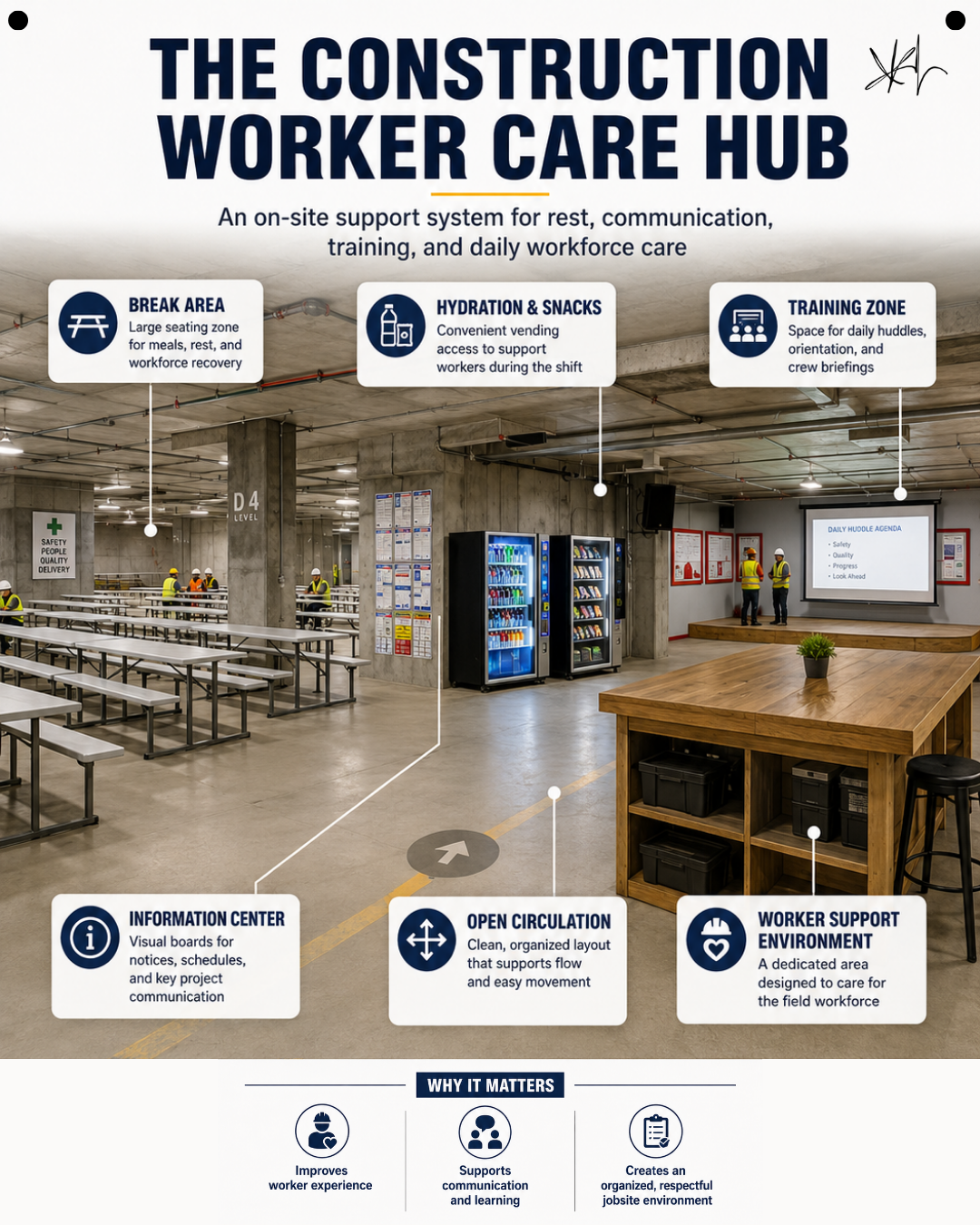
The Construction Worker Care Hub is built around six components, and each one addresses a specific need that most jobsites leave unaddressed.

A proper break area with real seating gives crews a designated space for meals, rest, and genuine recovery during their break, rather than whatever surface happens to be available. This matters because a break spent standing or perched on uncomfortable material is not the same as a break spent actually sitting down and disengaging from the work for a few minutes. Genuine rest during a break translates directly into better focus and energy for the remainder of the shift.

Convenient access to hydration and snacks keeps crews fueled through the shift without requiring them to leave the site or rely on whatever they happened to bring themselves. This is a simple, low cost addition that removes a friction most workers have simply learned to plan around, packing their own supply because the site does not provide one.

A dedicated training zone gives daily huddles, orientation, and crew briefings an actual space designed for the purpose, rather than a gravel lot competing with equipment noise. Information delivered in a space designed for it gets retained better than information shouted over ambient jobsite noise, and that retention directly affects how well the crew executes the plan discussed in that huddle.

An information center with visual boards for schedules, notices, and project communication gives the crew a reliable, physical place to check on updates rather than relying entirely on verbal communication that may or may not reach everyone. This is the same visual management principle behind the project KPI tracker and the Circle of Trust, applied specifically to the information a field crew needs day to day.

Open circulation, a clean and organized layout that supports safe and easy movement through the space, ensures the care hub itself does not become another cluttered area competing with the corridors and walkways this factory has already covered. A care hub that is disorganized or hard to move through undermines its own purpose.

And a worker support environment, the whole space designed with the field crew specifically in mind, ties all of the individual components together into a coherent statement rather than a collection of unrelated amenities.

Why This Improves Communication and Learning, Not Just Comfort

The care hub is often framed primarily as a comfort or morale investment, and that framing understates its actual value. A dedicated training zone with proper acoustics and visibility means the daily huddle actually functions as intended, information delivered clearly, retained accurately, and referenced later if questions arise. An information center with visual boards means schedule changes, safety notices, and project updates exist somewhere permanent and checkable, rather than depending entirely on someone remembering what was said out loud once.

This connects directly to everything this factory has covered about visual management and information flow. A project KPI dashboard works because performance data lives somewhere visible and continuous rather than buried in a report nobody opens. The same principle applies to a crew’s daily information needs. A schedule notice posted on a visual board in a space the whole crew passes through daily reaches more people, more reliably, than a verbal announcement made once during a huddle that half the crew may have been too far away to hear clearly.

Signals Your Project Needs a Dedicated Care Space

Look for these patterns on your current project:

  • Crews taking breaks scattered across whatever surface is available rather than a designated seating area
  • Daily huddles held in loud, exposed locations where information retention is inconsistent
  • No reliable, physical location where schedule changes or safety notices are posted for the crew to reference
  • Crews bringing their own water and snacks because no convenient access exists on site
  • Higher than expected turnover or disengagement without a clear operational explanation

Each of these signals a gap between what the crew needs to function well and what the physical environment currently provides.

Treat the Workforce Well and the Work Follows

This principle runs through every piece of content this factory has produced about crew care, from the Craft BBQ to heat stress prevention to the situation room built for leadership visibility. The consistent thread is that a workforce’s physical and emotional experience on site is not separate from production. It is an input to production, the same way material staging and clear corridors are inputs to production. A crew that feels supported shows up engaged, communicates clearly, and takes pride in what they build. That is not a sentiment. It is an observable pattern on every project that has actually invested in the physical space where its workforce spends the day.

If your project needs superintendent coaching, project support, or leadership development, Elevate Construction can help your field teams stabilize, schedule, and flow. Jason Schroeder and the LeanTakt team understand that the discipline behind a well-run Takt zone, a clean connex box, and organized corridors extends naturally to the spaces where the workforce rests, learns, and communicates, because every one of those spaces either supports the crew’s ability to perform or quietly works against it.

Build the Space Before You Ask for the Engagement

Here is your challenge. Walk your project and find the space, or the absence of one, where your crew currently takes breaks, holds huddles, and looks for information. Ask honestly whether that space communicates that the crew matters here, or whether it communicates that their comfort and communication needs were never really considered. Then build one improvement this month, real seating, a hydration station, a visual information board, whatever your project’s specific gap demands.

Jason Schroeder has said it plainly on projects across the country: you don’t build family by sympathy voting bad behavior, and you don’t build engagement by asking for it without investing in it first. A designed care space is not a request for engagement. It is the investment that makes engagement possible.

On we go.

FAQ

Isn’t a worker care hub a significant cost for a temporary jobsite?
The core components, seating, a vending or hydration station, a designated training space, and a visual information board, require a modest investment relative to the cost of turnover, disengagement, and communication failures that an unaddressed gap produces over the life of a project. The scale of the hub can match the project’s size and duration, but even a simple version delivers real value.

How is this different from a standard break trailer most projects already have?
A standard break trailer is often just enclosed space with minimal design attention. A Construction Worker Care Hub deliberately organizes distinct functions, rest, hydration, training, and information, into a coherent, well-laid-out space rather than treating a break area as a single undifferentiated room. The difference is intentional design versus incidental space.

Does a dedicated training zone actually improve huddle effectiveness?
Yes, primarily through better acoustics, visibility, and reduced competing noise compared to holding huddles in an open lot near active equipment. Information delivered and retained clearly translates directly into fewer questions and errors during the execution of that day’s plan.

If you want to learn more we have:

-Takt Virtual Training: (Click here)
-Check out our Youtube channel for more info: (Click here) 
-Listen to the Elevate Construction podcast: (Click here) 
-Check out our training programs and certifications: (Click here)
-The Takt Book: (Click here)

Discover Jason’s Expertise:

Meet Jason Schroeder, the driving force behind Elevate Construction IST. As the company’s owner and principal consultant, he’s dedicated to taking construction to new heights. With a wealth of industry experience, he’s crafted the Field Engineer Boot Camp and Superintendent Boot Camp – intensive training programs engineered to cultivate top-tier leaders capable of steering their teams towards success. Jason’s vision? To expand his training initiatives across the nation, empowering construction firms to soar to unprecedented levels of excellence.
Posted in All

Firemen Don’t Run into a Building, Feat. John Coffman

Read 8 min

Why Firemen Don’t Run Into A Building

Firemen do not run into a building. That line sounds like plain common sense until you notice how often construction teams do the exact opposite the moment a deadline starts pressing in on them, sometimes without even realizing they have crossed that line.

Where Schedule Pressure Quietly Creates Real Danger

A project falls behind, and the pressure to catch up starts pushing everyone to move faster. Pours get scheduled, designs get finalized, and work gets pushed forward under a steady stream of get it done, you’re wasting time, you’re wasting money. Somewhere in that pressure, the difference between moving quickly and moving carelessly starts to blur, and that is exactly the moment something genuinely dangerous can slip through unnoticed by an otherwise capable team.

Confusing Speed With Recklessness

The failure pattern is easy to miss because it hides behind a reasonable sounding demand. Nobody explicitly tells a team to skip safety checks. They just keep saying finish, finish, finish, until slowing down to verify something that feels off starts to seem like the real risk, when it is actually the only thing standing between a team and a disaster nobody saw coming.

The System Failed Them, They Didn’t Fail The System

The system failed them, they did not fail the system. Constant pressure to move faster rarely comes paired with equal pressure to move safely, so speed quietly becomes the only metric anyone is measuring against. Without a clear, repeated reminder that fast and careful are not opposites, teams under real deadline pressure default to treating caution itself as the thing slowing them down.

A Concrete Pour That Didn’t Feel Right

One story shows exactly what it looks like to walk in aware instead of running in blind. Ahead of a major concrete cap pour weighing roughly six hundred and fifty thousand pounds, something about the plan simply did not feel right to the superintendent overseeing it, even after the forms were up and the rebar was already in place. He brought the engineer back to the numbers not once, but three or four times, insisting they run the calculations again despite repeated assurances that everything checked out fine. On the final review, the engineer discovered the design would fail in shear rather than bending, an entirely different failure mode that had been missed every single time before that point. The whole assembly had to be taken apart down to the beams and rebuilt from scratch, and the pour never happened until it was actually confirmed safe.

A Boss Who Just Wanted The Tunnel Finished

A second story raises the stakes even further into genuinely life threatening territory. Assigned to finish the design on a seventy year old tunnel already deemed close to collapse, a superintendent noticed that steel throughout the structure was corroded far more severely than the surrounding concrete should have reasonably allowed. His boss pushed hard to simply finish the design and move on, repeating get it done, you’re wasting time, you’re wasting money over and over. He refused, personally chiseling into the concrete around exposed steel to investigate the corrosion himself, and eventually walked the entire three and a half mile tunnel directly with the project’s lead design engineer. What they found changed the design outright, and by his own account, very likely prevented people from dying underground in the process.

Why This Distinction Matters

This matters because pressure to hit a deadline never actually goes away on a real project, and the temptation to treat caution as the obstacle rather than the safeguard shows up on every job eventually. A team that confuses fast with careless is one uneasy feeling away from a disaster nobody will see coming until it is too late to stop. A team that knows how to move quickly while staying genuinely aware of real risk protects both the schedule and the people executing it, which is the only version of fast that actually holds up over time.

Walk In Aware, Do Not Run In Blind

The fireman comparison captures the real distinction perfectly. Firemen do not refuse to move quickly into a burning building. They walk in with their eyes open, aware of every hazard around them, because running in blind means running past something that could kill them before they even realize it happened. Construction crews facing real schedule pressure need that same posture, moving with real urgency while staying fully aware of the risks sitting directly in their path.

Trust The Feeling That Something Isn’t Right

Both stories share the same starting point, a nagging sense that something did not add up, even when everyone else involved insisted the numbers were fine. That instinct is not something to override in the name of staying on schedule. It is a signal worth investigating fully, even if it means asking an engineer to run the same calculation a third or fourth time, or personally chiseling into concrete to check something with your own hands instead of taking someone else’s word for it.

It Is The Superintendent’s Job To Watch Out For Everyone

Watching out for every person on a job is not a side responsibility that competes with hitting a schedule or a budget target. It is one of the core responsibilities the role actually exists to fulfill in the first place. As projects keep getting bigger and faster, that responsibility does not shrink. It becomes more important, precisely because there is less built in time to catch a mistake that got missed along the way.

Signs Your Team Is Running Instead Of Walking In Aware

Watch for these patterns before pressure turns into a real incident.

  • Get it done becomes the only message anyone hears from leadership
  • A nagging concern gets dismissed instead of investigated further
  • The same calculation or check only ever gets run once
  • Speed is treated as the goal instead of a byproduct of good preparation

Connect To Mission

None of this means slowing a project down without real reason to do so. If your project needs superintendent coaching, project support, or leadership development, Elevate Construction can help your field teams stabilize, schedule, and flow. It means moving with real urgency while staying genuinely aware of the hazards sitting directly in front of your team, because both things can be true at the same time.

Ways To Slow Down Without Slowing Down The Project

Use these the next time schedule pressure tempts your team to run instead of walk in aware.

  • Ask a second time whenever a plan still does not feel right
  • Investigate a concern personally instead of accepting a quick reassurance
  • Bring in a fresh set of eyes before finalizing a high risk decision
  • Separate genuine urgency from the habit of just moving fast out of pressure

A Challenge For Every Superintendent

Here is the challenge this week. The next time real pressure pushes your team to move faster, ask whether you are walking in aware or simply running in blind. As has been said plainly, firemen do not run into a building, and that same discipline belongs on every jobsite facing real pressure to finish.

On we go.

Frequently Asked Questions

What does firemen don’t run into a building actually mean for construction? It means moving with real urgency while staying fully aware of the hazards in front of you, rather than confusing speed with carelessness, since firemen walk into danger with their eyes open instead of running in blind.

Why does trusting an uneasy feeling about a plan matter so much? An uneasy feeling is often the first real signal that something has been missed, and investigating it fully, even repeatedly, can catch a serious failure mode before it ever becomes a real incident on site.

How can a superintendent stay fast without becoming careless? By separating genuine urgency from the habit of simply moving fast under pressure, and by treating any nagging concern as worth a second or third look instead of dismissing it to protect the schedule.

What happened when a team refused to rush a corroded tunnel repair? A superintendent personally investigated corrosion that did not add up, eventually walking the full tunnel with the lead design engineer, which led to a design change that very likely prevented a serious collapse and real loss of life.

Whose job is it to catch a hazard before it hurts someone? Watching out for everyone on the job is a core superintendent responsibility, not a side task that competes with the schedule, and that responsibility becomes more important, not less, as projects get bigger and faster.

If you want to learn more we have:

-Takt Virtual Training: (Click here)
-Check out our Youtube channel for more info: (Click here) 
-Listen to the Elevate Construction podcast: (Click here) 
-Check out our training programs and certifications: (Click here)
-The Takt Book: (Click here)

Discover Jason’s Expertise:

Meet Jason Schroeder, the driving force behind Elevate Construction IST. As the company’s owner and principal consultant, he’s dedicated to taking construction to new heights. With a wealth of industry experience, he’s crafted the Field Engineer Boot Camp and Superintendent Boot Camp – intensive training programs engineered to cultivate top-tier leaders capable of steering their teams towards success. Jason’s vision? To expand his training initiatives across the nation, empowering construction firms to soar to unprecedented levels of excellence.
Posted in All

You Cannot Count the Apples in a Seed

Read 8 min

You Can Count The Seeds In An Apple, But Not The Apples In A Seed

You can count the seeds in an apple, but you can’t count the apples in a seed. That line captures something worth sitting with, especially for anyone who measures their impact only in the things that happen to be countable at the end of a given day.

Where Real Impact Quietly Goes Unmeasured

Cut an apple open, and counting the seeds inside is a simple, mechanical task. Every one of them is right there, visible and finite, ready to be counted one by one. But plant just one of those seeds, and if it grows into a healthy tree, there is no way to count how many apples that tree will eventually produce, or how many further trees will grow from those apples, generation after generation, long after the original seed is forgotten entirely. The same is true for the help people give each other, and most of it never gets counted at all.

Measuring Only What Is Easy To Count

The failure pattern is simple to fall into because countable things feel more real than uncountable ones do in the moment. Dollars given, hours spent, calls made, all of it can be tallied up neatly on a page. But the actual ripple effect of a genuine act of help, the confidence it builds, the doors it opens, the people it eventually reaches secondhand and thirdhand without anyone tracking it, almost never makes it onto anyone’s ledger, which makes it easy to quietly undervalue the very things that matter most in the long run.

The System Failed Them, They Didn’t Fail The System

The system failed them, they did not fail the system. Nobody teaches people to think in terms of seeds and apples instead of simple transactions. We are trained from an early age to count what is countable, money, time, effort, so the exponential, compounding nature of real generosity and real mentorship gets overlooked almost by default, not because anyone decided it did not matter.

Furniture, A Loan, And A First Client

A few honest examples make the idea concrete and easy to picture. Parents helping furnish an empty house during a genuinely lean stretch early in a marriage is a countable act, a receipt, a dollar figure that could be added up exactly. What it actually produced, a stable home during a hard season that made everything afterward possible, was never something anyone could put a number on. The same is true of a relative who once loaned money that allowed a young family to get out of debt entirely and start building something new, and of the very first client who took a chance on a brand new business and gave it the early momentum it needed to survive its first real test out in the market.

Why This Distinction Matters

This matters because undervaluing the uncountable side of generosity means people quietly do less of it than they otherwise would over the course of a career. If the only thing that counts is what can be measured, mentorship, patience with a struggling new hire, and quiet acts of kindness toward a trade partner having a rough week all start to feel optional instead of essential parts of the job. But those uncountable seeds are very often what determines whether a person, a team, or an entire company actually thrives over the long run, long after the original moment is forgotten by everyone involved.

Seeds Multiply In Ways Nobody Can Predict

A single seed of genuine help rarely stays contained to one person or one moment in time. It becomes the training that gets passed on to someone else, becomes the example a young leader copies without ever fully realizing where they picked it up, becomes the story that gets told years later to explain why someone chose to stay in an industry instead of leaving it behind entirely for something easier. None of that shows up on a spreadsheet, and none of it needs to in order to be real and lasting for the people who experience it firsthand.

This Applies Directly To Construction Leadership

A foreman who takes the extra time to properly train a new worker, a superintendent who treats a struggling trade partner with patience instead of blame, a mentor who spends an afternoon walking a young engineer through a mistake instead of just fixing it themselves and moving on to the next task, all of these are seeds worth planting deliberately. The direct, countable cost is small, an afternoon, a few extra minutes, a moment of patience that costs almost nothing to give in the moment it happens. The uncountable return, the career that gets shaped, the crew culture that gets built, the industry that slowly gets better one relationship at a time, is enormous by comparison and impossible to fully tally no matter how carefully anyone tries to measure it after the fact.

Seeds That Are Easy To Underestimate

Watch for these everyday moments that carry far more weight than they first appear to carry at the time they happen.

  • Taking the time to properly train someone instead of just doing it yourself and moving on
  • Extending patience to a struggling trade partner instead of blame or frustration
  • Mentoring a younger colleague with no expectation of anything in return for it
  • Treating people with dignity even when nobody else is watching closely or keeping score

Connect To Mission

None of this means ignoring results or accountability on a real project that still has to finish on time and on budget. If your project needs superintendent coaching, project support, or leadership development, Elevate Construction can help your field teams stabilize, schedule, and flow. It means recognizing that the seeds planted through genuine mentorship and respect for people often matter more than anything that ever shows up on a countable report at the end of a project.

Questions To Ask About The Seeds You’re Planting

Use these to reflect on the impact you may be underestimating right now.

  • Who has quietly helped you in a way you never fully repaid or counted
  • What small act of patience or training could you offer again this week
  • What do you want to be remembered for, beyond what gets measured
  • Are you undervaluing an uncountable seed because it does not show up anywhere

A Challenge For Every Leader

Here is the challenge this week. Think honestly about the seeds you are planting right now, in how you train people, in how you treat a struggling trade partner, in how you mentor someone earlier in their career than you are. As has been said plainly, you can count the seeds in an apple, but you can’t count the apples in a seed, and whether those seeds are good or bad, you will never be able to count everything they eventually produce over time.

On we go.

Frequently Asked Questions

What does the apple seed analogy actually teach about impact? It teaches that direct, countable actions like money or time spent are only the visible surface of impact, while the real, lasting effect of genuine help multiplies in ways that can never be fully measured or predicted in advance.

Why is it hard to measure the real impact of mentorship or generosity? Mentorship and generosity create ripple effects that pass through other people over years and even generations, which means most of the actual impact happens far outside the original moment and is never directly witnessed by the person who started it in the first place.

How does this idea apply specifically to construction leadership? Training a new worker properly, mentoring a young engineer, and treating trade partners with patience instead of blame are all small, low cost seeds that shape careers, crew culture, and the industry itself far beyond their immediate, countable cost.

Why does it matter to reflect on the seeds you’re planting? Reflecting on this shifts attention away from only the outcomes that are easy to measure and toward the quieter, compounding actions that often matter more to the people and industry a leader actually wants to influence.

Can small, everyday actions really have a lasting impact? Yes. A single moment of patience, training, or genuine mentorship can shape how someone leads, trains, and treats others for the rest of their career, which means its true impact is almost always larger than it appears in the moment it happens.

If you want to learn more we have:

-Takt Virtual Training: (Click here)
-Check out our Youtube channel for more info: (Click here) 
-Listen to the Elevate Construction podcast: (Click here) 
-Check out our training programs and certifications: (Click here)
-The Takt Book: (Click here)

Discover Jason’s Expertise:

Meet Jason Schroeder, the driving force behind Elevate Construction IST. As the company’s owner and principal consultant, he’s dedicated to taking construction to new heights. With a wealth of industry experience, he’s crafted the Field Engineer Boot Camp and Superintendent Boot Camp – intensive training programs engineered to cultivate top-tier leaders capable of steering their teams towards success. Jason’s vision? To expand his training initiatives across the nation, empowering construction firms to soar to unprecedented levels of excellence.
Posted in All

Would a Professional Sports Team Do It?

Read 8 min

Why How You Treat People Shapes How They Perform

I am not talking to you like whatever position you happen to hold right now. I am talking to you like someone with real potential, real capability, and a future worth taking seriously. That shift in posture changes more about how people actually perform than almost anything else a leader can do, and it costs nothing to give.

Where Low Expectations Quietly Become Self Fulfilling

A team member makes an excuse, I am just not good with names, I am not really a details person, and a leader lets it slide because pushing back feels unkind in the moment. Over time, that small kindness becomes a ceiling nobody meant to build. The person never gets challenged to be anything more than the limited version of themselves they described out loud, and the leader never realizes that letting the excuse stand was not actually the compassionate choice it seemed to be at the time.

Confusing Sympathy With Respect

The failure pattern hides behind good intentions. Accepting a lower standard from someone feels like kindness, but it quietly communicates the opposite message, that this person is not actually capable of more. Real respect looks different. It treats someone as though they are already the capable, high performing version of themselves, and it expects them to rise to meet that version instead of settling into whatever excuse felt easiest to reach for that day.

The System Failed Them, They Didn’t Fail The System

The system failed them, they did not fail the system. Very few people ever hear, directly and clearly, that they are capable of far more than their current habits suggest they are. Without that direct message, it is easy to settle into whatever standard feels comfortable, especially when everyone around them has quietly agreed to lower the bar out of misplaced kindness rather than raise it out of genuine belief in what they can still become.

A Room Full Of Executives Acting Like Children

One story makes this principle concrete. During a live training session with dozens of company owners and executives in the room, side conversations and distractions kept pulling focus away from a session that had taken real effort and travel to prepare properly. Rather than letting it slide, the moment called for a direct, respectful correction, naming the behavior plainly and asking the room to show the same focus and professionalism their own positions actually demanded of them every single day. The room settled immediately, and the host of the event later admitted relief that someone had finally said what needed to be said out loud. A second example shows the same principle in a coaching setting. When someone in a training session leaned on an excuse instead of owning a real growth area, the more useful response was a direct question. Do you want to be coached like someone who has already decided their limits, or like a future leader with real potential still ahead of them. Nearly every time that question gets asked plainly, the person rises to meet it instead of retreating further into the excuse.

Why This Distinction Matters

This matters because how a person gets treated shapes how they actually show up, far more than most leaders realize in the moment they are deciding how to respond. Someone treated like a child who cannot help their own limitations tends to keep proving that story true over and over again. Someone treated like a capable professional with real potential tends to rise toward that expectation instead, not because the pressure feels good, but because someone finally communicated genuine belief in what they were capable of becoming, maybe for the first time in their career.

The Olympic Team Test

One simple test cuts through a lot of unnecessary hesitation around team accountability. Would a professional sports team, an elite military unit, or an Olympic team handle a real issue the way this team is currently handling it right now. Professional teams at that level do not insist that every piece of feedback happen quietly behind closed doors, one person at a time, away from the rest of the group entirely. They address real issues directly, as a team, because they understand that mutual accountability is what actually holds a high performing group together, not polite avoidance dressed up as consideration for someone’s feelings.

Applying This Test To Your Own Team

The next time a team defaults to avoiding a hard conversation, or insists an issue only gets raised in private rather than addressed as a group, it is worth asking honestly whether a genuinely elite team would operate that way under the same circumstances. If the answer is no, that avoidance is probably not actually protecting anyone involved. It is more likely protecting the discomfort of whoever is avoiding the conversation in the first place, at the cost of the clarity and growth the rest of the team actually needs to keep improving together.

Signs You’re Being Sympathy Voted Instead Of Challenged

Watch for these patterns in yourself or in how you are currently leading the people around you.

  • An excuse gets accepted instead of gently but firmly questioned
  • Feedback only ever happens privately, never in front of the team
  • Nobody expects more from you than you already expect of yourself
  • A real growth area gets avoided because raising it feels uncomfortable

Connect To Mission

None of this means being harsh or disrespectful toward anyone on a team, and it never should. If your project needs superintendent coaching, project support, or leadership development, Elevate Construction can help your field teams stabilize, schedule, and flow. It means treating every single person according to the real potential they actually have, and holding that expectation with enough genuine respect that they start to believe it themselves, sometimes for the very first time.

Questions To Ask About Your Team’s Standards

Use these to check whether your team currently operates at the level it is actually fully capable of reaching, or somewhere well below it.

  • Would a professional or Olympic level team handle this the same way we do
  • Are we avoiding a hard conversation out of respect, or out of discomfort
  • What excuse have I quietly accepted that deserves a second, honest look
  • Am I treating this person like their potential, or like their current habits

A Challenge For Every Leader

Here is the challenge this week. Find one place where you have been sympathy voting someone, accepting an excuse instead of expecting more from them, and have the direct conversation that treats them like the capable person they actually already are. As has been said plainly, if you would not see an Olympic team do it, why would we do it, and that same question belongs in every conversation about the standards your own team is willing to accept from itself.

On we go.

Frequently Asked Questions

What does it mean to treat someone according to their potential in a real workplace setting? It means responding to a person as though they are already capable of the high standard they are actually capable of reaching, rather than accepting a lower standard simply because it feels kinder or easier to allow in the moment.

What is sympathy voting, and why does it actually hurt the people it is meant to protect? Sympathy voting means quietly accepting someone’s excuse or lower standard out of misplaced kindness, and it hurts people because it communicates a belief that they are not actually capable of more, which becomes a ceiling instead of genuine support for their growth.

What is the Olympic team test for evaluating a team practice? It is the practice of asking whether a professional sports team, elite military unit, or Olympic team would handle a given situation the same way your own team currently does, which quickly reveals whether a habit is genuinely useful or just a comfortable avoidance.

Why might insisting on private, one on one feedback actually avoid real accountability? Elite teams often address real issues directly and openly because mutual accountability strengthens the group, so insisting every issue must be handled quietly in private can sometimes protect individual comfort rather than actually serving the team’s growth.

How can raising expectations actually be an act of respect? Raising expectations communicates genuine belief in someone’s real capability, which tends to help that person rise toward the standard being set, while consistently lowering the bar quietly communicates the opposite message about what a leader actually believes they can do.

If you want to learn more we have:

-Takt Virtual Training: (Click here)
-Check out our Youtube channel for more info: (Click here) 
-Listen to the Elevate Construction podcast: (Click here) 
-Check out our training programs and certifications: (Click here)
-The Takt Book: (Click here)

Discover Jason’s Expertise:

Meet Jason Schroeder, the driving force behind Elevate Construction IST. As the company’s owner and principal consultant, he’s dedicated to taking construction to new heights. With a wealth of industry experience, he’s crafted the Field Engineer Boot Camp and Superintendent Boot Camp – intensive training programs engineered to cultivate top-tier leaders capable of steering their teams towards success. Jason’s vision? To expand his training initiatives across the nation, empowering construction firms to soar to unprecedented levels of excellence.
Posted in All

Seagull Management

Read 8 min

Why Seagull Management Never Actually Helps A Project

Come to the job, fly around, cause a mess, and then leave. That pattern has a name in construction leadership circles, and once someone points it out, it becomes impossible not to notice how often it actually happens across projects everywhere.

Where Occasional Visits Quietly Become A Problem

An executive, director, or consultant shows up on a struggling project, points out everything wrong, stresses the team out, and disappears again until the next visit rolls around. Nobody feels helped afterward. The team is left to clean up the tension that visit created, on top of whatever problems already existed before that person ever walked onto the site in the first place.

Confusing Oversight With Occasional Criticism

The failure pattern is easy to fall into because showing up and pointing out problems feels like doing the job. It is not the same thing as actually helping fix them, and the difference between the two matters enormously to the team living with the consequences either way. A leader who only ever shows up to criticize, then leaves the team to handle the fallout alone, is providing the appearance of oversight without any of its real substance underneath it.

The System Failed Them, They Didn’t Fail The System

The system failed them, they did not fail the system. Plenty of people get promoted into oversight roles based on visibility and internal politics rather than a genuine track record of building strong projects from the ground up. Without ever being taught what real, hands on oversight actually requires day to day, it is easy to default to the only model available, showing up occasionally, judging from a distance, and leaving the actual work of fixing things to whoever is left standing on site when the visit ends.

Running Away From A Problem Versus Running Toward It

Two real examples show the difference clearly, and they involve two different leaders responding to two different struggling projects in almost opposite ways. On one struggling project, the executive responsible for it chose to blame a field director and send that person in to fix a situation the executive himself had actually created through his own earlier decisions, then stepped back to watch from a safe distance. On a different struggling project, a different executive called directly and said, I need help, let’s dive in together, no excuses, no blame, just a real commitment to fix it side by side. That person showed up personally, attended the team’s internal meetings, made the hard calls alongside the team instead of from a distance, and helped turn the project around into one where the client became a genuine advocate for the company afterward, actively recommending them for future work.

Why This Distinction Matters

This matters because a team that only ever experiences leadership as criticism followed by abandonment starts treating oversight visits as something to survive rather than something that actually helps them move forward. A team that experiences a leader who dives in, helps solve real problems, and stays engaged between visits builds genuine trust instead, and that trust is what actually makes hard conversations and hard decisions possible when a project truly needs them most.

Five Responsibilities You Cannot Hand Off

Real oversight starts with actually visiting a project regularly and helping build the team, making sure they have the people, funding, equipment, and approvals they need to succeed on their own terms. It means refusing to tolerate dysfunction, whether that is an abusive owner, a team member mistreating another, or simply letting real problems go unaddressed because confronting them feels uncomfortable in the moment. It means checking in personally with individual team members on a regular basis, not just about the project, but about how their career and their life outside of work are actually going day to day. It means making sure the project’s own internal team meeting is genuinely excellent, not just a formality everyone quietly tolerates because nobody wants to fix it. And it means actively communicating clarity about where the project is headed, to the team, to the owner, and to every stakeholder who depends on that clarity to do their own job well without constantly guessing.

Dig Deep On Three Things Every Visit

One practical habit separates genuine engagement from a seagull style drive by that leaves nothing useful behind. Rather than offering vague encouragement or general criticism across an entire project, pick three specific things on every visit and dig into them deeply enough to actually help remove a roadblock or catch a problem the team may not have fully seen yet themselves. That kind of focused, specific engagement is what turns a site visit into real help instead of just another disruption for the team to absorb and quietly move past once the visitor leaves.

How To Tell If You’re Seagull Managing

Watch for these patterns the next time you visit a project you are responsible for overseeing on any real basis.

  • You cannot say specifically what the team is currently working through this week
  • Your visits generate stress without leaving behind any real solutions to the problems raised
  • You take credit when things go well and assign blame when they do not go as planned
  • Team members seem relieved rather than genuinely supported after you leave the site

Connect To Mission

None of this means micromanaging every decision a capable team makes on their own without any need for outside input. If your project needs superintendent coaching, project support, or leadership development, Elevate Construction can help your field teams stabilize, schedule, and flow. It means staying close enough to a project that your presence actually removes obstacles instead of creating new ones for the team to clean up later once you have already left the site.

The Five Responsibilities Behind Real Oversight

Keep these five in mind every single time you step onto a project you are responsible for overseeing.

  • Build the team and make sure they have real resources to succeed
  • Refuse to tolerate dysfunction or abuse in any direction
  • Check in personally with team members about their career and wellbeing
  • Make sure the project’s internal team meeting is genuinely excellent
  • Communicate clarity of direction to the team, the owner, and every stakeholder

A Challenge For Every Leader Who Oversees A Project

Here is the challenge this week. Before your next site visit, decide on the three specific things you will dig into deeply, and commit to running toward the next real problem instead of away from it, no matter how tempting the easier path might look in the moment. As has been said plainly, run to your work, do not run away from it, and that single shift changes what a team actually experiences when their leader walks through the door.

On we go.

Frequently Asked Questions

What is seagull management? Seagull management describes a leader who visits a project only to criticize or create stress before leaving, offering the appearance of oversight without actually helping the team solve the problems they are facing.

What are the five responsibilities a project leader cannot hand off to someone else? Building the team and securing real resources, preventing dysfunction or abuse in either direction, checking in personally on team members, ensuring the internal team meeting is genuinely excellent, and communicating clarity of direction to everyone involved are all responsibilities that belong directly to the person overseeing a project, not to whoever happens to be standing closest when a problem finally surfaces.

What is the difference between running away from a problem and running toward it? Running away means blaming someone else and dispatching them to fix a situation from a distance, while running toward a problem means personally engaging, attending the real meetings, and making hard decisions alongside the team instead of from the sidelines.

Why do some underperforming leaders still get promoted? Promotions are sometimes driven more by internal visibility and political relationships than by an actual track record of building strong, successful projects, which can put people into oversight roles without the experience needed to do that job well.

What does it mean to dig deep on three key things when visiting a project? Instead of offering vague feedback across an entire project, a leader picks three specific issues and investigates them thoroughly enough to genuinely help remove a roadblock, which turns a site visit into real support instead of just another disruption.

If you want to learn more we have:

-Takt Virtual Training: (Click here)
-Check out our Youtube channel for more info: (Click here) 
-Listen to the Elevate Construction podcast: (Click here) 
-Check out our training programs and certifications: (Click here)
-The Takt Book: (Click here)

Discover Jason’s Expertise:

Meet Jason Schroeder, the driving force behind Elevate Construction IST. As the company’s owner and principal consultant, he’s dedicated to taking construction to new heights. With a wealth of industry experience, he’s crafted the Field Engineer Boot Camp and Superintendent Boot Camp – intensive training programs engineered to cultivate top-tier leaders capable of steering their teams towards success. Jason’s vision? To expand his training initiatives across the nation, empowering construction firms to soar to unprecedented levels of excellence.
Posted in All

MANN GULCH

Read 8 min

New Circumstances Require New Skills, Not Old Solutions

New circumstances always require new skills and tools, fresh training, and innovative solutions. That idea sounds obvious in theory, and yet teams reach for the same old playbook constantly, even after the actual situation in front of them has fundamentally changed into something the old playbook was never built to handle.

Where Old Solutions Quietly Become Dangerous

A team trained hard on one set of methods eventually runs into a situation those methods were never built for. The instinct is almost never to pause and ask whether the old approach still fits the moment. It is to apply it harder, faster, and with more effort, because that approach is what the team knows, what they trained for, and in many cases what makes up their entire professional identity as builders.

Confusing Familiar With Safe

The failure pattern is subtle because familiar solutions genuinely feel safer in the moment, even when they are not. Letting go of a known method under real pressure feels like losing competence, losing identity, and losing the years of training that built confidence in the first place. So teams keep reaching for what they know, even after the real problem in front of them has quietly turned into something the old method was never designed to solve.

The System Failed Them, They Didn’t Fail The System

The system failed them, they did not fail the system. Very few teams are ever trained to recognize the moment a problem has genuinely shifted rather than simply intensified. Without that specific training, there is no alternative model to reach for under pressure, so people default to whatever they already know how to do, even when it is actively working against them.

A Wildfire In Montana And A Lesson In Letting Go

One of the most striking real world examples of this comes from a wildfire that broke out in a remote Montana canyon in 1949. A crew of smokejumpers, firefighters trained to parachute into rugged backcountry, were dropped in to handle what looked like a manageable blaze on a routine assignment. Within minutes, a sudden shift in wind turned that small fire into a fast moving wall of flame covering thousands of acres, trapping the crew against a steep, nearly vertical canyon wall with almost nowhere left to go. Investigators later found that most of the men who died had kept their heavy tools, saws, axes, and packs, strapped to their bodies the entire time they tried to outrun the fire up that slope toward the ridge above them. Every one of those tools had been trained into them as essential equipment they were never supposed to leave behind. In an actual foot race against fire, that same equipment became dead weight that slowed the very people carrying it toward safety. Nobody had ever trained them to think about a scenario where survival meant abandoning their tools entirely, so under real pressure, none of them did. Three men survived that day, including the crew’s foreman, who did something no one on that crew had ever been taught to do. He struck a match, burned away the grass in a ring around himself, and lay down in the cleared patch as the main fire passed around him instead of through him, a technique with roots in older tactics used by Plains tribes facing wildfires long before the Forest Service adopted any formal firefighting doctrine at all. He had recognized something the rest of the crew never had time to see, that the real problem was no longer how to fight the fire, but how to survive it.

Why This Distinction Matters

This matters because the tools, habits, and training that build someone’s professional identity can become a liability the moment the actual problem changes shape entirely. Recognizing that shift in real time, and being willing to set aside a familiar approach in favor of something new, is a genuinely different skill than mastering the original method in the first place ever was. Teams that never practice that second skill tend to keep solving yesterday’s problem long after today’s problem has already moved past it and become something else.

Never Fight The Last War

This idea shows up throughout military history as well, and it applies just as directly to construction leadership. Armies that prepare meticulously for the previous conflict often get outmaneuvered by an opponent who assumes the next fight will look nothing like the last one. Rigid scheduling habits, command and control management styles, and the instinct to simply add more manpower or material to a struggling project are all tools that worked in a different set of circumstances at some point in the past. They are not automatically the right tool for whatever is actually happening on a project today, no matter how well they worked the last time they were used.

Recognizing When The Real Problem Has Changed

The actual skill worth building is noticing when a familiar problem has quietly turned into a different one. A schedule slipping because of a single missing submittal is a different problem than a schedule slipping because an entire trade partner relationship has broken down. Treating both with the same generic response, more pressure, more hours, more yelling, ignores the fact that the second problem needs an entirely different kind of solution than the first one does.

Signs You’re Using An Old Solution For A New Problem

Watch for these patterns before an outdated method quietly makes things worse than they already are.

  • The same fix gets applied harder every time it fails to work
  • Nobody asks whether the actual problem has changed shape recently
  • A method feels necessary mainly because it defines someone’s identity
  • Pressure increases while the actual approach never gets reconsidered

Connect To Mission

None of this means abandoning proven methods that are still genuinely working. If your project needs superintendent coaching, project support, or leadership development, Elevate Construction can help your field teams stabilize, schedule, and flow. It means staying willing to set a familiar tool aside the moment the real problem in front of you has actually become something new.

Questions To Ask When Circumstances Change

Use these the next time an old approach stops producing the results it used to.

  • Has the actual problem changed, or has it simply gotten more intense
  • Would this same approach still make sense if we were starting fresh today
  • What tool or method am I holding onto mainly out of habit or identity
  • What would a completely new solution to this problem actually look like

A Challenge For Every Leader

Here is the challenge this week. Look at the tool, habit, or method you rely on most, and honestly ask whether the problem it was built for still looks the same today as it did when you first learned it. As has been said plainly, new circumstances always require new skills and tools, fresh training, innovative solutions, and superior team members, and relying on past answers alone is often a quiet path toward failure rather than the safety it appears to offer.

On we go.

Frequently Asked Questions

What happened during the 1949 Montana wildfire referenced in this lesson? A sudden wind shift turned a small, manageable fire into a fast moving blaze that trapped a crew of smokejumpers against a steep canyon wall, and most of the crew did not survive the attempt to outrun it up the slope.

Why did the firefighters who died keep carrying their heavy tools while trying to escape? Their tools represented their training and professional identity, and since nobody had ever prepared them for a scenario where survival meant abandoning that equipment entirely, none of them made that choice under real pressure.

What made the surviving foreman’s solution different from what the rest of the crew did? He recognized that the real problem was no longer how to fight the fire but how to survive it, and he improvised an entirely new technique, burning a safe patch of ground around himself, instead of relying on standard firefighting training that no longer fit the situation.

What does never fight the last war mean for construction leadership? It means recognizing that tools and habits that worked for a previous set of circumstances, like rigid scheduling methods or command and control management, are not automatically the right fit for whatever a project actually needs today.

How can a team tell when a familiar problem has actually become a new one? A useful test is asking whether the same generic response, more pressure, more hours, more resources, actually addresses the root cause in front of them, or whether the real issue has shifted into something that response was never designed to solve.

If you want to learn more we have:

-Takt Virtual Training: (Click here)
-Check out our Youtube channel for more info: (Click here) 
-Listen to the Elevate Construction podcast: (Click here) 
-Check out our training programs and certifications: (Click here)
-The Takt Book: (Click here)

Discover Jason’s Expertise:

Meet Jason Schroeder, the driving force behind Elevate Construction IST. As the company’s owner and principal consultant, he’s dedicated to taking construction to new heights. With a wealth of industry experience, he’s crafted the Field Engineer Boot Camp and Superintendent Boot Camp – intensive training programs engineered to cultivate top-tier leaders capable of steering their teams towards success. Jason’s vision? To expand his training initiatives across the nation, empowering construction firms to soar to unprecedented levels of excellence.

Posted in All

The Success Formula – Part 1

Read 8 min

Clarity Gets You Nowhere Without The Right Mindset

You must have clarity in order to be successful in your career. That statement is true, and it is also dangerously incomplete on its own, because clarity only tells you where you are headed. It says nothing about whether you will actually get there, or what kind of person you will be once you do, and that gap is where plenty of otherwise capable people quietly get stuck.

Where Clear Goals Still Fail To Deliver

Plenty of capable people can describe exactly what they want, the title, the income, the position, the next project. And yet they stall out anyway, or they arrive at that goal and discover it was never actually what they wanted in the first place. Clarity felt like the missing piece. It was only ever half of it, and the other half is the part almost nobody talks about.

Confusing A Destination With A Way Of Traveling

The failure pattern is easy to miss because clarity feels so productive on its own. Someone writes down a clear five year goal, a clear six month target, a clear list of next steps, and assumes the hard part is finished. But how a person responds to setbacks, criticism, and fear along that path matters just as much as the destination itself, and that response is governed by mindset, not by the clarity of the goal sitting on paper.

The System Failed Them, They Didn’t Fail The System

The system failed them, they did not fail the system. Nobody teaches most professionals that mindset is a skill that has to be trained deliberately, the same way a trade skill does. Without that training, people default to whatever mindset they happened to inherit, and under real pressure, that default is very often a fixed, fearful one, even in people who are otherwise highly capable and experienced.

A Business Under Financial Stress, And A Book Almost Abandoned

Two honest admissions make this distinction real. Running a growing business through a genuinely uncertain financial stretch can trigger a scarcity mindset almost automatically, convincing a leader there is not enough money, not enough room to grow, and a real risk of failure sitting just around the corner. That mindset is not describing reality. It is describing a mental set point that needs retraining through real coaching, not willpower alone, and pretending otherwise only keeps the same fear on repeat. In a completely different moment, a wave of harsh, critical feedback on a book in progress from respected industry voices triggered a strong urge to abandon the project entirely, a classic fixed mindset response, shutting down instead of learning from the very feedback that was actually a gift being offered freely by people who cared enough to give it.

Why This Distinction Matters

This matters because a fixed mindset does not just slow someone down on a single task or a single day. It can stop real progress entirely, right at the moment feedback or difficulty could have made the work better than it was before. A growth mindset treats criticism as fuel and setbacks as data worth studying. A fixed mindset treats both as proof that giving up is justified. The difference between those two reactions, more than raw talent or even the clarity of the original goal, tends to determine who actually finishes what they start.

Growth Mindset Versus Fixed Mindset

A fixed mindset shows up as jealousy toward other people’s success, quiet competition instead of genuine celebration, and a tendency to shut down the moment something feels hard or uncertain on a given day. A growth mindset looks completely different. It says, I can learn from this failure, I can move forward, and I can genuinely celebrate someone else’s win without feeling threatened by it. Neither mindset is permanent. Both can be trained, but only one of them actually gets built without conscious effort.

A Rich Mindset Is Not About Money

One of the more useful reframes on this topic has nothing to do with actual wealth or bank account balances. A person with a rich mindset who loses everything tends to rebuild it within a relatively short amount of time, because their internal set point for what they believe they deserve and can create stays fixed at a high level regardless of circumstance. A person with a poor mindset who receives a financial windfall tends to lose it just as quickly, because their internal set point pulls them back to where they believe they actually belong. Circumstances do not create that set point. Mindset does, and mindset can be deliberately shifted with the right training.

Why Even Experienced Leaders Still Need A Coach

One of the more counterintuitive truths here is that experience does not make someone immune to a fixed mindset moment. It usually takes an outside voice, a spouse, an editor, a coach, or a mentor, to catch that shift in real time and help reframe it before it derails real progress. Nobody gets through this alone, no matter how many years of experience sit behind them, and pretending otherwise is often exactly what keeps a fixed mindset moment from getting interrupted in time.

Signs You’ve Slipped Into A Fixed Mindset

Watch for these patterns showing up in yourself or your team.

  • Feeling threatened or competitive when someone else succeeds
  • Wanting to quit the moment real feedback or criticism arrives
  • Believing a setback proves the goal was never really possible
  • Avoiding a challenge instead of treating it as something to learn from

Connect To Mission

None of this replaces real technical skill or a genuine plan for where you are headed. If your project needs superintendent coaching, project support, or leadership development, Elevate Construction can help your field teams stabilize, schedule, and flow. It means pairing real clarity about your direction with a mindset trained well enough to actually survive the road that gets you there.

Ways To Build Clarity And A Growth Mindset Together

Use these to strengthen both halves of this equation at once.

  • Write down where you genuinely want to be, not just what looks impressive
  • Treat every piece of harsh feedback as data before reacting to it emotionally
  • Find one person who will catch you in a fixed mindset moment and say so
  • Celebrate someone else’s success today without comparing it to your own

A Challenge For Every Leader

Here is the challenge this week. Write down your clarity, exactly where you want to go and why, and then honestly assess whether your current mindset can actually survive the setbacks that path will require. As has been said plainly, a rich person is rich because of mindset, not because of circumstances, and that same principle applies to far more than money.

On we go.

Frequently Asked Questions

What is the difference between a growth mindset and a fixed mindset? A growth mindset treats failure and criticism as something to learn from and keeps moving forward, while a fixed mindset treats the same setbacks as proof that giving up is justified, which quietly stops real progress before it can happen.

Why isn’t having clear goals enough on its own to guarantee success? Clarity only defines the destination, while mindset determines how a person responds to the setbacks, criticism, and fear that inevitably show up along the way, and that response often matters more than the clarity of the original goal.

What does it mean to have a rich mindset versus a poor mindset? A rich mindset keeps a person’s internal sense of what they can create or rebuild set at a high level regardless of circumstances, while a poor mindset pulls a person back toward a lower set point even after a genuine windfall, which is why mindset shapes outcomes more than money alone.

Why does even an experienced leader still need a coach or mentor? Experience does not prevent a fixed mindset moment from happening, and it usually takes an outside voice to catch that shift in real time and help reframe it before it quietly derails real progress.

How can someone catch themselves slipping into a fixed mindset? Noticing feelings of jealousy toward someone else’s success, an urge to quit after receiving real feedback, or a belief that a setback proves a goal was never possible are all reliable early signs worth pausing to address before they take hold completely.

If you want to learn more we have:

-Takt Virtual Training: (Click here)
-Check out our Youtube channel for more info: (Click here) 
-Listen to the Elevate Construction podcast: (Click here) 
-Check out our training programs and certifications: (Click here)
-The Takt Book: (Click here)

Discover Jason’s Expertise:

Meet Jason Schroeder, the driving force behind Elevate Construction IST. As the company’s owner and principal consultant, he’s dedicated to taking construction to new heights. With a wealth of industry experience, he’s crafted the Field Engineer Boot Camp and Superintendent Boot Camp – intensive training programs engineered to cultivate top-tier leaders capable of steering their teams towards success. Jason’s vision? To expand his training initiatives across the nation, empowering construction firms to soar to unprecedented levels of excellence.

Posted in All