
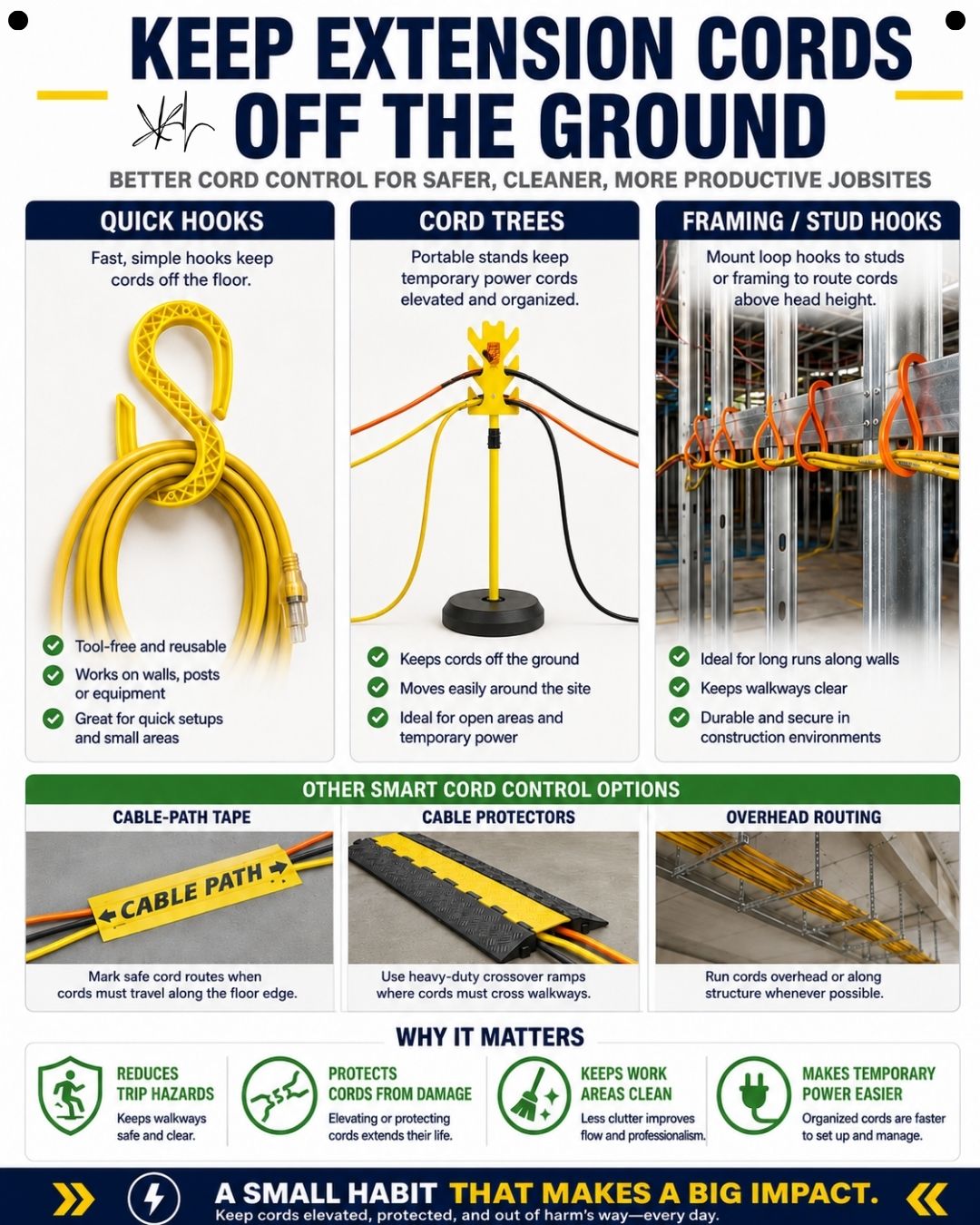
Here’s the deal. Keep extension cords off the ground. It sounds small. It is not. Walk any jobsite and you can tell within thirty seconds whether that team has a system or not. Cords are one of the biggest tells. Cords snaking across walkways say we are just surviving out here. Cords hung, routed, and protected say we respect our people and our work. Nobody has to explain the difference. It is visible the moment you step onto the site, before anyone says a single word about the project’s actual standards.
Short answer: Keeping extension cords off the ground means elevating every cord the moment it gets run, using quick hooks for short runs, cord trees for open areas, and framing or stud hooks for long runs. When a cord must cross a walkway, use cable protectors or cable path tape. It cuts trip hazards, extends cord life, keeps work areas clean, and takes a habit, not a budget.
The Pain of a Cord Nobody Elevated
Picture the ordinary version of this problem on a typical active jobsite. A temporary power run gets dropped at the start of a task, routed in whatever direction happens to reach the outlet, and left exactly where it landed for the rest of the day, and often for the rest of the week. It crosses a primary walkway because that was the shortest path when someone first ran it. Foot traffic passes over it dozens of times a day. Equipment occasionally rolls across it. Nobody specifically decided this was acceptable. It is simply what happened when a cord got run quickly and nobody circled back to elevate it once the immediate need was met.
This is the exact same degradation pattern I have written about before in cord management, but it deserves separate attention because the specific fix here is not inspection or replacement. It is elevation. A cord lying on the ground, even a brand-new, undamaged one, is a trip hazard and a wear point simply by virtue of being on the ground. The fix is not waiting for it to fail. It is never letting it touch the ground in the first place.
The Failure Pattern
The failure pattern is treating cord elevation as an extra step rather than as the default way a cord gets run.
Running a cord along the ground is faster in the moment. It requires no hook, no stand, no extra five minutes of setup. That speed is exactly why it becomes the default, and exactly why the default needs to be intentionally overridden with a better habit rather than left to whatever feels quickest under time pressure. A project that never names elevation as the expected standard will default to the ground every single time, because the ground option is always the path of least resistance in the moment, even though it creates far more cost over the life of that cord run than the few minutes saved at setup.
The Crew Didn’t Fail. They Had Nothing to Hang It On.
When a crew member trips over a cord, or a cord gets crushed and damaged by equipment traffic, the instinct is to ask why nobody moved it. They walked past it a dozen times. Why didn’t someone fix it?
Before reaching that conclusion, it is worth asking what tool that crew actually had on hand to elevate the cord quickly and without friction. If nobody provided quick hooks, cord trees, or stud-mounted routing options, then running the cord along the ground was not a failure of attention. It was the only practical option available in the moment, given the materials and time at hand. Give the same crew a tool-free hook they can hang in seconds, and the ground stops being the default, not because anyone became more careful, but because the faster option and the safer option finally became the same option.
What Tools Keep Extension Cords Off the Ground?
- Quick hooks solve the immediate, small-area problem. Tool-free and reusable, these hooks work on walls, posts, or equipment, and they are ideal for fast setups where a cord just needs to be lifted off the floor for a short run or a temporary task. The entire value proposition is speed. If elevating a cord takes longer than leaving it on the ground, the ground wins by default every time. A hook that requires no tools and takes seconds to deploy removes that excuse entirely.
- Cord trees address open areas and temporary power setups where a single fixed hook will not reach. A portable stand with multiple cord loops keeps several runs elevated and organized at once, and because the stand itself is portable, it moves easily around the site as work progresses, following the actual point of need rather than requiring a fixed installation that becomes outdated the moment the crew relocates.
- Framing and stud hooks handle the long-run problem specifically. Mounted directly to studs or framing members, these hooks route cords above head height along an entire wall or corridor, keeping walkways clear for the full length of the run rather than just at a single point. This option is especially valuable precisely because long runs are where the ground becomes most tempting, since elevating a short cord feels manageable but elevating fifty feet of cord along a corridor feels like a bigger task. A row of simple loop hooks mounted once along the framing turns that long run into the same quick, repeatable action as a single short hook, just repeated along the path. Use insulated, non-conductive hooks or cord hangers. Never staple, nail, or wire-tie a cord to the framing, and keep it off sharp edges. OSHA requires flexible cords to be protected from damage and kept away from sharp corners (29 CFR 1926.405(a)(2)(ii)(I)).
What Do You Do When a Cord Must Cross the Ground?
Elevation is not always possible for the full length of a run, and the standard accounts for that honestly rather than pretending every cord can be lifted off the floor in every situation.
Cable path tape marks a safe, intentional route when a cord genuinely has to travel along the floor edge, turning an unplanned, incidental path into a deliberate, marked one that anyone on site can recognize and respect. Cable protectors, the heavy-duty crossover ramps, exist specifically for the point where a cord must cross an active walkway, covering the cord so foot and equipment traffic pass over a protected ramp rather than over bare cable exposed to repeated crushing and the trip hazard of an unprotected edge. And overhead routing, running cords along structure whenever the physical layout allows it, keeps cords entirely out of the walking and working plane altogether. It is the single most effective option available whenever the site conditions make it possible.
| Tool | Best for |
|---|---|
| Quick hooks | Short runs and fast, temporary setups on walls, posts, or equipment |
| Cord trees | Open areas and temporary power, moving with the work |
| Framing and stud hooks | Long runs along a wall or corridor, above head height |
| Cable path tape | A marked route when a cord must run along the floor edge |
| Cable protectors | The point where a cord must cross an active walkway |
| Overhead routing | Running cords along structure whenever the layout allows |
Why Keep Extension Cords Off the Ground?
Reduced trip hazards are the most immediate benefit, keeping walkways safe and clear in exactly the way I have written about before for loose rock and general pathway discipline. A cord lying across a walkway is functionally the same hazard as any other obstruction in a marked path, just one that happens to also carry an electrical current.
Protecting cords from damage matters because elevation genuinely extends a cord’s working life. A cord lying on the ground gets stepped on, rolled over by equipment, and exposed to moisture and abrasion in ways an elevated cord simply does not experience. That extended life is a direct cost savings: fewer cords replaced over the life of a project, purely as a byproduct of how they were routed.
Keeping work areas clean follows naturally once cords stop accumulating on every available floor surface, and the resulting reduction in clutter improves both flow and the professional appearance of the site. It is the same signal I have written about before for the Lean Display Area and the perimeter fence line. And making temporary power easier to manage is the operational payoff that often gets overlooked. Organized, elevated cords are genuinely faster to set up, track, move, and manage than a tangle of ground-level runs that nobody can trace back to its source without physically following the cord by hand.
This Takes a Habit, Not a Budget
Here is the part that matters most for any team hesitant to invest time in this. This does not take a budget line. Quick hooks, cord trees, and stud-mounted loops are inexpensive, widely available, and require no specialized installation skill. The investment is a habit: the decision to spend the extra few seconds elevating a cord the moment it gets run, rather than leaving it on the ground and planning to deal with it later.
That habit, once it becomes the default rather than the exception, costs the project nothing in time, because elevating with a tool-free hook is no slower than letting a cord lie flat. The only real cost is the discipline of making elevation the first instinct rather than an afterthought reserved for whenever someone eventually notices the hazard and corrects it.
Set It, Model It, Make It the Expectation
For superintendents, this is one of those small-habit, big-impact standards I have written about before. A clean, organized jobsite is not cosmetic. It is the foundation for safety, flow, and morale, and cord elevation is one of the fastest, cheapest ways to demonstrate that standard in a way every single trade partner on site can see and copy immediately.
This connects directly to the standards I have written about before around fence maintenance, walkway discipline, and cord management, each one a small, visible element of the perimeter and the working environment that signals, before a single word is exchanged, whether a project genuinely holds a standard or merely talks about one. Our LeanTakt team treats small, visible habits like this as the actual proof of a culture, because anyone can post a safety policy, but only a team that has genuinely internalized the standard keeps its cords off the ground on an ordinary Tuesday with nobody watching.
Start With One Cord
So here is the challenge. Walk your site right now and find the first cord you see lying on the ground. Elevate it, with a quick hook, a stud mount, or whatever is already available. Then make that the expectation for every cord run going forward, for your own crew and for every trade partner working alongside you.
Epictetus taught that no man is free who is not master of himself, and a habit this small, repeated consistently until it becomes automatic, is exactly what mastery over the small stuff actually looks like in practice. Your crews deserve a site where they can move fast without looking down.
Bottom line: Keep cords elevated, protected, and out of harm’s way, every single day.
If your project needs superintendent coaching, project support, or leadership development, Elevate Construction can help your field teams stabilize, schedule, and flow.
On we go.
FAQ
Is elevating cords really worth the extra effort compared to just running them along the ground?
The extra effort is seconds, not minutes, once a team has quick hooks or stud-mounted loops readily available. Against that small cost, elevation removes a genuine trip hazard, extends the working life of the cord itself, and keeps walkways clear for the full duration of the run. The investment is nearly free relative to the risk and cost it prevents.
What is the best option when a cord absolutely must cross an active walkway?
A heavy-duty cable protector, the crossover ramp style device, is the right tool specifically for this situation. It allows foot and equipment traffic to pass directly over the protected cord without crushing it or creating a trip hazard, which is a better solution than simply hoping people will step carefully around an exposed cord crossing their path.
How is this different from a daily cord management system?
My earlier post on cord management addressed the full daily maintenance system: routing decisions, power positioned near the task, and a daily inspection cadence that catches damage before it worsens. This post focuses specifically on the physical tools and habit of elevation itself: the quick hooks, cord trees, and stud-mounted routing that make keeping a cord off the ground the fast, default choice rather than an extra step nobody has time for.
Does overhead routing work on every type of jobsite, or only certain site configurations?
Overhead routing depends on having structure available to route along, such as exposed framing, ceiling grids, or similar elements that a cord can be secured to above head height. On sites where that structure is not yet in place or not accessible, quick hooks and cord trees become the more practical elevation tools until overhead routing becomes feasible later in the project.
How do you get an entire crew, including multiple trade partners, to actually adopt this as a consistent habit?
Model it personally and make it the explicit, stated expectation rather than an unspoken preference. A superintendent who elevates their own cords every single time, and who provides the simple tools (hooks, stands, and stud mounts) needed to make elevation the fast choice, sets a visible standard that trade partners tend to follow naturally, especially once they see that the elevated approach is genuinely no slower than leaving a cord on the ground.
People Also Read:
Clean, Safe, and Organized: The Foundation of a High-Performing Job Site
What Is 5S and How It Applies to Construction
Monthly Field Walks
If you want to learn more we have:
-Takt Virtual Training: (Takt Virtual Training)
-Check out our YouTube channel for more info: (Elevate Construction on YouTube)
-Listen to the Elevate Construction podcast: (Elevate Construction Podcast)
-Check out our training programs and certifications: (Training Programs and Certifications)
-The Takt Book: (The Takt Book on Amazon)
Discover Jason’s Expertise:
Meet Jason Schroeder, the driving force behind Elevate Construction. As the company’s Founder and COO, he’s dedicated to taking construction to new heights. With a wealth of industry experience, he’s crafted the Field Engineer Boot Camp and Superintendent Boot Camp – intensive training programs engineered to cultivate top-tier leaders capable of steering their teams towards success. Jason’s vision? To expand his training initiatives across the nation, empowering construction firms to soar to unprecedented levels of excellence.