
Here’s the deal. I was recently invited to speak at a field leadership program graduation for Robins and Morton, a company I have genuine admiration for, run by people like Jen Lacy and Steve Moore who treat their craft workers remarkably well. I do not fly around much anymore, since my schedule is full and I love being present with my own kids. For this, despite a grueling multi-hop itinerary getting there and back, I said yes without hesitation. By the end of the talk, I was genuinely emotional, and I want to explain why this program matters so much to me.
Short answer: A field leadership program is a multi-month path that develops craft workers and foremen into leaders, with mentoring, shoulder-to-shoulder work, and a real promotion at the end.
Where My Own Belief in This Comes From
I did not come up through college. From about thirteen and a half years old until I was nineteen, I worked every break I had at a company called Conco Construction, technically working before I was legally old enough to, as a form setter, equipment operator, and cement mason finisher. I genuinely grew up inside this industry.
My own path forward opened up because of my dad, who worked at Service Rock Products and helped me get a union apprenticeship at Hensel Phelps, working as a cement mason on a federal prison project in Victorville, California. I was working hard, maybe a little chaotic, and I strained my shoulder on the job, likely something that runs in my family more broadly rather than a pure workplace injury. Instead of simply setting me aside, the leaders on that project kept me working, moving me into a role as a rodman supporting the field engineers. I fell in love with that work immediately and never wanted to go back.
From there, I worked my way up to a full field engineer, then lead field engineer, reading Wesley G. Crawford’s book Construction Surveying and Layout along the way. I even bought my own computer on credit and taught myself AutoCAD, using a copy I should not have used, something I genuinely do not recommend to anyone else, but it reflects how committed I was to learning everything I possibly could. From there, the promotions kept coming. Field engineer, lead field engineer, VDC, assistant superintendent, superintendent, project superintendent, senior superintendent, general superintendent, field director, project director, and eventually owning my own businesses, now employing over a hundred people across consulting, training, project support, and manufacturing, plus our own construction company.
Do We Have a Labor Shortage or a Training Shortage?
Every time someone gets a genuine chance like the one I was given, this industry gets better. I do not believe we have a labor shortage. I believe we have a training shortage and a hiring problem. There are plenty of capable people out there. What they need is real development, not another posting nobody with real potential ever sees.
I think about the version of me who strained a shoulder on a jobsite at nineteen years old, with no college degree and no obvious next step. If the leaders on that project had simply let me go rather than finding a way to keep me working and growing, none of what came after would exist. The businesses, the books, the training programs, the people we now employ. All of it traces back to a handful of leaders choosing development over convenience at exactly the right moment.
Our workers and foremen are genuinely smart and capable. What they actually need is somebody willing to work shoulder to shoulder with them and open a real door. That path can start through college, through another industry entirely, or directly as a craft worker, the way mine did.
Watch for these signs your own organization is treating this as a hiring problem rather than a development problem:
- Genuinely capable people passed over because they lack a specific credential rather than because they lack real potential.
- No structured, multi-month development path for craft workers who show genuine leadership capability.
- Promotion decisions made without real mentorship or shoulder-to-shoulder investment behind them.
What Robins and Morton Is Actually Doing
Robins and Morton puts real money behind this belief. Their program uses our books, Elevating Construction Superintendents and Elevating Construction Foremen, as part of a real multi-month development path. They take some of the best people already in the industry, invest in genuine mentoring and shoulder-to-shoulder development throughout, and at the end of that process, actually promote them into senior-level positions. That last part matters enormously. A development program that never actually leads to real advancement is not a genuine investment. It is a gesture.
Plenty of companies run training sessions or hand out a manual and call it development. Very few commit to months of structured mentorship followed by an actual promotion at the end. That follow-through is exactly what separates a program that genuinely changes careers from one that simply looks good on a company’s website.
What Does It Mean to Elevate as a Support System?
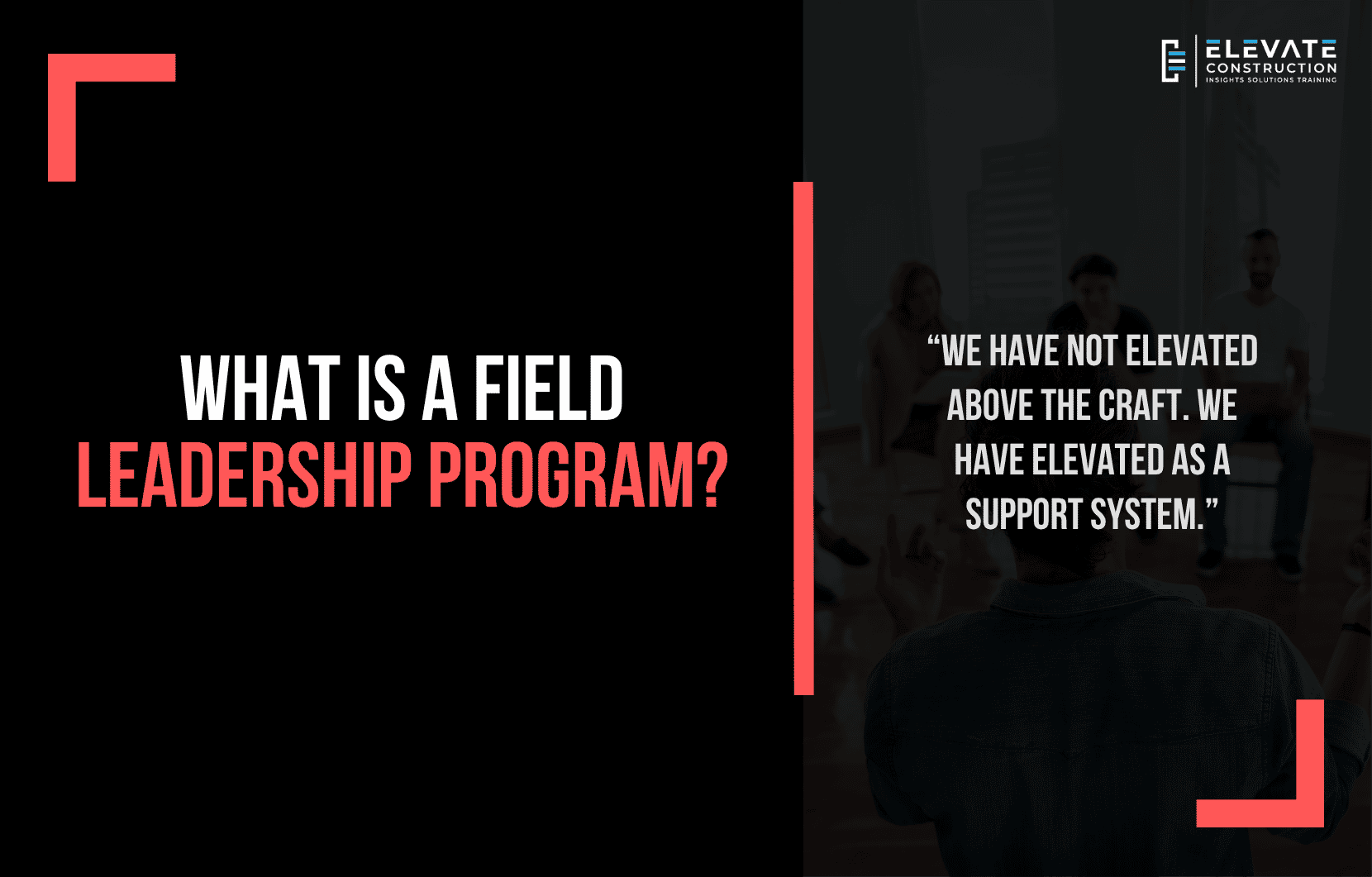
Here is the concept I shared at that graduation that I could barely get through without becoming emotional. We have not elevated above the craft. We have elevated as a support system.
That distinction changes everything about how leadership should actually think about its own role. It is our job to make sure workers and foremen have full kit, because they are our first customer. The building owner is our second customer. Once you accept that order, everything about leadership positions changes meaning. Moving into a support and enablement role does not mean rising above the people doing the physical work. It means taking on the responsibility of serving them well enough that they can earn any salary they want, support their families, and preserve their bodies over a long career, all while genuinely supporting the craft that actually builds the project.
Why This Deserves to Spread Across the Industry
If you ever get the chance to visit a Robins and Morton jobsite, or observe their field leadership program directly, take it. What I witnessed there reflects exactly what this industry needs far more of. We do not have a labor shortage. We have a training shortage, and companies like Robins and Morton are genuinely leading the way in closing that gap.
So here is the challenge. Look at your own organization’s craft workers and foremen and ask honestly whether any of them show genuine leadership potential that has never been given a real development path. If you find even one, that is exactly where to start building the kind of program that changed the entire course of my own career. Build your leadership development around that principle, and watch what happens to the people who finally get a real chance.
Bottom line: We have not elevated above the craft; we have elevated as a support system.
If your project needs superintendent coaching, project support, or leadership development, Elevate Construction can help your field teams stabilize, schedule, and flow.
On we go.
FAQ
What is a field leadership program?
It is a structured, multi-month development path that takes capable craft workers and foremen, mentors them shoulder to shoulder, and promotes them into senior-level positions at the end. Without the promotion, it is a gesture, not an investment.
Why does Jason say construction has a training shortage, not a labor shortage?
There are plenty of capable people who want to work in this industry. What is missing is real mentorship, training programs, and advancement paths for the people already showing up and doing the work.
What makes the Robins and Morton field leadership program stand out?
It pairs structured curriculum with months of mentorship, and it ends with a real promotion into a senior-level position. A program that never leads to advancement is a gesture, not an investment.
What does it mean for leadership to be a support system for the craft?
It means my job is to make sure workers and foremen have full kit: materials, information, and support. They are our first customer, and the building owner is our second.
Can you advance into construction leadership without a college degree?
Yes. I started as a form setter and cement mason, moved into field engineering, and worked my way up to running my own businesses without a college degree. What matters is capability paired with real development, mentorship, and a company willing to invest in your growth.
People Also Read:
Human Connection
Its about People!
The Ladder of Accountability
If you want to learn more we have:
-Takt Virtual Training: (Takt Virtual Training)
-Check out our YouTube channel for more info: (Elevate Construction on YouTube)
-Listen to the Elevate Construction podcast: (Elevate Construction Podcast)
-Check out our training programs and certifications: (Training Programs and Certifications)
-The Takt Book: (The Takt Book on Amazon)
Discover Jason’s Expertise:
Meet Jason Schroeder, the driving force behind Elevate Construction. As the company’s Founder and COO, he’s dedicated to taking construction to new heights. With a wealth of industry experience, he’s crafted the Field Engineer Boot Camp and Superintendent Boot Camp – intensive training programs engineered to cultivate top-tier leaders capable of steering their teams towards success. Jason’s vision? To expand his training initiatives across the nation, empowering construction firms to soar to unprecedented levels of excellence.