Why Lean? Why Now?

Read 10 min

Why Design Professionals Are the Missing Link in Lean Project Delivery

Lean has entered the mainstream of construction. Trade partners, construction managers, and a growing number of progressive owners are implementing Takt planning, Last Planner, pull planning, and the broader production system thinking that makes predictable project delivery possible. The evidence base is building. The results are real. And yet, the design professionals who pioneered sustainable design and Building Information Modeling, the architects and engineers who shaped the industry’s last two major transformations, remain largely on the sidelines of this one.

That gap matters more than most people in the industry have acknowledged. Lean project delivery is a whole-systems concept. It requires every stakeholder from the owner through design to general contractor through trade partners to operate from a shared set of values and methods. When design professionals are absent from that shared system, the project team is building on a foundation that is only partly Lean. The field can do everything right and still absorb the consequences of a design process that was never aligned to Lean principles.

The Culture That Has Held Design Firms Back

The design professions have been shaped by what can fairly be called a Robust culture, a system that has proven capable of delivering projects across centuries and has produced genuine brilliance in the built environment. But it has also built in specific patterns of thinking that conflict directly with Lean principles.

A Robust culture begins with inspection rather than respect. Quality is verified after the fact, through QA/QC processes that check deliverables before they leave the firm, rather than embedded into the process so that errors cannot occur in the first place. The Robust culture is entrepreneurial and risk-tolerant, it accepts waste as an unavoidable cost of doing complex, creative work. It emphasizes price over value, push over flow, and doing whatever it takes over optimizing the whole. And at the end of a project, it delivers in accordance with the contract and moves on to the next one, with only a token nod to lessons learned rather than a genuine commitment to continuous improvement.

Most architects and engineers are aware of this. They know that wastefulness is built into the Robust approach, the rework cycles, the coordination errors discovered late in design development, the construction documents that generate RFIs because the design was never fully constructible. They see the razor-thin margins and the client dissatisfaction that follows from those patterns. But awareness of a problem and willingness to change are different things. Without a compelling reason to change, most design firms default to the familiar which means Robust continues.

The Burning Platform Moment

For many design firms, the motivation to examine Lean seriously only comes when business circumstances create genuine pressure. Reduced influence in project delivery. Four decades of shrinking scope and fees. Competition that requires more value at lower cost. The metaphorical burning platform, the moment when staying where you are becomes more dangerous than leaping into something new is arriving for more design firms than it used to.

The two critical workflows every design practice must address are people providing clients with excellent service profitably and information preventing design error and inventing client value profitably. Both of those workflows are addressed directly by Lean principles. And the firms that discover this early, before the burning platform forces the question, have a significant head start on the competitive landscape that is coming.

What Lean Actually Means for Design Professionals

The Lean framework applied to design is not primarily about speed or efficiency in the narrow sense. It is about embedding quality into every step of the process rather than inspecting it in after the fact. In the Robust model, quality is a layer on top of the work, a series of checks before deliverables are released. In the Lean model, quality is built into the process itself, which means errors cannot propagate to the next step because the system is designed to prevent them from occurring.

The five core methods of Lean project delivery are the specific practices through which this principle becomes operational for design professionals. Conditions of satisfaction establish clear, specific expectations for both the project and its process not vague aspirations, but measurable outcomes that the whole team agrees to at the outset. Pull planning coordinates the flow of information and services across the team, replacing the push of deliverables on arbitrary dates with a sequence driven by what the downstream process actually needs and when it needs it. Target value design establishes a budget as a design parameter rather than a number checked at the end meaning design decisions are made with cost consequences visible in real time. Set-based design defines the full space of possible solutions before narrowing, which prevents the costly late-stage discoveries that come from converging too quickly on a single path. And choosing by advantages provides a decision-making framework that creates durable consensus rather than decisions that are relitigated at every project phase.

Here are the signals that a design firm is operating from a Robust rather than a Lean posture:

  • Design errors are discovered by QA/QC review rather than prevented by process design.
  • Deliverable schedules are pushed rather than pulled from downstream needs.
  • Budget is a check at the end of each phase rather than a real-time design parameter.
  • Lessons learned are documented but not systematically incorporated into how the next project starts.
  • The design process is treated as inherently creative and therefore resistant to standardization.

The Cultural Shift Is Harder Than the System Change

The tools are the easy part. An A3 thinking approach for problem-solving. A big room environment for co-location and visual management. Pull planning sessions that coordinate information and services the same way they coordinate construction activities. These can be learned and implemented. What takes longer is the cultural change, the shift in how design professionals see their work, how they speak about it, and what behaviors they reward.

Culture, at its most practical definition, is the common beliefs and actions of a social group. It is shaped by what leaders’ model, what the organization rewards, and what it tolerates. A design firm that says it values quality but measures success by how quickly deliverables are produced will not produce a quality culture. A firm that says it values continuous improvement but allocates no time for retrospectives and no budget for learning will not produce a learning culture. The cultural change toward Lean requires alignment between what the firm says and what it actually does in project delivery, in operations, in how it invests in its people.

Lean provides a coherent framework for that alignment. Operations become more productive through workflow efficiency. Project delivery becomes more reliable through pull planning, conditions of satisfaction, and target value design. And design itself becomes a creative process that prevents error rather than correcting it. These three dimensions, Lean Operations, Lean Project Delivery, and Lean Design connect into a single enterprise strategy when they are implemented as a system rather than as individual tools.

Why This Matters to Construction Teams

The construction team that partners with a Lean-aligned design firm experiences the project differently. Design decisions are made with constructability input from trade partners earlier in the process. The construction documents that arrive on site are more complete because the design process surfaced coordination errors before they were locked in. Owner expectations are clearly documented in conditions of satisfaction rather than implied in a set of drawings. And when issues arise during construction, the collaborative culture established in design carries into the field, people solve problems together rather than defending their scope.

When the design team is not Lean-aligned, the construction team absorbs the consequences. More RFIs. More coordination surprises. More design changes during construction. More rework. The field executes as well as it can on a foundation that was not built to support it. At Elevate Construction, the entire system from pre-construction planning through the Takt plan through the Last Planner System through the morning worker huddle is designed to create flow. That flow depends on the information coming from design being reliable, coordinated, and aligned to the production sequence. If your project needs superintendent coaching, project support, or leadership development, Elevate Construction can help your field teams stabilize, schedule, and flow.

Lean project delivery only works as a whole system. The design professions are the missing link. And as more owners demand Lean on their projects, the architects and engineers who have made that cultural shift will have a competitive advantage that the rest of the industry will eventually have to match.

On we go.

Frequently Asked Questions

Why have design professionals been slower to adopt Lean than construction professionals?

Because design firms have been insulated from the competitive pressure that forced other industries to change, because the Robust culture in design treats quality as something inspected rather than built in, and because Lean transformation requires changing how a firm thinks about its work not just adding new tools.

What is the difference between a Robust culture and a Lean culture in design?

A Robust culture begins with inspection and accepts waste as unavoidable. A Lean culture embeds quality into every step and systematically eliminates waste. Robust emphasizes price over value and push over flow. Lean emphasizes value creation and flow through coordinated, whole-systems thinking.

What is target value design and how does it change the design process?

Target value design establishes the project budget as an active design parameter from the beginning. Rather than checking cost at the end of each phase, the design team makes decisions with real-time cost visibility which prevents the late-stage budget overruns that come from designing without constraints and then discovering they cannot be built.

How does co-location support Lean design delivery?

Co-location puts designers, contractors, trade partners, and owners in the same physical or virtual workspace, enabling real-time coordination and fast decision-making. It replaces the batching of information through separate offices and delayed communication with immediate, integrated collaboration.

What does a design firm look like after genuinely adopting Lean?

Its processes are standardized enough to be improved continuously. Its projects routinely meet conditions of satisfaction without late-stage surprises. Its teams use pull planning for coordination and choose by advantages for decisions. And it tracks performance across projects to learn from each one not just delivering in accordance with the contract and moving on.

If you want to learn more we have:

-Takt Virtual Training: (Click here)
-Check out our Youtube channel for more info: (Click here) 
-Listen to the Elevate Construction podcast: (Click here) 
-Check out our training programs and certifications: (Click here)
-The Takt Book: (Click here)

Discover Jason’s Expertise:

Meet Jason Schroeder, the driving force behind Elevate Construction IST. As the company’s owner and principal consultant, he’s dedicated to taking construction to new heights. With a wealth of industry experience, he’s crafted the Field Engineer Boot Camp and Superintendent Boot Camp – intensive training programs engineered to cultivate top-tier leaders capable of steering their teams towards success. Jason’s vision? To expand his training initiatives across the nation, empowering construction firms to soar to unprecedented levels of excellence.

On we go
Posted in All

Resistance to Lean & Integrated Project Delivery Part I: Three Root Causes

Read 10 min

Why the AEC Industry Resists Lean: Three Root Causes That Keep the Industry Stuck

If you have attended any introduction to Lean construction session, you have probably seen the productivity chart. Construction on one side, other industries on the other. A clear and widening gap. The other industries manufacturing, agriculture, technology have realized substantial productivity gains over decades. Construction has not kept pace. The tools and methods that produce those gains in other sectors are available to construction. The evidence is documented. And yet most of the industry continues to operate in ways that would have been recognizable to a superintendent from thirty years ago.

Why? That is the question worth sitting with honestly. Not the comfortable answer that construction is different, that projects are unique, that the craft-based nature of the work makes the comparison unfair. The honest answer. What is actually causing the resistance to change in an industry that has so much evidence available to it about what is possible?

There are three root causes. And until the industry grapples with all three simultaneously, the gap will continue to widen.

First: The Knowing Culture

The AEC industry is built on craft. Design trades, engineering trades, construction trades, all of them take genuine pride in their expertise, in what they know, in the depth of their practical skill. That pride is legitimate and should be honored. But it has a shadow. When the identity of a professional is built around what they know, the suggestion that learning is needed becomes a threat. Not a mild discomfort, an identity threat. And when something threatens identity, the defense response is powerful and often invisible to the person experiencing it.

This shows up at every level of the industry. Owners hire firms based on track record and experience, not on demonstrated capacity to learn and improve. Firms sell their services based on past projects and established methods. Leaders are valued for what they have done, not for how effectively they are developing what they do next. And money for learning and continuous improvement is perpetually scarce because it is not perceived as investment, it is perceived as an admission that the current approach is not good enough.

Here is what that culture produces over time. Practitioners who are brilliant at replicating their existing approach and genuinely threatened by the suggestion that a different approach might produce better outcomes. Not because they are closed-minded people. Because the system they operate inside rewards knowing and penalizes learning. The problem is in the system, not the people.

Second: Inadequate Strategic Leadership

In the 1950s, Japanese corporate leadership made a deliberate decision to radically rethink how they operated. With guidance from W. Edwards Deming and others, and with the brilliant application of those ideas by leaders at Toyota and beyond, they built a strategy centered on quality through continuous learning and rigorous self-improvement. The results were not incremental. They were transformative, quality and speed to market that created global competitive pressure intense enough to force Western companies to fundamentally change how they operated. That pressure produced Total Quality Management, which produced Lean, Six Sigma, Agile, IPD, and the entire body of knowledge the AEC industry is now slowly adopting. The difference is that other industries had no choice but to change or lose market position. Construction has not yet experienced that level of competitive pressure in most markets.

What the research on Lean transformation in every industry consistently says is this: Lean transformation is not a collection of new behaviors and tools. It is a new enterprise operational strategy. It requires vision, determined intrinsic motivation, and an environment where healthy conflict is encouraged and disruptive thinking is supported. Management seeks to stabilize and standardize. Leadership seeks to disrupt to challenge the current standard and build a better one. A Lean transformation requires both: the discipline to hold to the current standard while the next one is being developed, and the courage to challenge the current standard before everyone is comfortable doing so.

Most AEC companies would struggle to articulate their existing business strategy with precision, let alone a new one centered on Lean thinking. The strategic leadership that a genuine transformation requires is not yet common in this industry. And without it, the tools remain tools rather than expressions of a coherent operating philosophy.

Third: Inertia

The third root cause is the most universal and, in some ways, the most honest. People do things the way they have always done them because that familiarity works not optimally, but well enough to avoid the discomfort of change. Habituation is a feature of the human brain, not a flaw. The brain defaults to familiar patterns because familiar patterns are efficient. Change requires interrupting that efficiency for a period of uncertainty and increased cognitive effort before the new pattern becomes automatic. Most people and most organizations will not voluntarily enter that discomfort unless something compels them to.

The construction industry has several factors that reinforce this inertia simultaneously. The absence of significant market pressure from Lean-capable competitors means most firms are not being forced to change or lose business. The proliferation of traditional practice around them makes “business as usual” seem like the norm and Lean seem like the exception. And the general unfamiliarity with production systems thinking means most leaders literally do not know what they do not know, they cannot see the waste in their own processes because they have no reference point from which to see it.

Doyle and Strauss, whose facilitation methodology gave birth to many of the collaborative planning techniques that Lean construction uses today including pull planning with sticky notes and plus-delta retrospectives identified something they called process blindness. When people experience problems, they almost always focus on the content of what went wrong: the wrong materials, the wrong sequence, the wrong person. They rarely look at the process, how the work is being done, how decisions are made, how information flows. The problems that recur on projects are almost always process problems, not content problems. But because the process is invisible to most practitioners, the same failures repeat indefinitely while the people inside them believe they are addressing root causes.

Here are the signals that all three root causes are active in an organization:

  • Learning and training investment is treated as overhead rather than competitive advantage.
  • Leaders talk about Lean in meetings but the production system operates the same way it always has.
  • Problems on projects are attributed to individuals or circumstances rather than to system design.
  • The same types of failures recur across projects with no systemic change in response.
  • New methods are adopted as add-ons rather than as replacements for the existing approach.

Why Naming These Root Causes Matters

Doyle and Strauss offered a principle that should be the starting point for every Lean leadership conversation in the AEC industry: if you do not agree on the problem, you probably will not agree on the solution. IPD contracts, Last Planner, Takt planning, pull planning, visual management, co-location, these are all solutions. They were developed to address a specific problem: the AEC industry’s failure to realize productivity gains that other industries have achieved. If the practitioners receiving those solutions do not believe there is a problem, if they believe the gap in productivity is either not real, not significant, or not addressable in construction, then no solution will take hold. They will be implemented halfheartedly, evaluated unfairly, and abandoned prematurely.

The conversation about Lean in construction has to start with agreement about the problem. And it has to be honest about the root causes. The knowing culture is real. The inadequate strategic leadership is real. The inertia is real. None of them make the people inside them bad or resistant for the sake of it. All of them are rational responses to the systems and incentives that currently exist. And all of them are changeable not easily, not quickly, but genuinely through committed leadership that understands transformation as a long-term enterprise strategy rather than a project to complete.

If your project needs superintendent coaching, project support, or leadership development, Elevate Construction can help your field teams stabilize, schedule, and flow.

The industry has everything it needs to close the gap. The evidence exists. The tools exist. The theory exists. What is still developing is the leadership culture that takes all of it seriously enough to build around it rather than bolt it on.

On we go.

Frequently Asked Questions

Why does the AEC industry lag behind other industries in productivity improvement?

Three root causes: a knowing culture that treats expertise as identity and learning as a threat; inadequate strategic leadership that has not experienced the competitive pressure other industries faced; and inertia from habituation, unfamiliarity with production systems thinking, and absence of compelling market pressure to change.

What is “process blindness” and how does it affect construction projects?

Process blindness is the tendency to focus on the content of problems, what went wrong rather than the process through which those problems occur. In construction, this means the same types of failures repeat across projects because the system producing them is never examined. Lean thinking makes the process visible, which is what enables it to be improved.

Why is it important to agree on the problem before implementing Lean tools?

Because tools are solutions to specific problems. If the practitioners using them do not believe the problem those tools address is real or significant, they will implement them halfheartedly and abandon them when they encounter friction. Alignment on the problem is the foundation for genuine adoption of the solution.

What makes a knowing culture different from a learning culture?

A knowing culture values demonstrated expertise and treats the need for learning as a threat to professional identity. A learning culture values the capacity to improve and treats knowledge as something built continuously, not something possessed. The difference shows up in how training is funded, how feedback is received, and how leaders respond to evidence that the current approach is not optimal.

What would it take for the AEC industry to achieve productivity gains similar to other sectors? 

Committed Lean leadership that treats transformation as a long-term enterprise strategy, a shift from knowing to learning culture, market conditions that create genuine competitive pressure to improve, and adoption of a whole-systems perspective that diagnoses process problems rather than blaming individuals.

If you want to learn more we have:

-Takt Virtual Training: (Click here)
-Check out our Youtube channel for more info: (Click here) 
-Listen to the Elevate Construction podcast: (Click here) 
-Check out our training programs and certifications: (Click here)
-The Takt Book: (Click here)

Discover Jason’s Expertise:

Meet Jason Schroeder, the driving force behind Elevate Construction IST. As the company’s owner and principal consultant, he’s dedicated to taking construction to new heights. With a wealth of industry experience, he’s crafted the Field Engineer Boot Camp and Superintendent Boot Camp – intensive training programs engineered to cultivate top-tier leaders capable of steering their teams towards success. Jason’s vision? To expand his training initiatives across the nation, empowering construction firms to soar to unprecedented levels of excellence.

On we go
Posted in All

Resistance to Lean & Integrated Project Delivery Part II: Develop “Profound Knowledge” to Address the Root Causes of Resistance

Read 10 min

Why Lean Transformation in Construction Requires a Different Kind of Leadership Thinking

Most discussions about Lean in construction focus on methods. Takt planning. Last Planner. Pull planning. Visual management. These are real tools that produce real results when implemented well. But there is a deeper problem that the industry has not fully faced, and it is the reason so many Lean efforts plateau or collapse: the production system can only perform as well as the thinking of the leaders running it allows. If the mental model is wrong, the tools do not matter. This blog is about what it actually takes to lead a Lean transformation in the AEC industry and why it starts with how leaders think, not what systems they implement.

The Pain the Industry Has Normalized

Here is the honest picture. Other major industries, automotive, manufacturing, technology have been on Lean transformation journeys for decades and have achieved productivity gains that are both measurable and dramatic. The AEC industry has largely not kept pace. Projects still routinely finish over budget and behind schedule. The tools and methods that produce reliable outcomes elsewhere are available to construction. The knowledge exists. And yet the transformation has been slow, uneven, and in many cases superficial.

The gap is not primarily in the methods. It is in the leadership culture that adopts them or does not. A company that bolts Lean onto an existing strategy, running Takt planning sessions in the morning and managing by CPM in the afternoon, treating Lean as a program rather than a way of doing business, will not achieve the results Lean is capable of producing. Lean must become the way, not an addition to it.

The System Is Almost Always the Problem

  1. Edwards Deming, the father of the modern quality movement that produced Lean, Agile, Six Sigma, and the production thinking that Toyota built its system upon, stated something that every construction leader should internalize: no person can perform better than the capabilities and constraints of the work system in which they operate allow. In more than 95 percent of all failures, system inadequacies are wholly or mainly at fault not the individual team members who are generally trying their best. The responsibility for the effectiveness of the production system belongs to management. Not to the workers. Not to the foremen. Not to the trade partners. Management.

That is uncomfortable to hear in an industry that has spent generations managing by blame. But it is the most important truth in this conversation. When a project underperforms, the first question to ask is whether the system the team is operating inside is adequate to support success. Almost always, it is not. And the leader’s job is to fix the system, not to find someone to hold accountable for operating poorly inside a broken one.

Four Elements of Profound Knowledge Every Lean Leader Needs

Deming proposed what he called a System of Profound Knowledge, four interconnected elements that he believed were required for any leader serious about transformation. Applied to construction, each one is a direct challenge to how the industry has historically operated.

The first element is appreciation for a system. Traditional construction breaks projects into discipline-specific pieces, managed by separate contracts, controlled by budgets and schedules that are tracked retrospectively. That fragmentation makes it nearly impossible to see how all the parts of the project production system need to work together to create value. Lean and IPD take the opposite approach: a whole-systems perspective from project definition through completion. As Deming put it, the greater the interdependence between components of a system, the greater the need for communication and cooperation between them and for overall management. Construction is full of interdependencies. The failure to manage them systemically is where most of the waste lives.

The second element is knowledge about variation. Variation exists in every production system. Deming’s critical insight is that leaders must distinguish between common causes of variation, the expected, acceptable variation that is built into the system and uncommon causes, which are signals that something outside the normal system behavior has occurred. Traditional AEC practices, focused on individual trade activity optimization without a view of the whole system, cannot support this kind of variance analysis. Lean construction changes this. When variation is reduced through stable, designed production systems through Takt, through buffering, through make-ready discipline, reliability improves, flow improves, and quality, cost, and schedule performance all improve simultaneously. The traditional assumption that these three must trade off against each other is a product of managing variation poorly, not an inherent feature of construction.

The third element is theory of knowledge. This is the one that most construction leaders find least intuitive, because the industry has long prized practical experience over theoretical understanding. But knowledge is always based on theory on a model of how things work. And when facts contradict the existing model, a new theory is required to make sense of what has been learned. Management requires prediction. Prediction requires a theory. If the theory is wrong, if leaders are operating from a model of construction that does not reflect how production actually works, no amount of additional data will produce better outcomes. Both Deming and Russell Ackoff made the same point: data is not knowledge, knowledge is not understanding, and understanding is not wisdom. Without theory, experience produces no learning. In 2002, Howell and Koskela published a paper arguing that the underlying theory of project management is obsolete. Their evidence: over forty years of research found no coherent theory underlying traditional project management. And yet over 80 percent of capital projects end up over budget, behind schedule, or both. The theory needs to change.

The fourth element is psychology. Deming insisted that a leader of transformation must understand the psychology of individuals, groups, organizations, and change. This is not soft content. It is the operational requirement for any change effort. People are unique and complex. When unique and complex people form a project team, unique and complex dynamics emerge. Understanding those dynamics, how trust is built, how conflict gets navigated, how people adopt new habits, how motivation works under pressure is what separates leaders who successfully transform cultures from leaders who repeatedly try and fail. Lean leadership requires people to want to follow, not simply to be told to follow. The difference between those two outcomes is entirely psychological.

Here are the warning signs that a Lean effort in construction is being led without this kind of profound knowledge:

  • Lean tools are being implemented but the leaders are not changing how they think about the production system.
  • Variation is managed reactively rather than designed out of the system.
  • Problems are attributed to individuals rather than to the system conditions that produced them.
  • The leadership team says it is committed to Lean but does not invest time, attention, or resources that reflect that commitment.
  • The transformation is treated as a program with a completion date rather than as a permanent change to how the organization operates.

What This Means for Construction Leaders Today

The resources to support a genuine Lean transformation in construction exist. Books on Lean transformation and Lean leadership. Local and national Lean Construction Institute chapters. Research institutions and professional associations. Coaching, consulting, and training programs. The knowledge is available. What has been scarce is the committed Lean leadership that makes that knowledge operational, leaders who walk the talk, who invest time and attention in their own development as Lean thinkers, and who treat Lean as the way rather than a tool to try.

The construction industry has watched other sectors, automotive, healthcare, aerospace, manufacturing apply these principles and achieve results that look impossible from the outside but are entirely reproducible with the right leadership approach. There is no inherent reason construction cannot do the same. The production systems are different in form but not in principle. The human dynamics are universal. The path is well documented. What is required is the willingness to lead differently to diagnose systems before blaming people, to manage variation rather than react to it, to build theory alongside practical skill, and to develop the psychological understanding that makes genuine team transformation possible.

If your project needs superintendent coaching, project support, or leadership development, Elevate Construction can help your field teams stabilize, schedule, and flow.

Lean is not a program. It is not a tool. It is not a bolt-on. It is a way of thinking about production, people, and improvement that, when it becomes genuinely embedded in leadership culture, changes what a project team is capable of achieving. The work of building that culture starts with the leader.

On we go.

Frequently Asked Questions

Why have Lean tools not produced dramatic productivity gains in the AEC industry?

Because tools require the right mental model to function as designed. When Lean tools are implemented on top of a traditional management culture blame over system diagnosis, CPM over flow-based scheduling, individual optimization over whole-system thinking the tools produce modest gains at best and collapse at worst. The culture must change alongside the methods.

What does Deming mean when he says the production system is management’s responsibility?

He means that system design, including how work flows, how variation is managed, and how interdependencies are coordinated, is a leadership function. Workers and trade partners operate within the system as it is designed. When performance is poor, the first question is whether the system supports success. In most cases, it does not and fixing that is management’s job, not the worker’s burden.

Why is theory important for a construction leader who learns by doing?

Because without theory, experience does not produce transferable learning. A leader who learns purely from experience may become very good at recognizing patterns but cannot explain why those patterns exist, predict when they will appear in a new context, or teach others to replicate the insight. Theory is what converts experience into knowledge.

What is the difference between common and uncommon causes of variation?

Common causes are the expected, acceptable variation inherent in the production system, the natural fluctuation within a stable process. Uncommon causes are signals that something outside the system’s normal behavior has occurred and requires investigation. Managing them as though they are the same is what produces overreaction to normal variation and underreaction to genuine problems.

What does “walking the talk” look like for a Lean leader in construction?

It means visibly investing time in Lean training and development, participating in pull planning sessions rather than delegating them, diagnosing system problems before assigning blame, building psychological safety for honest feedback, and treating Lean not as a project phase but as the permanent operating model of the organization.

If you want to learn more we have:

-Takt Virtual Training: (Click here)
-Check out our Youtube channel for more info: (Click here) 
-Listen to the Elevate Construction podcast: (Click here) 
-Check out our training programs and certifications: (Click here)
-The Takt Book: (Click here)

Discover Jason’s Expertise:

Meet Jason Schroeder, the driving force behind Elevate Construction IST. As the company’s owner and principal consultant, he’s dedicated to taking construction to new heights. With a wealth of industry experience, he’s crafted the Field Engineer Boot Camp and Superintendent Boot Camp – intensive training programs engineered to cultivate top-tier leaders capable of steering their teams towards success. Jason’s vision? To expand his training initiatives across the nation, empowering construction firms to soar to unprecedented levels of excellence.

On we go
Posted in All

How to Create Efficient and Effective Supply Chains

Read 10 min

Project Supply Chains in Construction: How to Build One That Actually Supports Flow

Every project manager has experienced it. The materials are supposed to arrive Tuesday. The trade partner is mobilized and the zone is ready. Tuesday comes. The delivery does not. The crew waits. The Takt time is blown. The superintendent is on the phone trying to find out where things are, and the answer comes back from somewhere in the supply chain that nobody quite controls. The schedule absorbs the hit. The trade partner loses a day. And the team collectively shrugs and calls it a supply chain problem, as though supply chains are things that simply happen to projects rather than systems that projects design and manage.

Supply chain failures are not random. They are almost always the result of a production system that never treated the supply chain as part of the system in the first place. The procurement log got filled out at the start of the job. Delivery dates were entered. And then the supply chain was handed off to someone and not actively managed against the production plan again until a shortage showed up in the field. The system produced the failure. The project team is the one living with it.

The Pain of a Disconnected Supply Chain

Here is what a disconnected supply chain looks like on a real project. Materials for scopes that are months away arrive early and fill the staging area, requiring constant repositioning and creating hazard exposure. Materials for scopes that are weeks away are not yet ordered because nobody translated the production dates into procurement trigger dates. Trade partners show up to zones that are not yet kitted because the information supply chain, the RFIs, the shop drawings, the approved submittals is running behind the material supply chain, and both are running behind the production schedule. The train of trades stalls. People wait. And the cost of that waiting in labor, in disruption, in schedule is often more than the cost of the materials that were mismanaged.

The ninth waste in Lean is alignment specifically, the cost of a lack of it. When the supply chain is not aligned to the production plan, it generates the most avoidable waste on the project. Not because the materials were bad. Because they arrived at the wrong time, in the wrong quantity, without the information the crew needed to install them.

What an Effective Project Supply Chain Actually Requires

The first requirement is reliability. Materials must arrive when they are needed and in accordance with quality specifications. This sounds obvious until you examine how most construction procurement actually works. Delivery dates are estimated at the start of the job based on a CPM schedule that does not reflect real production flow. Those dates are not updated when the production plan changes. And when a trade partner’s zone slides two weeks because of an upstream constraint, nobody has adjusted the procurement log to account for it. The delivery arrives on the original date, into a zone that is not ready, and now it is in the way.

Reliability in a Lean production system is achieved by aligning procurement dates to the production plan specifically, to the Takt plan’s phase start dates and adding buffers that account for lead time variability. When the production plan shifts, the procurement log updates. When materials are a week out, the team confirms readiness at the zone level. When something is at risk, the strategic planning and procurement meeting surfaces it six weeks out, not the day before the crew arrives.

The second requirement is transparency. At any given point in the project, the leadership team should be able to see when inbound materials are expected to arrive, whether they are on track, and whether there are deliveries that will arrive too early or too late. A procurement log that is current and visible in every strategic planning meeting not buried in a spreadsheet nobody opens is the minimum standard for transparency. The goal is that supply chain status is not something you discover in a crisis. It is something the team monitors continuously.

The third requirement is redundancy. Single points of failure in a supply chain are risk events waiting to happen. When a critical material has only one supplier, any disruption to that supplier, a strike, a production delay, a shipping problem becomes a project emergency. Toyota, one of the most studied supply chain systems in the world, maintains two suppliers in most categories, one receiving approximately 80 percent of the volume and the other 20 percent specifically to protect against this exposure. On construction projects, the equivalent is having qualified backup suppliers for long-lead and critical-path materials, and maintaining a risk register that tracks supply chain exposure as actively as it tracks schedule exposure.

The fourth requirement is agility and flexibility. Demand changes on construction projects constantly, scope revisions, design changes, owner-driven modifications. A supply chain that cannot respond to those changes without excessive cost or delay is a supply chain that will amplify every disruption. The key to agility is exactly what Sort addresses in the 5S system: reducing excess inventory. When excess inventory is distributed through the supply chain, it increases the time required to make changes. Materials that were ordered for a scope that has been redesigned cannot be returned, repositioned, or replaced quickly if they are already on site, already processed, already committed. Lean supply chain management means maintaining the minimum strategic quantity on site and keeping the upstream pipeline responsive.

The fifth requirement is cost efficiency and this is where many projects get the logic backwards. Cost efficiency in a supply chain does not mean selecting the lowest-price supplier for every category. It means operating the entire supply chain as an end-to-end value stream, where cost is measured across the full cycle from ordering through installation, not just at the point of purchase. A cheaper material that arrives late, causes waiting, requires rework, or generates hazardous staging conditions is not cost-efficient. The real cost of supply chain failure is almost always absorbed in field labor and schedule, not in the purchase price line item.

Here are the warning signs that a project’s supply chain is not aligned to its production system:

  • Procurement dates were set at project kickoff and have not been updated since.
  • Materials regularly arrive at zones before the preceding work is complete.
  • The strategic planning and procurement meeting does not include a visual procurement log.
  • Trade partners find out about delivery problems the day of rather than weeks out.
  • Work-in-process is stacking up in staging areas because the zone is not ready to receive it.

The Inventory Problem

Work-in-progress and stock levels in a construction supply chain require active management in both directions. Too much work-in-process extends cycle times, ties up cash, and reduces agility. Too little leaves crews waiting. Too much stock on site creates all of the sorting and staging problems that 5S addresses. Too little creates delays. The right amount is defined by the production plan specifically by the weekly and two-week horizons of the look-ahead planning process. What does this trade need to install next week? Stage that. What does this trade need for the week after? Ensure it is procured and will arrive with a buffer. Everything beyond that horizon should be in the supply chain, not on the job site.

The supply chain buffer is the procurement-side equivalent of the time buffer in the Takt plan. If the production plan has a four-week buffer at the end of a phase, the supply chain should have a corresponding buffer in its delivery timeline. When the production plan absorbs a delay and the buffer shrinks, the supply chain should adjust accordingly. The two systems must be managed in tandem, not independently.

Connecting to the Mission

The supply chain exists to serve one purpose: giving the workers and foremen on the project everything they need to install work without waiting. When it does that consistently, the trade train flows. Crews work in their zones with full kit. Handoffs happen cleanly. The production plan holds. And the families behind all of those workers are protected because the project is not requiring burnout to compensate for material shortages that better planning would have prevented. If your project needs superintendent coaching, project support, or leadership development, Elevate Construction can help your field teams stabilize, schedule, and flow.

The supply chain is not something that happens to a project. It is a system the project team designs, monitors, and steers continuously. Start with the production plan. Align procurement to it. Manage it in every strategic planning and procurement meeting. And treat supply chain transparency as a production tool, not a reporting function.

On we go.

Frequently Asked Questions

Why should procurement dates be aligned to the Takt plan rather than set at project kickoff? Because the Takt plan reflects the actual production sequence and zone-by-zone timing of the work. Procurement set against a static kickoff schedule becomes misaligned as soon as the production plan evolves. Aligning to the Takt plan, with buffers, ensures materials arrive when production actually needs them.

What is the difference between too much and too little inventory in a construction supply chain?

Too much inventory creates handling waste, staging congestion, cash tied up, and reduced agility to respond to design changes. Too little creates waiting, delays, and stalled zones. The strategic amount enough for one to two weeks of production work is determined by the look-ahead planning process and updated weekly.

What does supply chain redundancy look like in construction?

It means identifying critical and long-lead materials, qualifying backup suppliers, and maintaining a risk register that tracks supply chain exposure. When a single supplier delay can stop the train of trades, the project has unacceptable single-point-of-failure risk.

How does the supply chain connect to the 5S Sort principle?

Sort asks how much material belongs on site right now for the near-term production horizon. The supply chain system is what delivers only that amount, on time, aligned to production dates. Without Sort discipline on site and without supply chain alignment upstream, excess inventory accumulates and creates all of the friction that Sort is designed to eliminate.

What is a supply chain buffer and how does it relate to the Takt plan?

A supply chain buffer is the time cushion built into procurement timelines to account for lead time variability. It should mirror the buffer built into the Takt plan’s phase schedule. When the production plan shifts, both buffers adjust together. Managing them in tandem keeps the supply chain synchronized with production reality.

If you want to learn more we have:

-Takt Virtual Training: (Click here)
-Check out our Youtube channel for more info: (Click here) 
-Listen to the Elevate Construction podcast: (Click here) 
-Check out our training programs and certifications: (Click here)
-The Takt Book: (Click here)

Discover Jason’s Expertise:

Meet Jason Schroeder, the driving force behind Elevate Construction IST. As the company’s owner and principal consultant, he’s dedicated to taking construction to new heights. With a wealth of industry experience, he’s crafted the Field Engineer Boot Camp and Superintendent Boot Camp – intensive training programs engineered to cultivate top-tier leaders capable of steering their teams towards success. Jason’s vision? To expand his training initiatives across the nation, empowering construction firms to soar to unprecedented levels of excellence.

On we go
Posted in All

The Project Neighbors

Read 10 min

The Neighbors Your Project Forgot to Respect

Every construction project has a client. Most teams could tell you exactly what that client wants, what their expectations are, and what success looks like in their eyes. There are meetings, submittals, RFI responses, and quality walk-throughs all dedicated to making sure that relationship is healthy. Now ask a different question: who is taking care of the family that lives in the apartment building forty feet from the site hoarding? Who is protecting the business owner whose storefront is buried behind a fence and a jersey barrier for eighteen months? Who is managing the experience of the pedestrian who used to walk that sidewalk and now has to navigate an unmarked detour through a construction zone every morning?

On most projects, the honest answer is nobody. Not because the team doesn’t care about people most builders care deeply. But the community adjacent to the project was never designed into the project management system. They were treated as a consequence of the work, not as stakeholders in it. And they feel that absence every single day.

What the Construction Industry Normalizes That It Shouldn’t

Construction impacts are real. Noise, vibration, dust, traffic disruption, blocked sightlines, closed sidewalks, early-morning deliveries, weekend work these are not trivial inconveniences. For a business owner, a blocked entrance during peak hours can mean lost revenue for months. For a family in a nearby residence, six months of early-morning demolition work while young children try to sleep is a genuine quality-of-life issue. For an elderly neighbor who depends on a specific pedestrian route, an unmarked closure creates real hardship and real risk.

The industry has normalized treating these impacts as unavoidable. “That’s construction.” “They knew it was coming.” “We have the permits.” All of that may be legally accurate and still be a failure of leadership. Having a permit to make noise does not mean you cannot communicate when the noise will happen. Having the right to close a sidewalk does not mean you cannot design a safe, clearly marked alternative. The permission to build does not relieve the team of the responsibility to care.

A Story About What Happens When You Don’t Win the Neighborhood

Early in my career I was on a project in a dense urban area where we had underestimated the community relations dimension of the job. We had done everything right from a permitting standpoint. Traffic control was approved. Noise variances were in order. The schedule was posted in the trailer. Within the first month, we had a business owner showing up at the site office daily, a city council member calling our project executive, and a noise complaint that triggered an unannounced inspection during a critical pour. None of those problems came from doing bad work. They came from a community that felt invisible and uninformed.

When we finally sat down with the neighboring business owners, the number-one complaint was not the noise level or the truck traffic. It was the lack of communication. Nobody had told them what was coming. Nobody had given them a way to ask questions or flag concerns. Nobody had treated them like people who mattered to the project’s success. Once we established a community hotline, sent weekly impact notices, and posted the weekly work schedule publicly, the tension dropped almost immediately. The work hadn’t changed. The relationship had.

What a Well-Designed Community Care System Looks Like

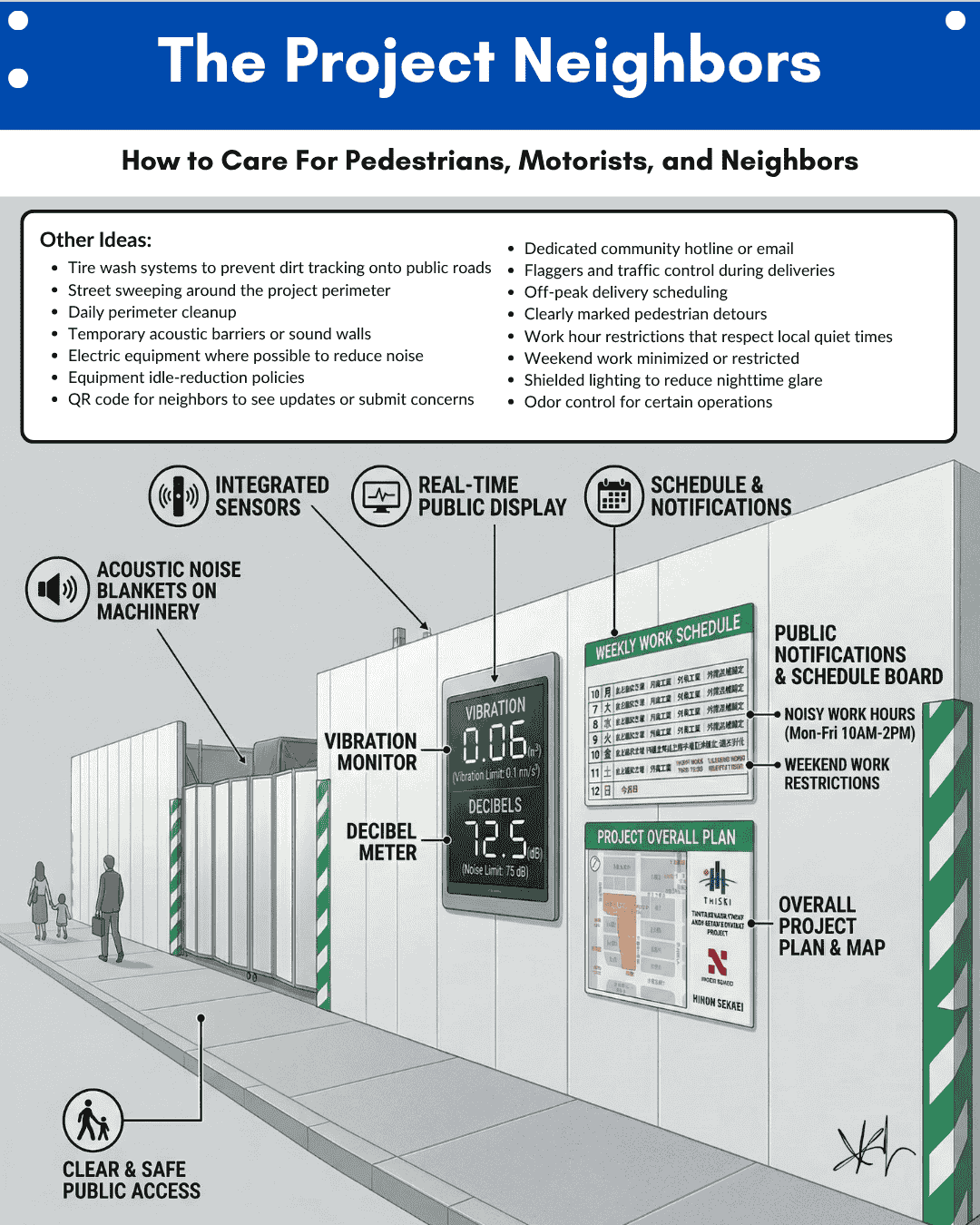
The image in this post shows what it looks like when a project team designs the community experience the same way they design the production system: intentionally, visually, and with the people affected firmly in mind.

The real-time public display on the fence showing current vibration readings and decibel levels is one of the most powerful elements in the system. It does something no amount of community meetings can fully replicate: it puts accurate information in front of neighbors at the moment they’re experiencing the impact, without requiring them to ask anyone or submit a complaint. A parent walking by with a child who is bothered by noise can look at the display and see exactly what the reading is, whether it’s within permitted limits, and what the project’s committed noise window is. The transparency removes the adversarial dynamic. When people can see that the project is operating within standards, even if those standards are uncomfortable, trust builds. When they can’t see anything and just experience the impact, they assume the worst.

The vibration monitor serves the same function for the ground-transmitted impacts that demolition and heavy equipment create. Sensors feed real-time data to the public display so that a business owner who feels a vibration through their floor doesn’t have to wonder whether it’s normal or whether something has gone wrong. The data is right there, public, honest, and continuous.

Watch for these signs that a project’s community care approach needs redesign:

  • Neighbors showing up at the site office to complain rather than reaching a dedicated hotline
  • City council or elected officials becoming involved because community members had no other escalation path
  • Sidewalk closures with unclear or unmarked detour routing
  • Weekend work or early-morning deliveries occurring without advance notice to the surrounding area
  • Adjacent businesses experiencing predictable impacts that nobody addressed in the communication plan

Transparency as a Production Strategy

Jason Schroeder teaches that transparency is not a personality trait it is a production strategy. Hidden problems become expensive problems. This principle applies not just inside the project team, but to everyone the project affects. A neighbor who doesn’t know what’s coming is a neighbor who escalates when it arrives. A business owner who has no way to communicate concerns becomes a city council agenda item. An uninformed community becomes a project delay when permits get challenged, inspections get triggered, and political pressure creates schedule risk that no production plan accounted for.

The weekly work schedule on the public-facing board flips the dynamic entirely. Instead of neighbors experiencing the project as a black box of unpredictable disruption, they can see what’s planned for the coming week when the noisy work is happening, when deliveries will be arriving, what areas will be affected, and when quiet periods are protected. That predictability respects people’s ability to plan their own lives around the project’s impacts. It treats the neighbor as an intelligent adult who deserves information, not as a bystander to be managed after the fact.

The acoustic noise blankets on machinery, the equipment idle-reduction policies, the off-peak delivery scheduling, the tire wash systems that prevent dirt tracking onto public roads each of these is a design decision that says: we thought about the people who live and work around us before we started. We made choices to reduce our impact even when we weren’t legally required to. That posture builds goodwill that no marketing effort can replicate, and it protects the project from community friction that no schedule buffer can fully absorb.

Why This Is About Respect for People, Not Just Public Relations

The Elevate Construction mission is to build remarkable people and systems that build the world. That vision doesn’t stop at the fence line. The world being built includes the community the project sits inside. The families being protected are not just the families of the workers on the site they include the families who live next door, whose sleep matters, whose businesses matter, whose sidewalks matter.

Jason Schroeder’s core teaching on respect for people is straightforward: answer every decision by asking, what would respect people? Applied to community care, the question becomes: does this decision treat the neighbors of this project as people who matter, or as obstacles to be minimized? A real-time noise display respects people. A community hotline respects people. A clearly marked pedestrian detour that is safe, maintained, and actually functional respects people. Sending mobilization and impact notices before work begins, so no one is surprised, respects people. If your project needs superintendent coaching, project support, or leadership development, Elevate Construction can help your field teams stabilize, schedule, and flow. Building that culture extends beyond the site boundary to everyone who shares the neighborhood with the work.

Build the Reputation That Outlasts the Project

Here is the challenge I want to leave with you. Think about the most recent project your team completed and ask: what did the neighbors experience? Did they know your hotline number? Did they receive impact notices before significant work phases? Did they have a way to see the weekly schedule without coming to the site office? Were their pedestrian routes safe, maintained, and clearly signed? Were quiet hours protected with enforcement, not just intention?

The answers to those questions define the reputation your company built in that community and in the minds of every business owner, city official, and resident who watched the project happen. That reputation travels. It shows up in the next permit application, the next community meeting, the next project in that neighborhood or that city. Great builders don’t just build buildings. They build goodwill. And goodwill, like a good production system, is designed not assumed.

On we go.

Frequently Asked Questions

Why should construction teams actively manage the community experience?

Because community friction is a real project risk. Unmanaged neighbor concerns escalate to permit challenges, unannounced inspections, and political pressure that can delay the schedule none of which any production plan can fully absorb.

What does a real-time public noise and vibration display accomplish?

It puts accurate live data in front of neighbors at the exact moment they’re experiencing an impact, removing the need to call or complain. When people can see the project is within standards, trust builds instead of resentment.

How does the public weekly work schedule benefit the surrounding community?

It transforms the project from an unpredictable source of disruption into something neighbors can plan around. A business owner who knows loud work is scheduled Tuesday morning can prepare accordingly predictability is its own form of respect.

What is the value of a community hotline for construction projects?

A hotline gives neighbors a designed channel to raise concerns before they escalate to the city or elected officials. A complaint that gets answered and resolved is a relationship one that doesn’t show up as a project risk.

When should impact notices be sent to neighbors?

Before any major phase change, noisy work period, or weekend work schedule not after the impact has already started. Sending them in advance is what separates a real communication system from an apology.

If you want to learn more we have:

-Takt Virtual Training: (Click here)
-Check out our Youtube channel for more info: (Click here) 
-Listen to the Elevate Construction podcast: (Click here) 
-Check out our training programs and certifications: (Click here)
-The Takt Book: (Click here)

Discover Jason’s Expertise:

Meet Jason Schroeder, the driving force behind Elevate Construction IST. As the company’s owner and principal consultant, he’s dedicated to taking construction to new heights. With a wealth of industry experience, he’s crafted the Field Engineer Boot Camp and Superintendent Boot Camp – intensive training programs engineered to cultivate top-tier leaders capable of steering their teams towards success. Jason’s vision? To expand his training initiatives across the nation, empowering construction firms to soar to unprecedented levels of excellence.

On we go
Posted in All

Total Productive Maintenance

Read 11 min

Why Waiting for Equipment to Break Is a Production Strategy Just a Terrible One

Every project team has a version of the same story. The excavator goes down on Tuesday morning. The operator noticed something off on Monday but figured it would hold. By the time the repair crew arrives Wednesday, two other trades are waiting on work that needed that machine to happen first. A half-day problem became a two-day cascade. The schedule absorbs it quietly and the team moves on, treating it as one of those things construction projects just deal with.

That pattern is not bad luck. It is a predictable outcome of a system that was designed to react rather than prevent. And the cost in schedule loss, crew downtime, rental overruns, and stress absorbed by the team is almost never measured accurately because it distributes itself across a dozen line items and a week of disruption that nobody attributes to the breakdown that started it.

The Way Most Projects Handle Equipment

Most construction projects treat heavy equipment the way most people treat a car they’re renting. They use it until something goes wrong, then they deal with it. The operator knows the machine best but rarely has a structured way to flag what they’re noticing before it becomes a failure. The superintendent knows when the equipment is critical to the path but rarely has visibility into its maintenance status. And the company managing the fleet is responding to breakdowns rather than preventing them because no system has been designed to do otherwise.

There’s no visual schedule showing when each machine is due for service. There’s no standard work checklist that the operator completes at the start of each shift so small issues are caught before they compound. There’s no root-cause tracking that shows which types of failures are recurring and what might be causing them. And when something breaks, the first instinct is to ask what the operator did wrong not what the maintenance system failed to prevent.

The operator didn’t fail the system. The system failed the operator.

A Story That Illustrates the Cost

I was on a civil project years ago where we had a critical crane operating during the most intensive phase of the work. The operator had been mentioning a hydraulic issue for days small symptoms, nothing dramatic. Nobody had a documented way to capture that, and there was no maintenance board that made the machine’s service history visible to the project leadership. When the crane went down hard during a pour, the consequences were significant: a delayed concrete placement, a scramble for a replacement crane, a full day of multiple trade crews at standstill, and rework on the partial pour. The post-incident conversation blamed the operator. The real story was that the system provided no mechanism to act on what the operator already knew.

That’s not a crane problem. That’s a system problem. And it’s one that a Total Productive Maintenance board is specifically designed to prevent.

What Total Productive Maintenance Actually Is

Total Productive Maintenance TPM is a Lean discipline that originated in manufacturing to eliminate equipment downtime through proactive, operator-led maintenance supported by a visible management system. The core idea is simple: equipment reliability is not a maintenance department problem. It is a shared system problem, and like all system problems, it requires visibility to solve.

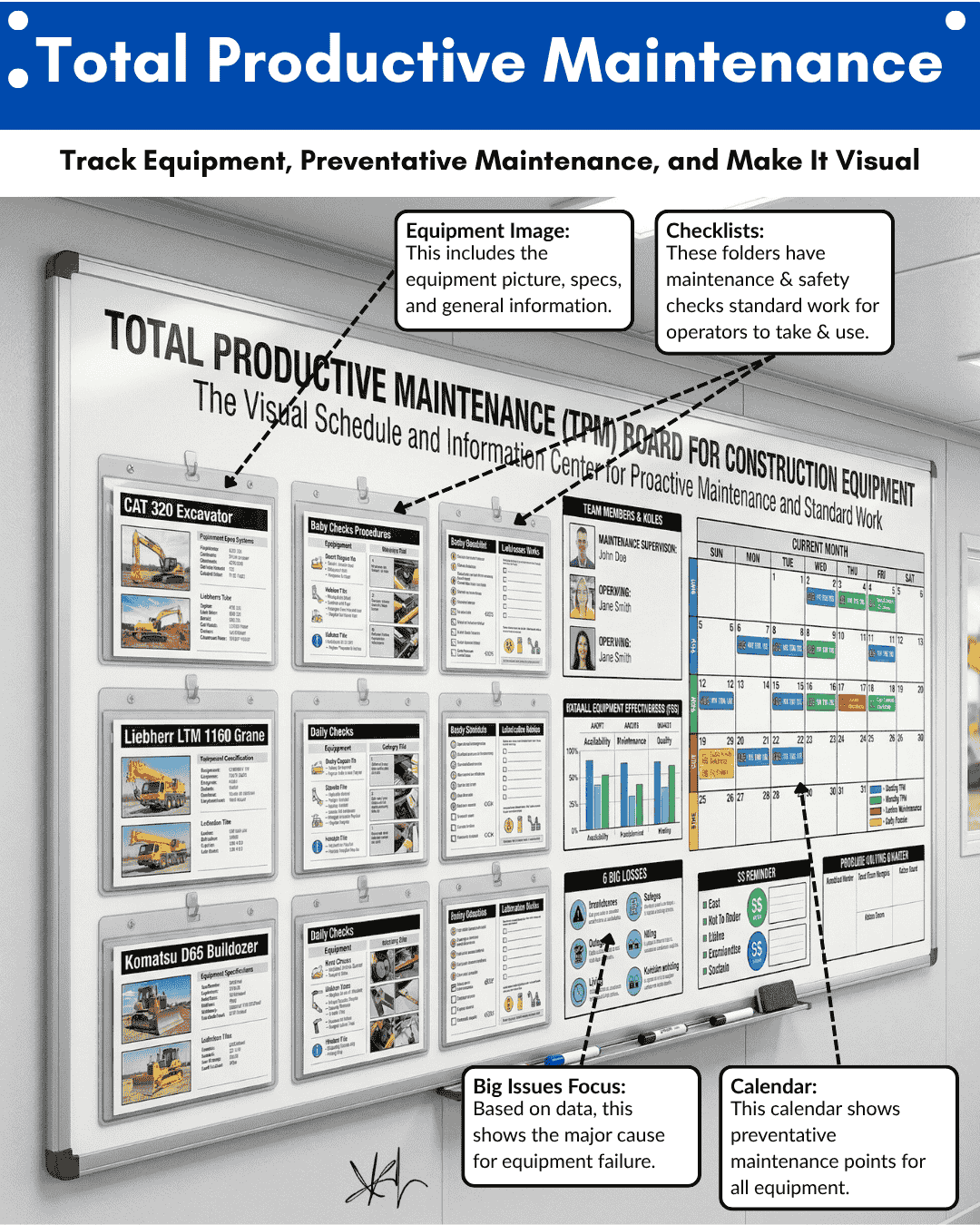
The TPM board shown in this post applies that discipline directly to construction equipment. Each major piece of equipment excavator, crane, bulldozer, and others has its own visual profile on the board that includes an equipment image, specifications, and general information so anyone on the project team knows exactly what machine they’re looking at and what its operational parameters are. This sounds basic, but on a multi-contractor project with rotating equipment and crews who have never worked with a specific machine before, that visual reference eliminates real confusion and real errors.

The operator checklists attached to each equipment panel are the most operationally critical element. These are standardized maintenance and safety inspection checklists that the operator takes and uses at the start of each shift. The checklist is not a formality. It is the daily observation loop that catches what the operator is already noticing the hydraulic level that’s slightly low, the noise in the turntable bearing, the brake response that feels different from yesterday. With a checklist, that observation becomes a documented signal. Without one, it stays in the operator’s head until it becomes a crisis.

Watch for these conditions on your project that indicate equipment is being managed reactively:

  • No documented operator inspection routine for any piece of equipment
  • Maintenance records that exist somewhere in the company but are not accessible or visible on the project
  • Equipment breakdowns that trace to symptoms the operator had noticed but not reported through any formal channel
  • No scheduled preventative maintenance windows built into the project production plan
  • Breakdowns consistently attributed to operator error without root-cause analysis of the underlying system

The Preventative Maintenance Calendar and Root-Cause Tracking

The maintenance calendar on the TPM board makes the service schedule for all equipment visible to the entire project team in the same place they look at everything else. This is not a reminder in someone’s phone or a spreadsheet on a fleet manager’s computer in the home office. It’s on the wall, on the project, where the people operating and depending on that equipment can see it every day. Scheduled service becomes a production event with a date, not a vague future activity that gets deferred when the schedule is tight.

That last point matters enormously. Preventative maintenance windows get deferred on most projects because nobody has designed them into the production plan. The excavator is critical to the phase. There’s no visible signal that service is due this week. The foreman needs the machine running. The service gets pushed two more weeks. And then the machine goes down hard at the worst possible moment not because the maintenance team was negligent, but because the system had no visual mechanism to protect the service window from production pressure.

The root-cause tracking section of the board is where the system becomes self-improving over time. When an equipment issue occurs, it gets documented. When patterns emerge the same component failing on the same machine type, the same failure mode recurring across projects the board reveals them. This is how a project team stops treating every breakdown as a one-off bad event and starts treating equipment reliability as a system they can improve. You can’t manage what you can’t see. The board makes the data visible.

Why This Is a Lean Question, Not Just a Maintenance Question

Jason Schroeder teaches visual management as a core Lean principle a work environment that is self-ordering, self-explaining, self-regulating, and self-improving because of visual devices. When everyone can see the plan, see the roadblocks, and see the standard, total participation becomes possible. Equipment maintenance is no different. When the service calendar is visible, when the operator checklist is standardized, when root causes are tracked, the entire team can participate in equipment reliability instead of leaving it invisible until something breaks.

The Takt Production System depends on the train of trades moving through zones on a defined rhythm. Equipment is part of that rhythm cranes, excavators, telehandlers, and hoists are the physical infrastructure that enables material flow, zone transitions, and production sequencing. When a critical piece of equipment goes down unexpectedly, it doesn’t just pause one activity. It stalls the zone, affects the handoff to the next trade, burns buffer, and compresses the schedule for everyone downstream. A breakdown that looks like a maintenance problem is actually a production problem, a safety problem, and a people problem all at once.

Stable equipment means stable production. Stable production means predictable schedules. Predictable schedules mean crews go home on time. And crews going home on time is not a peripheral benefit of better maintenance it is the whole point of building better systems.

Respect for People Starts with Reliable Tools

There is a human story inside the equipment maintenance conversation that almost never gets told. The operator sitting in a machine that they know is declining is not having a neutral experience. They’re managing a risk that the system handed them without acknowledgment. They’re making judgment calls about when to push through and when to stop. They carry that uncertainty through the day, through the pour, through the lift and then come home carrying the knowledge that if something goes wrong, the first question will be what they did wrong, not what the system failed to prevent.

Giving that operator a standard checklist, a visible maintenance calendar, and a documented channel to flag what they’re observing is not bureaucracy. It’s respect. It says: your observations matter. Your knowledge of this machine is valued. We built a system that captures what you know and acts on it before it becomes a crisis. If your project needs superintendent coaching, project support, or leadership development, Elevate Construction can help your field teams stabilize, schedule, and flow. Building systems that protect the people doing the work from the gate to the connex box to the equipment panel is what that work looks like in practice.

Build the Board. Build the System. Build Reliability.

Here is the practical challenge. Identify the three pieces of equipment most critical to your current production phase and ask: does every operator have a standardized daily inspection checklist? Is the preventative maintenance schedule visible to the project team in a central location? When this equipment has had problems in the past, was the root cause documented in a way the team can learn from? If the answer to any of those questions is no, the system is relying on the machine to outlast the project and the operator’s vigilance to catch what the system can’t.

Build the TPM board. Start with visual profiles and checklists for your critical equipment. Add the maintenance calendar. Begin tracking issues and root causes. That board will return its investment the first time it catches a developing problem before it becomes a breakdown and it will pay dividends across every project that uses it after that. Great builders don’t just manage projects. They build systems that make success repeatable. Sometimes that starts with a board on the wall.

On we go.

Frequently Asked Questions

What is Total Productive Maintenance and how does it apply to construction?

Total Productive Maintenance is a Lean discipline that prevents equipment downtime through proactive, operator-led inspection supported by a visible management system. In construction, it means giving operators standard daily checklists, displaying preventative maintenance schedules visually on a project board, and tracking equipment issues and root causes so patterns can be identified and addressed before breakdowns occur.

Why is the operator daily checklist the most important element of the system?

The operator spends more time with the machine than anyone else and notices the earliest warning signs of failure sounds, responses, fluid levels, behaviors that are subtly different from normal. Without a structured checklist, that knowledge stays in the operator’s head and rarely reaches the project team in time to act.

How does a visible maintenance calendar prevent service deferral?

When preventative maintenance dates are visible on the project board, service windows become known production events that foremen and superintendents plan around not vague future activities that can be quietly deferred. Without visibility, service gets pushed when equipment is critical to the plan. With a visible calendar, the team can coordinate around the service date the same way they coordinate around a concrete pour or a crane pick.

What does root-cause tracking accomplish over time?

Root-cause tracking turns individual breakdowns into collective learning. When failure modes are documented and reviewed, patterns emerge the same component failing repeatedly, the same machine type underperforming in a specific operating condition, the same maintenance gap causing recurring downtime.

How does equipment reliability connect to the Takt Production System?

Equipment is part of the production infrastructure that the Takt rhythm depends on. Cranes, excavators, and telehandlers enable zone transitions, material delivery, and scope completion on the schedule the trade sequence requires. An unexpected equipment failure stalls the zone, delays the handoff to the next trade, burns production buffer, and compresses the schedule for everyone downstream.

If you want to learn more we have:

-Takt Virtual Training: (Click here)
-Check out our Youtube channel for more info: (Click here) 
-Listen to the Elevate Construction podcast: (Click here) 
-Check out our training programs and certifications: (Click here)
-The Takt Book: (Click here)

Discover Jason’s Expertise:

Meet Jason Schroeder, the driving force behind Elevate Construction IST. As the company’s owner and principal consultant, he’s dedicated to taking construction to new heights. With a wealth of industry experience, he’s crafted the Field Engineer Boot Camp and Superintendent Boot Camp – intensive training programs engineered to cultivate top-tier leaders capable of steering their teams towards success. Jason’s vision? To expand his training initiatives across the nation, empowering construction firms to soar to unprecedented levels of excellence.

On we go
Posted in All

Sort the First “S”

Read 10 min

5S as a System: Why Cleaning Up Is Not Enough

Let me say something directly because it needs to be said. Cleaning up a mess is not 5S. Organizing a gang box is not 5S. Running a site cleanup day before the owner walks the project is not 5S. These things have their merits they are better than not doing them but they are not the system. And the difference between doing 5S correctly as a complete, living system and doing a one-time cleanup is the difference between a project site that gets better every day and one that returns to its disorganized state within two weeks of every cleanup effort.

The 5S system is the world’s most effective method for creating standards in a workplace. Standards are the foundation that makes improvement possible. Without a standard, you have no reference point. You cannot improve from chaos because chaos has no floor to push off of. The entire value of 5S is that it builds the first standard the condition from which everything else gets better. Once that standard exists, you can see what is in standard and what is out of standard. And once you can see that, you can eliminate the waste that is causing the deviation. That is where the real gains live.

The Pain of Treating 5S as Separate Activities

Here is the pattern on most construction projects. The superintendent calls for a 5S push. Crews sort through their areas. Some things get thrown away. Tools get reorganized. The gang boxes look better. Within a few weeks, the clutter returns. Another sort happens in three months. The cycle repeats. And the conclusion, eventually, is that the people on site just do not care enough to maintain the standard.

That conclusion misses the actual problem. The activities were treated as separate events rather than as a complete, interconnected system with a living standard at its center. Sort without Set in Order means sorted items have no defined home and drift back into chaos. Set in Order without Shine means the organized area gets dirty and problems hide under the grime. Shine without Standardize means the cleaning happens when someone feels like it. And Standardize without Sustain means the standard exists on paper and nowhere else. Each S depends on the others. They function as a system or they do not function at all.

The System Failed the Team

When 5S collapses on a project site, the failure is almost always in how it was implemented, not in the willingness of the people. Workers who were never shown the vision of what the area should look like cannot maintain a standard they never understood. Crews who were never included in creating the target condition have no ownership of it. Leaders who treated 5S as a one-time event rather than a daily habit never built the muscle memory that makes it stick. The system was not properly built. The people cannot be blamed for a system they were never taught to run.

Where 5S Actually Comes From

The 5S system has roots that go back further than Toyota. Henry Ford developed something he called the CANDO system Clean up, Arrange, Neatness, Discipline, Ongoing improvement as a way to bring order and efficiency to the production floor. Toyota took those same principles, refined them within the Toyota Production System, and named them using five Japanese words that we have translated into Sort, Straighten, Sweep, Standardize, and Sustain. Different people use slightly different translations Shine instead of Sweep, Set in Order instead of Straighten but the intent and purpose are the same. What matters is not the exact word. What matters is the system.

What Each S Is Actually Doing

Sort is the act of removing everything from the work area that is not needed for the current scope. Nothing hits the floor. Unneeded items never enter the zone. This is not about throwing things away for the sake of it. It is about protecting the production capacity of the area by eliminating the clutter and confusion that slow every task down. When the area contains only what is needed, finding what you need is instant.

Straighten is establishing a defined place for everything that remains after sorting, labeled and accessible at the point of work. The principle is simple: a place for everything and everything in its place. In a gang box, this looks like shadow boards where the outline of every tool is visible and missing tools are obvious at a glance. On a staging area, it looks like color-coded zones by trade, dunnaged materials in sequence, and nothing sitting directly on the ground in an unmarked location.

Sweep or Shine is maintaining the work area at a standard of cleanliness where defects, hazards, and missing items are immediately visible. The purpose of cleaning is not cosmetic. It is a control strategy. A clean surface reveals a problem the moment it appears. A dirty surface hides the same problem until it has compounded into something expensive. The bathroom quality on a construction site is still the most honest early indicator of whether this principle is actually active.

Standardize is the state that exists when the first three Ss are consistently maintained. It is not an activity it is a condition. Standardize means the Sort, Straighten, and Sweep happen every day as part of the workflow, not as special events. Visual 5S is the goal: anyone who walks into the area can immediately tell what is in standard and what is not, without asking anyone.

Sustain is converting all of it into a daily habit. This is the hardest S and the one that separates projects with real 5S from projects that do 5S once. Sustain requires leadership presence, daily reinforcement in the morning worker huddle, visible tracking of the 5S score, and a culture where maintaining the standard is treated as part of the job not extra work on top of the job.

What Happens When 5S Is Done Right

The prefabrication industry offers one of the clearest illustrations of what 5S as a system actually produces. One electrical prefab team implemented 5S across their shop with a focus on a single product in-wall electrical assemblies. Before 5S, each assembly took roughly twelve minutes to build from start to finish. After one week of focused 5S implementation and improvement, they built the same assembly in under five minutes. On a job with twenty-six thousand assemblies, that improvement alone saved over one hundred and fifty thousand dollars. And because the standard was sustained, the savings compound year after year on every subsequent job.

That result did not come from working harder. It came from seeing the waste that the 5S standard made visible, eliminating it through small, incremental experiments, and sustaining the improved standard so the gains held. That is what 5S as a system produces that a cleanup day never can.

Here are the signals that a team is running 5S as a system rather than as a series of one-time events:

  • Workers can describe the standard for their area without looking at a document
  • Missing or out-of-place items are noticed and corrected by the crew, not the superintendent
  • The 5S score is tracked visibly and the team knows whether they are improving or degrading
  • The morning huddle includes a brief reference to 5S standards at least a few times per week
  • New crew members receive a 5S orientation as part of their project onboarding

5S Is an Expression of Company Values

There is one more dimension of 5S that most people never discuss because it sounds too elevated for a conversation about gang box organization. The values that most construction companies claim to hold safety excellence, respect for people, continuous improvement, collaboration, integrity are expressed or contradicted every day by the condition of the work environment. A project site that is clean, organized, and maintained daily is a project site that is living its values. A site that is dirty, disorganized, and managed through periodic cleanup emergencies is one that is saying something different about what leadership actually cares about.

5S is not separate from the mission of building remarkable people who build remarkable things. It is one of the most direct daily expressions of that mission. When the environment respects the people working in it, those people respect the work they produce. The quality of the building, the safety record, the engagement of the workforce all of it starts with the clarity of the environment those workers inhabit every day. If your project needs superintendent coaching, project support, or leadership development, Elevate Construction can help your field teams stabilize, schedule, and flow.

Sort, Straighten, Sweep, Standardize, Sustain. Not as five events. As one system. Every day. Until it is the only way you know how to work.

On we go.

Frequently Asked Questions

What is the difference between cleaning up and actually doing 5S?

Cleaning up is a one-time improvement to a disorganized area. 5S is a system that creates a standard for the area and then sustains that standard as a daily habit. The difference is that 5S makes waste visible permanently, while a cleanup removes the symptoms without addressing the cause.

Why does 5S have to be a system rather than separate activities?

Because each S depends on the others. Sort without Set in Order means sorted items have no home. Shine without Standardize means cleaning is inconsistent. Standardize without Sustain means the standard exists in theory only. The five activities only produce lasting results when they are practiced as a complete, interconnected system.

What is a 5S score and how is it used?

A 5S scorecard is a simple audit tool that rates the current state of a work area against a defined standard, producing a score out of 100. Most first-time audits land between 6 and 17. The score creates a measurable baseline and a visible improvement trajectory that motivates the team and tracks real progress.

How does 5S connect to waste elimination?

5S creates a standard. Deviations from that standard are visible. Visible deviations reveal waste motion, waiting, searching, defects that would otherwise be hidden in the noise of a disorganized environment. You cannot eliminate waste you cannot see. 5S is how you see it.

What role does the morning worker huddle play in sustaining 5S?

It is the daily mechanism for reinforcing the standard. Brief training on a specific 5S principle, recognition of crews maintaining the standard, and visible score tracking in the huddle area keep 5S alive between formal audits and prevent the gradual drift back to the pre-5S condition.

If you want to learn more we have:

-Takt Virtual Training: (Click here)
-Check out our Youtube channel for more info: (Click here) 
-Listen to the Elevate Construction podcast: (Click here) 
-Check out our training programs and certifications: (Click here)
-The Takt Book: (Click here)

Discover Jason’s Expertise:

Meet Jason Schroeder, the driving force behind Elevate Construction IST. As the company’s owner and principal consultant, he’s dedicated to taking construction to new heights. With a wealth of industry experience, he’s crafted the Field Engineer Boot Camp and Superintendent Boot Camp – intensive training programs engineered to cultivate top-tier leaders capable of steering their teams towards success. Jason’s vision? To expand his training initiatives across the nation, empowering construction firms to soar to unprecedented levels of excellence.

On we go
Posted in All

Introduction to the 5S System

Read 10 min

5S as a System: Why Cleaning Up Is Not Enough

Let me say something directly because it needs to be said. Cleaning up a mess is not 5S. Organizing a gang box is not 5S. Running a site cleanup day before the owner walks the project is not 5S. These things have their merits they are better than not doing them but they are not the system. And the difference between doing 5S correctly as a complete, living system and doing a one-time cleanup is the difference between a project site that gets better every day and one that returns to its disorganized state within two weeks of every cleanup effort.

The 5S system is the world’s most effective method for creating standards in a workplace. Standards are the foundation that makes improvement possible. Without a standard, you have no reference point. You cannot improve from chaos because chaos has no floor to push off of. The entire value of 5S is that it builds the first standard the condition from which everything else gets better. Once that standard exists, you can see what is in standard and what is out of standard. And once you can see that, you can eliminate the waste that is causing the deviation. That is where the real gains live.

The Pain of Treating 5S as Separate Activities

Here is the pattern on most construction projects. The superintendent calls for a 5S push. Crews sort through their areas. Some things get thrown away. Tools get reorganized. The gang boxes look better. Within a few weeks, the clutter returns. Another sort happens in three months. The cycle repeats. And the conclusion, eventually, is that the people on site just do not care enough to maintain the standard.

That conclusion misses the actual problem. The activities were treated as separate events rather than as a complete, interconnected system with a living standard at its center. Sort without Set in Order means sorted items have no defined home and drift back into chaos. Set in Order without Shine means the organized area gets dirty and problems hide under the grime. Shine without Standardize means the cleaning happens when someone feels like it. And Standardize without Sustain means the standard exists on paper and nowhere else. Each S depends on the others. They function as a system or they do not function at all.

The System Failed the Team

When 5S collapses on a project site, the failure is almost always in how it was implemented, not in the willingness of the people. Workers who were never shown the vision of what the area should look like cannot maintain a standard they never understood. Crews who were never included in creating the target condition have no ownership of it. Leaders who treated 5S as a one-time event rather than a daily habit never built the muscle memory that makes it stick. The system was not properly built. The people cannot be blamed for a system they were never taught to run.

Where 5S Actually Comes From

The 5S system has roots that go back further than Toyota. Henry Ford developed something he called the CANDO system Clean up, Arrange, Neatness, Discipline, Ongoing improvement as a way to bring order and efficiency to the production floor. Toyota took those same principles, refined them within the Toyota Production System, and named them using five Japanese words that we have translated into Sort, Straighten, Sweep, Standardize, and Sustain. Different people use slightly different translations Shine instead of Sweep, Set in Order instead of Straighten but the intent and purpose are the same. What matters is not the exact word. What matters is the system.

What Each S Is Actually Doing

Sort is the act of removing everything from the work area that is not needed for the current scope. Nothing hits the floor. Unneeded items never enter the zone. This is not about throwing things away for the sake of it. It is about protecting the production capacity of the area by eliminating the clutter and confusion that slow every task down. When the area contains only what is needed, finding what you need is instant.

Straighten is establishing a defined place for everything that remains after sorting, labeled and accessible at the point of work. The principle is simple: a place for everything and everything in its place. In a gang box, this looks like shadow boards where the outline of every tool is visible and missing tools are obvious at a glance. On a staging area, it looks like color-coded zones by trade, dunnaged materials in sequence, and nothing sitting directly on the ground in an unmarked location.

Sweep or Shine is maintaining the work area at a standard of cleanliness where defects, hazards, and missing items are immediately visible. The purpose of cleaning is not cosmetic. It is a control strategy. A clean surface reveals a problem the moment it appears. A dirty surface hides the same problem until it has compounded into something expensive. The bathroom quality on a construction site is still the most honest early indicator of whether this principle is actually active.

Standardize is the state that exists when the first three Ss are consistently maintained. It is not an activity it is a condition. Standardize means the Sort, Straighten, and Sweep happen every day as part of the workflow, not as special events. Visual 5S is the goal: anyone who walks into the area can immediately tell what is in standard and what is not, without asking anyone.

Sustain is converting all of it into a daily habit. This is the hardest S and the one that separates projects with real 5S from projects that do 5S once. Sustain requires leadership presence, daily reinforcement in the morning worker huddle, visible tracking of the 5S score, and a culture where maintaining the standard is treated as part of the job not extra work on top of the job.

What Happens When 5S Is Done Right

The prefabrication industry offers one of the clearest illustrations of what 5S as a system actually produces. One electrical prefab team implemented 5S across their shop with a focus on a single product in-wall electrical assemblies. Before 5S, each assembly took roughly twelve minutes to build from start to finish. After one week of focused 5S implementation and improvement, they built the same assembly in under five minutes. On a job with twenty-six thousand assemblies, that improvement alone saved over one hundred and fifty thousand dollars. And because the standard was sustained, the savings compound year after year on every subsequent job.

That result did not come from working harder. It came from seeing the waste that the 5S standard made visible, eliminating it through small, incremental experiments, and sustaining the improved standard so the gains held. That is what 5S as a system produces that a cleanup day never can.

Here are the signals that a team is running 5S as a system rather than as a series of one-time events:

  • Workers can describe the standard for their area without looking at a document
  • Missing or out-of-place items are noticed and corrected by the crew, not the superintendent
  • The 5S score is tracked visibly and the team knows whether they are improving or degrading
  • The morning huddle includes a brief reference to 5S standards at least a few times per week
  • New crew members receive a 5S orientation as part of their project onboarding

5S Is an Expression of Company Values

There is one more dimension of 5S that most people never discuss because it sounds too elevated for a conversation about gang box organization. The values that most construction companies claim to hold safety excellence, respect for people, continuous improvement, collaboration, integrity are expressed or contradicted every day by the condition of the work environment. A project site that is clean, organized, and maintained daily is a project site that is living its values. A site that is dirty, disorganized, and managed through periodic cleanup emergencies is one that is saying something different about what leadership actually cares about.

5S is not separate from the mission of building remarkable people who build remarkable things. It is one of the most direct daily expressions of that mission. When the environment respects the people working in it, those people respect the work they produce. The quality of the building, the safety record, the engagement of the workforce all of it starts with the clarity of the environment those workers inhabit every day. If your project needs superintendent coaching, project support, or leadership development, Elevate Construction can help your field teams stabilize, schedule, and flow.

Sort, Straighten, Sweep, Standardize, Sustain. Not as five events. As one system. Every day. Until it is the only way you know how to work.

On we go.

Frequently Asked Questions

What is the difference between cleaning up and actually doing 5S?

Cleaning up is a one-time improvement to a disorganized area. 5S is a system that creates a standard for the area and then sustains that standard as a daily habit. The difference is that 5S makes waste visible permanently, while a cleanup removes the symptoms without addressing the cause.

Why does 5S have to be a system rather than separate activities?

Because each S depends on the others. Sort without Set in Order means sorted items have no home. Shine without Standardize means cleaning is inconsistent. Standardize without Sustain means the standard exists in theory only. The five activities only produce lasting results when they are practiced as a complete, interconnected system.

What is a 5S score and how is it used?

A 5S scorecard is a simple audit tool that rates the current state of a work area against a defined standard, producing a score out of 100. Most first-time audits land between 6 and 17. The score creates a measurable baseline and a visible improvement trajectory that motivates the team and tracks real progress.

How does 5S connect to waste elimination?

5S creates a standard. Deviations from that standard are visible. Visible deviations reveal waste motion, waiting, searching, defects that would otherwise be hidden in the noise of a disorganized environment. You cannot eliminate waste you cannot see. 5S is how you see it.

What role does the morning worker huddle play in sustaining 5S?

It is the daily mechanism for reinforcing the standard. Brief training on a specific 5S principle, recognition of crews maintaining the standard, and visible score tracking in the huddle area keep 5S alive between formal audits and prevent the gradual drift back to the pre-5S condition.

If you want to learn more we have:

-Takt Virtual Training: (Click here)
-Check out our Youtube channel for more info: (Click here) 
-Listen to the Elevate Construction podcast: (Click here) 
-Check out our training programs and certifications: (Click here)
-The Takt Book: (Click here)

Discover Jason’s Expertise:

Meet Jason Schroeder, the driving force behind Elevate Construction IST. As the company’s owner and principal consultant, he’s dedicated to taking construction to new heights. With a wealth of industry experience, he’s crafted the Field Engineer Boot Camp and Superintendent Boot Camp – intensive training programs engineered to cultivate top-tier leaders capable of steering their teams towards success. Jason’s vision? To expand his training initiatives across the nation, empowering construction firms to soar to unprecedented levels of excellence.

On we go
Posted in All

Preparing The Team to Implement 5S

Read 10 min

How to Prepare Your Team for 5S in Construction: The Three Steps Most Leaders Skip

Here is the thing about 5S that most people who have implemented it will tell you with some degree of frustration: they have done it. More than once. And it did not stick. The company learned the five steps, ran a sort-out weekend, got the area looking good, took some photos, and then watched it gradually return to the state it was in before. After enough of those cycles, the conclusion is that 5S does not really work in construction, or that the people on the site simply do not care enough to maintain it.

That conclusion is wrong. The problem is not that 5S does not work. The problem is that most teams skip the preparation that makes it work. They start with Sort and call that implementation. But the foundation the team understanding, the shared vision, the honest diagnostic never gets built. And a 5S system built without that foundation will collapse every single time.

The Pain of 5S Without Preparation

Walk into any construction company that has “done” 5S and ask them to show you their standard. Most of the time, the standard was never written down. The vision of what the area should look like was never documented, let alone co-created with the people who work there. The initial diagnostic was never done, so there is no baseline to measure against and no score to improve. The team was told to clean and organize. They were never shown what they were working toward or given the connection between that standard and the quality of their own work experience.

When the system eventually degrades and without those foundations it always does the blame lands on the individuals. They did not sustain it. They did not care. They went back to their old habits. But the system was never designed to sustain itself in the first place. The preparation was skipped. The system failed the team.

5S Is a Countermeasure, Not a Destination

The most honest thing I can say about 5S is this: it is not the goal. It is a countermeasure. It solves the problem of a workplace having no standard and no stability from which improvement can actually take hold. You need 5S because without it, continuous improvement Kaizen, the daily habit of making small things better has nothing to stand on. You cannot improve a process you cannot see. You cannot see a process buried in clutter and disorganization. 5S creates the visibility that makes everything else in a Lean system possible.

Until there is a standard, there can be no improvement. That sentence is the entire argument for 5S in one line. The sort, the set in order, the shine all of it is in service of creating a standard for the workplace that the team can maintain, improve from, and be proud of. The fifth S sustain is where most implementations fail because sustaining requires that the first three steps happened correctly. And those three steps are what we are going to talk about.

The Three Preparation Steps That Change Everything

The first preparation step is introducing the 5S system to the team. Not presenting it to the team. Not announcing it at a toolbox talk and moving on. Introducing it in a way that creates ownership. The concept here is simple but easily misunderstood: 5S should be employee owned and management supported. That means the people who do the work in the area are the ones who own the standard for that area. Management provides the resources, the time, the training, and the accountability. But the system belongs to the people running it every day.

Think about what that actually requires. It requires the superintendent or foreman standing in front of the crew and genuinely inviting them into the system not as the latest mandate from the office, but as a tool that will make their work environment less frustrating, their tools easier to find, their zones safer to work in, and their day less cluttered with the friction that a disorganized environment creates. The introduction works when people leave it understanding why this benefits them. Not why management wants it. Why they want it.

The second preparation step is creating a vision with the team. This is the step that generates the energy the whole implementation runs on, and it is also the most commonly mishandled. The vision is not a presentation about what 5S looks like in a manufacturing facility. It is a conversation with the specific people in the specific area about what their current condition looks like and what they would actually like it to look like. Write down exactly what they say. Do not translate their words into management language. Use the words they use.

The purpose of this step is to create a healthy dissatisfaction with the status quo. Not frustration, not blame, but genuine recognition that the current condition is not what it could be. Showing the team pictures of what a 5S’d gang box looks like versus what theirs looks like right now not to embarrass them, but to give them a concrete target to aspire to is the kind of vision creation that actually moves people. When workers come out of that meeting with a picture in their minds of what their area could look like, and they genuinely want to close the gap between now and that picture, the implementation has a chance to succeed. When they come out of it feeling like they were lectured to about someone else’s standard, it will not.

The third preparation step is performing a workplace scan and diagnostic. This is the baseline measurement that makes progress visible and motivating. A simple 5S scorecard and there are free ones available allows the team to audit the current state of their work area honestly and generate a score out of 100. In most construction environments, a candid first-time diagnostic will land somewhere between six and seventeen points out of one hundred. That is not a failure. That is an honest starting point and an enormous amount of improvement runway. The diagnostic gives the team two things they need: a concrete picture of where they actually are, and a clear path for how every small improvement advances the score.

Here are the warning signs that a 5S implementation was launched without these three preparation steps:

  • Workers cannot explain what the 5S standard for their area is supposed to look like
  • Nobody ran a diagnostic before the implementation, so there is no score to track and no improvement to celebrate
  • The vision of the target condition was created by management, not with the team
  • The implementation felt like a cleaning day rather than the launch of a living standard

What Comes After Preparation

Once the team understands why they are doing 5S, what the target looks like, and where they are starting from, the five activities themselves Sort, Set in Order, Shine, Standardize, Sustain become much more effective. Sort is not just cleaning up; it is eliminating the specific items the team identified in the diagnostic as creating clutter and slowing their work. Set in Order is not just organizing; it is creating the specific places the team agreed should exist for the things they use most. Shine is not just sweeping; it is bringing the area to the standard the team defined in their vision. And Standardize and Sustain are not impositions from the outside they are the team’s commitment to maintaining what they themselves defined as the right condition.

The daily morning worker huddle is one of the best mechanisms for sustaining 5S long-term. Two minutes of training on a specific 5S concept, recognition of crews who have held the standard, and a visible scoreboard that the team can see improving over time these small investments compound into a culture where cleanliness and organization are the default rather than the exception. And once the culture reaches that point, all of the other Lean systems that depend on a stable, visible environment can function as designed.

Connecting to the Mission

At Elevate Construction and LeanTakt, we believe deeply that clean, safe, organized project sites are not a cosmetic preference. They are the foundation of respect for people. You cannot have total participation in a visual planning system if the environment is chaotic. You cannot have flow on a Takt plan if zones are cluttered with materials that were never sorted or staged correctly. You cannot have quality at the source if problems are hidden under the visual noise of a disorganized area. 5S is where stability begins. If your project needs superintendent coaching, project support, or leadership development, Elevate Construction can help your field teams stabilize, schedule, and flow.

Prepare the team correctly. Create the vision together. Run the diagnostic. Then launch the five activities from a foundation that will actually hold.

On we go.

Frequently Asked Questions

Why do most 5S implementations fail to sustain themselves?

Because the preparation steps were skipped. When the team does not co-create the vision, does not understand the purpose, and has no diagnostic baseline to improve from, the system has no foundation. Sustain is only possible when Sort, Set in Order, and Shine were built on something the team owns and believes in.

What is the purpose of the workplace diagnostic before implementing 5S?

It creates an honest baseline score that makes progress visible and motivating. Most first-time diagnostics score between six and seventeen out of one hundred. That is not discouraging it is an honest starting point that shows the team exactly how much improvement opportunity exists and gives them a number to beat.

Why should the vision be created with the team rather than for them?

Because ownership follows participation. When the team defines what the target condition looks like in their own words, the standard belongs to them. When management defines it and presents it to them, it belongs to management. The difference in engagement and sustained performance between those two approaches is enormous.

How does 5S connect to Takt Planning and flow?

A stable, organized environment is the precondition for Takt flow. Zones that are cluttered disrupt handoffs. Materials that are not staged correctly create waiting waste. Tools that are not organized create motion waste. 5S removes those sources of variation so the train of trades can move through the project without fighting the environment.

What does “employee owned, management supported” mean in practice?

It means the workers who use the work area own the standard for it they define what it should look like, maintain it, and improve it. Management provides the time, training, resources, and accountability that make ownership sustainable. When this relationship is reversed, with management defining the standard and workers expected to comply, the system does not sustain.

If you want to learn more we have:

-Takt Virtual Training: (Click here)
-Check out our Youtube channel for more info: (Click here) 
-Listen to the Elevate Construction podcast: (Click here) 
-Check out our training programs and certifications: (Click here)
-The Takt Book: (Click here)

Discover Jason’s Expertise:

Meet Jason Schroeder, the driving force behind Elevate Construction IST. As the company’s owner and principal consultant, he’s dedicated to taking construction to new heights. With a wealth of industry experience, he’s crafted the Field Engineer Boot Camp and Superintendent Boot Camp – intensive training programs engineered to cultivate top-tier leaders capable of steering their teams towards success. Jason’s vision? To expand his training initiatives across the nation, empowering construction firms to soar to unprecedented levels of excellence.

On we go

Posted in All