6 Tips On How To Implement A Lean Office in the AEC Industry

Read 10 min

Lean Office in the AEC Industry: How to Eliminate Waste Where Projects Are Actually Lost

Here is a thought that most construction leaders have never seriously sat with. Your field execution might be exceptional. Your crews might be flowing. Your Takt plan might be dialed in. And your project is still losing time, money, and alignment because nobody ever looked at where most of the real bottlenecks actually live in purchasing, in design coordination, in administrative processes, in the decisions that travel from the office to the field and arrive incomplete, late, or both. Lean in the AEC industry is not just a field system. It is a whole-company system. And until the office is Lean, the field will always be absorbing waste it should never have to carry.

The Pain That Starts Upstream

Walk the project site and you will find problems that had their origin weeks earlier in a conference room or an inbox. An RFI that sat unresolved for twelve days because nobody owned the decision chain. A submittals process that requires seven touchpoints and two weeks minimum, regardless of the urgency on site. A design change that was decided by the owner three weeks ago and only reached the superintendent yesterday. A procurement request that entered the purchasing queue and disappeared into a silo nobody monitors. By the time any of those issues become visible in the field, the train of trades has already been disrupted. The crews are not the source of the problem. The administrative and managerial processes upstream are.

The System Failed to Look at Itself

Most companies think of Lean as something you implement in the production areas on site, in the zones, in the meeting system. The office is treated as a separate function that supports the field from a distance. And because the office never gets examined through a Lean lens, its waste compounds invisibly. It shows up as delays in information, late decisions, unclear conditions of satisfaction, procurement gaps, and design surprises all of which the field team absorbs through overtime, rework, and firefighting. The system produced the waste. The field teams are just the ones living with it.

What Lean Office Actually Looks Like in AEC

The first practice is basing continuous improvement on real customer needs and being honest about who the customer is at every step of the process. Within any AEC organization, there are internal customers and external customers. The external customer is the owner or end user. The internal customers are every person or function that receives the output of any other function. The design team is a customer of the owner’s decisions. The superintendent is a customer of the project manager’s procurement process. The trade partner is a customer of the field engineer’s pre-construction preparation. An improvement is only worth making if it improves something a customer actually values. When purchasing is disconnected from the production schedule, or when the sales team is making promises that the production system cannot keep, the internal customer chain is broken. The pull principle deliver what is needed, when it is needed, in the quantity needed applies to information and decisions just as much as it applies to materials and labor.

The second practice is reducing unnecessary steps by mapping the value stream. Draw a map of how information, decisions, and work actually flow through your organization from project initiation through field completion. Connect the production areas with the non-production areas. Every step in that map is either value-added, necessary non-value-added, or waste. Most organizations, when they do this honestly for the first time, discover that a significant portion of what their administrative and management functions produce is not directly adding value to the customer. It is coordination overhead, approval chains, redundant documentation, and batching that delays decisions which could have been made on the same day.

The third practice is applying 5S to the office environment. The same principles that make a clean, organized project site more productive apply directly to the office. Every item on the desk, every file in the folder structure, every document in the Procore library should be there because it serves a function. Unnecessary items create visual noise that slows decision-making. Disorganized file structures create treasure hunts that steal time from every person who needs to find something. A Kanban system for consumables office supplies, materials lists, procurement items means people never run out of what they need because inventory levels are visible and replenishment is triggered automatically. 5S in the office is not housekeeping. It is production support.

The fourth practice is using visual management to make the workflow visible. A project status board in the office that shows the current state of all active trades their pre-construction meeting status, their first in-place inspection readiness, their procurement dates against production plan dates gives every team member the information they need without having to ask, search, or wait for a meeting. Visual management in the office means that any person walking into the workspace can understand what is on track and what needs attention within sixty seconds. When the plan is invisible, it cannot be managed. When it is on the wall, it manages itself through the collective awareness of the team.

Here are the signals that Lean office practices are taking hold in an AEC organization:

  • Procurement dates are visible against production plan dates and monitored weekly
  • Design decisions have defined owners and defined response windows
  • The office team can describe the current project focus without checking a document
  • Pre-construction meeting completion is tracked visually, not verbally
  • Information supply chain problems surface in the strategic planning meeting, not in the field

The fifth practice is using digital tools in the right sequence. The mistake most organizations make is reaching for software before the process is standardized. Digital tools amplify whatever process you put into them. If the process is chaotic, the software accelerates the chaos. The right sequence is to standardize the process first using physical tools, cards, boards, and visible standards and then select digital tools that serve the standardized process. Start with simpler, often free versions of software. Master the rules and routines in those environments before investing in more powerful or complex platforms. Toyota’s principle applies here: use only reliable, thoroughly tested technology that serves your people and your process. Technology is not the process. It is the carrier.

The sixth practice is co-location and the elimination of siloed offices. Every Lean concept we know centers around total participation everybody working as a group, seeing the same information, making decisions together. You cannot have total participation if the teams that need to coordinate are in separate buildings, on separate floors, or isolated behind closed office doors. The big room concept, developed in IPD methodology, exists for exactly this reason: putting designers, general contractors, and key trade partners in the same workspace accelerates decision-making, surfaces conflicts before they become expensive, and creates the integrated team culture that Lean depends on. When I arrive at a project site and there are separate offices with walls and doors between the office team, the first thing I want to do is take down those walls. People like people they are near. Integration happens in proximity.

Why This Connects to the Whole System

The Lean system in construction is one complete chain. The First Planner System sets up the conditions. The Takt Production System creates the rhythm. The Last Planner System executes in the short interval. And the office functions procurement, design coordination, administrative management, communication systems are the upstream that either supports or undermines all of it. When the office is Lean, information arrives at the right time. Decisions are made quickly and clearly. The supply chain is aligned to the production plan. The pre-construction meetings happen three weeks out because someone upstream managed the schedule to make that possible. If your project needs superintendent coaching, project support, or leadership development, Elevate Construction can help your field teams stabilize, schedule, and flow.

The field is not the only place where Lean matters. It is just the most visible place where Lean failures show up.

A Challenge for Every Leader With an Office

Map one process in your office this week just one. Pick procurement, or RFI management, or the design coordination workflow. Draw what actually happens, step by step. Count how many touchpoints it takes. Measure how long it takes on average. Then ask honestly: which steps add value? Which are necessary overhead? Which are waste? You will almost certainly find that the process can be cut significantly not by working faster, but by eliminating steps that were never serving the customer in the first place. That is where a significant amount of the time your field team is waiting actually lives.

Taiichi Ohno said, “Where there is no standard, there can be no improvement.” Build the standard for your office processes. Then improve from there.

On we go.

Frequently Asked Questions

Why do most AEC companies focus Lean only on the field?

Because field waste is visible stacking trades, waiting crews, rework while office waste is invisible until it hits the field as delayed information, late decisions, or procurement surprises. The field gets the attention because that is where the symptoms appear, even though the causes are often upstream.

What is a value stream map and how is it used in an AEC office?

A value stream map traces the flow of information, decisions, and work from initiation through delivery, showing every step and classifying each as value-added, necessary non-value-added, or waste. In an AEC office it reveals where decisions are batching, where approvals are creating delays, and where administrative overhead is adding no value to the customer.

How does the pull principle apply to office work?

Pull means delivering what is needed, when it is needed, in the quantity needed not batching work ahead and creating queues. In the office, pull means design decisions are made when the production plan needs them, procurement is triggered by production dates not a fixed calendar, and information flows to the field on demand rather than in slow, batched packets.

Why should digital tools come after process standardization?

Because software amplifies the process you put into it. A chaotic procurement process implemented in Procore is still a chaotic process now it is just digital. Standardize the workflow first, then select tools that support the standard. Technology is a carrier, not a cure.

What does co-location actually change about how a team functions?

It eliminates the time and communication loss that occurs when teams are separated. People who work in proximity make faster decisions, surface conflicts earlier, and develop the relational trust that makes collaboration genuine rather than procedural. The big room in IPD is not just a convenience. It is a production strategy.

If you want to learn more we have:

-Takt Virtual Training: (Click here)
-Check out our Youtube channel for more info: (Click here) 
-Listen to the Elevate Construction podcast: (Click here) 
-Check out our training programs and certifications: (Click here)
-The Takt Book: (Click here)

Discover Jason’s Expertise:

Meet Jason Schroeder, the driving force behind Elevate Construction IST. As the company’s owner and principal consultant, he’s dedicated to taking construction to new heights. With a wealth of industry experience, he’s crafted the Field Engineer Boot Camp and Superintendent Boot Camp – intensive training programs engineered to cultivate top-tier leaders capable of steering their teams towards success. Jason’s vision? To expand his training initiatives across the nation, empowering construction firms to soar to unprecedented levels of excellence.

On we go
Posted in All

Keys and Tips to Implement the 5S Methodology

Read 9 min

5S in Construction: The Stability Foundation That Makes Lean Work

There is a sequence to Lean construction that most people miss, and it starts in a place that sounds too simple to matter. Before you can implement Takt Planning. Before Last Planner. Before pull planning and zone-by-zone sequencing and buffer management and all of the other systems that make production predictable you have to have a clean, safe, organized site. Not as a nice-to-have. Not as a background preference. As the foundation that everything else is built on. 5S is how you build that foundation. And if you cannot get into a Kaizen culture in construction without doing this first, it is worth understanding what 5S actually is and why it is a production tool, not a housekeeping standard.

The Pain of Building on an Unstable Foundation

Walk a project site that has never been 5S’d and you will feel it in the first few minutes. Crew members are spending time searching for tools that are not where they were yesterday. Materials are staged in walkways. Cord maintenance is a daily battle. Nobody knows how much of a consumable is on hand until they run out of it. The gang boxes are full of things nobody recognizes from two projects ago. And the field leaders who are supposed to be running production are spending cognitive energy managing the chaos of an environment that was never organized well enough to run itself.

None of this is the crew’s fault. The system handed them a disorganized environment and then expected productive execution inside it. That is a system failure, not a people failure.

What 5S Actually Is And What It Is Not

5S is not about aesthetics. It is not about impressing visitors with a clean site or posting pictures of organized gang boxes on social media. It is a production support system that removes friction from the work environment so that the people doing the building can install work without searching, waiting, or navigating clutter. When the environment is organized correctly, problems become visible. When materials are staged correctly, waiting is eliminated. When tools have homes, motion waste disappears. And when cleanliness is the standard rather than the exception, safety hazards surface before they become incidents.

5S originated at Toyota in the 1960s as part of the foundation for the Toyota Production System. The same system that construction is drawing on when it implements Takt, Lean scheduling, and visual management. 5S is not a bolt-on addition to those systems. It is the precondition for all of them. You cannot have total participation if the environment is chaotic. You cannot have visual management if the workspaces are disorganized. You cannot have flow if crews are constantly stopping to find what they need.

The Five Steps and What They Mean in Construction

Sort is the first step. The principle is simple: remove everything from the work area that is not needed for the current scope. Nothing hits the floor that does not belong there. Unneeded items never enter the zone in the first place. This is especially important with materials just-in-time delivery means materials arrive at the place of work when they are needed, not weeks early, where they become clutter that trades work around and sometimes damage. Sorting is also a leadership responsibility, not something to be delegated to the crew at the end of a long day. The superintendent and the foreman set the standard by how they treat the environment themselves.

Set in Order is the second step. A place for everything and everything in its place. Gang boxes with shadow boards so every tool has a defined home and missing tools are instantly visible. Staging areas that are labeled, accessible, and organized by trade. Consumables stored where they can be found in under thirty seconds. Cord management systems so crews are not tripping over or constantly relocating extension cords. When the environment is set in order, searching is eliminated and production capacity goes up not because people are working harder, but because the system stopped wasting their time.

Shine is the third step. Keeping the work area clean enough that defects, safety hazards, and problems are immediately visible. A clean zone reveals what needs attention. A dirty zone hides it. When graffiti appears on portable toilets, when material scraps accumulate in walkways, when the logistics area is caked in mud with no dunnage these are not cosmetic issues. They are signals that the culture of care has broken down. And the bathroom quality on a construction site is often the first indicator of whether respect for people is real or just stated. If the facilities are not good enough for the project manager’s grandmother, they are not good enough for the workers building the project.

Standardize is the fourth step. This is the step that makes the first three last. Standardize means building systems and procedures that make Sort, Set in Order, and Shine automatic rather than dependent on individual effort. Visual 5S is the goal a state where anyone walking into the area can immediately distinguish between normal and abnormal conditions without asking. Shadow boards show what is missing. Color coding shows which area belongs to which trade. Cleaning assignments are defined by zone and visible to everyone. When the standard is built into the environment, maintaining it becomes the path of least resistance rather than an act of willpower.

Sustain is the fifth step. Turning the correct procedures into a daily habit. Morning worker huddles are one of the best vehicles for this two minutes of training on a 5S concept, recognizing crews who have kept their areas clean, and reinforcing the standard as part of the daily communication cycle. Gamification, recognition, and genuine leadership presence all contribute. But none of them substitute for the leader modeling the behavior. When the superintendent holds the line on cleanliness and organization without anger but also without exception, the culture shifts. What the leader tolerates is what the culture becomes.

Where to Apply 5S on a Construction Project

Gang boxes are the most obvious and highest-leverage starting point. How many times do crews arrive at a gang box and rummage through it for five minutes to find what they need? Shadow boards, organized containers for consumables, dedicated spots for every tool these changes pay for themselves in the first week in recovered production time alone.

Staging areas are the second application. A disorganized staging area costs the project in damaged materials, wasted search time, and logistics confusion. Organized, labeled, dunnaged staging areas with clear trade zones and JIT delivery principles protect materials and make logistics visible.

Shop floors and prefab areas benefit enormously from 5S organization because they operate like a manufacturing environment. Floor markings, clearly defined stations, visual inventory controls the same principles that Toyota has used for decades apply directly.

The office trailer or conference room is an area most leaders overlook. The project management office sets the tone for the whole site. If the trailer is organized, with clear meeting systems, labeled resources, clean surfaces, and standards for everything it signals to everyone who enters that this is a project that runs with discipline. If it is a disaster of loose papers, empty coffee cups, and thirty browser tabs nobody can find it signals the opposite.

5S as the Gateway to Everything Else

Here is the sequence that cannot be skipped. You cannot get to Kaizen the genius of the team improving the system daily if the environment is not clean and stable first. You cannot flow together on a Takt time if the zones are disorganized. You cannot work in one-piece flow if the work area is cluttered with materials from three scopes that have not been sorted. Stability must come before everything else. And 5S is what creates stability.

The six Lean principles respect for people, stability and standardization, one-piece flow, flowing together on a Takt time, total participation through visual systems, and quality through continuous improvement are sequential. 5S lives in the stability tier. Until that tier is solid, the higher tiers cannot be built. If your project needs superintendent coaching, project support, or leadership development, Elevate Construction can help your field teams stabilize, schedule, and flow. Every Lean effort that skips 5S eventually comes back to the problems that 5S would have prevented. Do it first. Do it fully. Sustain it daily.

On we go.

Frequently Asked Questions

What is the simplest way to start 5S on a construction site?

Start with gang boxes. Sort them down to only what is needed for the current scope, establish a home for every tool using shadow boards, and set a standard for how they look at the end of every shift. Once one area is right, replicate the standard to staging areas, office trailers, and work zones.

Why is bathroom quality a Lean indicator?

Because the condition of portable toilets and site facilities reflects how much leadership actually values the workers using them. When facilities are clean and maintained, workers feel respected. When they are neglected, the message is that nobody is paying attention to the standard and that permission extends to everything else on site.

How does 5S reduce waste on a construction project?

By eliminating the motion waste of searching for tools, the waiting waste of unavailable materials, and the defect risk of hidden hazards. A 5S environment makes problems visible when they are cheap to fix rather than after they have created rework, injuries, or delays.

What is the “30 seconds test” and why does it matter?

The 30 seconds test is a simple check: any item, tool, document, or person on the project should be findable within thirty seconds. If it takes longer, the environment is not set in order. It is a fast and honest audit of whether the system is working.

How does 5S connect to Takt Planning and the Last Planner System?

5S creates the stable, organized environment that Takt Planning and Last Planner depend on. If zones are not cleaned and maintained, handoffs break down. If materials are not staged correctly, just-in-time delivery fails. If the environment is chaotic, total participation in visual planning is impossible. 5S is the foundation. Everything else is the structure.

If you want to learn more we have:

-Takt Virtual Training: (Click here)
-Check out our Youtube channel for more info: (Click here) 
-Listen to the Elevate Construction podcast: (Click here) 
-Check out our training programs and certifications: (Click here)
-The Takt Book: (Click here)

Discover Jason’s Expertise:

Meet Jason Schroeder, the driving force behind Elevate Construction IST. As the company’s owner and principal consultant, he’s dedicated to taking construction to new heights. With a wealth of industry experience, he’s crafted the Field Engineer Boot Camp and Superintendent Boot Camp – intensive training programs engineered to cultivate top-tier leaders capable of steering their teams towards success. Jason’s vision? To expand his training initiatives across the nation, empowering construction firms to soar to unprecedented levels of excellence.

On we go
Posted in All

How to Build a High-Performing Construction Team

Read 10 min

How to Build a High-Performing Construction Team

There is a version of team building in construction that most leaders have experienced and most have found frustrating. You put the right people together, you have a kickoff meeting, you assign roles, and then you hope. The chemistry either develops or it does not. The team either gels or it stays fragmented. And when it fragments, the instinct is to look at the individual personalities rather than the system that was never designed to produce a functioning team in the first place. High-performing teams are not discovered. They are built. And building them requires intentionality at every step.

Short answer: High-performing construction teams are built on purpose, in five steps: name a clear mission, define roles and a leader coordinator, set behavior standards out loud, build trust and healthy conflict (Lencioni’s model), and train continuously with shoulder-to-shoulder leadership. If one of those is missing, start there.

What Happens to a Team Without a Foundation?

Walk into a project team that was never deliberately built and you will feel it immediately. The project manager and the superintendent are operating as independent functions with minimal coordination. The field engineers are executing tasks without a clear understanding of how those tasks serve the larger production goal. The foremen are managing their individual scopes without a sense of collective commitment. Everyone is working. Nobody is truly functioning as a team. And when pressure hits (which it always does), the fragmentation becomes visible, expensive, and impossible to manage by goodwill alone.

This is not a people failure. These are capable individuals who were never given the structure, the standards, and the relational investment that produce team performance. The system handed them a project and assumed they would figure it out. They did not fail. The system failed to build them.

Why Does Team Building Require Intentionality?

Culture is not something that happens to a team. It is something that is installed, deliberately, like an operating system. Culture is the common beliefs and actions of a social group. When those beliefs and actions are never defined, never spoken, never reinforced, what emerges by default is whatever the loudest, most confident, or most senior personality produces. Sometimes that is good. Often it is not. And even when it is good, it is fragile, because it depends on a single person rather than a structure that can sustain itself when that person is unavailable.

The teams that perform at the highest level in construction are the ones where the leader took time at the beginning to name the mission, define the roles, establish the behavioral standards, build the relationships, and keep training the people throughout the life of the project. Not once. Continuously.

What Framework Builds a High-Performing Team?

The first element is a clear mission. Not a vague one. Not “finish on time and on budget.” That is a goal, not a mission. A clear mission answers the question: what are we actually trying to accomplish here, and why does it matter? It connects the project to a purpose that people can carry into the field. Once everybody understands the mission, the teaming component becomes available. Before that, everyone is just showing up for a paycheck.

The second element is identifying roles and appointing a leader coordinator. This is especially important when you have a team full of high performers (type-A personalities who are all used to being in charge). Put those people in a room without clear roles and you get a lot of talking, very little listening, and zero coordinated action. Some people need to step forward. Others need to step back. The leader coordinator’s job is to gather the information from the team, synthesize it, and move the group toward decisions. That role must be named explicitly, not assumed.

The third element is establishing behavioral standards. I have skipped this in training sessions and with project teams, and every single time it comes back to cause problems. Clear, verbally spoken behavioral standards are not bureaucracy. They are the minimum pay-to-play rules of the culture you are trying to create. In a meeting context, this might be as simple as phones away, one person speaks at a time, and everyone participates. On a project team, it includes how conflict gets raised, how feedback gets given, how problems get escalated, and what it looks like to hold each other accountable with dignity. When these standards are explicit from the beginning, the culture becomes something you can shape rather than something that shapes you.

The fourth element is building the team through Patrick Lencioni’s model, and I want to be direct: read all of his books. If someone told me they wanted a fable-based, highly readable series of books that would teach them how to leverage the wisdom of a team, Patrick Lencioni is exactly that. They aren’t written for construction, but every lesson applies to project teams. The model works like this. In The Motive, Lencioni names the jobs a leader can’t hand off or avoid: build the leadership team first, have the hard conversations, manage and mentor direct reports, run great meetings, and repeat clarity over and over. Liz Wiseman calls this kind of leader a multiplier. That leader’s presence creates the conditions for the team to get to know each other, which builds trust. Trust enables healthy conflict real, honest disagreement that moves the team toward better decisions. Healthy conflict produces commitment to shared goals and standards. Commitment makes accountability possible. And accountability produces results. That is the five dysfunctions model operating in the right direction.

Add to that the concept from Silos, Politics, and Turf Wars (a single thematic goal that the whole team is pointing toward), and the structure is complete. Mission, roles, behavioral standards, a multiplier leader, relational trust, healthy conflict, shared goals, accountability, results, and one unifying focus. That is how a high-performing team gets built.

Here are the signals that a construction team has been built with intentionality:

  • Everyone can articulate the mission in their own words
  • Roles are clear and rarely need to be renegotiated in the middle of a conflict
  • Problems surface early because the behavioral standards created safety for honesty
  • The team holds each other accountable without the leader having to be the enforcer every time
  • Training is happening consistently, not just at project kickoff

Why Is Training Not Optional?

Once the team structure is in place, there is one more thing that is non-negotiable: training. The instinct on most projects is that once people are hired, they know their job. They do not. Not fully. Not for the systems and standards this project requires. The belief that experienced people do not need training is how construction teams stay at the level they started instead of compounding toward excellence.

We build people before we build things. That is not a slogan. It is the sequence that determines everything downstream. The construction industry does not have a talent shortage. It has a training shortage. We do not invest enough in developing the people we have, and then we wonder why results are inconsistent. The teams that win are the ones where training happens every day: in morning huddles, in foreman meetings, in one-on-one coaching conversations, in boot camps, in reading together, in learning systems together.

And alongside training, the highest expression of team culture is shoulder-to-shoulder leadership. Not chucking work over a wall and hoping people figure it out. Standing beside them. Showing them. Helping them. Supporting them until they can do it independently and then supporting them through the next level. Leadership is clarity, training, and support to accomplish what the team has been trained on. Nothing more. Nothing less.

How Does This Connect to Our Mission?

At Elevate Construction, the foundation of everything we do is this: we build remarkable people who build remarkable things. The sequence is embedded in that sentence. Build the people first. Build the relationships. Install the culture deliberately. Train continuously. Lead shoulder to shoulder. And then watch what becomes possible on the projects those people go build together. If your project needs superintendent coaching, project support, or leadership development, Elevate Construction can help your field teams stabilize, schedule, and flow.

A high-performing team does not cost you more. It returns more: more productivity, more quality, more psychological safety, and more of the intangible energy that makes a project feel like it is running instead of limping.

A Challenge for Every Leader

Before your next project kicks off, ask yourself whether you have done these five things deliberately: named the mission clearly, defined the roles and the leader coordinator, established the behavioral standards out loud, created the conditions for the team to build trust, and committed to training as a continuous practice rather than a one-time event. If even one of those is missing, that is where to start.

Patrick Lencioni’s message in The Motive is that leadership is not a reward. It’s a responsibility to the team. Take that responsibility seriously from day one.

On we go.

Frequently Asked Questions

What makes a construction team high-performing?

Clear mission, defined roles, explicit behavioral standards, relational trust, healthy conflict, shared accountability, and continuous training. None of those happen by accident. All of them require deliberate investment from the leader.

Why are behavioral standards so important to establish early?

Because culture is built by what leaders tolerate and model. When behavioral standards are named explicitly at the start, the team has a shared reference for what is expected and what is not. Without them, the culture defaults to whatever the dominant personality produces, which may or may not be what the team needs.

What is a multiplier leader and how is it different from a typical leader?

A multiplier leader builds teams, has hard conversations with respect, coaches and mentors direct reports, runs productive meetings, and scales clarity. A diminisher leader creates dependence, avoids hard conversations, and makes themselves the bottleneck. Multipliers get all of the team’s capability plus a growth dividend.

Why is continuous training non-negotiable on a high-performing team?

Because people do not arrive already at the standard your project requires. They develop to it through deliberate investment. Teams that train continuously compound their performance over time. Teams that stop training stay flat.

What is shoulder-to-shoulder leadership?

It is the practice of standing beside people (showing them, helping them, supporting them) rather than directing from a distance and expecting people to figure things out on their own. It is how real mentorship happens in construction, and it is the most visible expression of respect for the people you are responsible for developing.

People Also Read:
Cover and Move: Building a Construction Team Before the Project Starts

If you want to learn more we have:

-Takt Virtual Training: (Takt Virtual Training)
-Check out our YouTube channel for more info: (Elevate Construction on YouTube)
-Listen to the Elevate Construction podcast: (Elevate Construction Podcast)
-Check out our training programs and certifications: (Training Programs and Certifications)
-The Takt Book: (The Takt Book on Amazon)

Discover Jason’s Expertise:

Meet Jason Schroeder, the driving force behind Elevate Construction. As the company’s Founder and COO, he’s dedicated to taking construction to new heights. With a wealth of industry experience, he’s crafted the Field Engineer Boot Camp and Superintendent Boot Camp – intensive training programs engineered to cultivate top-tier leaders capable of steering their teams towards success. Jason’s vision? To expand his training initiatives across the nation, empowering construction firms to soar to unprecedented levels of excellence.

Posted in All

What Is the Critical Path in Takt Planning and What Tools Are Used to Manage It?

Read 10 min

What Is the Critical Path in Takt Planning And What Tools Actually Manage It

“Watch the critical path.” If you have spent any time in construction scheduling, you have heard that phrase treated like gospel. Protect it. Track it. Never let it slip. Entire project strategies are built around it, and entire teams spend their careers believing that if the critical path is intact, the project is under control. Here is the honest truth: the way the industry defines and uses the critical path is fundamentally incomplete, and in many cases it is actively hurting the projects it is supposed to protect.

The Pain That Every Team Running CPM Knows

You have seen the pattern. The CPM schedule says you are on time. The field is fighting. Trades are stacking in zones. Foremen are making reactive calls because the plan stopped reflecting reality weeks ago. Overtime is being authorized. Weekends are being added. And the project manager is updating the schedule not to understand what is happening but to document that they tried. The critical path exists on the screen, but it has stopped telling the truth about the project a long time ago.

This is not a personal failure. It is a structural one. CPM was designed to track the longest sequence of activities and protect zero-float paths. It was not designed to show how trades move through space. It does not account for crew movement, zone-to-zone handoffs, work density, or the physical reality that five trades cannot occupy the same zone at the same time. The tool was handed to the industry and the industry treated it as a production system when it is, at best, a reporting tool. The system set the teams up to fail.

The Failure Is in the Tool, Not the People

I want to say this directly. The superintendents and project managers who are struggling with CPM schedules that do not reflect field reality are not doing something wrong. They were trained to use a tool that was never designed for what they are trying to accomplish. CPM tracks activities. It does not track production. And those are two different things entirely.

A CPM schedule will show you that framing is scheduled for weeks two through four in a zone. It will not show you whether the preceding trade actually finished, whether the layout is complete, whether the materials are staged, or whether putting framing in that zone during that window creates a collision with two other trades who are also scheduled in the same area. Those gaps in visibility are not edge cases. They are the primary reason projects go sideways. And no update meeting, no recovery plan, and no amount of overtime resolves something that was never visible to begin with.

From Critical Path to Path of Critical Flow

Here is the concept that changes everything. CPM asks: what is the longest chain of activities with zero float? Takt Planning asks: how do we create stable, reliable flow through space and time? The shift sounds subtle. The outcome is enormous.

In CPM, the critical path is built from activities, durations, and logic ties. That is a two-dimensional picture of a three-dimensional problem. In Takt Planning, we take everything CPM provides and add two critical elements: trade flow and buffers. Those two additions transform the critical path into what we call the path of critical flow.

The path of critical flow is the sequence of trade-driven work that must be protected with buffers to maintain continuous flow and project stability. It is not just identifying which activities are at risk. It is designing the system so risk is absorbed before it reaches the field. It identifies where the project is most sensitive, which trade trains carry the most dependency weight, and where leadership attention must be concentrated to keep the system running.

Trade flow is the first of those additions and it is the one CPM most critically lacks. When you introduce trade flow into a production plan, you begin managing production instead of just tracking tasks. You ask whether trades are moving smoothly from zone to zone. You ask whether handoffs are clean and predictable. You ask whether crews are working in a consistent rhythm or being constantly stopped and restarted. The answer to those questions tells you more about project health than any float calculation ever will. Every schedule must have trade flow. Without it, you are looking at a document, not a production system.

Buffers are the second addition and they are what make the entire system resilient. Zero float, which CPM treats as a feature, is actually the most dangerous characteristic of a schedule. It means the project has no capacity to absorb anything. Any variation a delayed delivery, a design change, a single trade that takes an extra day in a zone cascade immediately into the critical path and everyone scrambles to recover. When you build buffers into the Takt plan time buffers, space buffers, and capacity buffers at the end of each phase the system can absorb variation without breaking rhythm. Delays get eaten by the buffer. The train of trades keeps moving. Families go home on time.

The Tools That Make Critical Flow Manageable

The Takt planning board is the visual foundation. It shows zones, time, and trade movement simultaneously so that flow or the absence of it is immediately visible to everyone in the conference room. When a trade is running behind, you can see it on the board before it becomes a problem. When two trades are approaching the same zone at the same time, the board surfaces the collision before it happens in the field.

Flowline charts, also called line-of-balance charts, show how trades move through space over time. They make the diagonal trade flow visible each crew moving from zone to zone at a consistent pace, maintaining their line of balance. When a flowline is breaking down, the visual tells you which trade, in which zone, at which point in the phase.

Takt time analysis defines the rhythm of the project and verifies that each trade can execute their wagon within the defined time window without being overburdened or underutilized. The Takt time calculation wagons plus zones minus one, multiplied by the Takt time gives you a mathematically verifiable duration for each phase. This is not estimation. It is production math.

Buffer management, drawing on critical chain thinking, tracks buffer consumption in real time so the team can see risk before it becomes a delay. When a buffer is being consumed faster than expected, the warning is visible early enough to act. When it is being preserved, the team knows the system is healthy. This is the leading indicator that percent plan complete alone can never provide.

Here are the signals that a project is managing critical flow rather than just tracking a critical path:

  • The superintendent can show you the train of trades on one page and explain why each trade is in that zone at that time
  • Buffers are visible in the production plan and tracked in every steering meeting
  • Roadblocks are being removed six weeks out, not the day the crew arrives at the zone
  • The weekly work plan is filtering from the production plan, not being recreated every Friday
  • The field team can see the plan, understand the plan, and execute without a tutorial

Why This Matters to the People Building the Project

The gap between CPM and critical flow is not just a scheduling philosophy debate. It is a people debate. When the schedule is CPM and it stops reflecting reality, the people absorbing the consequences are the foremen who are being pushed into zones that are not ready. The workers who are asked to work overtime because the schedule promised something the production system was never designed to deliver. The families whose person is not coming home because the plan required burnout to succeed.

If the plan requires burnout to succeed, the plan is broken not the people. And a CPM schedule with zero float, no trade flow, and no buffers is a plan that requires burnout almost by design. The path of critical flow in Takt Planning is not a technical preference. It is a respect-for-people decision. If your project needs superintendent coaching, project support, or leadership development, Elevate Construction can help your field teams stabilize, schedule, and flow.

Design the plan so people can win. Build in the buffers. Show the trade flow. Make the path of critical flow visible. The schedule on paper should reflect what is actually achievable not a promise the field has to bleed to keep.

A Challenge for Every Project Leader

Pull up your current master schedule. Ask yourself honestly: can I see the trade flow? Can I see where the buffers are? Can I identify the path of critical flow and explain to a foreman exactly why their zone matters to the zones behind them? If the answer is no, you are managing a document, not a production system. The Takt plan, with its visible zones and diagonal trade flow and built-in buffers, is what production management actually looks like. Start there.

As W. Edwards Deming said, “A bad system will beat a good person every time.” CPM without trade flow and buffers is that bad system. The path of critical flow is how you replace it.

On we go.

Frequently Asked Questions

What is the critical path in CPM and why is it insufficient for construction?

In CPM, the critical path is the longest chain of activities with zero float. It tracks tasks and durations but does not show trade movement through space, zone-to-zone handoffs, or crew collisions. Without those elements, the schedule gives a false sense of control while hiding the real production risks.

What is the path of critical flow in Takt Planning?

It is the sequence of trade-driven work that must be protected with buffers to maintain continuous flow and project stability. It adds trade flow and buffers to the standard CPM logic, transforming a fragile activity tracker into a resilient production system.

Why are buffers more important than zero float?

Because zero float means any variation immediately becomes a crisis. Buffers are the capacity the system needs to absorb reality late deliveries, scope changes, trade variability without breaking rhythm. They are not padding. They are mathematically derived protection for the people and the plan.

What tools manage critical flow on a Takt project?

Takt planning boards, flowline charts, Takt time analysis, buffer management using critical chain thinking, look-ahead planning, and daily and weekly control systems. Together they make production visible, steerable, and resilient rather than reactive.

Can CPM and Takt be used together? Yes, but with clear role separation.

The Takt plan is the production control tool used by the field team. A high-level CPM summary can be generated from the Takt plan for owner reporting and contract compliance. The CPM is the report. The Takt plan is the plan.

If you want to learn more we have:

-Takt Virtual Training: (Click here)
-Check out our Youtube channel for more info: (Click here) 
-Listen to the Elevate Construction podcast: (Click here) 
-Check out our training programs and certifications: (Click here)
-The Takt Book: (Click here)

Discover Jason’s Expertise:

Meet Jason Schroeder, the driving force behind Elevate Construction IST. As the company’s owner and principal consultant, he’s dedicated to taking construction to new heights. With a wealth of industry experience, he’s crafted the Field Engineer Boot Camp and Superintendent Boot Camp – intensive training programs engineered to cultivate top-tier leaders capable of steering their teams towards success. Jason’s vision? To expand his training initiatives across the nation, empowering construction firms to soar to unprecedented levels of excellence.

On we go
Posted in All

How Much Does an Assistant Superintendent Make in Construction?

Read 7 min

The Construction Career That Pays More Than You Might Expect

Thinking about stepping into an assistant superintendent role? Here’s what the numbers look like before you make your move.

At a Glance:

  • The national average salary for a construction assistant superintendent ranges from roughly $65,000 to $95,000 per year
  • Location, project type, and company size all play a major role in compensation
  • Experience and certifications can push earnings well beyond the average
  • Assistant superintendents in commercial and multi-family construction tend to earn more than those in residential
  • The path from assistant superintendent to superintendent represents one of the most direct salary jumps in the field

Landing an assistant superintendent role in construction is one of the most strategic career moves a field professional can make. It positions you between the hands-on work you know and the leadership responsibilities that come with a full superintendent title, and the compensation reflects that.

An infographic showing assistent superintendent salaries at the entry, mid, and senior levels.

Why Salaries Vary So Much

The range on assistant superintendent pay is wide, and that gap exists for real reasons. A few of the most common factors that move the needle:

Geographic Location

Geographic location is one of the biggest variables. Assistant superintendents working in high cost-of-living markets like New York, San Francisco, Seattle, and Boston routinely earn 20 to 30 percent more than peers doing similar work in the Midwest or Southeast. However, regional construction booms can shift this quickly. Sun Belt markets like Texas, Florida, and Arizona have seen significant salary increases over the past several years due to sustained construction demand.

Project Type and Scale

Commercial construction, large-scale multi-family developments, and institutional projects typically carry higher pay than residential or small-scale work. An assistant superintendent on a 400-unit multifamily high-rise will generally earn more than one managing a subdivision of single-family homes, simply because the complexity, coordination demands, and stakes are higher.

Company Size and Structure

Larger general contractors with established pay bands and HR departments tend to offer more competitive base salaries along with benefits, training budgets, and defined paths to advancement. Smaller firms may offer more flexibility or ownership opportunity, but the base pay can be harder to predict. Larger firms also tend to have dedicated talent acquisition teams and structured onboarding processes, which can mean a smoother experience as a new hire compared to smaller operations where roles and expectations are less defined.

Education and Certifications

While the construction field has historically valued experience over credentials, that dynamic is shifting. Assistant superintendents who hold OSHA certifications, a two-year certificate in construction management, or a four-year degree tend to command higher starting salaries and move up the pay scale faster.

The Exceptions Worth Knowing About

Most salary data reflects averages, and averages have limits. Here are a few situations where compensation for an assistant superintendent can look very different from the standard range:

Union vs. Non-Union Environments

In unionized construction settings, compensation is governed by negotiated agreements that set wages, overtime rules, and benefits at a standardized rate. According to the Bureau of Labor Statistics, union workers in construction and extraction occupations consistently report higher median weekly earnings than their non-union counterparts. The tradeoff is less individual negotiating flexibility.

Specialty Sectors

Some industries with adjacent superintendent-style roles, like golf course superintendent work or facility management, operate under entirely different compensation structures. The GCSAA publishes its own compensation data for turf managers and golf course professionals, and salaries in those areas follow a different curve than commercial construction. If you are coming from or considering a move into that world, comparing the two directly can lead to some confusion. They are different career paths with different market dynamics.

Project Recovery Scenarios

When a project is in distress and a company brings in experienced talent to stabilize it, compensation can move well above market rate. The Associated General Contractors of America has noted sustained demand for experienced field leadership, particularly on complex or distressed projects. Assistant superintendents with a track record of successfully managing difficult projects or turnaround situations are in high demand, and companies in that position are often willing to pay a premium to get the right person on site.

Remote or Travel-Heavy Assignments

Projects in rural areas, resource extraction, infrastructure, or large-scale commercial work often require travel or extended time away from home. Many companies compensate for this with per diem, housing stipends, or adjusted base salaries that push total compensation above what a local position would offer.

Hiring Agency vs. Direct Employment

Some assistant superintendents find their positions through a staffing or hiring agency specializing in construction employment. Placements made this way can sometimes come with higher hourly rates to offset the lack of benefits, though direct employment with a GC typically offers more stability and a clearer path to advancement.

Infographic showing the demand for superintendents across america.

Room for Growth: What Comes After Assistant Superintendent

The assistant superintendent title is not a destination. For most professionals in the field, it is the step that precedes a full superintendent role, and that transition typically comes with a meaningful salary jump.

  • Superintendent: $95,000 to $140,000+ depending on market and project scope
  • Senior Superintendent / Project Executive: $130,000 to $180,000+
  • Director of Field Operations or VP of Construction: $160,000 and up

Beyond the title, there are other ways to increase earning potential without moving into purely administrative work. Taking on larger and more complex projects, building a reputation for bringing projects in on schedule, and developing strong leadership skills all make a meaningful difference in what companies are willing to pay.

Leadership skills, in particular, are increasingly recognized as a differentiator in construction compensation. Field professionals who develop strong mental models for how projects sequence, how trades interact, and how schedule decisions ripple through the work calendar are the ones who get promoted and paid accordingly. The characteristics that define a top assistant superintendent go well beyond showing up on time and knowing how to read plans.

How to Position Yourself for the Higher End of the Range

If your goal is to push your compensation toward the top of the scale rather than the middle, there are a few things worth focusing on:

  • Build a track record on complex projects. Experience managing larger crews, tighter schedules, and multi-trade coordination is what separates competitive candidates from average ones.
  • Get intentional about leadership development. Many superintendents rise through technical skill but plateau because they have not developed the people-management capabilities the next level demands.
  • Pursue relevant certifications. OSHA 30, CPM designations, or construction management coursework all signal commitment to the craft.
  • Understand project financials. Assistant superintendents who understand schedule impact on budget, and can speak to both, move up faster.
  • Seek training that translates to real project outcomes. Generic professional development rarely moves the needle. Training that is built around the actual realities of field work does.
  • Stay connected to your industry. Membership in a professional association like the AGC or CMAA keeps you plugged into market trends, salary benchmarking, and networking opportunities that can surface roles before they hit job boards.

Civil engineer or manager with suit and safety hat stands confident in his precast factory. Factory owner in formal dress look forward for his success in a factory

Take Your Career Further With Elevate

Knowing the salary range is one thing. Putting yourself in a position to earn at the top of it is another. Elevate Construction exists specifically to help field professionals and construction leaders build the skills, systems, and leadership capabilities that make that possible.

From superintendent training rooted in Lean and Takt planning methods to coaching built around real project performance, Elevate works with the people who build things for a living. Their services are tailored specifically to construction roles and field realities, not generic corporate programs. If you are ready to advance your role, increase your earning potential, and become the kind of leader that talent acquisition teams at top construction firms actively seek out, Elevate’s training programs are built with you in mind.

Visit elevateconstructionist.com to learn how Elevate can help you maximize your success as an assistant superintendent and beyond.

Posted in All

The Secure Access Turnstile System

Read 10 min

Lean Construction Starts at the Gate

Most project teams spend months building a production plan, designing zone sequences, setting up crew boards, and engineering the morning huddle into a tight, disciplined routine. Then day one comes and half the crew walks onto the floor before the huddle starts, three workers show up who haven’t been oriented, and somebody from a sub-tier sub is wandering a zone they have no business being in. The production system that was so carefully designed begins its first day already compromised not by a planning failure or a scheduling error, but by an uncontrolled gate.

This is the problem that most Lean conversations never reach. We talk about Takt, Last Planner, visual management, and crew preparation huddles. We build meeting systems and zone maps and roadblock logs. But if the gate is open to anyone, at any time, with no verification of who they are or whether they’re prepared to be there every system built downstream of that gate is exposed to instability from the moment the first boot hits the ground.

The Site Entry Problem Nobody Measures

Walk the entry of a typical commercial project during mobilization week. People arrive in waves, some before the huddle, some after. Some are oriented, some are waiting for their turn but went ahead to find their foreman first. Some have their PPE, some are borrowing a hardhat from a coworker by the gate. Nobody knows exactly how many workers are on the site at any given moment. If something happens and you need to account for every person on the project, you’re cross-referencing sign-in sheets, calling foremen, and hoping the picture is accurate.

That’s not a workforce problem. That’s a system problem. And the system was not designed to produce a different result.

I remember a project early in my career where we had a serious near-miss in the first week of heavy MEP installation. When we did the post-incident review, one of the first questions asked was: who was in that area? It took three hours to reconstruct an accurate picture of who had been where and when. The paperwork didn’t match what the foremen recalled. The sign-in sheet had gaps. One worker who had not yet attended orientation had entered the site through a secondary gate that was occasionally left open for delivery access. Nobody intended for that to happen. The system allowed it to happen because nobody had designed the entry to prevent it.

What Controlled Site Access Actually Creates

The Secure Access Turnstile System shown in this post is not about surveillance. It’s about stability. The full-height steel turnstile chassis with integrated card and RFID access reader does something elegantly simple: it makes entry conditional. You enter when you have been verified. You enter when your orientation is on record. You enter when the system confirms you have permission to be on this project today. Not before.

The anti-tailgating rotor arms mean the system can’t be defeated by two people walking through on one badge. The integrated surveillance camera provides a real-time record of every entry and exit, creating an accurate headcount that the project team can access instantly rather than reconstructing from paper records during an emergency. The secure control cabinet manages all of it from a single, ruggedized system that operates in the outdoor construction environment without degrading over a long project.

The use case that matters most is the one at the bottom of the image: preventing entry to the site before the morning worker huddle is complete. That single function is worth examining carefully because its implications run deeper than most people initially recognize.

Watch for these signals that site entry is producing instability on your project:

  • Workers appearing on floors before the huddle has completed, with no knowledge of the day’s safety focus or plan
  • Difficulty producing an accurate headcount within ten minutes of an emergency or incident
  • Unoriented workers found in active work zones who entered through unsecured access points
  • Foremen starting crew prep huddles with incomplete crews because some members arrived late after the main huddle
  • Unauthorized sub-tier workers on site who were not registered through the general contractor’s verification system

Why the Morning Worker Huddle Cannot Be Optional

Jason Schroeder teaches that the morning worker huddle is the most important meeting in construction. Its purpose is to create one social group, win over the workforce, and communicate the plan for the day safety focus, permits, active deliveries, weather conditions, and daily training. When workers feel listened to and respected in that huddle, something shifts. The project becomes a team instead of a collection of separate subcultures competing for space and resources. People see as a group, know as a group, and act as a group.

But that result depends entirely on one condition: everyone is in the huddle. Not most people. Everyone. When workers arrive after the huddle starts and slip into the work area, they carry fragmented information into a system that was designed around shared knowledge. They don’t know the safety focus for the day. They haven’t heard the delivery windows. They weren’t part of the training topic that the whole crew just aligned on. And when something goes wrong in that zone later a near-miss, a coordination failure, a quality issue the thread often traces back to a worker who was present on the project but absent from the alignment that the whole day depended on.

The turnstile makes the huddle non-optional without a single additional reminder or enforcement conversation. The gate doesn’t open until the huddle is complete. There’s nothing more to enforce. The system does it.

Orientation, Verification, and Respect for Every Worker

Beyond the daily flow, the access control system addresses one of the most overlooked risks on active construction projects: unverified entry. The card and RFID reader means only workers who have been properly onboarded and received their site credential can enter. This isn’t bureaucratic it’s protective. A worker who hasn’t attended orientation doesn’t know the site-specific safety standards. They don’t know the emergency egress plan, the active hazard zones, the PPE requirements for specific areas, or the behavior expectations that the project team has worked to establish. Sending them into a live construction environment without that knowledge is not respectful. It’s a risk to them and to everyone working around them.

The best onboarding programs including the approach Elevate Construction recommends deliver a series of trainings through the daily morning huddle specifically because crews fluctuate and workers join at different times. A trade joining mid-project deserves the same quality of information as trades that mobilized in week one. The turnstile reinforces this standard by making entry conditional on completed orientation, regardless of when in the project lifecycle a worker arrives. It protects new arrivals by ensuring they’re never sent into an active site without the context they need to be safe and effective.

Control Is Not the Opposite of Respect It’s an Expression of It

The word “control” makes some leaders uncomfortable. They hear “turnstile” and think surveillance, restriction, distrust. But there’s a different frame that’s more accurate: controlled entry is how you protect every person who walks through that gate. It’s how you guarantee that the craft worker arriving at 6:45 AM will hear the safety briefing that was designed to protect them. It’s how you confirm they’ve been told about the active lift zone on level three, the wet concrete in the southwest corner, and the revised delivery sequence that changes traffic flow this morning. It’s how you know, without paper or guesswork, who is on the project and where.

That’s not control for control’s sake. That’s Respect for People made operational. If your project needs superintendent coaching, project support, or leadership development, Elevate Construction can help your field teams stabilize, schedule, and flow. Stability at the production level is impossible without stability at the site entry level. The gate is where the system begins. Design it accordingly.

Build the Foundation That Every Other System Depends On

Here is the challenge I want to leave with you. Think about the project you are running right now and ask: at any moment during the workday, can I tell you exactly how many verified, oriented workers are on this site? Can I confirm that every one of them attended this morning’s huddle before they entered the work area? Can I produce that information in under five minutes without calling four foremen and cross-referencing two different sign-in sheets?

If the answer is no, the foundation of the production system is not as stable as the planning system you’ve built above it. The Takt plan, the visual area boards, the crew prep huddle, the zone control walks all of it performs better when the team that executes it is complete, aligned, and verified at the point of entry. Design the gate the way you design the schedule: with intention, with systems, and with the people doing the work firmly in mind. Lean construction starts at the gate. Build the gate right.

On we go.

Frequently Asked Questions

What is a secure access turnstile system and how is it different from a sign-in sheet?

A secure access turnstile system uses card or RFID credentials tied to verified orientation records to control physical entry. A sign-in sheet captures who reported being there it cannot prevent entry, verify credentials, track exits, or produce a real-time headcount. The turnstile makes entry conditional and the headcount automatic.

How does the turnstile enforce morning huddle attendance without added supervision?

The system can be configured to lock entry until the huddle is complete. Workers arriving before that time wait at the gate. No supervisor needs to manage it, enforce it, or track exceptions. The gate is the enforcement mechanism, which removes the need for daily reminders and confrontational accountability conversations.

Why does unverified site access create a safety problem?

Workers who haven’t attended orientation don’t know site-specific safety standards, hazard zones, emergency egress routes, or PPE requirements for specific areas. Sending them into an active construction environment without that knowledge exposes them and everyone working near them to preventable risks. Controlled entry ensures every person on the project has the information they need to be safe.

What does the anti-tailgating feature do?

Anti-tailgating rotor arms prevent two people from entering on a single credential scan. Without this feature, someone who isn’t verified can enter by following closely behind someone who is. The anti-tailgating mechanism ensures every entry is individually verified, maintaining the integrity of the access control system throughout the day.

How does real-time entry and exit tracking support emergency response?

In an incident or emergency requiring site evacuation, knowing exactly who is on the project and being able to verify it in real time is critical to an accurate muster count. Paper sign-in sheets require manual cross-referencing under pressure. The integrated tracking system produces an accurate headcount instantly, giving the safety team the information they need to confirm everyone has evacuated.

If you want to learn more we have:

-Takt Virtual Training: (Click here)
-Check out our Youtube channel for more info: (Click here) 
-Listen to the Elevate Construction podcast: (Click here) 
-Check out our training programs and certifications: (Click here)
-The Takt Book: (Click here)

Discover Jason’s Expertise:

Meet Jason Schroeder, the driving force behind Elevate Construction IST. As the company’s owner and principal consultant, he’s dedicated to taking construction to new heights. With a wealth of industry experience, he’s crafted the Field Engineer Boot Camp and Superintendent Boot Camp – intensive training programs engineered to cultivate top-tier leaders capable of steering their teams towards success. Jason’s vision? To expand his training initiatives across the nation, empowering construction firms to soar to unprecedented levels of excellence.

On we go

Posted in All

Connex Box Organization

Read 10 min

Why Your Connex Box Is Either Protecting Flow or Killing It

Open the connex box on most construction projects and you’ll find the same thing. Power tools piled on a shelf in no particular order. Hardware in a bucket somewhere near the back or maybe two buckets, it’s hard to tell. Extension cords looped loosely into a corner that somehow turn into a tangle no matter how carefully you left them the night before. Consumables sitting wherever there was room when they arrived. And somewhere in the middle of all that, a journeyman spending the first fifteen minutes of the morning trying to locate a specific bit, a specific blade, or a specific box of anchors that definitely came in last week but nobody is exactly sure where it landed.

That picture is so common it has become invisible. Nobody questions it. Nobody measures it. And because it repeats every single day across every trade on every project, the cumulative cost of that fifteen minutes per worker never shows up in any report. It just quietly consumes the capacity that the crew needed to finish the zone on time.

The Problem Is Not the Box. It’s the Absence of a System.

The connex box was never supposed to be a storage dumpster. It’s supposed to be a mini warehouse and a Lean workstation a hub that feeds the crew everything they need, exactly when they need it, without searching, without improvising, and without a side trip to the supplier because something ran out without warning. When it’s designed that way, it functions that way. When it’s never designed at all, it functions as a holding tank for chaos.

I remember doing a walkthrough early in my career on a large MEP project where we had four different trades sharing a staging area. The connex boxes were packed. Every single one had more tools than it could reasonably hold, hardware mixed in with consumables, extension cords in every drawer, and no labeling anywhere. Each morning, the trades would spend significant time foremen included searching for what they needed or borrowing from each other. What nobody had calculated was how much of that morning time was pure motion waste. No value added. No progress made. Just people fighting a system that was never designed to support them. The system failed them. They didn’t fail the system.

What a Well-Designed Connex Box Actually Does

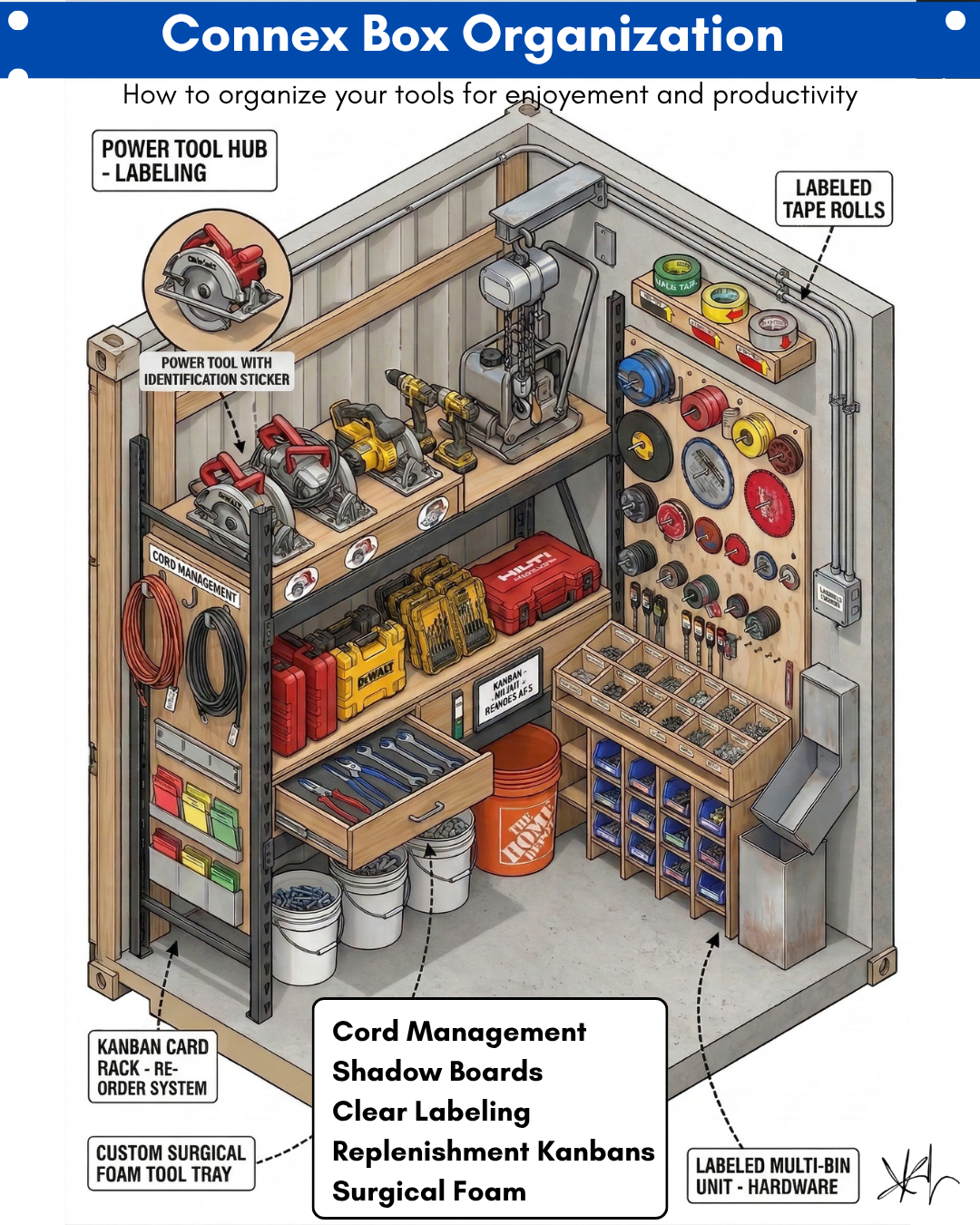
The image in this post shows what intentional connex box organization looks like when it’s built on real Lean principles rather than wishful thinking.

The shadow board and hook system on the back wall handles large power tools circular saws, drills, grinders in a way that makes every absence instantly visible. Each tool has a silhouette. When the tool is there, you see the tool. When it’s gone, you see the shadow. That’s not decoration. That’s a visual management system that tells the team in three seconds whether all the tools that should be at the site are at the site. No count. No question. No digging. The missing tool is visible before the task starts, not twenty minutes after.

The custom surgical foam tool trays in the drawers apply the same principle to hand tools and specialty items. Precision cutouts mean each tool has one home, shaped exactly for it. A tool cannot end up in the wrong place because the wrong place doesn’t have the right shape. That’s Set in Order made physical the principle that everything needed has a defined place, labeled and easy to access at the point of work. When the environment is organized this way, searching is designed out. It cannot happen because the system doesn’t allow it.

Cord management solves one of the most consistent daily friction points on any construction site. Tangled extension cords are not a discipline problem. They are a system problem a predictable outcome of a storage design that doesn’t account for how cords behave. Proper cord management, built into the box, means cords are accessible, untangled, and ready to use without a five-minute wrestling match at the start of every task. It’s a simple fix that returns real time to the crew every single day.

Watch for these signals that a connex box is functioning as a storage dumpster rather than a Lean workstation:

  • Workers opening and closing multiple drawers before finding what they need
  • Tools from one day’s work ending up in the wrong location by the next morning
  • Hardware mixed across containers with no labeling by type or size
  • Extension cords requiring untangling before any corded tool can be used
  • No visible indicator of when consumables are running low until they run out

The Kanban Replenishment System: Solving the Shortage Problem Before It Happens

One of the most operationally powerful elements in the connex box design is the Kanban card rack and re-order system. This is where 5S and procurement discipline meet at the crew level.

In a traditional connex box, hardware and consumables run out when they run out. Someone notices the anchors are gone. Someone calls the foreman. The foreman calls the office. Materials get ordered. Days pass before the next shipment. In the meantime, the crew adapts substitutes the wrong fastener, borrows from another trade, slows down the task waiting for the right hardware to arrive. That sequence is not a procurement failure in the traditional sense. It’s a system that was never designed to signal demand before the shortage occurred.

The Kanban card solves this at its root. Each hardware bin has a re-order card placed at the level where restocking needs to be triggered not when the bin is empty, but when it reaches the minimum threshold. When the card becomes visible, the signal is already sent. The foreman sees it on the morning check, submits the re-order, and the replacement arrives before the crew ever runs dry. Just-in-time replenishment at the crew level is not complicated. It requires only that someone designed the signal into the system rather than waiting for the absence to force the conversation.

The labeled multi-bin hardware station extends that same logic across the full range of fasteners, anchors, screws, and electrical hardware the crew uses daily. Each bin is labeled by type, size, and count. Every worker including someone new to the project knows immediately where to find the right fastener without asking anyone. The system is self-explaining. That’s what visual management is supposed to create: a work environment where the crew can orient, locate, and act without friction.

Why This Is a Respect-for-People Question, Not an Organization Question

Jason Schroeder teaches 5S not as housekeeping but as production support a way to remove friction so crews can install work without searching. Searching is hidden schedule erosion. When the connex box is organized, the crew’s time goes into installation. When it isn’t, the crew’s time goes into logistics work that the system should have solved before they arrived.

There’s a deeper truth here that gets passed over in most conversations about organization. When skilled tradespeople electricians, pipefitters, carpenters who have spent years mastering their craft are forced to start every day digging through a disorganized box to find what they need, the message that sends is not subtle. It says: we didn’t think about you before you got here. We didn’t design this for your productivity. Your time was not worth the effort of setting this up properly. That’s not intentional. But it’s what an unorganized connex box communicates, every morning, to every worker who opens it.

The flip side is equally true. A connex box with shadow boards, labeled bins, Kanban cards, surgical foam trays, and managed cords communicates something entirely different. It says: we thought about this before you arrived. We built a system that supports you. Your time matters enough to design around. That’s Respect for People made visible, one drawer at a time. If your project needs superintendent coaching, project support, or leadership development, Elevate Construction can help your field teams stabilize, schedule, and flow. Building that culture starts with exactly this kind of intentional environment design.

Start With the Box. Finish With Flow.

Here is the practical challenge. Walk your current project’s connex boxes this week not to inspect people, but to evaluate the system. Open every drawer. Ask: does every tool have a labeled home? Is every piece of hardware sorted and labeled by type? Are cords managed so they’re immediately usable? Is there a system that signals when consumables are getting low? Is a new worker able to find what they need within sixty seconds without asking anyone?

If the answer to most of those questions is no, the crew is absorbing a daily friction tax that the system created. The connex box doesn’t require a major investment to fix. It requires an afternoon of intentional design foam trays cut to fit, shadow boards mounted, bins labeled, Kanban cards placed. Do it once, sustain it daily, and the return in crew time and crew morale will show up immediately. Paul Akers says fix what bugs you every day, make two-second improvements. The disorganized connex box bugs every person who opens it. Fix it. Build a system that lets them win.

On we go.

Frequently Asked Questions

What is a Kanban card in a connex box and how does it work?

A Kanban card is a re-order signal placed at the minimum threshold level in a hardware bin. When the bin drops to that level, the card becomes visible, triggering a restocking request before the bin empties. It prevents mid-task shortages by signaling demand ahead of time rather than reacting after the supply runs out.

How does the shadow board system work for power tools?

Each power tool has a silhouette painted or outlined on the board in its exact shape and storage position. When the tool is stored, the silhouette is hidden. When the tool is missing, the shadow is visible an immediate visual signal that something is out of place or not returned. No counting or inventory check is needed.

Why does cord management matter enough to be part of the connex box design?

Tangled cords create a daily friction tax time spent untangling before any corded tool can be used. Across a full crew for a full project, this adds up to significant lost productive time. Proper cord management built into the storage system means cords are always accessible and ready, removing a predictable daily obstacle from the crew’s morning.

How does the labeled multi-bin hardware station protect production pace?

It ensures every worker can locate the correct fastener, anchor, or fitting by type and size without asking anyone. This eliminates hardware-related search time, reduces substitution errors when the right fastener isn’t easily found, and allows new workers to become self-sufficient immediately. The system communicates the standard without requiring a supervisor to do it.

How does surgical foam in tool drawers reduce waste?

Surgical foam with precision cutouts ensures every tool has one specific home that matches its shape exactly. Tools cannot be stored in the wrong place because the wrong place won’t fit them. This eliminates disorganized drawers, speeds up retrieval, and makes any missing tool visible the moment the drawer is opened protecting both crew time and tool accountability.

If you want to learn more we have:

-Takt Virtual Training: (Click here)
-Check out our Youtube channel for more info: (Click here) 
-Listen to the Elevate Construction podcast: (Click here) 
-Check out our training programs and certifications: (Click here)
-The Takt Book: (Click here)

Discover Jason’s Expertise:

Meet Jason Schroeder, the driving force behind Elevate Construction IST. As the company’s owner and principal consultant, he’s dedicated to taking construction to new heights. With a wealth of industry experience, he’s crafted the Field Engineer Boot Camp and Superintendent Boot Camp – intensive training programs engineered to cultivate top-tier leaders capable of steering their teams towards success. Jason’s vision? To expand his training initiatives across the nation, empowering construction firms to soar to unprecedented levels of excellence.

On we go

Posted in All

How To Choose The Right Trade Partners (Lean Construction)

Read 9 min

How to Choose the Right Trade Partners

Let me give you the short answer and then explain why it matters more than everything else on the list. The right trade partner is the one who is willing to partner. Not the one with the most impressive resume. Not the one with the longest track record. Not the one who won the most awards or has the nicest office. The one who will show up to the pre-construction meeting prepared, engage honestly with the pull plan, raise problems early instead of banking them into a change order, and stay invested in the success of the project even when the plan changes. That willingness more than any credential is what makes a trade partnership work.

The Pain of Getting This Wrong

I have worked with trade contractors who had the best credentials in the industry and made every day miserable. The awards, the track record, the office none of it transferred into a collaborative, productive working relationship. They were prima donnas. Everything was their way or a lawsuit. Communication was adversarial. And every interaction reinforced that their priority was their scope, their margin, and their protection not the project or the people building it alongside them.

I have also worked with trade contractors who were newer, less decorated, less credentialed and who were willing to show up, listen, partner, and build something together. Those experiences were the most enjoyable and the most productive of my career. The willingness to partner is the variable that makes everything else either work or not work.

The Language Matters

Sub means below. Sub means less than. When you call a trade contractor a subcontractor, the word itself frames the relationship as hierarchical GC above, trade below. That framing produces subcontractor behavior: I do my scope, you manage around it, and when something goes wrong, we refer to the contract. That is not a working relationship. It is a contractual cage.

Partner means equal. In fact, if you want to be fully honest about it, trade partners are above general contractors in one critical dimension performance. They are the ones with boots on the ground putting work in place. They are the ones whose crews are actually building the building. General contractors coordinate, schedule, manage the environment, and enable the trades to execute. The trades execute. Treating them as lesser participants is not just disrespectful. It is strategically foolish. Owners are getting smarter about multi-prime delivery and direct engagement with trade contractors. General contractors who do not treat trades as genuine partners may find themselves replaced by integrators who do.

The System That Produces Bad Trade Relationships

Here is the honest diagnosis of why so many GC-trade partner relationships are adversarial. The system trained GCs to win projects by minimizing cost and to manage trades by contract enforcement. Low bid selection. Retainage held as long as legally possible. Cure notices as the first response to a performance issue. Design documents passed over the wall to trades who were never involved in the planning. A culture where the GC wins when the trade loses. That system is not producing partners. It is producing adversaries. And then when the adversarial relationship produces adversarial behavior, the GC is surprised. The system built the outcome. The trades are responding rationally to the environment they were handed.

What Selecting the Right Trade Partner Actually Requires

Here is the standard I hold to, and it comes directly from how Toyota thinks about vendor relationships. Toyota general managers spend 90 percent of their time with the vendors and suppliers that support Toyota not inside Toyota. That ratio is not an accident. The quality of your vendor relationships is directly proportional to the time and investment you put into them before and during the work.

Before I hire a trade partner, I visit their office. I visit their job sites. I interview their foremen not just their executives. I watch how they interact with their own people and with other general contractors. I gather promises and observe whether the organization behind those promises is one that can keep them. I am looking for culture alignment, Lean mindset, communication quality, collaboration posture, financial health, consistent staffing, and reliability. Not just a low number.

A trade that will not meet in pre-construction, will not engage collaboratively in pull planning, and is generally difficult to work with before they are hired will be exactly that way once they are hired. The pre-construction process is the interview. What you see there is what you will get in the field.

The reason so many GCs end up with trades that do not show up reliably, do not staff adequately, or do not perform to expectations is not a trade problem. It is a selection and investment problem. Not having the right trade partner is a symptom of spending too much time behind email looking at the lowest number instead of spending time in the field getting to know who you are actually partnering with.

Here are the qualities that distinguish a genuine trade partner from a trade contractor who will cause problems:

  • They come to the pre-construction meeting prepared, not showing up to hear what you tell them
  • They bring their foremen into planning conversations, not just their project manager
  • They raise problems early in the process instead of waiting to see if you notice
  • They communicate honestly about capacity rather than overpromising and understaffing
  • They stay engaged when the plan changes instead of retreating to the contract language
  • They see the success of the whole project as connected to their own success

Why Total Participation Is the Standard

Every trade partner that comes onto a job site enters through what I call a queue and the queue is total participation and relationships. That means before any trade is on site, there is a relationship built, expectations are clear, and the commitment to participate fully in the system is established. Nobody gets to be adversarial. Nobody gets to ignore the pre-construction meeting. Nobody gets to skip the morning worker huddle or refuse to participate in the weekly work planning. Those are not optional elements. They are the environment.

And when that environment is built correctly from the start when the GC invests in the trade relationship early, treats the trade as a partner from day one, and establishes the system as one the trade was part of building the participation comes naturally. It is not compliance. It is buy-in. Because when people help build the plan, they own the plan.

If a trade is not willing to meet that standard, the honest answer is to find a trade that is. A challenging relationship at the pre-construction stage will not become a collaborative one after mobilization. It will become a more expensive, more documented, more stressful version of what it already was.

Connecting to the Mission

We build remarkable people who build remarkable things and remarkable things are built by teams, not by isolated contractors executing separate scopes in parallel. The trade partner is not beneath the GC in the production system. They are inside it. Their crews are the value creators. Their foremen are the last planners. Their expertise in their scope is irreplaceable. Treating them with that level of respect before selection, during pre-construction, throughout the project is not just the right thing to do. It is the production strategy that makes everything else work. If your project needs superintendent coaching, project support, or leadership development, Elevate Construction can help your field teams stabilize, schedule, and flow. Choose partners. Not the cheapest. Not the most credentialed. The ones who will show up as partners and stay that way from first conversation to final inspection.

On we go.

Frequently Asked Questions

What is the most important quality in a trade partner?

Willingness to partner. More than credentials, track record, or price the quality that determines whether the relationship will work is whether the trade is genuinely willing to collaborate, communicate honestly, and invest in the success of the whole project.

Why does calling contractors “subcontractors” matter?

Because language shapes behavior and expectations. “Sub” means below and frames the relationship as hierarchical. “Partner” frames it as collaborative. The word you use signals the culture you intend, and that signal matters before the first conversation about scope.

How much time should a GC invest in getting to know a trade partner before selection?

More than most currently do. Visiting their office, touring their active job sites, interviewing their foremen, and observing how they communicate before any contract is signed gives you the information that a proposal and a reference check never will.

What should a GC do if a trade partner is performing poorly mid-project?

Start with a direct conversation focused on the system rather than the person what is not working, what would need to change, and how you can support the change. If the issue is unwillingness rather than capability, that is a different conversation and may require different action. But system-first diagnosis before accountability is always the right sequence.

How does the Toyota vendor relationship model apply to construction?

Toyota general managers spend 90 percent of their time with the vendors that support them rather than inside their own company. The principle is that the quality of your output depends on the quality of your supplier relationships, and maintaining those relationships requires sustained, direct investment of time and presence not just contract management.

If you want to learn more we have:

-Takt Virtual Training: (Click here)
-Check out our Youtube channel for more info: (Click here) 
-Listen to the Elevate Construction podcast: (Click here) 
-Check out our training programs and certifications: (Click here)
-The Takt Book: (Click here)

Discover Jason’s Expertise:

Meet Jason Schroeder, the driving force behind Elevate Construction IST. As the company’s owner and principal consultant, he’s dedicated to taking construction to new heights. With a wealth of industry experience, he’s crafted the Field Engineer Boot Camp and Superintendent Boot Camp – intensive training programs engineered to cultivate top-tier leaders capable of steering their teams towards success. Jason’s vision? To expand his training initiatives across the nation, empowering construction firms to soar to unprecedented levels of excellence.

On we go

Posted in All

Construction Retrospective: What Worked, What Didn’t, What’s Next

Read 9 min

Construction Retrospectives: The Continuous Improvement Practice Every Team Needs

Continuous improvement is one of the six pillars of Lean construction. Every serious Lean practitioner will tell you it belongs at the core of how a project team operates. But here is the honest reality on most projects: continuous improvement gets talked about more than it gets practiced. Teams finish a meeting, a phase, a training, or even a whole project and move immediately to the next thing without ever stopping to examine what went well, what did not, and what specifically should change the next time. The retrospective is the practice that closes that gap. And when it is embedded in the standard work of a project team, it compounds into something remarkable.

The Pain of Skipping the Retrospective

Projects that never do retrospectives have a recognizable pattern. The same problems recur on project after project. The same communication gaps reappear. The same pre-construction meeting that went poorly last time goes poorly again because nobody systematically captured what needed to change and updated the process. The team is always applying effort, always working hard, but the effort is not compounding. Each project starts from roughly the same place as the last one because the learning from the last one was never extracted, standardized, and carried forward.

This is not a laziness failure. Most project teams are working at full capacity and then some. The issue is that learning requires a dedicated practice a structured pause with specific questions and without that structure, the lessons dissolve into the general blur of moving from one project to the next.

The System Never Built the Learning Loop

When a project team does not run retrospectives, it is almost never because the individuals do not want to improve. It is because the system never built the mechanism for improvement into the workflow. No standard agenda for the retrospective. No scheduled time for it. No safe environment for honest feedback. No process for updating the standard work when an improvement is identified. The system failed to create the learning loop, and the team kept working without one.

The goal of a retrospective is not to assign blame or score performance. It is to improve the system. And when the system is designed to support that with psychological safety, clear questions, and a direct connection to updated standard work the loop closes and the team accelerates.

Where Retrospectives Come From

The retrospective is a core component of the Scrum framework. In Scrum, the team holds a retrospective at the end of every sprint not to celebrate or debrief, but specifically to examine the process and identify one or two improvements to carry into the next sprint. Over time, those small improvements compound into a significantly better way of working.

I learned it through the Scrum.org Scrum Master certification, and I have implemented it everywhere I possibly can since after Super PM Boot Camps, after training events, after planning sessions, after trade partner meetings. Some people run a plus-delta format. Some use roses, buds, and thorns. Some use stop, start, continue. The format matters less than the practice. The important thing is that after any meaningful event, the team pauses, evaluates honestly, and captures what to do differently next time.

The Five Elements of a Constructive Retrospective

The first element is psychological safety. This is the foundation without which nothing else works. If people do not feel safe sharing honest feedback, the retrospective produces only the polished, comfortable version of what happened not the real one. Building psychological safety means creating an explicit invitation to surface problems, separating the feedback from the person who delivers it, and responding to hard feedback with curiosity rather than defensiveness.

I learned this the uncomfortable way. After one of our boot camp days, the feedback I kept hearing was that I had not been clear enough about what was coming. I added visuals. I added a pre-meeting. I explained things more explicitly. And I still heard it. I was starting to get frustrated. The problem was not the clarity. The problem was that I had not created a safe enough container for the specific, actionable feedback that would have actually told me what to change. Without psychological safety, you get the symptom. You need the root cause.

The second element is identifying what worked. Not just what people liked that is subjective and not always useful. The question is what met the purpose of the event. What produced the outcome you were aiming for? What should absolutely be carried forward unchanged because it is working well? Starting with what worked before moving to what did not is not just good facilitation. It creates an accurate baseline and prevents the session from collapsing into a complaint list.

The third element is identifying what did not work. What did not meet the purpose? What pushed people in the wrong direction? What created confusion, friction, or outcomes that were the opposite of what you intended? This is where the most valuable learning lives, and it requires the psychological safety built in the first step. When the environment is safe and the focus is on the system rather than the person, people surface real observations that can actually change outcomes.

The fourth element is specifying what changes to make. Feedback without a proposed change is less useful than feedback with one. The format that works well is: I noticed this, if we did this, we would get this. That structure takes an observation and turns it into an actionable improvement. It requires more thinking than just pointing at a problem, but it produces something the team can actually implement. And critically always blame the system, not the person. Every improvement should be framed as a change to a process, a standard, an agenda, a structure. Not as a judgment about someone’s character or effort.

The fifth element is standardizing the improvement. This is the step that makes the retrospective compound over time. When an improvement is identified, it needs to go into the standard work the presentation, the agenda, the checklist, the prep guide, whatever document governs that activity. If the improvement stays in someone’s memory, it will not survive the next time someone else runs the same process. If it gets updated into the standard, it becomes the new baseline and the team starts from a higher floor the next time.

Here are the signals that a team is running retrospectives effectively:

  • The standard work for recurring activities gets updated after each iteration
  • Problems that appeared last time do not appear again in the same form
  • People leave retrospective sessions with specific, actionable items rather than general impressions
  • The team’s meetings, trainings, and processes are noticeably better than they were six months ago

The PDCA Cycle in Real Life

The retrospective is the check and act phase of the PDCA cycle plan, do, check, act. The planning is the design of the event or process. The doing is the execution. The checking is the retrospective. The acting is updating the standard work with the improvements identified. Without the retrospective, PDCA becomes plan-do, plan-do, plan-do the same loop, never improving. With it, the cycle genuinely compounds.

At our Super PM Boot Camp in Dallas and Atlanta, we had 78 people. They left as raving fans. But the retrospectives we ran after each day with attendees, with the guide team, with everyone who watched the process produced a list of improvements that is already being implemented for the next boot camp. The 4D visualization is being added. AI elements are being integrated. Some segments are being shortened. Others lengthened. Video capture is being improved. None of that would happen without a structured retrospective that gives the team permission and a framework to be honest.

Connecting to the Mission

The mission is to build remarkable people who build remarkable things. Remarkable people do not arrive at remarkable. They build toward it iteratively, improving every time, never accepting the current standard as the final one. The retrospective is the mechanism that makes that iterative improvement real. If your project needs superintendent coaching, project support, or leadership development, Elevate Construction can help your field teams stabilize, schedule, and flow.

Apply retrospectives to every significant activity: your weekly work planning meeting, your trade partner pre-construction meeting, your pull plan session, your phase completion, your project closeout. Every time you do it, you improve the standard. And every improvement makes the next iteration better than the last.

On we go.

Frequently Asked Questions

What is a retrospective and how is it different from a debrief?

A retrospective is a structured improvement practice that examines what worked, what did not, and what changes to make with those changes going into updated standard work. A debrief often stops at reflection. A retrospective commits to specific improvements and carries them forward.

How often should construction teams run retrospectives?

After every significant repeated activity weekly work planning meetings, pull plan sessions, pre-construction meetings, training events, and project phase completions at minimum. The more frequently teams retrospect on recurring processes, the faster those processes improve.

Why is psychological safety the first requirement for a useful retrospective?

Because without it, people share the comfortable version of what happened rather than the honest version. The most valuable learning comes from the hard observations, and those only surface when people trust that their honesty will be met with curiosity, not defensiveness.

How does a retrospective connect to standard work?

Every improvement identified in a retrospective should update the relevant standard work the agenda, the checklist, the presentation, the preparation guide. If the improvement does not make it into the standard, it will not survive the next time someone else runs the same process.

What is the best format for running a retrospective?

Plus-delta, roses-buds-thorns, stop-start-continue, or any structured format works. The format matters less than the three core elements: what worked, what did not, and what specific changes will be made. The Scrum retrospective framework from Scrum.org provides an excellent foundational model.

If you want to learn more we have:

-Takt Virtual Training: (Click here)
-Check out our Youtube channel for more info: (Click here) 
-Listen to the Elevate Construction podcast: (Click here) 
-Check out our training programs and certifications: (Click here)
-The Takt Book: (Click here)

Discover Jason’s Expertise:

Meet Jason Schroeder, the driving force behind Elevate Construction IST. As the company’s owner and principal consultant, he’s dedicated to taking construction to new heights. With a wealth of industry experience, he’s crafted the Field Engineer Boot Camp and Superintendent Boot Camp – intensive training programs engineered to cultivate top-tier leaders capable of steering their teams towards success. Jason’s vision? To expand his training initiatives across the nation, empowering construction firms to soar to unprecedented levels of excellence.

On we go
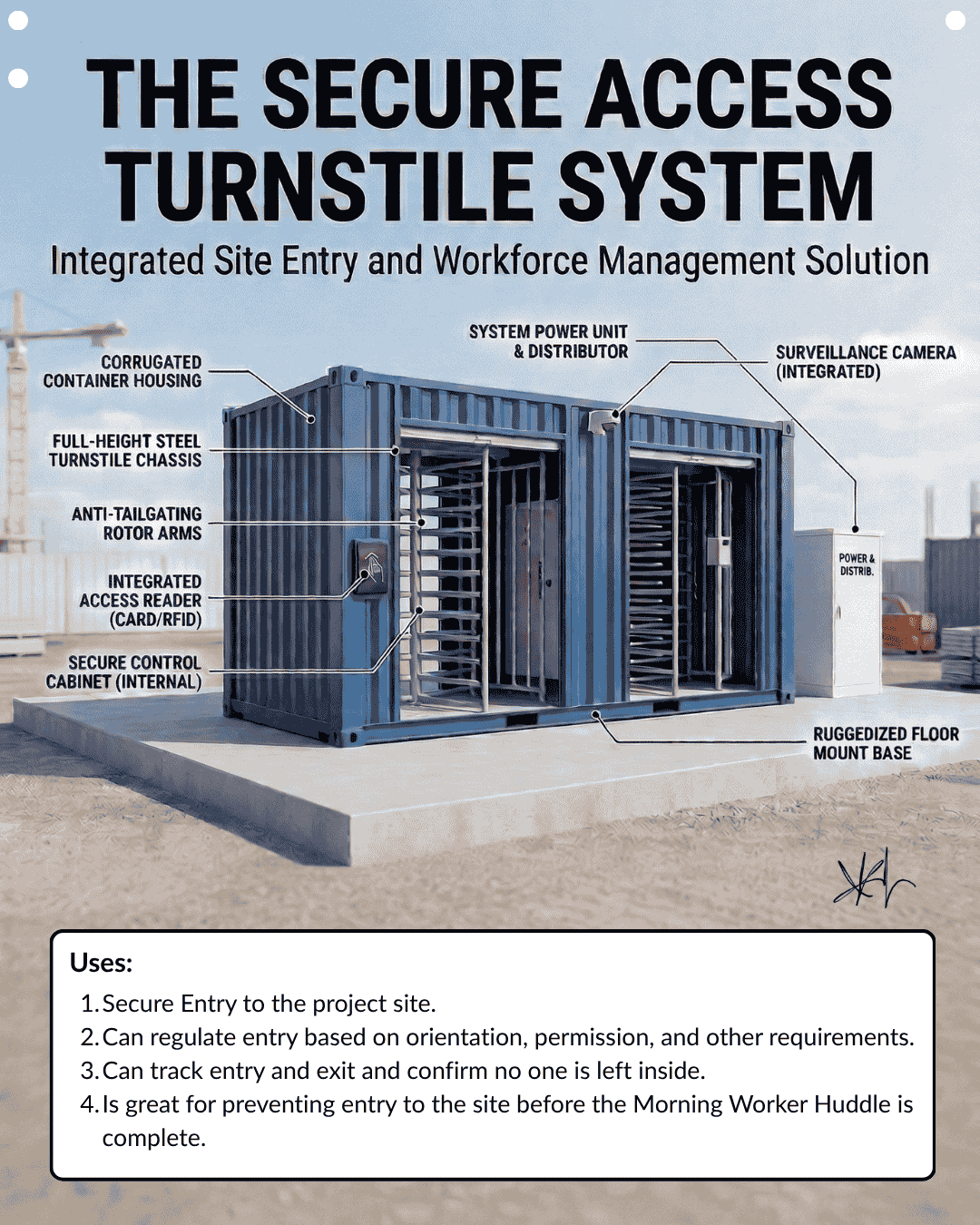
Posted in All