Seeing Roadblocks Trick: Give Your Trades an Assignment

Read 7 min

Stop Asking “Any Roadblocks?” and Give Your Trades an Assignment

Here’s the deal. I have a killer idea for you today that I literally just learned about by being on projects yesterday, and I want to share it with you. It is a really cool idea that can help us see roadblocks out ahead.

Short answer: Don’t just ask your trade partners, ‘Any roadblocks?’ At the start of the weekly tactical or the afternoon foreman huddle, hand out the printed six-week make-ready lookahead, put the ten-point ‘ready’ list on the wall, and give everyone five to ten minutes to find what will go wrong out ahead. A real assignment surfaces roadblocks that a generic question never will.

First, a Recap on Make-Ready Planning

I have talked before about the make-ready lookahead, and this is not the main focus of today, but it sets up the idea. First and foremost, you should be able to visualize the work in 2D, visualize it in 3D, and visualize the environment surrounding it. You should be able to connect emotionally and ask yourself how you feel about that space.

Really experience the question of whether we are ready in a certain area for make-ready lookahead planning. Not just with a thought, not just with words, but with visuals. Not just visuals, but 3D visuals. Not just 3D visuals, but actually being there and experiencing the space.

What “I’m Ready” Really Means

I want to make a definitive comment. When any of your trade partners say they are ready for an activity, or that they do not have roadblocks, here is what it means for that activity.

  • The expectations are clear.
  • The materials are correct, on time, inventoried, and inspected.
  • Labor is available, and that labor is trained.
  • RFIs, information, and submittals, anything necessary for that work, are ready.
  • The quality feature of work board and any safety requirements, including the JHAs, are ready.
  • The space will be or is ready.
  • The layout is or will be ready without issue.
  • The equipment and tools are available.
  • There are no issues with permissions such as permits, inspections, or gates that would stop the work from proceeding.
  • Contracts and insurance will be ready.

That is the list we agree on together as a group. I would invite you, in your trade partner weekly tactical and your afternoon foreman huddle, to print that list out as big as you can and put it on the wall. That way, when you ask trade partners whether they are ready, they can reference it and actually see it. I think that is a one hundred percent brilliant idea.

The New Idea

Now let me go to the new idea I had recently while I was at a job site. I saw a project team doing a really good job. The superintendent asked, hey, are there any roadblocks, and they looked out the next six weeks, but there was not really enough time to dig in and look at it. So it was a general, generic question.

Kudos to this job site. The superintendent already had the six-week make-ready lookahead printed on the desk for the meeting, for everyone.

Then it hit me. Why not, at the beginning of the meeting, say to all the trade partners, as we begin this meeting, please look at that printout of the six-week make-ready lookahead. Look at all of your activities and make sure all ten of those things are ready for every activity. And I want you to try to find a roadblock.

Do not just ask, are there any roadblocks? Give them an assignment. Your assignment is, if something is going to go wrong, what will go wrong? What will go wrong out ahead? What is going to happen that will stop your work? Then give them five or ten minutes.

If I were a foreman, that would be a time to clear my mind. I would not be on my phone. I would not be distracted. I would not be on the radio. With my pencil or pen, I would literally go through and check each of the items and do that kind of visualization. It hit me that this would work.

What Counts as a Roadblock

We have to start looking out ahead, because remember, roadblocks are items to be cleared ahead of the train of trades. Here is what they could be.

  • An RFI that is not answered.
  • Layout that is not ready or is incorrect.
  • A work area that has not been made ready.
  • Missing material or equipment.
  • A crew that is not ready ahead.
  • Improper planning, overcommitting, or miscommunication.
  • A change in the work plan.
  • A safety concern.
  • Improper sequencing.
  • Resources that are unavailable.
  • Work that is not authorized.
  • A change in the work plan by the owner.
  • An internal resource problem with my own company.
  • Plans that will not be ready, or anything else.

Put Roadblocks and Constraints on the Wall

The other thing I was thinking is, why not put this roadblocks and constraints visual up on the wall, to say, here are some of the things that will mess you up. Constraints are items that are a part of the design of the train of trades that can be adjusted. To remove constraints, you adjust the following.

  • The Takt zones.
  • The Takt time.
  • The work packaging.
  • The sequence.
  • The leveling of labor.
  • The trade processes.
  • The zone configuration.
  • The number of zones.
  • Labor productivity.
  • Variation, by reducing it.
  • Standard work, by improving it.
  • Site configurations.
  • Unforeseen conditions, by mining for them.

You could literally have your roadblocks and constraints list up on the wall, ready to go, and say, let’s see if any of these are going to affect you, because you have given the right amount of time to do that planning. This is an idea I love, love, love, and I want to see all of you implement it as part of your weekly trade partner tactical and your afternoon foreman huddles.

If your project needs superintendent coaching, project support, or leadership development, Elevate Construction can help your field teams stabilize, schedule, and flow.

So here is the challenge. Print your six-week make-ready lookahead for everyone at your next meeting, give your trade partners five or ten minutes, and ask them what will go wrong out ahead. Then put your roadblocks and constraints lists on the wall.

Bottom line: If something’s going to go wrong, what will go wrong?

On we go.

FAQ

What does it mean when a trade partner says they are ready for an activity?

It means expectations are clear, materials are correct and on time, labor is available and trained, information is ready, quality and safety requirements are ready, the space and layout are ready, equipment and tools are available, permissions are in place, and contracts and insurance will be ready.

What is the new idea Jason shares?

At the start of the meeting, give the trade partners the printed six-week make-ready lookahead and an assignment to find a roadblock, instead of just asking whether there are any. They get five or ten minutes to think through what will go wrong out ahead.

What is the difference between a roadblock and a constraint?

Roadblocks are items to be cleared ahead of the train of trades. Constraints are items that are part of the design of the train of trades that can be adjusted.

Where should these visuals be used?

On the wall in the weekly trade partner tactical and the afternoon foreman huddle, so trade partners can reference it.

People Also Read:

Ways to get Roadblocks from Trades
Roadblock Tracking Maps
Takt Steering And Control Book
Last Planner System and Takt training

Want your team trained on this? See our Last Planner System and Takt training.

If you want to learn more we have:

-Takt Virtual Training: (Takt Virtual Training)
-Check out our YouTube channel for more info: (Elevate Construction on YouTube)
-Listen to the Elevate Construction podcast: (Elevate Construction Podcast)
-Check out our training programs and certifications: (Training Programs and Certifications)
-The Takt Book: (The Takt Book on Amazon)

Discover Jason’s Expertise:

Meet Jason Schroeder, the driving force behind Elevate Construction. As the company’s Founder and COO, he’s dedicated to taking construction to new heights. With a wealth of industry experience, he’s crafted the Field Engineer Boot Camp and Superintendent Boot Camp – intensive training programs engineered to cultivate top-tier leaders capable of steering their teams towards success. Jason’s vision? To expand his training initiatives across the nation, empowering construction firms to soar to unprecedented levels of excellence.
Posted in All

Stop Optimizing Yourself – Optimize the Whole

Read 9 min

Optimize the Whole, Not Yourself

Here’s the deal. There is a concept that will help you go back to your teams, your projects, and your company and see whether it is happening to you. It is called optimizing the whole. It is a Lean concept, and it means you optimize the entire project, the entire effort, and not just individual parts and components.

Short answer: Optimizing the whole means doing what is best for the entire project, not for one trade, one team, or one person. Resource efficiency asks each trade to go as fast as it can. Flow efficiency keeps the train of trades moving through the zones at the same speed and the same distance apart, which is what actually finishes the project faster.

What Resource Efficiency Looks Like

Think about the trade partners who say, I want to lay out all the duct on all the floors and just bang through it. Or the fire sprinkler contractor who says, let me just do the whole floor and bang it out. Or the framing and drywall contractor who wants to go at their own speed.

Each of them is looking at what is called resource efficiency. They want to make themselves, the resource, efficient individually, instead of the train of trades. Optimizing the whole means keeping the train of trades going the same speed, the same distance apart, adding the same amount of value with the same amount of work in each of the zones. It means we do what is best for the entire project, and not what is just best for one contractor or one person.

The Question That Started This

I was at a job site where we were talking about the possible implementation of Takt. I love these people, and there is no drama or lack of love here. I am just saying this way of thinking is out of control in our industry. There were quite a few people on the project, and there was a scheduling team. The first question was, how much more work will this add to my scheduling team if we implement this?

You might not think that is a big deal, but to me it is. I do not care at all how much effort this adds to your scheduling team.

Think about a cooking or baking competition show. Nobody says, I want you to have an easy time while you are making this. They say they want it beautiful, they want it to taste good, they want it fluffy, to the right specifications, and they do not care how hard it is to make. They want it to be delicious.

I have talked to you about this before. CPM is a list of ingredients, and Takt is a recipe. A recipe is harder. It is harder to make a good plan. It is harder on a superintendent to actually think it out. It is harder on the general contractor and the project team to enable the trades and help them make money. I do not care. That is your job.

A colleague has a sign in his office that says, do your job. I do not know where he got it, but I love it. Do what you are supposed to do. Superintendents, project managers, project teams, and general contractors are here to enable everyone else.

So here is my one-sentence sermon. I do not care in the slightest how much added time or effort this gives your team. I care only about what it does to the workers, the foremen, the trades, the productivity on our project site, and the entire whole of the project. I do not care about resource efficiency. I want flow efficiency, which comes from trains of trades going through zones at the same speed, the same distance apart.

People Trying to Optimize Themselves

We have a problem with people trying to optimize themselves. We have it with trade partner crews sometimes. We have it with individual scheduling teams, quite a bit.

Someone who cares deeply about people saw one of my posts criticizing CPM and said, Jason, you need to calm down. There are people who make their living doing this, and we need to be respectful. I appreciated her input, and I said I would be a little easier. But let me say one thing to the scheduling managers, scheduling directors, and schedulers who keep perpetuating the CPM world. See how this lands for you.

In all of my travels, I have never seen an organization hire a professional scheduler focused on CPM where that scheduler was not then in the way. They really only cared about what they knew. They framed everything in their own mindset. They worried about their own efficiency and the strengths and optimization of their own team. And they set up systems that counteracted almost every single productivity gain we could get in the field.

I would like to ask owners and contractors to only hire scheduling managers, directors, and professionals who really know Takt, Last Planner, and Scrum. If someone has a CPM background, I would want them to go through some mental restructuring and make a commitment to changing their approach before they structure the company’s systems in a way that counteracts all the productivity we could gain on the site. Too many people are worried about resource efficiency, about their own teams, and about the system they know, instead of learning the right way to schedule. It has to stop.

Optimizing the Office

We also have a problem with optimizing the office. I have talked over and over about office teams, software companies, and other vendors saying, here is a new desk, here is a new type of office, here is a new software, here is a new computer. When are we going to start asking what is right for the field crews? When are we going to get them better gloves, better tools, better equipment, better schedules, and better visuals?

We need to optimize the field crews and the whole of the project first. Resource efficiency is the least Lean thing we could possibly do. I do not care. Do your job. Let’s get it done.

Don’t Care, Do Your Job

You hear it when project teams respond like this.

  • Asking how hard it will be to implement Takt.
  • Asking how morning worker huddles will affect them, since it seems like a lot of time and commitment.
  • Asking how long it will take to build bathrooms and lunchrooms for their people.
  • Saying that in pre-construction, they cannot really do this because they are too big.

My answer is the same every time. I do not care. Do your job. We could go through any of this. We could talk about procurement management and holding a weekly procurement meeting. We could talk about prefabrication, visualizing the logistics systems, and quality pre-installation. We could talk about zero tolerance, roadblock removal, Lean contracts, Takt, Last Planner, and Scrum. We could talk about setting up the conference room trailer, implementing Takt steering and control, grading contractors, quality at the source, and doing a field walk and finding ten or fifteen things that need to be done that day.

I could talk about any operational system that is part of Lean, and I guarantee someone has said to me, I do not have time for that, how is that going to affect me. And my answer is the same. I do not care. Do your job.

The Whole, the Workers, and the Foremen

We need to be optimizing the whole. We need to be optimizing the workers. We need to be optimizing the foremen. When we only think about our selfish little selves, we are not optimizing the whole. We are focused on resource efficiency, and we are being selfish. As my colleague’s sign says, we are not doing our job.

If your project needs superintendent coaching, project support, or leadership development, Elevate Construction can help your field teams stabilize, schedule, and flow.

So here is the challenge. The next time you catch yourself asking how a Lean practice will affect you or your team, ask what it does for the workers, the foremen, the trades, and the whole of the project.

Bottom line: Optimizing the whole means we do what is best for the entire project, not what is best for one contractor or one person.

On we go.

FAQ

What is optimizing the whole?

Optimizing the entire project or effort, not just individual parts. It means keeping the train of trades at the same speed, the same distance apart, adding the same value with the same work in each zone, and doing what is best for the project instead of one contractor or person.

What is resource efficiency?

Making an individual resource, such as one trade or one team, efficient on its own. Jason contrasts it with flow efficiency, which comes from trains of trades moving through zones at the same speed and distance apart.

Why doesn’t it matter how much work Takt adds to a scheduling team?

Because the purpose of Takt is to make work easier for the trades by putting more effort into planning, coordination, and preparation upfront.

Who should owners and contractors hire?

People who understand Takt, Last Planner, and Scrum and are willing to rethink their approach, especially if they come from a CPM background, before setting up the company’s systems.

People Also Read:

The 10 Myths of CPM

Want your team trained on this? See our Last Planner System and Takt training.

If you want to learn more we have:

-Takt Virtual Training: (Takt Virtual Training)
-Check out our YouTube channel for more info: (Elevate Construction on YouTube)
-Listen to the Elevate Construction podcast: (Elevate Construction Podcast)
-Check out our training programs and certifications: (Training Programs and Certifications)
-The Takt Book: (The Takt Book on Amazon)

Discover Jason’s Expertise:

Meet Jason Schroeder, the driving force behind Elevate Construction. As the company’s Founder and COO, he’s dedicated to taking construction to new heights. With a wealth of industry experience, he’s crafted the Field Engineer Boot Camp and Superintendent Boot Camp – intensive training programs engineered to cultivate top-tier leaders capable of steering their teams towards success. Jason’s vision? To expand his training initiatives across the nation, empowering construction firms to soar to unprecedented levels of excellence.
Posted in All

There Is No Such Thing as Firing Someone

Read 8 min

Packard’s Law and the Keeper Test: Knowing When It Is Time to Make a Change

Here’s the deal. I want to talk about letting people go and what firing or termination really means. Over the years, I have had to make some really hard decisions with some really cool people. I do not like having to make those decisions, and having guides that can help you through them has been a big thing for me.

Short answer: Letting someone go isn’t really firing them. It’s moving them to a place where they fit and can be happy. Before you decide, use three tests: the Netflix keeper test (would you fight to keep them if they were leaving?), Jim Collins’ key seats question (are the right people in at least 90 percent of your key seats?), and the People Analyzer from Traction (score them on your core values).

Packard’s Law

Packard’s Law, as Jim Collins named it after David Packard, says that no company can grow revenues consistently faster than its ability to get enough of the right people to implement that growth and still become a great company. I think that is spot on. So how do you know whether you have enough of the right people? Here are three tools I use.

The Keeper Test

In the book No Rules Rules, by Reed Hastings and Erin Meyer, which is about Netflix, there is what is called the keeper test. If a team member was leaving for a similar role at another company, would the manager try to keep them?

I really like that, because a lot of times we work from scarcity and say, what if, what if, what if. The real question is simpler. If they were leaving, would you try to keep them? If a person on your team were to quit tomorrow, would you try to change their mind, or would you accept their resignation, perhaps with a little relief? If the latter, you should give them a severance package now and look for a star, someone you would fight to keep.

The purpose of this is to increase your talent density. Any team or organization has to focus on making sure its talent density is increasing. We are not just here to keep good employees. We are here to always have the best employees and have a high-performance team.

On a construction project, this plays out every day between superintendents, PMs, and foremen. Before holding someone accountable for a missed commitment or poor result, the first step should be coaching: make sure the expectation is clear, the person has been properly trained, and they have what they need to succeed. Once those pieces are in place, leaders can use the Ladder of Accountability to determine the appropriate next step when performance still falls short.

The Key Seat Evaluation

In Beyond Entrepreneurship 2.0, by Jim Collins and Bill Lazier, he talks about tracking the number one metric, which is the percentage of key seats on the bus filled with the right people for those seats. Stop and think about what percentage of your key seats are filled with the right people. If your answer is less than ninety percent, you have just identified your number one priority.

Here are the questions he uses.

  • Ask whether you are beginning to lose other people by keeping this person in this seat.
  • Ask whether you have a values problem, a will problem, or a skills problem.
  • Ask what the person’s relationship is to the window and the mirror, meaning whether they look at themselves when problems arise or look out the window and blame other people.
  • Ask whether the person sees work as a job or as a responsibility.
  • Ask whether your confidence in this person has gone up or down in the past year.
  • Ask whether you have a bus problem or a seat problem.
  • Ask how you would feel if this person quit.

The People Analyzer

The third tool comes from the book Traction, by Gino Wickman and it is called the People Analyzer. You take your core values and score each person on a plus, a plus/minus, or a minus. A plus means they exhibit the core value. A plus/minus means they sometimes exhibit it. A minus means they do not exhibit it. With about five core values, the person should have no minuses, no more than a couple of plus/minuses, and the rest pluses.

Why Protecting the Culture Matters

Those are some key ways to know when it is time to say goodbye to somebody. The reason you would do it is that you are protecting the culture. Our company follows pretty strictly the No Rules Rules Netflix culture. If you have gone through that coaching and there has been some due diligence, ask yourself the keeper question.

There Is No Such Thing as Firing Somebody

Here is where I get a little unusual. One time I had to do this, and it was very difficult, and I prayed about it. I do not know whether the answer I received was just for me at that time or whether it is an eternal truth, but it gave me a different perspective. The answer, or the feeling, was that there is no such thing as firing somebody.

There are many great companies out there in this world. When somebody is not a cultural fit, or when it is not working, it is really about repositioning them to a place where they can fit and where they will be happy. If you look at it that way, it is a positive thing.

I have also told you before that when you separate from somebody, you usually find out it was something they agreed to. They say, yes, I am glad this happened, I was miserable too, I am glad you made that tough decision. Then they end up relocating into a better spot.

Right People, Right Seats, Right Bus

What are we doing this for? It is being done out of respect. It is being done so we can get people in the right seats and on the right bus. There are so many buses out there, and ours is not the only one. If it were the only bus, you might feel guilty about kicking somebody off. In our current environment, that is just not the case. Most of the time, people say, wow, this new bus is a whole lot better. I fit here. These are my kind of people. At the end of the day, you are doing people a favor.

The number one metric in a company is the right people in the right seats. Sometimes people need to be let go, and it is very, very difficult. Instead of looping on it, go through the tests.

If your project needs superintendent coaching, project support, or leadership development, Elevate Construction can help your field teams stabilize, schedule, and flow.

So here is the challenge. Go through the keeper test, the key seat evaluation, and the people analyzer. You can use one of the three or all three.

Bottom line: It’s being done out of respect.

On we go.

FAQ

What is Packard’s Law?

No company can grow revenues consistently faster than its ability to get enough of the right people to implement that growth and still become a great company.

What is the keeper test?

If a team member were leaving for a similar role at another company, would the manager try to keep them? If the answer is no, you should give them a severance package now and look for a star, someone you would fight to keep.

What is the number one metric Jim Collins describes?

The percentage of key seats on the bus filled with the right people for those seats. If it is less than ninety percent, that is your number one priority.

How does Jason reframe letting someone go?

As repositioning them to a place where they can fit and be happy, done out of respect, so that people end up in the right seats on the right bus.

If you want to learn more we have:

-Takt Virtual Training: (Takt Virtual Training)
-Check out our YouTube channel for more info: (Elevate Construction on YouTube)
-Listen to the Elevate Construction podcast: (Elevate Construction Podcast)
-Check out our training programs and certifications: (Training Programs and Certifications)
-The Takt Book: (The Takt Book on Amazon)

Discover Jason’s Expertise:

Meet Jason Schroeder, the driving force behind Elevate Construction. As the company’s Founder and COO, he’s dedicated to taking construction to new heights. With a wealth of industry experience, he’s crafted the Field Engineer Boot Camp and Superintendent Boot Camp – intensive training programs engineered to cultivate top-tier leaders capable of steering their teams towards success. Jason’s vision? To expand his training initiatives across the nation, empowering construction firms to soar to unprecedented levels of excellence.
Posted in All

10 Ways to Encourage a Growth Mindset

Read 8 min

Ten Specific Ways to Nurture Your Growth Mindset

Here’s the deal. I talk a lot about the growth mindset, where any of us who are learning, growing, and gaining our success are really just proud of growing instead of knowing, becoming instead of having. The question is how we nurture it. I saw a post the other day about how to nurture your growth mindset, and I thought it was light, cute, and impactful. I want to take it and weave it into construction, including some of the specific things we can do.

Short answer: You can build a growth mindset on purpose. The ten habits are: focus on self-improvement, take on personal stretch challenges, know your learning style, treat problems as opportunities, be patient with yourself, find inspiration, believe in yourself, welcome feedback, focus on your daily process, and lead with a clear sense of purpose.

One: Focus on Self-Improvement

Believe you can always get better, and look for areas of your performance that can be developed. Assess yourself frequently, actively seek solutions based on your own evaluation, and create the time to assess yourself.

If wanting to improve yourself becomes almost like an addiction, it is a powerful thing. It will lead you to pay for and gain the training, or to take and implement the training, you need to advance in whatever part of life you want. That could be your work, your scheduling, your health, your mental health, or your physiology. Always be focused on self-improvement.

Two: Look for Personal Challenges

This is a good one for me. Challenges should not just be for others. Set yourself daily and weekly objectives related to your own day-to-day routines and rhythms, and every now and then, when appropriate, accept a personal challenge.

I like what Brandon Montero says when he talks about opportunities for growth. That feeling in your stomach where it is awkward, hard, difficult, or scary is the exact moment. That is the opportunity. The caveat is that you should not push yourself into what might be called the danger, panic, or trauma zone. A stretch goal or a stretch activity is the target.

Here are some examples of stretch challenges.

  • Apologizing to someone.
  • Forgiving someone.
  • Doing an interview.
  • Having a hard conversation where you give feedback.
  • Taking on an assignment that is just a bit outside of your comfort zone.

Seek after those personal challenges, and you will encourage your growth mindset.

Three: Know Your Learning Style

Growth and development are much more enjoyable and efficient if we know which approach leads us to the highest benefit. There are multiple approaches to learning. Make sure you know what works for you and what does not.

Some people focus on visual, auditory, or kinesthetic. Some focus on whether they learn in a specific way or a contextual way, or whether they are thinking or feeling. Play around with these personality styles and learning styles, and do a little internet research. If you can start to grow in the way you like best, even if it is just from observation, that is really powerful.

Four: Recognize Problems as Opportunities

Failures and mistakes are as much an opportunity to grow as success, and in some ways more powerful. How you see these moments is hugely important in building yourself for the next phase of personal development. Do not get down about them.

I once worked with an assistant superintendent who used to say, these are not problems, these are opportunities. Every time he talked about something, he would say, here is an opportunity. I really like that. You can call mistakes, failures, hardships, or difficult things problems, but if you start to recognize them as opportunities, it can be really powerful.

Five: Be Patient With the Timeline and Yourself

A realistic attitude about your time scale, and how long it will take you to learn something, will stop frustration. Learning, personal growth, and acquiring skills are a marathon and not a sprint. It requires time and a nurturing mindset.

On a construction project, a superintendent may need time to learn how to coordinate trades effectively, anticipate scheduling conflicts, and improve daily planning. Each project provides opportunities to build experience and develop better judgment.

Experience is a powerful force in growth, and by definition it can only be built over time. It cannot be rushed. So be patient with yourself.

Six: Find a Way to Get Inspired

Look at others, both near and far, and take inspiration from how they operate and what they achieve. Listen and learn from those you respect. We all need inspiration, so be clear about what inspires you to improve.

For me personally, I love Tony Robbins. Those events get me dancing, yelling, screaming, hooting, hollering, and working in teams. I am inspired by that. Every now and then I need that boost, so I go do something that inspires me.

Seven: Believe in Yourself

Believe that through your efforts and learning, you will improve and you will get personal benefits. Also believe that you will improve the environment for those you lead by improving yourself. For a superintendent or foreman, this might mean learning from a scheduling mistake, improving how you communicate with a trade partner, or finding a better way to prepare the crew for the next day’s work. That means having a vision and a purpose. In that way, your development is not just about yourself or a nice idea. It has a positive impact on others, and it becomes crucial.

Eight: Receive Feedback for Improvement

Feedback is a powerful source of improvement. Learn how to take it well, and learn how to give it too. Embrace feedback from others, individually or through something like a 360 review, where you hear from multiple people. Ask your foremen for feedback in the afternoon huddle.

Even when it is delivered right, feedback is sometimes not comfortable. It should not be ignored, because it will help you improve and grow.

Nine: Have a Process That Leads to Results

Focus on your day-to-day process to improve, and the results will follow. Break your day down into its activities and processes, and see where you can make small improvements. For a superintendent, this could mean looking at the daily routine from the morning plan and trade coordination to site walks and the afternoon huddle, and identifying where small process improvements can make the work flow more reliably. Results will follow those improvements, and the score will take care of itself. As you score yourself and evaluate how you are progressing, it will drive improvement.

Ten: Have a Sense of Purpose

Be clear about why you are leading. By making yourself and those around you improve, you can deliver with a sense of purpose. That gives you an inner drive to overcome challenges in pursuit of that purpose, through ongoing development of your own skills and capability.

If you really know where you want to go, and it is pulling you to improve, that is when improvement, a growth mindset, and learning become really powerful.

The Ten in One Place

There are specific ways to encourage your growth mindset, and it does not have to be some ambiguous thing.

  • Focus on self-improvement.
  • Look for personal challenges.
  • Know your learning style.
  • Recognize problems as opportunities.
  • Be patient with the timeline and yourself.
  • Find a way to get inspired.
  • Believe in yourself.
  • Receive feedback for improvement.
  • Make sure you have a process that will lead to results.
  • Make sure you have a sense of purpose.

If your project needs superintendent coaching, project support, or leadership development, Elevate Construction can help your field teams stabilize, schedule, and flow.

So here is the challenge. Pick one of the ten and put it into practice this week. If you are not sure where to start, choose a personal challenge that makes your stomach feel a little awkward, and stay out of the danger zone.

Bottom line: There are specific ways to encourage your growth mindset. It doesn’t have to be some ambiguous thing.

On we go.

FAQ

What does it mean to be proud of growing instead of knowing?

It means aligning your identity with becoming rather than having, so your sense of success comes from learning and growing instead of from already knowing everything.

Why does Jason say mistakes can be more powerful than success?

Because failures and mistakes are as much an opportunity to grow as success. How you see those moments is hugely important for your next phase of development, so the point is not to get down about them.

How do you choose a good personal challenge?

Look for a stretch goal, such as apologizing, forgiving, interviewing, giving feedback in a hard conversation, or taking an assignment slightly outside your comfort zone. The awkward feeling in your stomach is a sign of opportunity, but avoid pushing into the danger, panic, or trauma zone.

Why does Jason recommend focusing on process?

Because if you break your day into activities and look for small improvements, results will follow and the score will take care of itself.

If you want to learn more we have:

-Takt Virtual Training: (Takt Virtual Training)
-Check out our YouTube channel for more info: (Elevate Construction on YouTube)
-Listen to the Elevate Construction podcast: (Elevate Construction Podcast)
-Check out our training programs and certifications: (Training Programs and Certifications)
-The Takt Book: (The Takt Book on Amazon)

Discover Jason’s Expertise:

Meet Jason Schroeder, the driving force behind Elevate Construction. As the company’s Founder and COO, he’s dedicated to taking construction to new heights. With a wealth of industry experience, he’s crafted the Field Engineer Boot Camp and Superintendent Boot Camp – intensive training programs engineered to cultivate top-tier leaders capable of steering their teams towards success. Jason’s vision? To expand his training initiatives across the nation, empowering construction firms to soar to unprecedented levels of excellence.
Posted in All

We Must Fix the Systems First

Read 10 min

It Is the System: The Components That Must Be in Place

Here’s the deal. I realized something very acutely recently. It really is not the people. That is not just a cute little saying I adopted from the Lean community. I am telling you, it really is not the people who are the problem. It is the system. The systems are causing the problems, and we are never going to make progress in this industry until we fix and replace them. That is not dogma, and it is not me being dramatic, though I will admit that sometimes I am.

Short answer: It isn’t the people, it’s the system. Locked sequences, no float, a single critical path, no buffers, and forced trade stacking set trades up to fail. Every project needs the right system in place: a well-built team, a won-over workforce, good onboarding, Takt, Lean contracts, weekly procurement management, a visual Last Planner environment, zero tolerance, daily correction, quality at the source, and contractor grading.

First, a Word on Training

Before I get into systems, I want to share something that happened at a recent Super PM Boot Camp. A guy came who paid for the training himself, and then his company found out and offered to pay for it. That took a lot of initiative. He is taking his own career and being responsible for it, and I thought that was pretty neat.

The feedback I gave the group was this. When you leave here, make sure you get at least $5,000 worth of training this year. Next year it can be $7,000. After that, $10,000, then $15,000, then $30,000, then $60,000, and then $120,000 a year. You might say those are big numbers. If you want to make big money, you need to invest in big, good training.

So here is how I put it. If you are not ready to spend money for training, you are not ready for leadership and increased wealth, because the world will pay you in direct proportion to the value that you give it. Think about that for a little bit.

The Project Where Nothing Could Change

I went to a project the other day, and I know this might sound arrogant, but we can solve all of their problems. It would be hard, and it would not roll out easily. It would be a couple of months of real, difficult work. But at the end of that time, we could solve their problem completely.

What I kept hearing was, we cannot do this because of this, and we cannot do that because of that. Somebody created a system that was ineffective and actually hurts people, and now everyone has adapted to that system. The system is so locked in that it prevents any solution from taking hold.

I learned from Hal Macomber that every system is perfectly designed to get the results it is getting. And when you enter a system, you have to understand what the goal of the system is. As I see it, the goal of the systems we have on our construction projects is to get the lowest bidder, abuse and de-incentivize people, run them into the ground, not finish on time, and blame it on somebody else.

A List of Unethical Behaviors

I wrote down a list the other day, and I called it unethical behavior. I was mad, and I planned to do a post about it. Here is what was on it.

  • Locking in the sequences without trade partner input.
  • Not allowing float on your projects.
  • Forcing CPM as a system where you have one critical path and cannot create flow for trades.
  • Only allowing the time impact analysis on the critical path.
  • Forcing work breakdown structures that are based on deliverables instead of location.
  • Forcing a single critical path and not recognizing that other items are critical too.
  • Not allowing Takt, flow, or rhythm on projects.
  • Not allowing buffers to absorb variation.
  • Forcing trades to stack their work, which means forcing trade stacking and out-of-sequence work.
  • Forcing approval for re-sequencing, which locks trades into sequences that do not make sense.
  • Using push techniques for recovery that hurt people.

Guess where I got those. I got them from that project. I said we have the solution to fix these problems, and they said we cannot. The owner stipulated that the schedule had to be completed, vetted, and published before the trades ever got on the job. We cannot change the sequences, because they are locked in. We cannot create flow for them. We cannot create an extension for them unless it is on the critical path. We are not allowing you to adjust any of the parameters to make them successful. If they get behind, we will force them to trade stack regardless of their ability to do so. They are not allowed to re-sequence, and when we have a recovery or we are behind schedule, they will pay for it.

I said, wait a minute. No one can succeed outside of the system design. No one.

You Have to Adopt the System, Not Just Admire It

When I talk about implementing Takt planning, people say, oh Jason, that is a good idea, that is really neat, here is the visual schedule. No. That is not what I mean. What I mean is that you have to implement Takt to adjust the system, or you will not make any progress.

These are not just good ideas. If you do not do them, you will not run a project right. Period. End of story.

  • If you do not build the team first and put it together the right way, you will not do a project right.
  • If you do not win over the workforce, with good bathrooms and lunchrooms, you will not run a project right.
  • If you do not effectively onboard people to where they are bought in and know exactly what is expected of them, you will not run that project right.
  • If you do not include Takt, pre-construction, Lean contracts, and remarkable procurement, you will not run a project right. I do not care if you like the procurement log. If you do not have a great way of managing procurement weekly with the on-site team and managing the supply chain, you will not run that project right.
  • If you do not have the visual Last Planner environment, you will not run that project right.
  • If you do not have Takt, it is impossible to finish on time consistently.
  • If you do not implement zero tolerance, a daily correction method, quality at the source, and contractor grading, you will not run a project on time.

I do not know how else to say it. It is the systems.

Trade Partners Are Victims of the System

The trade partners do not have the infinite flexibility to do whatever they want. They do not have the flexibility to redirect the entire project site. They are victims of the system.

Here is one last example. Say you have zones throughout the project and a train of trades running through them. If you have a trade that is lumped together and takes forever zone by zone, going really slowly, and you do not adjust their crews, break them out, and put them in sequence behind each other at the same speed and the same distance apart as everyone else, then nobody will go faster than that slowest trade. You could put the best people on earth in the sequence and they could not go faster.

Or look at the number of zones. If you only have two or three zones and Little’s Law says it will take seventy days, and you go to five zones and Little’s Law shows it will take forty-two days, then sticking with two or three zones at seventy days means no one can go faster than seventy days.

Construction is governed by mathematical laws, and we know how the systems work now. Everything is known. You can optimize the system, design how a project is run, and clear the roadblocks out ahead. You can be wildly successful, and absorb enough of the industry’s supply chain delays and variation to still finish on schedule consistently.

Stop Blaming People

We have to stop blaming the people. It is all about the system design, and it is only us who can change it. As Hal Macomber said, learn systems thinking. Read Thinking in Systems by Donella Meadows. Read The Fifth Discipline by Peter Senge. Look at your business, your project, and everything else as a system. And if you want to know how to implement Lean to the fullest, check out the Integrated Production Control System. We know now, today, every single component of the system, and it must be in place.

If your project needs superintendent coaching, project support, or leadership development, Elevate Construction can help your field teams stabilize, schedule, and flow. 

So here is the challenge. Look at your project and ask which of these components is missing. Then ask whether the problem you keep blaming on people is really a problem in the system.

Bottom line: It’s time to stop blaming people, and it’s time to start focusing on systems.

On we go.

FAQ

What does it mean that a system is perfectly designed to get the results it is getting?

It means the results you see are produced by the design of the system, not by bad luck or bad people. If you want different results, you have to change the system, and you need to understand what the goal of the system actually is.

What are the system components Jason says must be in place?

A well-built team, winning over the workforce with good bathrooms and lunchrooms, effective onboarding, Takt, pre-construction, Lean contracts, remarkable weekly procurement management, a visual Last Planner environment, zero tolerance, a daily correction method, quality at the source, and contractor grading.

Why does Jason say trade partners are victims of the system?

Because they do not have the flexibility to redirect the project site or change the schedule. Locked sequences, no float, forced trade stacking, and recovery paid by the trades mean they cannot succeed outside the system design.

What does Jason recommend reading to learn systems thinking?

Thinking in Systems and The Fifth Discipline, a recommendation he credits to Hal Macomber.

People Also Read:

The 10 Myths of CPMProcurement Log Service
It’s NOT Their Fault!
Build the System – Support the People!

Want your team trained on this? See our Last Planner System and Takt training.

If you want to learn more we have:

-Takt Virtual Training: (Takt Virtual Training)
-Check out our YouTube channel for more info: (Elevate Construction on YouTube)
-Listen to the Elevate Construction podcast: (Elevate Construction Podcast)
-Check out our training programs and certifications: (Training Programs and Certifications)
-The Takt Book: (The Takt Book on Amazon)

Discover Jason’s Expertise:

Meet Jason Schroeder, the driving force behind Elevate Construction. As the company’s Founder and COO, he’s dedicated to taking construction to new heights. With a wealth of industry experience, he’s crafted the Field Engineer Boot Camp and Superintendent Boot Camp – intensive training programs engineered to cultivate top-tier leaders capable of steering their teams towards success. Jason’s vision? To expand his training initiatives across the nation, empowering construction firms to soar to unprecedented levels of excellence.
Posted in All

It’s NOT Their Fault!

Read 11 min

Whose Job Was It? Why Blaming Workers and Trade Partners Is Wrong

Here’s the deal. I want to talk about a pretty important topic, which is why our industry blames people, the workers and the trade partners, for its problems. This one comes from some things I heard and read recently that I allowed to affect me emotionally, and I want to say it plainly.

Short answer: Most construction problems are system problems, not people problems. Workers, foremen, and trade partners don’t control the schedule, the contract, the site setup, or the training. The general contractor and the owner do. So before you blame a trade, ask whose job it was to train them, set up the site, build the schedule, and write the contract.

Most of Our Problems Are System Problems

The more I do with social media and posts, the more critics and trolls I attract, and that is fairly normal. But I am understanding two key things that I am pretty concerned about.

The first is that most of our problems, if not all, are not people problems. They are system problems. I want to give a shout-out to Hal Macomber for teaching me about this. We have a major, major problem when it comes to the systems we use.

Takt planning is not just something I talk about. It is the system, from a scheduling standpoint, that wraps in all other systems from a project control standpoint. It is our escape path. It is our exit, our way out of this mess. We can dismiss it. We can take it casually. But until we take it seriously, we are not going to fix the industry.

What I Heard Recently

The second thing is that I heard so many people recently blame their trade partners and the workers in the workforce. I am not saying this in a critical way, but let me tell you what I heard.

I heard a comment that on a large job, the scheduler is the most important person on the project. I also heard that the problem is not the system and not the schedule. The problem is the trade partners, the workers, and the foremen who just do not care, who are not good enough and not doing a good enough job. And I heard this comment: I will replace every trade, every worker, every foreman, every person on the project, but I will not replace the senior scheduler, because that is the most important position.

With every fiber of my body, I disagree. If you have a senior scheduler who knows the plan, and only he knows the plan, I have no respect for that whatsoever. The idea that foremen and trade partners are expendable feeds into the abusive general contractor mindset we have in the United States, and I am not happy about it at all.

Someone also commented on one of my LinkedIn posts, where I was talking about blaming the process and not the people, that workers are just bad and that it is their fault and their problem. This has to stop.

Blaming Them Is Wrong

In our industry, we think the problem is the workers, the trades, and the foremen. We think it is our trade partners. That thought will never serve us. It puts us as victims, and it will not trigger action. So I am categorically saying that any time somebody blames our industry’s problems on the workers, the foremen, or their trade partners, that is wrong. It is morally and ethically wrong, and it lacks perspective.

Think of a Family Member

Let me ask you something. Imagine a family member of yours, your brother, your sister, your mom, your grandma, is in a relationship where the other person always wants as much as they possibly can from them, and always takes. No matter what your family member does, the partner complains about it, then sets up situations that are impossible to overcome, and then blames your family member. For example, the partner does not provide a car, and then asks, why don’t we have a good dinner? Your family member says, I do not even have a car to get to the store.

Then there is punishment when the partner does not get what they want. Your family member has to go without money, without food, without communication, or is kicked out. Finally they leave, and they get into a new relationship, and it happens again, and again, over and over.

Then one day your family member comes to your place and says, I need to stay with you for a while. And they are traumatized, frazzled, snappy. Would you say to them, why would you act like that, you are inhuman, you are the problem? Would you say that to a beloved family member after abuse after abuse? Injured people injure people. Would you be that unforgiving, that unkind?

This is not exactly analogous to what I am talking about, but here is the connection. Every single person who comes onto your job has been yelled at, blamed, threatened with not being paid, treated in a dirty manner, lied to, and forced into unhealthy circumstances, over and over and over again.

What I Honestly Feel

I am a consultant in the construction industry, and I do this to pay for the training we give and the social media content we provide. I am a former general contractor. I was you. And I will be honest with you. I find it very hard to work with general contractors who treat people this way. If I, as an industry-respected consultant, whom superintendents are happy to have on their job, feel that way, what do you think the foreman and the worker at a trade partner feel when you do not even take the time to talk to them?

We have a deep problem in this industry, and it is not our trade partners. You may be thinking, but what about this, what about that. You do not even have a schedule where they can win. I am telling you for a fact that your jobs are getting completed on time in spite of the systems, and in spite of the lack of teaming. Your trades show up, do their best, and overcome this nightmare with effort, and without them, you are nowhere. And it was not their fault in the first place. It is the systems.

How can they survive with bad contracts that lock them in? How can they survive with a CPM schedule that does not create flow and counteracts every single aspect of it? How can they survive when you make them pay for your mistakes, like late procurement, or getting the job started late because of design? I could go on, and you understand exactly what I am saying.

Whose Job Was It?

I do not want to rant too long, so let me close with some questions, and the answers.

  • It was our job to train the workers.
  • It was our job to train the foremen.
  • It was our job to treat the trade partners properly.
  • It was our job to set up a clean and organized site that somebody could work on.
  • It was our job to have a proper schedule that did not counteract productivity.
  • It was our job to get a contract they could actually work with.
  • It was our job to help these smaller companies succeed.

It was ours. It was the general contractor’s job, and it was the industry leaders’ job. No one else is going to do it. It was the big companies sitting on hundreds of millions of dollars of cash. We could have been doing training programs. We could have helped technical schools and trade schools. We could have been developing the workforce and starting training programs on the project site.

And if you say it was the trade partner’s job to do it, great. Now how about instead of burning them with paperwork and trade stacking their crews, we let them have the time to train their people?

What Has to Happen

To the trade partners, I will say this. You have to train your people, and you have to do two, three, or four times as much. But this is not going to end until the following happens.

  • Owners stop doing design-bid-build work, stop ramming schedules down the contractor’s throat, and start treating people right.
  • Contractors actually learn their job. Very few contractors know what they are doing. Everyone knows how to write an RFI, a submittal, and a subcontractor pay application. You need to learn how to schedule, how to create an environment of safety on your project, and how to create an environment where your trade partners and everyone on the project can do their job and make money.
  • After those two are done, the trade partners will have the time to develop the workforce we need.

Where Are the Parents?

It is like going into somebody’s home and looking at their five-year old and saying it is the child’s fault. What about the parents? Who was supervising the situation? Who is providing the environment? Who is overseeing the culture of the home? You would never go into a house, see a five-, six-, or seven-year-old behaving badly, and blame the child. You would ask where the parents are.

Trade partners, foremen, and workers are not children, so please do not get after me for that analogy. But we have created a tier of hierarchy that is similar to parent and child. Workers, foremen, and trade partners have zero control of the system or the project site. They deal with multiple people and have to react to schedules, trade stacking, and rushes, and then you expect them to fix the system, and to fix the industry. If the general contractor is not creating the schedule, the system, the environment, the training, and the standards, who is? If the owners purchasing buildings are not requiring this from their people, who is? You are expecting the children in the family to restructure the culture, and they do not even have the authority.

If your project needs superintendent coaching, project support, or leadership development, Elevate Construction can help your field teams stabilize, schedule, and flow.

So here is the challenge. The next time you hear someone blame the workers, the foremen, or the trade partners, ask the question. Whose job was it to train them, to set up the site, to build the schedule, and to write the contract?

Bottom line: It was our job. It was the general contractor’s job.

On we go.

FAQ

Why does Jason say most construction problems are system problems and not people problems?

Because the training, schedule, contract, site setup, and standards are all created by the general contractor and the owner, not by workers, foremen, or trade partners. People cannot fix a system they have no authority over.

What does he mean by “injured people injure people”?

He uses the analogy of a family member coming out of a series of abusive relationships. You would not blame them for being snappy, and in the same way, workers who have been blamed, yelled at, and lied to over and over arrive on a job already carrying that.

What three things does he say have to happen?

Owners must stop ramming schedules down contractors’ throats and start treating people right. Contractors must learn their job, including scheduling and creating an environment of safety and profitability for trade partners. Then trade partners will have the time to develop the workforce.

What is the parent and child analogy?

You would never blame a five-year-old for bad behavior without asking where the parents are. Workers and trade partners have no control of the system, so blaming them for the industry’s problems is like expecting children to restructure a family’s culture.

People Also Read:

Respect for People, Nature & Resources
We Don’t Blame People
Build the System – Support the People!
We Must Fix the Systems First

Want your team trained on this? See our Last Planner System and Takt training.

If you want to learn more we have:

-Takt Virtual Training: (Takt Virtual Training)
-Check out our YouTube channel for more info: (Elevate Construction on YouTube)
-Listen to the Elevate Construction podcast: (Elevate Construction Podcast)
-Check out our training programs and certifications: (Training Programs and Certifications)
-The Takt Book: (The Takt Book on Amazon)

Discover Jason’s Expertise:

Meet Jason Schroeder, the driving force behind Elevate Construction. As the company’s Founder and COO, he’s dedicated to taking construction to new heights. With a wealth of industry experience, he’s crafted the Field Engineer Boot Camp and Superintendent Boot Camp – intensive training programs engineered to cultivate top-tier leaders capable of steering their teams towards success. Jason’s vision? To expand his training initiatives across the nation, empowering construction firms to soar to unprecedented levels of excellence.

Posted in All

Speed Comes from Stability

Read 7 min

Speed Comes From Stability, Not Pushing

Here’s the deal. I had a realization that I had never had before, and it is just genius. I learned it at Super PM Boot Camp from some of the wonderful supers and PMs who were there. This is the concept, and really the quote. Speed comes from stability.

Short answer: When a project needs to go faster, don’t push. Throwing labor, money, and materials at it causes batching, context switching, overtime, and chaos. Speed comes from stability: clean, organize, create safety and standard systems, break the project into zones, and keep every trade at the same speed and the same distance apart.

What Happens When We Throw Resources at a Project

I have been railing about pushing for a long time, and about the difference between pushing and creating capacity. I have written about that before, so I will not go through all of it again. But when I think about adding money, labor, and materials to a project, I am really critical of it, because I believe it is a very big mistake. It leads to more pushing.

When you start stacking and throwing people at a project, you really lose production. Here is how the slide happens.

  • You start batching instead of doing one-piece flow.
  • You have context switching, which is compounded by too large a team size and the added complexity of communication.
  • You change leaders and change crew composition.
  • You end up working overtime.
  • Once you are working overtime, you stop putting work in correctly.
  • Then you stop removing roadblocks, and the project descends into chaos.

What Pushing Looks Like

Here is the definition of pushing that I keep coming back to. Pushing is any of the following.

  • Throwing manpower at the problem.
  • Throwing money at the problem.
  • Making workers work too fast.
  • Working in unsafe and unclean conditions.
  • Working with too much dependency.
  • Not having enough time in the schedule.
  • Having batch sizes that are too large or too small.
  • Working without proper preparation.
  • Throwing materials at the problem.
  • Becoming frantic so that your boss can be proud of you.

I have railed on these things for good reason.

Pushing Creates Overburden

I also finally understood, from the Lean community, some of the wisdom of how we encounter problems on a project site. Overburden really happens when workers are being pushed. They are going too fast, working too much overtime, working in too many areas, and dealing with too much context switching. The zone density is too high. There are not enough people for the task. There is fatigue from working conditions. Workers are working beyond their training, or there is a lack of needed resources. The work is too complex, and there is a lack of breaks and buffers.

I have constantly told superintendents that you cannot do that and respect workers. In fact, it is insane. If somebody says, let’s just throw labor, materials, and money at the problem, and let’s start pushing and overburdening people, that is most assuredly going to extend the project life cycle, the total project duration. It is also going to hurt people, and it is going to cost a whole heck of a lot of money.

What I Had Not Connected Until Now

What I had not connected until now is that speed comes from stability. So when a superintendent says, okay Jason, you want me to stop pushing and stop overburdening people, what do you want me to do? Here is my answer.

  • I want you to clean.
  • I want you to organize.
  • I want you to create safety.
  • I want you to create standard systems.
  • I want you to break your project into zones.
  • I want you to make sure you are going the same speed.

I have been repeating this concept that flow comes when trades are working the same long-term plan, going the same direction, in the same sequence, adding the same amount of value, doing the same amount of work in each zone, going the same speed, the same distance apart. If you want to go fast, you create stability. You stabilize the direction. You stabilize the sequence. You stabilize the value and the work packaging of the trades. You stabilize the level of effort in each of the zones. You stabilize the speed. You stabilize the distance apart.

Stabilize Against Waste, Unevenness, and Overburden

You will also stabilize by removing the eight wastes, which are overproduction, inventory, unused talent, waiting, overprocessing, motion, transportation, and defects. You will stabilize by preventing unevenness. You will stabilize by watching for overburden and preventing it. And you will stabilize by implementing foreman and super control, leveling work, removing roadblocks, and installing a quality product.

We have guides and graphics for all of these things. It is a genius system, and I am not just bragging here. I want supers to understand something I have never explained before, and I apologize for that. If you want to go fast, you stabilize.

When You Need to Pick Up the Pace

As soon as we say, I need to pick up the pace, we do not start pushing, because that creates more chaos and variation. We stabilize. I know this might need a little more work and a little more description as we go down the road.

What I want to challenge everybody to think about is this. How can you stabilize to go fast? What are the things on your project that you can do tomorrow to make a real difference?

If your project needs superintendent coaching, project support, or leadership development, Elevate Construction can help your field teams stabilize, schedule, and flow.

So here is the challenge. Pick one thing on your project that you can stabilize tomorrow, whether it is the direction, the sequence, the work packaging, the level of effort in each zone, the speed, or the distance apart.

Bottom line: Speed comes from stability, not pushing.

On we go.

FAQ

What does “speed comes from stability” mean?

It means that when you want to go faster, you stabilize the system instead of pushing. Pushing creates more chaos and variation, while stabilizing the direction, sequence, work packaging, level of effort, speed, and distance apart creates flow.

Why is adding labor, money, and materials a mistake?

Stacking people on a project leads to batching, context switching, changed leaders and crew compositions, and overtime. People stop putting work in correctly and stop removing roadblocks, and the project descends into chaos.

What should a superintendent do instead of pushing?

Clean, organize, create safety, create standard systems, break the project into zones, and make sure everyone is going the same speed.

What does it mean to stabilize against the eight wastes?

It means working to remove overproduction, inventory, unused talent, waiting, overprocessing, motion, transportation, and defects, along with preventing unevenness and watching for overburden.

People Also read:

First Stabilize, then Optimize!
What Stability Looks Like
Stability & Standardization
Flowing Together on a Takt Time & Pull

Offering: Super PM Boot Camp

Want your team trained on this? See our Last Planner System and Takt training.

If you want to learn more we have:

-Takt Virtual Training: (Takt Virtual Training)
-Check out our YouTube channel for more info: (Elevate Construction on YouTube)
-Listen to the Elevate Construction podcast: (Elevate Construction Podcast)
-Check out our training programs and certifications: (Training Programs and Certifications)
-The Takt Book: (The Takt Book on Amazon)

Discover Jason’s Expertise:

Meet Jason Schroeder, the driving force behind Elevate Construction. As the company’s Founder and COO, he’s dedicated to taking construction to new heights. With a wealth of industry experience, he’s crafted the Field Engineer Boot Camp and Superintendent Boot Camp – intensive training programs engineered to cultivate top-tier leaders capable of steering their teams towards success. Jason’s vision? To expand his training initiatives across the nation, empowering construction firms to soar to unprecedented levels of excellence.
Posted in All

Authenticity for Leaders: It’s Not About You

Read 7 min

Here’s the deal. This post was inspired by a Super PM Boot Camp, where something became clear to me that I want to share. My hope is that you can implement it on your project and get to a spot where you can more authentically do the things you need to do as a leader. That is how you progress, fulfill the measure of your creation, be successful in your role, get promotions, get home on time, and run the projects you want to run.

Short answer: For a leader, authenticity is not about doing only what feels natural to you. Workers do the things that motivate themselves. Leaders do the things that motivate the team, like giving a speech, holding someone accountable, or having a hard conversation, even when it feels uncomfortable. The only exceptions are things that are inappropriate, harassing, or illegal.

The $50 Million Exercise

At our boot camps, we have exercises that force people out of their comfort zone to perform and do things they would not normally do. One of the big ones is winning $50 million. I do not think it is a secret that leadership development trainings use this technique, so I am not going to be shy about sharing it.

You get in front of a group of people, and you teach them how to get into state using focus, physiology, and language, meaning the words you say to yourself. You learn to flip it on like a switch and give one hundred percent. It is really a math formula. I told the group that happiness equals your reality minus your expectations. If your reality is less than your expectations, you end up with a negative number, and negative happiness. To change that, you form habits, and the formula as I teach it is that a habit equals a trigger, plus the habit loop, plus a reward, plus sixty days.

So we do exercises where people learn to do hard things and form hard habits, the things leaders do, so they can form great habits for their career and elevate their happiness. One of those exercises is to come up with full enthusiasm, lose it, and pretend you just won $50 million.

Brandon Montero usually does the introduction, and I am usually the demo. I flail all over the place, go crazy, no control, totally let loose. I have conditioned myself to do this because I have done it so many times. It is the ability to break through your blocks to leadership, and we never get anywhere in professional development trainings unless we do this exercise.

The Objection

Inevitably, and this is totally fine, I am not making fun of it at all, there are great, deep thinkers who say, I would not authentically do that. I would not flail around. I would not pretend to win $50 million.

Brandon and I have had this discussion with people multiple times, and our answer has always been the same. Look at what leaders have to do.

What Do Leaders Have to Do That Feels Inauthentic?

On a project, that might mean leading the morning huddle with energy when you would rather stand in the back, or telling an owner face to face that the schedule slipped.

Whatever the hard, gut-wrenching thing is that you have to do, or get to do, that you are really nervous about, you will want the ability to get into state with focus, physiology, and language, and you will have wanted that practice. Whether it is authentic to you or not, it is really about whether you can go do the thing. If you can do the thing with the $50 million, you can do anything. Sometimes it lands, and sometimes it does not.

What Authenticity Means

A thought came to me recently as a pure burst of inspiration, and I loved it. I looked up the definition of authenticity. It says authenticity means you are true to your own personality, values, and spirit, regardless of the pressure you are under to act otherwise.

I get the definition. But here is the insight I think is key. Workers, and individuals who do not lead others, do things that get themselves authentically motivated. When they motivate themselves, they will usually only do things that are authentic, or that feel authentic, to themselves. I love workers, by the way. Leaders, though, do things that get the team authentically motivated.

If your team is inspired by a speech, by high energy, by you setting an example, or by something you would not normally do, you get to do that, authentically or inauthentically, I do not care what you call it. It is not about you. It is about you motivating others on a team. That is what people do not get.

You Signed on the Dotted Line

I do care about authenticity. But when you are a leader, you automatically signed on the dotted line and agreed to do things you do not want to do, for the benefit of your people.

There are exceptions, and they are a different story.

  • Inappropriate behaviors.
  • Anything that would be harassing or inappropriate, sexual or otherwise.
  • Illegal things and HR-type

But if you are saying, I am a leader, and it is not authentic for me to give a performance review, or run a meeting, or fire an employee, then I do not care. Authenticity does not really come into it, except for the HR-type and illegal things I just mentioned. You do not get to be individually authentic anymore. You get to do the things that authentically move your people forward.

There are a lot of real deep thinkers, great people, who think, why would I do that, it is not authentic. There is nothing wrong with thinking that. But when you signed up to be a leader, you signed up to do things that feel inauthentic so that your people can be authentically motivated.

Bottom line: Workers and individuals do things that get themselves authentically motivated. Leaders do things that get the team authentically motivated.

If your project needs superintendent coaching, project support, or leadership development, Elevate Construction can help your field teams stabilize, schedule, and flow.

Want to build this skill with your team? See our Superintendent Boot Camp and leadership coaching.

So here is the challenge. The next time you are about to say that something is not authentic for you, ask whether it would authentically move your team forward.

On we go.

FAQ

What is the $50 million exercise?

Participants pretend they just won $50 million and show full enthusiasm, using focus, physiology, and language to get into state. It builds the ability to flip a switch and give one hundred percent, which helps leaders break through their blocks.

What is the difference between how workers and leaders think about authenticity?

Workers and individuals do things that get themselves authentically motivated. Leaders do things that get the team authentically motivated, even if those things feel inauthentic to them personally.

Does this mean a leader should do anything to motivate people?

No. The exceptions are anything harassing or inappropriate, and illegal or HR-type issues.

What are the formulas Jason shares in this post?

Happiness equals your reality minus your expectations, and a habit equals a trigger plus the habit loop plus a reward plus sixty days.

People Also Read:
Three Long-Term Habits That Build Great Construction Leaders
Promotions and the Gates of Leadership.

If you want to learn more we have:

-Takt Virtual Training: (Takt Virtual Training)
-Check out our YouTube channel for more info: (Elevate Construction on YouTube)
-Listen to the Elevate Construction podcast: (Elevate Construction Podcast)
-Check out our training programs and certifications: (Training Programs and Certifications)
-The Takt Book: (The Takt Book on Amazon)

Discover Jason’s Expertise:

Meet Jason Schroeder, the driving force behind Elevate Construction. As the company’s Founder and COO, he’s dedicated to taking construction to new heights. With a wealth of industry experience, he’s crafted the Field Engineer Boot Camp and Superintendent Boot Camp – intensive training programs engineered to cultivate top-tier leaders capable of steering their teams towards success. Jason’s vision? To expand his training initiatives across the nation, empowering construction firms to soar to unprecedented levels of excellence.

Posted in All

Full Kit in the Zone

Read 13 min

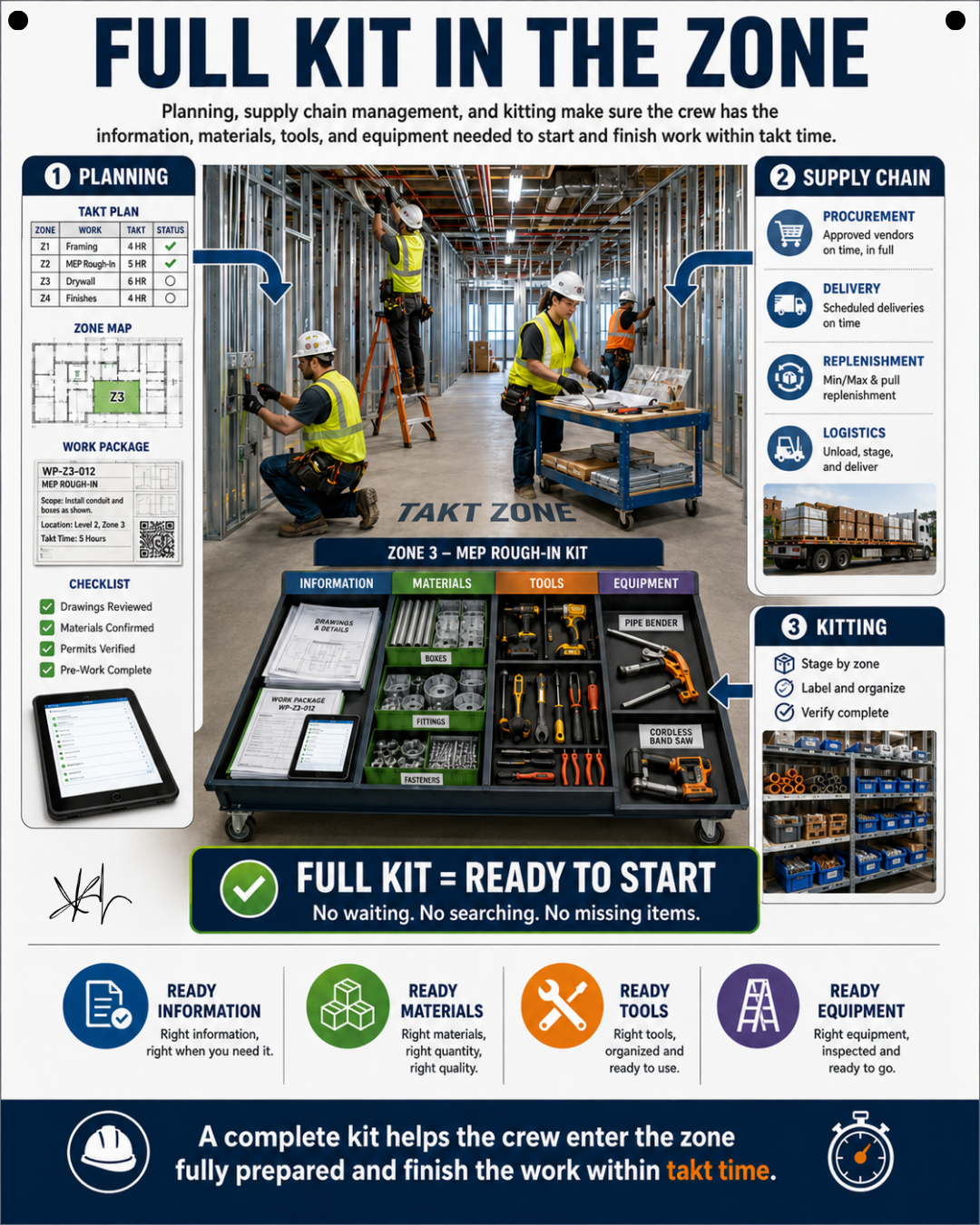
Full Kit in the Zone: Where Flow Gets Won or Lost Before the Crew Ever Steps Inside

Have you ever watched a crew enter a zone and stop twenty minutes later because something was missing? A drawing. A fitting. A pipe bender. A permit.

Here is the deal. That is not a worker problem. That is a preparation problem. When we talk about flow in the Takt Production System, this is where it actually gets won or lost, before the crew ever steps into the zone. By the time a worker discovers a missing item mid-task, the damage is already done. The clock has started, the Takt duration is already ticking, and every minute spent searching for something that should have already been there is a minute the zone will never get back.

Short answer: Full kit in the zone means a crew is not released into a Takt zone until someone has physically checked four things against the work package: ready information, ready materials, ready tools, and ready equipment. Three systems make it possible: planning (the Takt plan, zone map, work package, and pre-work checklist), the supply chain, and kitting.

The Pain of a Stopped Crew

Picture this. A crew enters Zone 3 for MEP rough-in, ready to execute five hours of planned work inside the Takt duration assigned to that zone. Twenty minutes in, someone needs the pipe bender, and it is not there. Maybe it is still sitting in a connex box three hundred feet away. Maybe nobody confirmed it was actually on site before the crew started. The crew stops. Someone walks away to find it. The rest of the crew either waits or improvises around the gap, and the five-hour Takt window that was supposed to carry this zone cleanly into the next one is already compromised before the first hour is even complete.

This moment repeats across projects constantly, and it almost never gets traced back to its actual cause. A superintendent walking the zone an hour later sees a crew that looks slow, and the easy conclusion is that the crew is not moving fast enough. The actual cause was decided well before the crew ever walked in, the moment nobody verified that every piece of information, material, tool, and equipment the task required was actually present, staged, and ready.

The Failure Pattern

The failure pattern is treating readiness as something that gets planned for in general and assumed to be true in specific, rather than something that gets physically verified, zone by zone, before a crew is ever released into the space.

A Takt plan can be meticulously built, every zone sequenced, every duration calculated, every handoff defined. None of that planning automatically guarantees that the specific materials, tools, and information a specific crew needs for a specific zone are actually sitting there, ready, the moment that crew arrives. Planning tells you what should happen. It does not confirm that what should happen has actually been made physically true. That gap, between a plan that looks complete on paper and a zone that is actually ready in reality, is exactly where a Takt rhythm breaks down, one missing pipe bender at a time.

The Crew Didn’t Fail. The Zone Wasn’t Ready.

When a crew stalls inside a Takt zone, the instinct is to look at the crew. Why didn’t they move faster? Why didn’t someone flag the missing item sooner?

Before reaching that conclusion, it is worth asking what that crew actually had the chance to verify before they walked into the zone. If nobody checked, specifically and physically, that the pipe bender was staged in that zone before the crew’s Takt clock started, then the crew did not fail through carelessness. They walked into a space that was never actually confirmed ready, trusting that someone upstream had already done that verification, when in fact nobody had. The crew is not the constraint. The verification step that never happened is the constraint.

What Full Kit Actually Requires

Full Kit means the crew has everything needed to start and finish the work within Takt time, organized into four specific categories, each one answering a different question about readiness.

Ready information means the right information, right when you need it, drawings reviewed, the specific work package defined with its scope, location, and assigned Takt time clearly stated, and a checklist confirming drawings, materials, permits, and pre-work have all actually been confirmed rather than simply assumed. A crew walking into Zone 3 should not need to track down a current drawing revision once the task has already started. That information belongs at the point of use, verified, before the clock begins.

Ready materials means the right materials, right quantity, right quality, physically staged in labeled bins at the zone itself, boxes, fittings, fasteners, exactly matching what the specific work package actually requires, not a general supply somewhere on site that the crew has to locate and retrieve mid-task. This connects directly to the staging materials practice already covered in this series, applied specifically to the Takt zone level, where precision matters even more because the entire zone duration depends on it.

Ready tools means tools organized and ready to use, every hand tool, every specialty item, staged in its own labeled section of the kit rather than scattered across a general tool crib the crew has to search. Ready equipment means equipment like the pipe bender and the cordless band saw inspected and ready to go, confirmed functional and present before the crew ever needs to reach for it mid-task.

The Three Systems That Make Full Kit Possible

Full Kit does not happen by accident. It happens through three connected systems working together, and missing any one of them breaks the whole chain.

Planning starts with the Takt plan itself, the zone-by-zone breakdown of work, assigned duration, and current status, alongside a zone map that shows exactly where Zone 3 sits within the broader floor plan. The work package translates that plan into a specific, concrete scope, naming exactly what gets installed, where, and within what Takt time. The pre-work checklist, drawings reviewed, materials confirmed, permits verified, pre-work complete, is the actual verification step that turns a plan into a confirmed, ready zone rather than an assumed one.

Supply chain ensures the materials and equipment the plan calls for actually arrive, through procurement with approved vendors delivering on time and in full, scheduled deliveries that land when the plan needs them rather than whenever convenient, min and max replenishment that prevents both stockouts and overstocking, and logistics that unload, stage, and deliver material to the actual point of use rather than a general laydown area the crew then has to navigate.

Kitting is the final, physical assembly of everything the first two systems produced into one organized, mobile unit, staged by zone, labeled and organized so every item has an obvious home, and verified complete before the crew ever arrives. This is the step that turns information from a plan, material from a supply chain, and tools from a connex box into one single, trustworthy kit sitting at the zone entrance, ready for inspection before anyone starts working.

Full Kit Equals Ready to Start

No waiting. No searching. No missing items. That is the entire promise of a verified Full Kit, and it is worth noticing how different this promise is from simply having a good plan or a well-stocked supply chain. A project can have excellent planning and excellent procurement and still fail this test, if nobody physically confirms, kit by kit, zone by zone, that everything actually landed where it needed to be before the crew’s Takt clock started.

This is the same discipline already covered in this series under Advanced Work Packaging, where full kit readiness was defined as materials, tools, information, access, permits, and predecessors all verified true simultaneously before a crew gets scheduled against a package. Full Kit in the Zone applies that identical standard at the physical, tactical level of a single Takt zone, with the kit itself serving as the visible, checkable proof that the verification actually happened.

For the general case, see Full Kit: Why You Must Have Everything Before You Start and Rules of Flow in Construction: Full Kit. This post covers the single Takt zone.

Why This Is Love in Action for Workers

When a crew enters the zone fully prepared, they do not just work faster. They work safer, they work happier, and they finish within Takt time. That outcome deserves to be taken seriously rather than treated as a pleasant side effect. A crew that is never interrupted mid-task by a missing item experiences their work completely differently than a crew that spends part of every shift improvising around gaps nobody closed in advance. The first crew moves with confidence. The second crew moves with a low-grade, constant uncertainty about whether this task, too, is going to stall halfway through.

That difference is exactly what this series has already named as love in action elsewhere, the Construction Worker Care Hub and the Lean break area. Full Kit belongs in the same category. It is not primarily a scheduling tool. It is a decision that the crew deserves to walk into a zone already set up for their success, rather than discovering, task by task, what the project forgot to prepare.

Signals Your Zones Are Not Actually Full Kit

Look for these patterns on your current project:

  • Crews stopping mid-task to search for a tool, material, or piece of information that should have already been staged
  • A Takt plan that looks complete on paper with no corresponding pre-work checklist actually verified zone by zone
  • Materials staged in a general laydown area rather than a labeled, zone-specific kit at the actual point of use
  • Equipment that gets discovered as missing or non-functional only once a crew is already mid-task and needs it
  • No one specifically assigned to verify kit completeness before a crew is released into a zone

Each of these signals a readiness gap that exists regardless of how good the underlying Takt plan and supply chain actually are, because none of that planning matters if nobody physically confirmed the kit before the crew walked in.

Build the Habit of Verifying Before Releasing

If your project needs superintendent coaching, project support, or leadership development, Elevate Construction can help your field teams stabilize, schedule, and flow.

Our LeanTakt team treats Full Kit verification as a non-negotiable gate, not a nice-to-have, because a Takt rhythm that looks perfect on the schedule and fails at the zone level teaches you nothing except where the real work still needs to happen.

Go deeper with the Advanced Work Packaging Done Right book and the Takt Production System Masterclass.

Here is your challenge. Pick one upcoming zone on your project and walk it yourself before the crew does, checking every category directly against the work package, information, materials, tools, equipment. Confirm it is actually there, not assumed to be there. Do that before every zone release going forward, and watch how many of your stalled tasks simply stop happening.

Want your team trained on this? See our Last Planner System and Takt training.

Bottom line: The impediment to action advances action. What stands in the way becomes the way. A Full Kit does not remove every obstacle a crew will ever face. It removes the ones that were entirely preventable, the missing pipe bender, the unverified drawing, the material that was never actually staged. Clear those before the crew walks in, and let them spend their Takt time on the work itself.

On we go.

FAQ

Who should be responsible for verifying a kit is complete before a crew is released into a zone?

A specific, assigned owner, often a project engineer or field engineer close to the work package, who physically checks each category, information, materials, tools, equipment, against what the work package actually requires. Shared or informal responsibility for this verification tends to produce exactly the gaps this practice is designed to close.

How is Full Kit in the Zone different from the Advanced Work Packaging practice already covered in this series?

Advanced Work Packaging defines full kit readiness at the level of an entire Installation Work Package, verifying materials, tools, information, access, permits, and predecessors across potentially multiple days of work. Full Kit in the Zone applies that same standard at a tighter, more tactical scale, a single Takt zone and its specific duration, with the physical kit itself serving as the visible proof that verification actually happened before the crew arrived.

What happens if a kit is found incomplete right before a crew is scheduled to start?

The crew should not be released into the zone until the gap is closed, even if that means a short delay before the Takt clock starts. Releasing a crew into an unverified zone simply moves the same stall into the middle of the task instead of catching it beforehand, which costs more time and disrupts the rhythm of every zone that follows.

How much time does kit verification actually add to a project’s schedule?

Far less time than the gap it prevents. A quick walk through a staged kit against its work package checklist takes minutes. A crew stalling mid-task because something was missing costs significantly more, both in direct lost time and in the ripple effect on every subsequent zone that depended on this one finishing on schedule.

How does Full Kit connect to the broader Takt Production System?

Takt planning defines the rhythm, the sequence, and the duration assigned to each zone. Full Kit is the verification step that makes that rhythm actually achievable in reality, confirming that everything the rhythm depends on, information, materials, tools, equipment, is physically present before the clock starts. A Takt plan without Full Kit verification is a schedule built on hope. A Takt plan with it is a schedule built on confirmed readiness.

People Also Read:
Full Kit: Why You Must Have Everything Before You Start
Rules Of Flow In Construction: Full Kit
Zone Release Checklist

If you want to learn more we have:

-Takt Virtual Training: (Takt Virtual Training)
-Check out our YouTube channel for more info: (Elevate Construction on YouTube)
-Listen to the Elevate Construction podcast: (Elevate Construction Podcast)
-Check out our training programs and certifications: (Training Programs and Certifications)
-The Takt Book: (The Takt Book on Amazon)

Discover Jason’s Expertise:

Meet Jason Schroeder, the driving force behind Elevate Construction. As the company’s Founder and COO, he’s dedicated to taking construction to new heights. With a wealth of industry experience, he’s crafted the Field Engineer Boot Camp and Superintendent Boot Camp – intensive training programs engineered to cultivate top-tier leaders capable of steering their teams towards success. Jason’s vision? To expand his training initiatives across the nation, empowering construction firms to soar to unprecedented levels of excellence.

Posted in All