
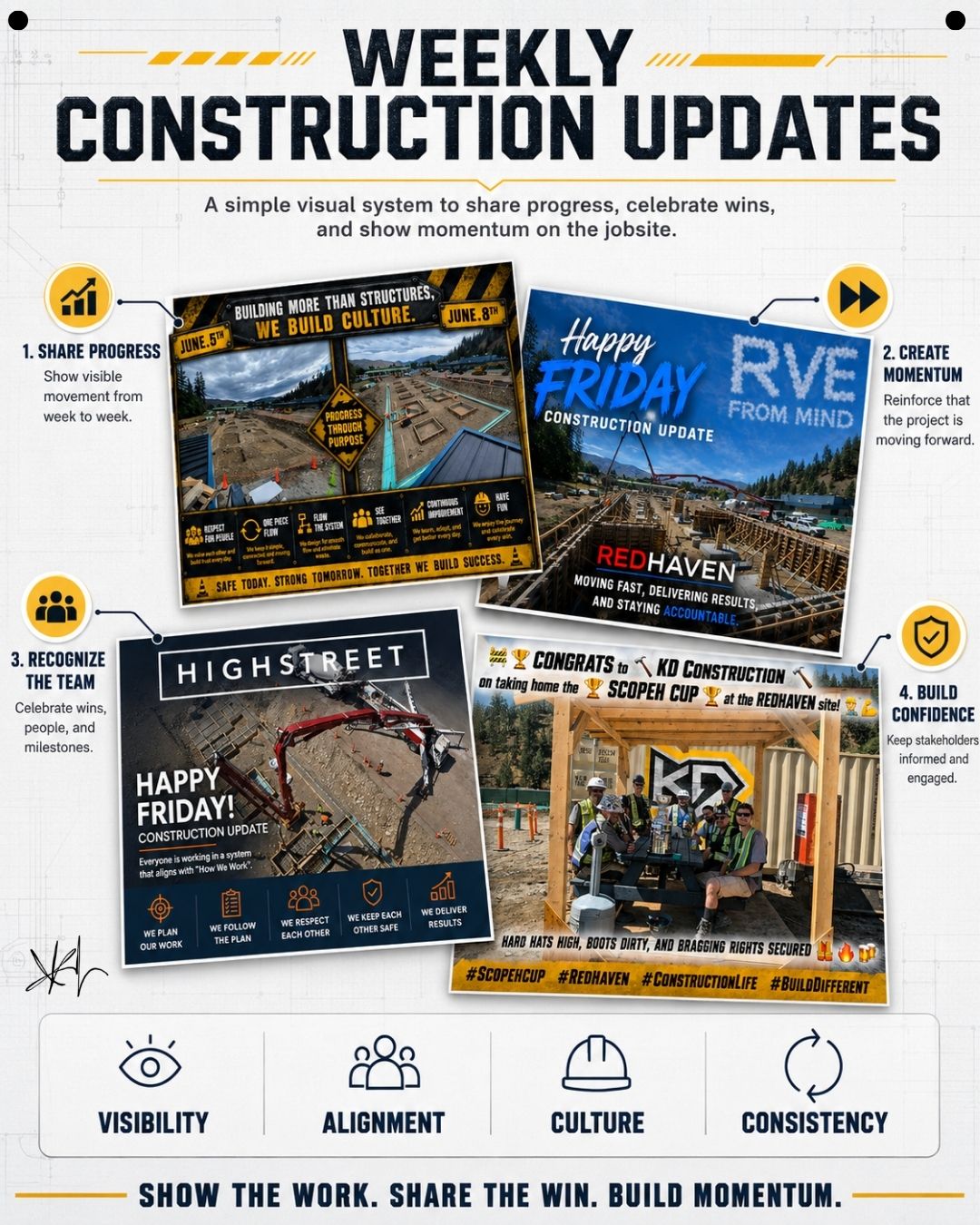
Here’s the deal. Most jobsites are full of amazing work that nobody ever sees. The crews show up. The structure rises. The wins stack up week after week. And then, silence. No one shares it. No one celebrates it. The momentum stays invisible, locked inside the daily grind of production, known only to the handful of people physically present to witness it. That is exactly the gap a weekly construction update closes, and it closes it with almost nothing more than a few photos, a few words, and thirty minutes of deliberate attention.
Short answer: A weekly construction update is a short, recurring update that shares progress, creates momentum, recognizes the team, and builds confidence with owners, stakeholders, and trade partners. It takes about thirty minutes a week: two photos from the same vantage point, a few sentences about what moved forward, and a specific shout-out to a person or team by name. This is not marketing. It is leadership.
The Pain of Invisible Progress
Picture a typical project running without any kind of recurring visibility practice. Real, substantial work happens every single week: foundations get poured, structures rise, milestones get hit, and a trade partner does something genuinely excellent that deserves recognition. None of it reaches anyone beyond the small circle physically on site that week. The owner, checking in periodically, sees only a status report full of percentages and schedule language that communicates almost nothing about the actual, visible momentum happening in the field. Trade partners working in isolation from each other have no sense of the broader project’s trajectory, only their own narrow slice of it. The crew that worked hard to hit a milestone gets no acknowledgment beyond whatever their immediate foreman happened to say in passing.
This invisibility costs the project more than most people realize. An owner who cannot see progress starts to feel uncertain regardless of how well the schedule is actually tracking, because uncertainty fills the vacuum left by silence. A crew that never sees its own wins celebrated loses a source of energy that would otherwise carry them through the harder weeks. And a culture of genuine momentum, the kind that compounds week over week into real morale and trust, never gets the chance to form, because nobody ever took the time to actually show anyone what was happening.
The Failure Pattern
The failure pattern is treating visibility as something that happens automatically through the quality of the work itself, rather than as something that requires a deliberate, recurring practice to actually produce.
Good work does not advertise itself. A foundation poured correctly, on schedule, with genuine craftsmanship, is invisible to anyone not physically standing in front of it, unless someone takes a photo, writes a few words, and puts it in front of the people who need to see it. Most projects assume that strong execution will naturally translate into stakeholder confidence and crew morale, without recognizing that translation requires an actual communication step that someone has to deliberately perform. Skip that step, and even the best project in the world can feel uncertain from the outside and unrecognized from the inside, purely because nobody built the simple system that would have made the progress visible.
The Project Didn’t Fail. Nobody Could See It.
When an owner grows anxious about a project that is actually on track, or a crew seems to lose energy despite genuinely strong weekly progress, the instinct is to assume something is actually wrong and that confidence or morale naturally tracks actual project health.
Before reaching that conclusion, it is worth asking what anyone outside the immediate work was actually shown that week. If the answer is nothing beyond a status report full of numbers, then the anxiety or the flagging morale is not a sign of a troubled project. It is the predictable result of genuine progress happening in a vacuum, with no one taking the simple step of making that progress visible to the people who needed to see it to feel confident or energized. The project did not fail to perform. It failed to show what it had already accomplished.
What Does a Weekly Construction Update Actually Do?
- Sharing progress means showing visible movement from week to week, in a form people can actually see rather than infer from a schedule percentage. A photo comparing site conditions from one week to the next communicates momentum instantly, in a way a status report full of numbers never quite manages. People need to see the project moving, because seeing is what actually produces the feeling of confidence that a written update alone rarely creates.
- Creating momentum follows directly from that visibility. When the team sees progress, they feel progress, and momentum genuinely builds on itself once it becomes visible rather than staying buried in the daily grind. A crew that sees its own accumulated progress laid out clearly, week after week, experiences something different than a crew that simply shows up and works without ever stepping back to see the larger trajectory they are actually building.
- Recognizing the team means celebrating wins, people, and milestones explicitly and publicly, rather than letting genuine achievement pass by unnoticed. A specific shout-out to a trade partner for a real accomplishment, a recognition tied to an actual event rather than generic praise, does something a private thank-you never quite accomplishes, because it makes that recognition visible to peers, to leadership, and to the whole project community at once.
- Building confidence keeps owners, stakeholders, and trade partners informed and genuinely engaged, rather than left to construct their own mental picture of project health from whatever fragments of information happen to reach them. A stakeholder who sees consistent, visible progress every week develops a trust in the project that a quarterly formal report, however accurate, simply cannot build at the same pace or depth.
This Is Leadership, Not Marketing
Here is the distinction that matters most. This is not marketing. It is leadership. A marketing update exists to make a project look good for an external audience: polished, curated, and designed to manage perception. A leadership update exists to actually build the things a project needs to succeed: visibility that produces trust, recognition that produces morale, and momentum that produces the kind of compounding energy that carries a crew through the harder weeks that inevitably come.
When you show the work and share the win, you build more than structures. You build belief. That belief is not a soft, decorative byproduct of good communication. It is a genuine operational asset. A crew that believes in the project’s momentum works differently than a crew that has no visibility into whether their effort is actually adding up to anything. A stakeholder who believes in the project’s trajectory behaves differently than one left anxious by silence. That stakeholder is more patient with the inevitable friction of a complex build and more willing to extend trust when something does need to be worked through together.
How Long Does a Weekly Construction Update Take?
This system does not require a marketing department, a communications budget, or a significant time commitment. It takes maybe thirty minutes a week. A few photos. A few words. A little recognition. That is genuinely the entire investment required, and the return on that thirty minutes compounds every single week it continues, because each update builds on the visible momentum of the last one, creating a cumulative record of progress that becomes more valuable the longer it runs.
This connects directly to the same principle running through the auto-launch drone visibility system and the 360-degree camera practice I have written about before. Mieruka, making the work visible so the whole team and every stakeholder can see reality, does not require expensive infrastructure to start. A weekly update built from a phone camera and a few sentences achieves the same fundamental goal as a sophisticated automated capture system, closing the gap between what is actually happening on the project and what the people who need to know about it can actually see.
What Shows Up in a Good Weekly Update
A strong update typically anchors on a recognizable visual comparison, the same vantage point photographed across two dates, making the week’s actual physical progress immediately obvious to anyone looking at it. It names the project and situates the audience, whether that is a specific site, a specific phase, or a specific team. It reinforces the project’s stated values or working principles explicitly, connecting the week’s visible progress back to the deeper culture the team is trying to build: respect for people, one-piece flow, continuous improvement, safety, and consistency.
And critically, it makes space for genuine recognition: a specific team or individual called out by name for a specific accomplishment, not generic praise but something tied directly to a real event, such as a cup won, a milestone hit, or a specific piece of excellent work that deserves to be seen by more than the handful of people who happened to witness it directly.
Sample: Medical office building, Week 12. Two photos from the same spot. What moved forward: Level 2 drywall is hung and taped. Shout-out: the drywall crew for finishing Zone B a day early. Next week: prime and paint Level 2.
Signals Your Project Needs This Habit
Look for these patterns on your own project:
- Genuine weekly progress exists but nobody outside the immediate crew or trailer ever sees it.
- Owners or stakeholders express uncertainty or anxiety about a project that is actually tracking well.
- Trade partners have no sense of the broader project’s trajectory beyond their own narrow scope.
- Real wins and milestones happen and pass without any public recognition.
- The only communication reaching stakeholders is a formal status report, with no visual, momentum-building counterpart.
Each of these signals a visibility gap, not a performance gap, and that gap closes with almost no investment once someone decides to spend thirty minutes a week closing it.
How Do You Start a Weekly Construction Update?
Our LeanTakt team treats this kind of visible, recurring momentum building as a direct leadership responsibility, not an optional extra, because a team and a stakeholder base that can actually see progress behaves fundamentally differently than one left to guess at it.
So here is the challenge. This Friday, before you close out the week, take two photos from the same vantage point you can return to next week. Write three sentences about what moved forward. Name one person or team that did something worth recognizing, specifically, by name. That is the entire system. Do it again next Friday.
My own guiding belief applies directly here: respect for people is the basis of all decisions. A weekly update that takes the time to actually show people what they built, and to name the people who built it, is that belief put into practice, every single Friday, for the cost of thirty minutes.
Bottom line: When you show the work and share the win, you build more than structures; you build belief.
If your project needs superintendent coaching, project support, or leadership development, Elevate Construction can help your field teams stabilize, schedule, and flow.
On we go.
FAQ
How is a weekly construction update different from a standard weekly progress report sent to the owner?
A standard progress report typically communicates schedule percentages and status language that is accurate but difficult to actually feel. A weekly update is built around visible, photographic progress and specific recognition, designed to be felt rather than merely read, which produces a very different emotional and motivational response from both stakeholders and the crew itself.
Who should be responsible for putting the weekly update together?
Typically a superintendent or project leader with direct visibility into the week’s actual progress and the people who contributed to it. The task does not require design skill or specialized software, only the discipline of taking a couple of photos and writing a few honest, specific sentences every single week.
Does this only work for projects with a strong visual story, like a vertical structure rising?
No. Every project has some form of visible weekly progress, even underground or infrastructure work that is less dramatic visually than a rising structure. The same vantage-point comparison technique works for a trench progressing along its planned route or a utility system taking shape underground, as long as the same reference point gets photographed consistently from week to week.
How do you keep this from feeling repetitive or losing its impact over time?
Vary the specific recognition each week, since there is always a different person, team, or milestone worth calling out, and let the visible progress comparison itself carry the weight of showing momentum. The consistency of the format is actually part of what builds trust over time. Stakeholders and crews come to expect and look forward to it, in the same way a reliable weekly rhythm builds trust in any other recurring practice.
How does this connect to drone and 360-degree camera visibility systems?
All three practices share the same underlying goal: Mieruka, making the actual state of the work visible to the people who need to see it rather than leaving them to construct their own picture from secondhand description or silence. The drone and camera systems automate that visibility continuously and in real time. A weekly update achieves a lighter version of the same goal manually, with almost no infrastructure investment, which makes it the right starting point for any project not yet ready to invest in automated capture systems.
People Also Read:
Monthly Field Walks
Roadblock Tracking Maps
What Is 5S and How It Applies to Construction
If you want to learn more we have:
-Takt Virtual Training: (Takt Virtual Training)
-Check out our YouTube channel for more info: (Elevate Construction on YouTube)
-Listen to the Elevate Construction podcast: (Elevate Construction Podcast)
-Check out our training programs and certifications: (Training Programs and Certifications)
-The Takt Book: (The Takt Book on Amazon)
Discover Jason’s Expertise:
Meet Jason Schroeder, the driving force behind Elevate Construction. As the company’s Founder and COO, he’s dedicated to taking construction to new heights. With a wealth of industry experience, he’s crafted the Field Engineer Boot Camp and Superintendent Boot Camp – intensive training programs engineered to cultivate top-tier leaders capable of steering their teams towards success. Jason’s vision? To expand his training initiatives across the nation, empowering construction firms to soar to unprecedented levels of excellence.